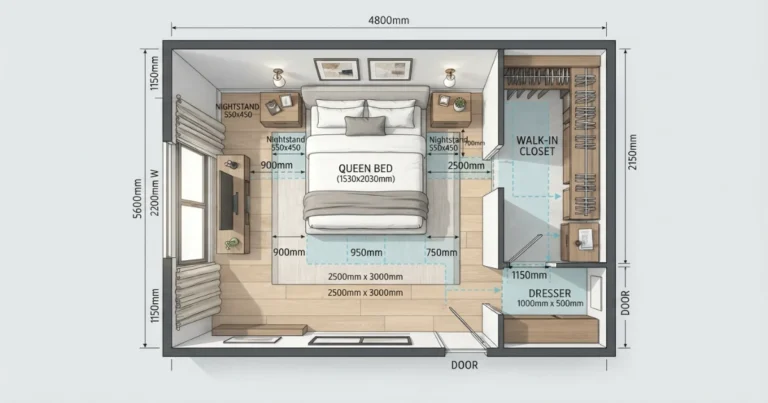
Find the exact number of rolls and waste allowance for any room.
Use the wallpaper calculator by entering your wall dimensions, choosing a roll size and selecting the pattern repeat to get an instant roll estimate — using the same waste allowance rules professional decorators rely on. No guesswork, no wall area math, and no third trip back to the store for one more roll.
Standard roll quantities by room size.
These estimates assume an 8 foot wall height, a US single roll (20.5 in × 33 ft), one door, one window and a plain, non-repeating pattern. Use the wallpaper calculator above for your exact room. Rooms with more doors, windows or a larger pattern repeat will need a larger waste allowance than these defaults, so treat the table as a starting reference rather than a final order.
| Room Size | Wall Area | Net Area | Total w/ Waste | Rolls |
|---|---|---|---|---|
| 6 × 8 ft (bathroom) | 224 sq ft | 197 sq ft | 217 sq ft | 4 rolls |
| 8 × 10 ft (bedroom) | 288 sq ft | 261 sq ft | 287 sq ft | 5 rolls |
| 10 × 12 ft (living area) | 352 sq ft | 316 sq ft | 348 sq ft | 6 rolls |
| 12 × 15 ft (open plan) | 432 sq ft | 396 sq ft | 436 sq ft | 7 rolls |
| 15 × 20 ft (family room) | 560 sq ft | 524 sq ft | 576 sq ft | 9 rolls |
| 20 × 25 ft (great room) | 720 sq ft | 684 sq ft | 752 sq ft | 12 rolls |
Four repeat sizes — and how much extra each one needs.
The wallpaper calculator treats pattern repeat as a major factor because it affects both appearance and waste. Here is what each repeat size means, how much extra material it needs, and which papers use it.
No Repeat
A plain color, texture or random design with no printed motif to align. The most efficient option with the least waste, and the easiest for most installers to hang quickly.
Waste: ~10%Small Repeat
A repeat under 12 inches, such as a small floral or geometric print. Needs a modest extra allowance to keep the motif lined up between drops.
Waste: ~15%Medium Repeat
A repeat between 12 and 24 inches, common on stripes and mid-size florals. More trimming is needed at every drop to keep the pattern matched across the wall.
Waste: ~20%Large Repeat
A repeat over 24 inches, typical of large-scale murals and statement florals. A striking, high-end look for feature walls, but the most demanding pattern for waste and labor.
Waste: ~25%See how roll quantity changes by room.
These steps cover the essentials: measuring the walls, choosing a roll size, and accounting for waste before you order rolls.
Measure the walls
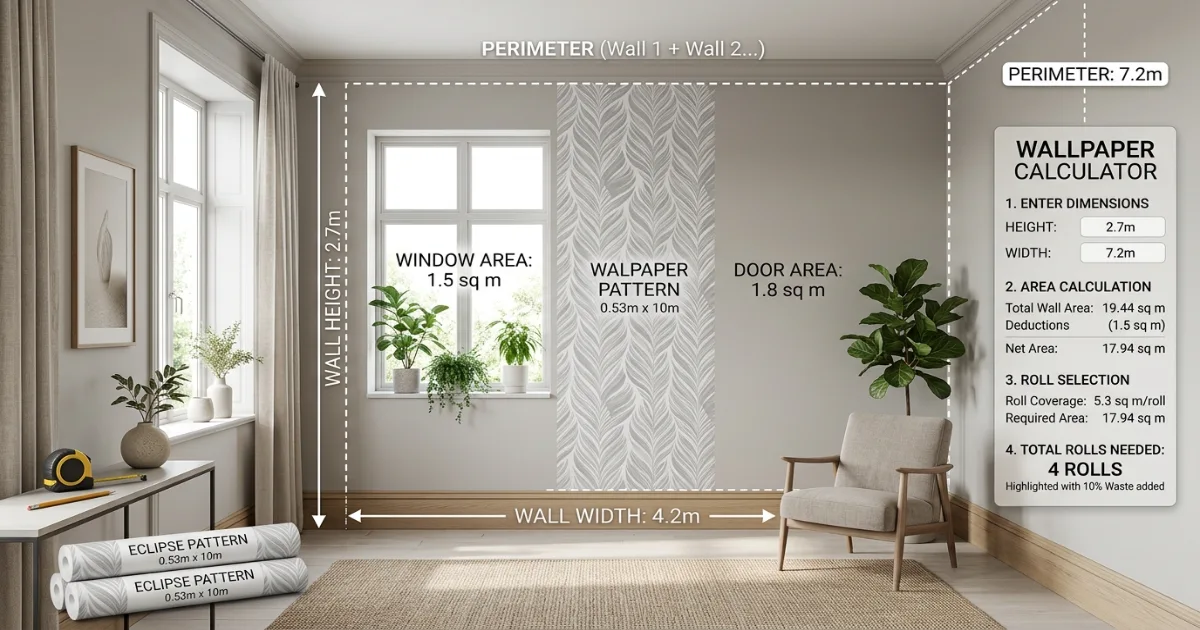
Start the wallpaper calculator with the room perimeter and wall height before choosing a roll size. Write both numbers down along with door and window counts, since all three feed into the total area calculation later.
Choose a pattern repeat
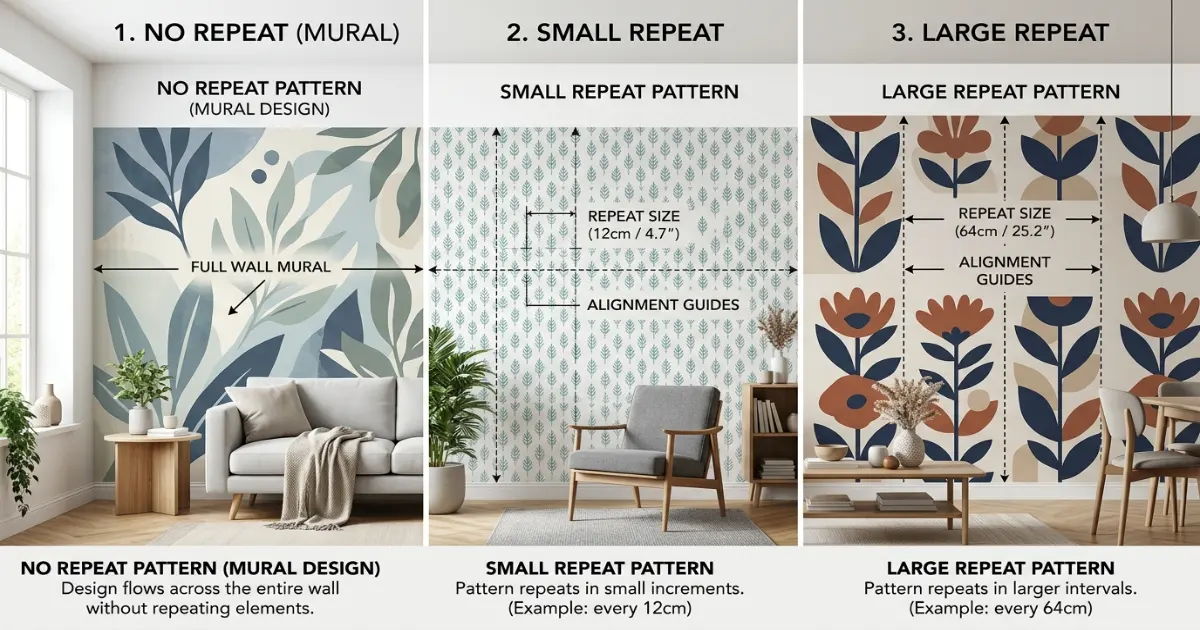
The wallpaper calculator adds more waste for larger repeats because they need extra trimming to keep the pattern aligned. This is usually the single factor that changes a waste estimate the most, more than roll width itself.
Set the roll size
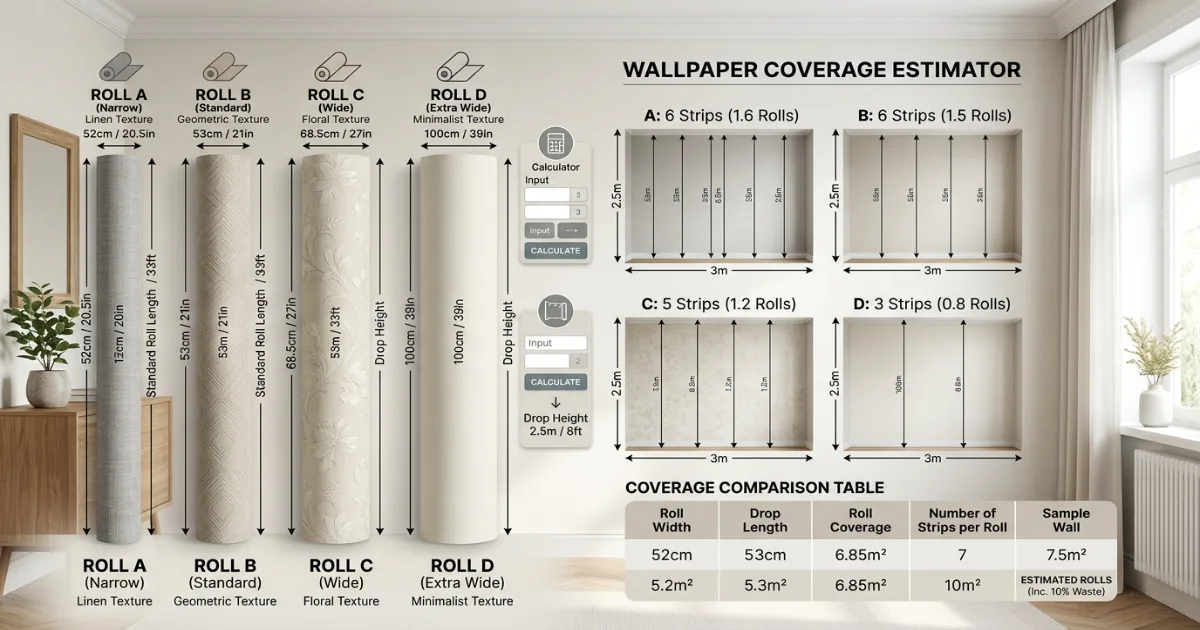
The wallpaper calculator accounts for the fact that wider European rolls cover more wall per roll but need more careful handling. Standard US single rolls are easier to maneuver but need more seams.

Check roll size and pattern repeat
Match the calculator settings to the exact product label before ordering, especially the roll width, roll length and vertical pattern repeat.
How to calculate wallpaper — the complete guide.
The most common wallpapering mistake is buying too little extra material. Run numbers vary between production batches, so running short partway through a job can mean a subtly different shade of paper finishing the room. When in doubt, round up to the next full roll, and buy one extra roll beyond your calculated total for future repairs and cuts that go wrong.
How to use the wallpaper calculator
The wallpaper calculator converts room dimensions into a practical roll estimate by calculating wall perimeter, multiplying by wall height, subtracting openings and applying a pattern-repeat waste allowance.
Enter the room width, length and wall height into the wallpaper calculator using one measurement system. Avoid mixing feet, meters and inches in the same calculation.
Select the actual roll format shown on the product label. The wallpaper calculator compares the usable wall area with the selected roll dimensions, but the manufacturer’s stated coverage remains the final product reference.
Choose the pattern-repeat category carefully. A wallpaper calculator must allow more material for large motifs because every drop may need trimming before the pattern aligns with the previous strip.
Enter realistic door and window counts, but do not automatically subtract every small opening. Installers often keep a safety margin because offcuts around openings are not always reusable.
Use the wallpaper calculator result as the minimum project order, then consider one additional roll from the same production batch for future repairs, damaged drops or pattern matching.
For a feature wall, measure that wall separately rather than entering the complete room. The wallpaper calculator will then estimate the rolls for the wall you actually plan to cover.
Before ordering, mark the measurements, check the roll width, confirm whether the listing uses single or double rolls and compare the wallpaper calculator result with the retailer’s coverage details.
Step 1: Measure the walls
Measure the width and length of the room and add them together twice to get the perimeter, then multiply by the wall height to get the total wall area. For rooms with alcoves or dormers, split the space into simple rectangles, calculate each one separately, and add the totals together. Measure at several points along each wall, since older rooms are rarely perfectly square, and always round each measurement up to the nearest half foot rather than down.
Compare the wallpaper calculator with professional estimating guidance
The Wallcoverings Association estimating guide recommends measuring wall height and the length of each wall to establish the total wall area. The wallpaper calculator uses the same basic dimensions and then applies the selected roll and waste settings.
For installation planning, the Wallcoverings Association residential installation guidance explains that strips require extra material for trimming at the ceiling and baseboard. This is one reason a wallpaper calculator should not treat the wall’s visible height as the only material requirement.
When converting between feet and meters, use consistent units. The NIST conversion-factor reference records the international foot as exactly 0.3048 meter, which supports consistent imperial-to-metric measurements.
Step 2: Deduct doors and windows
Subtract the area of doors and windows from the total wall area, since wallpaper is not needed there. A standard door is about 21 square feet and a standard window is about 15 square feet, though large picture windows or double doors should be measured individually rather than using the average.
Step 3: Choose a roll size
Standard American single rolls run about 20.5 inches wide by 33 feet long. Double rolls are sold as one continuous unit twice that length, which reduces the number of packages to track but still covers the same area. European rolls run wider, around 27 inches, which means fewer seams across a wall but a heavier, less forgiving roll to reposition once pasted. Wide-format rolls, up to 36 inches, are common for large-scale murals and feature walls.
Step 4: Choose a pattern repeat
Pattern repeat is the vertical distance before a design repeats itself, and it changes both the finished look and the waste allowance. A plain or random-texture paper is the most efficient and needs roughly 10 percent extra material. A small repeat under 12 inches needs about 15 percent extra. A medium repeat between 12 and 24 inches needs about 20 percent, and a large repeat over 24 inches can need 25 percent or more, since every drop requires extra trimming to keep the motif aligned with the drop next to it.
Step 5: Calculate the waste allowance
Waste allowance covers trimming at the ceiling and baseboard, pattern matching between drops, and future repairs. Add the pattern’s base waste percentage to your net wall area, and add a few percentage points more if the room has many corners, a sloped ceiling, or architectural features to cut around. Simple rectangular rooms need the least extra; rooms with dormers, alcoves or many windows should add 5 percent or more on top of the pattern allowance.
Step 6: Convert to rolls
Divide your total wall area, including waste, by the usable coverage of a single roll after accounting for pattern repeat trimming. Always round up to the next full roll rather than down, since a partial roll still has to be opened and paid for in most cases. Buying wallpaper from the same production run, known as the same run or batch number, for the entire job also prevents subtle color shifts between rolls purchased at different times.
Step 7: Plan for wall prep
Wallpaper needs a smooth, clean, and properly primed wall to adhere well and look seamless. Textured or previously painted walls with a glossy finish typically need a liner paper or a wallpaper-specific primer first, while freshly patched drywall needs to be fully cured and sealed. Factor in drying time for any wall prep before the paper goes up, since hanging over a damp or uncured surface is one of the most common causes of bubbling and peeling later.
Step 8: Avoid the most common ordering mistakes
Beyond underestimating waste, a few other mistakes come up repeatedly. Ordering wallpaper from different run numbers is one of the most frequent, since even the same pattern name can shift slightly in color between production batches. Forgetting to account for a large pattern repeat is another, since a calculator based on total square footage alone can underestimate the trimming needed to keep a big motif aligned. Finally, skipping the extra roll for future repairs means a damaged strip years later may not be replaceable with a matching run.
Wallpaper material types: paper-backed, vinyl and grasscloth
- Paper-backed — the traditional, most affordable option, suited to low-traffic rooms like bedrooms. Easier to trim than vinyl, which can make DIY installation more approachable.
- Vinyl-coated or solid vinyl — more washable and durable than plain paper, standing up well to kitchens, bathrooms and hallways. Slightly heavier to hang, so plan for a smoothing tool rather than a dry brush alone.
- Grasscloth and natural-fiber — woven textures like grasscloth or jute offer unique depth and warmth, but need careful, dry handling since they cannot be wiped clean like vinyl. Expect visible seams as part of the intended look rather than a flaw.
- Peel-and-stick — a removable, self-adhesive option often used for rentals or accent walls, offering an easier hang and removal. Coverage per roll is usually smaller than traditional pasted rolls.
Wallpaper buying rules that prevent a second trip to the store.
A calculator gives the best starting numbers, but the final purchase still depends on wall condition, pattern repeat, and how the paper will actually be trimmed and matched. The rules below cover the details that a single perimeter-and-height measurement can’t capture on its own, and they’re worth reviewing even after you’ve settled on a quantity from the calculator above.
For most rooms, measure perimeter by wall height for total wall area, subtract doors and windows, add 10 percent waste for a plain paper or 15 to 25 percent for a small to large pattern repeat, then round up to the next full roll. Buy one extra roll beyond that for future repairs. If you’re unsure between two quantities, the larger order almost always costs less in the long run than a second trip for a mismatched run number.
Never buy exact wall area
Ordering the bare minimum leaves nothing for trimming, pattern matching or mistakes. Always add the repeat-appropriate waste percentage before rounding up to rolls, even for a simple, rectangular room.
Match run number across rolls
Wallpaper color can shift subtly between production batches even under the same pattern name. Buy all rolls for a single job from the same run number, and check the batch code printed on each roll before opening it.
Check wall prep requirements first
Wallpaper needs a smooth, primed base. Confirm whether your walls need a liner, a specialty primer, or patch repairs before ordering paper, since drying time can push back the install schedule.
Keep leftover rolls sealed
Store any unopened extra rolls flat in a dry area rather than returning them immediately. A sealed roll of matching wallpaper is the easiest way to repair a damaged strip years later without re-papering the whole room.
Finally, always order a sample or a small swatch before committing to a large room. Color and pattern scale can look different under a showroom’s lighting than they will next to your own trim, furniture and daylight direction, and a sample is a far cheaper way to catch a mismatch than a full return of a room’s worth of paper.
Helpful room planning topics.
A papered wall rarely stands alone in a room’s design. Once you know your quantity and pattern, it helps to plan the surrounding elements at the same time — rug placement, curtain fabric against the wallpaper tone, and furniture proportions relative to the finished surface. Getting these elements to agree with each other is usually what separates a room that feels intentionally designed from one that feels like it was renovated piece by piece over time. Use these supporting pages from the HomeStyle Calculator homepage to plan the rest of the room.
Six things professional decorators always check before ordering wallpaper.
Dry-lay drops before cutting anything
Unrolling a length against the wall without paste first reveals how the pattern will fall at the corners and helps center the design for the most balanced look, especially in rooms with an obvious focal point like a fireplace.
Buy more waste than feels necessary
Running short mid-job is the most common decorator complaint. Err toward the higher end of the waste range even if the budget calculation suggests less, since a mismatched run number on a follow-up order is a worse outcome than a spare roll.
Check the wall for texture
Textured walls in particular need a liner paper first to avoid the texture telegraphing through the finished wallpaper. A skim coat or lining paper is a common fix before hanging over an uneven surface.
Plan seam placement away from focal points
Starting the first drop from a corner farthest from the door means any slight pattern mismatch at the final seam falls in the least noticeable spot in the room.
Book-fold pasted strips before hanging
Folding a pasted strip paste-side in and letting it rest allows the paste to activate evenly, which helps the paper lay flatter and reduces bubbling once it’s on the wall.
Order a sample before committing
Wallpaper color and pattern scale shift dramatically under different lighting. Order a sample swatch and view it in the room at both day and night before ordering a full quantity, ideally taped to the actual wall for a few days.
Wallpaper calculation questions — answered.
12 calculators for every room decision.
Every tool uses professional designer formulas. Free, instant, no sign-up — just enter your room and get the exact answer.
Bookmark HomeStyle Calculator for every room in the house.
From a small bathroom to a whole-floor renovation, our free tools give you the exact roll count and waste allowance before you order material.