Curtain Measurement Guide: get rod width, length and fullness right the first time.
Curtain measurement guide: measure the window, choose rod extension, set mounting height, calculate curtain length, confirm fabric fullness and order the correct panel count so the finished treatment looks balanced.
Written by Rehana K · Updated July 16, 2026 · Built for practical window measuring, online curtain shopping and hanging-height confidence.
Measure the window
Record window width and height frame to frame, then note the wall space above and beside the window.
Choose the mount
Decide between an inside mount that sits within the frame and an outside mount that extends past it.
Set rod and length
Extend the rod beyond the frame and pick a curtain length that matches the room’s style and function.
Calculate fullness
Multiply rod width by your fullness ratio to find the total fabric width needed for a gathered look.
Curtain Measurement Guide Quick Planner
Enter your window measurements to get a fast planning snapshot: recommended rod width, total fabric width, drop length and panel count.
Your curtain planning baseline
Use this as a first check, then confirm against the exact product listing before buying.
Window width plus extension on each side.
Combined width of both panels for a gathered look.
Length from rod to your chosen finishing point.
Standard pair, sold individually per side.
Curtain Measurement Guide Calculators and Related Tools
Curtain sizing works best alongside room and wall measurements. Use these HomeStyle Calculator tools to finish the full window and room plan.
Curtain Measurement Guide: Four Decisions That Most Often Go Wrong
Curtains look easy in product photos but the proportions rarely translate directly to a real window. Start with these four checks before you order.
Rod width
A rod that is too narrow blocks light and crowds the glass when panels are open.
Drop length
Curtains that stop short of the intended finishing point look unfinished, not intentional.
Fabric fullness
Flat, stretched panels read as cheap even in an expensive fabric.
Mounting height
A rod hung too close to the window frame visually shortens the wall and the room.
Curtain Measurement Guide: the complete window-by-window sizing system
Curtains are one of the fastest ways to change how a room feels, and also one of the easiest things to get wrong.
A panel that is too narrow looks stretched and skimpy. A rod mounted too close to the window frame makes the ceiling feel lower and the window feel smaller. A curtain cut a few inches short of the floor reads as an accident rather than a style choice.
None of these mistakes come from bad taste. They come from measuring the window instead of measuring the whole window treatment: the rod, the wall space around the window, the mounting height, the fabric fullness and the finishing length together.
This guide walks through every measurement decision in order, the same order a professional would use when planning a window treatment. By the end, you should be able to confidently choose a rod width, a curtain length, a fullness ratio and a panel count for any window in your home, whether you are buying ready-made panels online or having curtains custom sewn.
Quick rule before buying anything
Measure the window, then measure the wall around it, then decide the mount type, the rod width, the length and the fullness in that order. A curtain is only the right size when all five of these agree with each other, not just with the glass.
Curtain Measurement Guide Step 1: Measure the Window Itself
Start with the window opening. Measure the width from frame edge to frame edge, and the height from the top of the frame to the sill or apron, whichever you plan to use as a reference point.
Take these measurements in inches, since curtain hardware and fabric are almost always sold in inch increments. Measure at three points across the width and three points down the height, because window frames, especially in older homes, are not always perfectly square.
Use the smallest width measurement if you are choosing an inside mount, and the largest if you are choosing an outside mount, to avoid gaps or a rod that will not fit.
Also note the trim width, the depth of the window frame, and whether there is a radiator, window seat, blind or shutter that the curtain needs to clear. These details affect both the mount type and the final drop length, and they are easy to forget until the curtains are already hanging.
Curtain Measurement Guide Step 2: Choose Inside or Outside Mount
An inside mount sits within the window frame itself, similar to a blind or shade. It gives a clean, built-in look and works well when you want the trim to remain visible, or when wall space beside the window is limited.
It requires a minimum frame depth, usually at least two to three inches, so the hardware has somewhere to sit.
An outside mount is far more common for fabric curtains. The rod is mounted on the wall above and beside the window frame rather than inside it.
This is the mount type that allows a room to feel larger, because the rod width and mounting height are no longer limited by the window opening. Outside mounts also let curtains fully clear the glass when open, which lets in more daylight and creates a cleaner sightline.
Unless you have a specific reason to use an inside mount, an outside mount is the better default for most living rooms, bedrooms and dining rooms.
Curtain Measurement Guide Step 3: Set the Rod Width
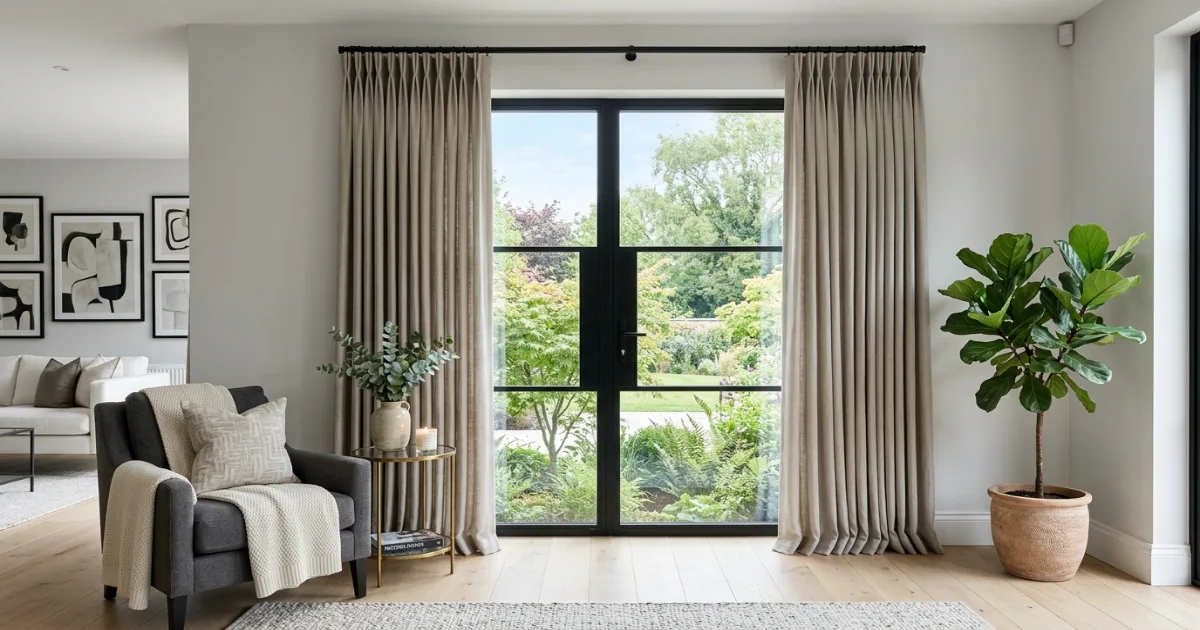
Rod width is one of the most underestimated measurements in the entire process. A rod that matches the window width exactly will force the curtains to sit on top of the glass even when fully open, blocking light and making the window look smaller than it is.
The standard approach is to extend the rod four to ten inches beyond each side of the window frame. In a room with generous wall space, extending even further, sometimes to the edge of the nearest wall, can make the window look dramatically larger and let in noticeably more light.
The right extension also depends on furniture and adjacent walls. If a window sits close to a corner, you may only have a few inches of wall space to work with, and the rod width should respect that limit rather than force hardware into a space that cannot support it.
If there are two windows close together, consider whether a single wide rod spanning both windows would look more intentional than two separate narrow rods.
| Window width | Suggested rod extension per side | Approx. total rod width |
|---|---|---|
| 24–30 in | 4–6 in | 32–42 in |
| 36 in | 6–8 in | 48–52 in |
| 48 in | 6–10 in | 60–68 in |
| 60 in (sliding door) | 8–10 in | 76–80 in |
| 72 in and wider | 10 in or more where wall space allows | 92 in or more |
Curtain Measurement Guide Step 4: Decide the Mounting Height
Mounting height changes how tall both the window and the room appear to feel. A rod mounted directly on top of the window frame is the most literal option, but it tends to visually shorten the wall.
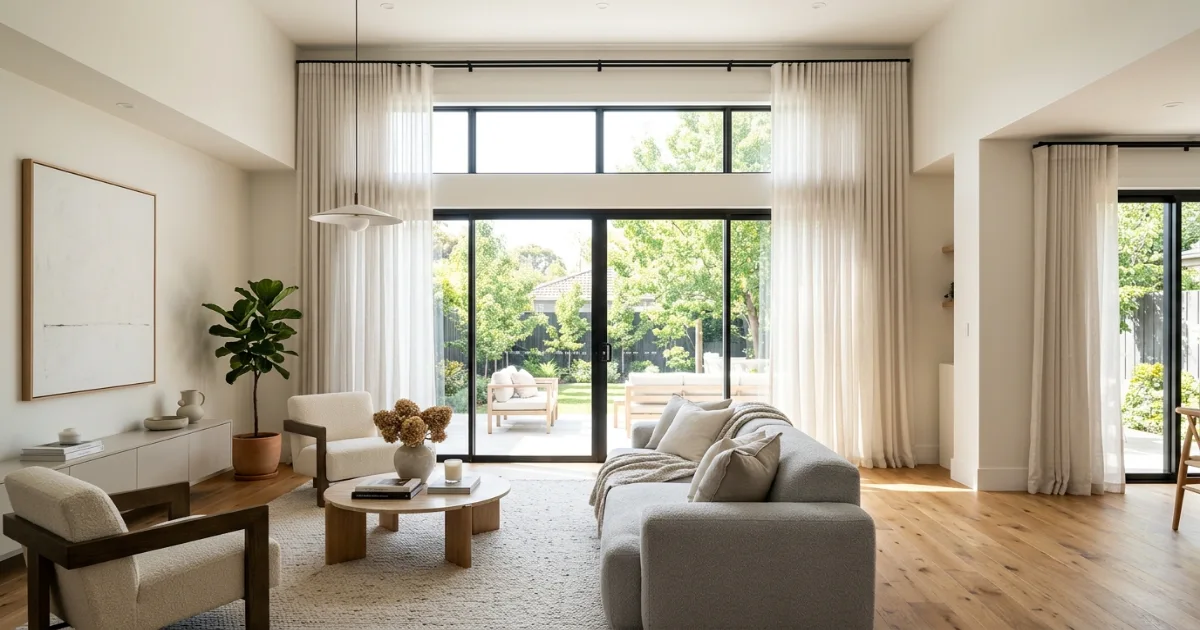
A more common styling approach is mounting the rod four to six inches above the frame. In rooms with higher ceilings, or where you want to create the illusion of height, mounting the rod closer to the ceiling, sometimes six to twelve inches above the frame, draws the eye upward and can make an average-height room feel noticeably taller.
There is a trade-off to keep in mind: mounting the rod higher increases the total drop length needed, since the curtain now has to travel further to reach the same finishing point at the floor or sill.
Always decide the mounting height before finalizing the drop measurement, not after, so the length calculation is accurate the first time.
Curtain Measurement Guide Step 5: Choose the Curtain Length
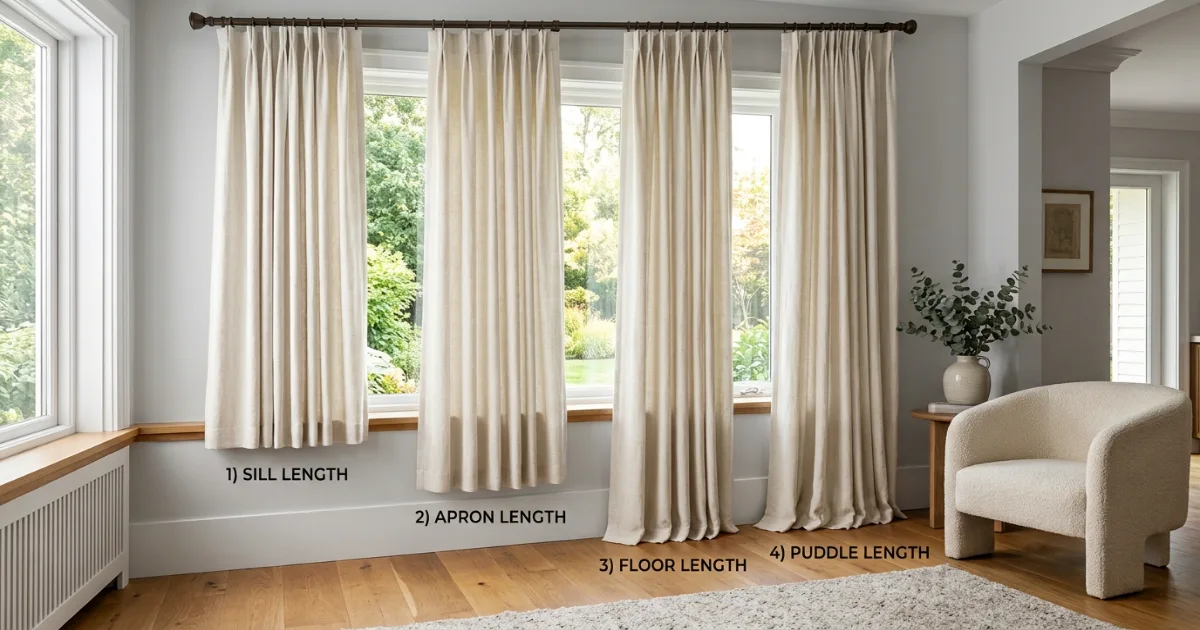
Curtain length is a style decision as much as a measurement decision, and different lengths suit different rooms and different windows. Here are the five lengths used most often in home styling.
- Sill length ends at or just below the windowsill. It suits kitchens, bathrooms, and windows above a sink, radiator or window seat where a longer curtain would be impractical.
- Apron length extends a few inches past the sill, roughly to where the window trim ends below the frame. It works well over furniture, radiators or shallow window seats.
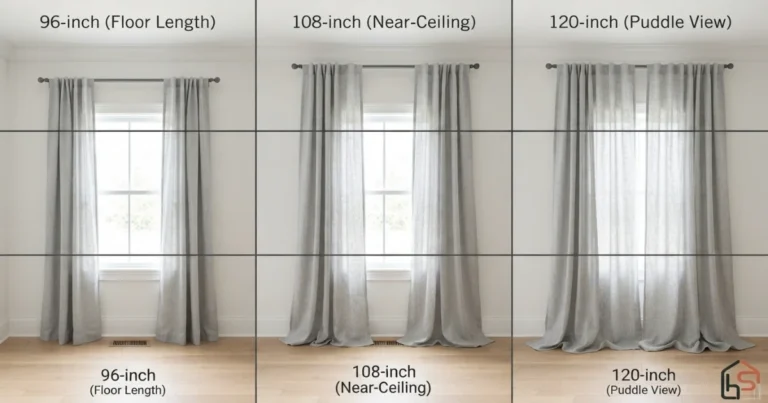
- Floor length just grazes the floor or hovers about half an inch above it. This is the most commonly chosen length for living rooms and bedrooms because it looks tailored without dragging or bunching.
- Break length extends slightly beyond the floor, roughly half an inch to one inch, so the fabric folds softly at the base. This creates a relaxed, slightly formal look without a full puddle.
- Puddle length pools several inches onto the floor, typically three to six inches or more. It reads as formal and luxurious, but it also collects dust more easily and needs regular adjustment, so it suits low-traffic, more decorative rooms better than busy family spaces.
Once you choose a length style, measure the exact drop from the rod, not from the top of the window frame, down to the finishing point you want. This is the single number that most directly determines whether the finished curtain looks tailored or accidental.
Curtain Measurement Guide Step 6: Calculate Fabric Fullness
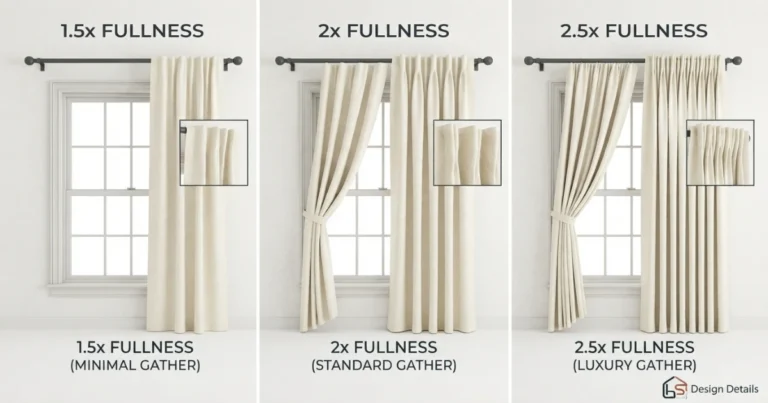
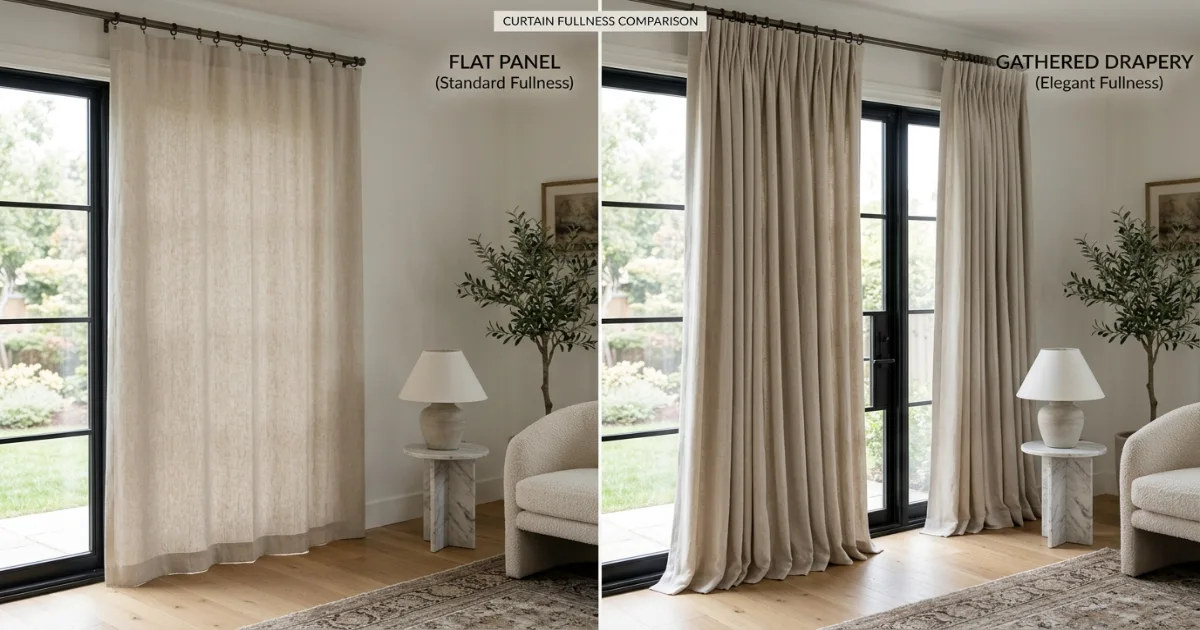
Fullness describes how much extra fabric a curtain has compared to the rod width it covers. A curtain sewn at exactly the rod width will hang almost flat, with visible flat panels and minimal movement in the fabric.
A fuller curtain gathers into soft folds even when closed, which is part of what makes fabric curtains look intentional rather than stretched.
The standard fullness ratio for most drapery is between one and a half and three times the rod width. A ratio of two times the rod width is a reliable, balanced default for most rooms.
Lighter fabrics such as sheers often look better with more fullness, sometimes closer to two and a half or three times the rod width, because thin fabric needs more volume to read as substantial.
Heavier fabrics such as velvet or blackout linings can look intentional with a slightly lower ratio, since the fabric itself already has visual weight.
To calculate total fabric width, multiply your finished rod width by the fullness ratio you choose. For example, a 60 inch rod at two times fullness needs 120 inches of total fabric width across both panels, or 60 inches per panel if you are using a standard two-panel setup.
Curtain Measurement Guide Step 7: Decide the Panel Count
Most curtains are sold as a single panel rather than a pair, which is one of the most common surprises when shopping online.
Unless a listing specifically states that it is sold as a pair, assume you are ordering one panel per side and will need two panels total to cover one window with a center opening.
For very wide windows or sliding doors, three or four panels are sometimes used to achieve the desired fullness without relying on unusually wide single panels, which can be harder to source and more expensive per yard of fabric.
If you prefer a single, non-opening panel that stays pushed to one side as a stationary accent, only one panel may be needed, but confirm that the width still meets your fullness target so the panel does not look thin against the window.
Curtain Measurement Guide Step 8: Match Fabric to the Room
Fabric choice interacts directly with sizing, because different fabrics behave differently once fullness and gravity are involved.
Sheer fabrics let light through and work well layered under a heavier drapery panel, giving privacy during the day without blocking the window completely.
Blackout or room-darkening fabrics work well in bedrooms and media rooms, but they are heavier, so confirm that the rod and mounting hardware can support the added weight, particularly for wide windows or floor-to-ceiling installations.
Linen and cotton blends offer a relaxed, textured look and are popular for living rooms and casual dining spaces. Velvet and heavier weaves suit formal rooms and can help with both insulation and sound dampening, but they generally look better with a slightly fuller cut to avoid appearing stiff or boxy.
Curtain Measurement Guide Step 9: Rings, Rods and Hanging Style
The hanging style you choose changes both the finished look and the exact drop measurement.
Rod pocket curtains slide directly onto the rod through a fabric channel, which creates a soft, gathered header but makes the curtains harder to open and close smoothly.
Grommet curtains have metal rings sewn into the top and glide easily along the rod, giving clean, structured folds.
Curtain rings with clips attach separately from the fabric and add a small amount of extra drop length, usually about one to two inches, which should be subtracted from your finished length measurement if you want the hem to land exactly at your chosen finishing point.
Pinch pleat and tab top styles are also common. Pinch pleats create structured, tailored folds and work well in more formal rooms, while tab tops give a relaxed, casual look but sit closer to the rod, which slightly changes how much of the rod remains visible once the curtains are open.
Curtain Measurement Guide Step 10: Room-by-Room Decisions
Different rooms place different demands on a curtain, beyond simple aesthetics.
Bedrooms often benefit from blackout or lined curtains for better sleep, and floor or break length usually feels appropriate.
Living rooms tend to work well with floor length curtains in a medium-weight fabric that layers nicely with existing furniture and rugs.
Kitchens usually call for sill or apron length curtains in a washable fabric, since longer curtains near a stove or sink are impractical and can be a safety concern.
Dining rooms can handle a more formal length, including break or puddle length, since there is generally less daily foot traffic near the window.
Home offices often benefit from adjustable light control, so a layered approach with sheers and heavier drapery gives flexibility throughout the day.
| Room | Common length choice | Fabric consideration |
|---|---|---|
| Bedroom | Floor or break length | Blackout or lined fabric for better sleep and privacy |
| Living room | Floor length | Medium-weight fabric that layers with rugs and sofas |
| Kitchen | Sill or apron length | Washable, lightweight fabric away from heat sources |
| Dining room | Break or puddle length | Formal fabric such as linen blends or light velvet |
| Home office | Floor length, layered | Sheer plus a heavier panel for adjustable light control |
| Bathroom | Sill length or a moisture-friendly alternative | Quick-drying fabric or a water-resistant blend |
Curtain Measurement Guide Step 11: Common Measuring Mistakes
The most frequent mistake is buying curtains sized to the window rather than the finished treatment.
This usually shows up in two ways: a rod that is too narrow, which blocks light even when the curtains are fully open, and panels that are too flat, which happens when the fullness ratio is ignored and a single panel is stretched across the entire rod width.
Another common mistake is skipping the drop measurement from the rod and instead measuring from the top of the window frame, which produces curtains that are too short once the rod is mounted above the frame as intended.
Buying based on product photos is another frequent issue, since listing photos are often styled with a fuller fold or a different mounting height than what a specific room can accommodate.
Always compare the listed finished width and length in inches against your own measurements rather than relying on the visual impression of the photo alone.
Curtain Measurement Guide Buying Checklist
Before finalizing an order, confirm the following details against your own measurements rather than assuming the listing matches your window automatically.
- Confirm whether the listing price is per panel or per pair, and order enough panels to reach your target fullness.
- Check the finished panel width and length in inches, not just the product title or category name.
- Confirm the header style, whether rod pocket, grommet, pinch pleat or tab top, works with the rod you already have or plan to buy.
- Verify that the rod supports the fabric weight, especially for blackout, velvet or extra-wide installations.
- Check the return policy before ordering custom-cut, made-to-measure or final-sale curtain products.
Curtain Measurement Guide Step 12: Care and Maintenance
Sizing decisions also affect how easy a curtain is to maintain over time.
Floor-length and break-length curtains that graze or lightly touch the floor pick up dust, pet hair and foot traffic marks faster than curtains hung an inch or two above the ground, so households with pets or young children may prefer a slightly shorter finished length even within the same style category.
Puddle-length curtains need the most attention, since the pooled fabric collects dust and needs to be reshaped by hand after vacuuming or cleaning the floor beneath it.
Check the fabric care label before finalizing a fullness ratio as well. Fuller curtains use more fabric, which means more weight to launder, steam or dry clean, and heavier fabrics can shrink slightly after washing.
Where shrinkage is a concern, it can help to order a curtain slightly longer than the exact calculated drop, then hem it to the final length once, or after the first wash, rather than risking a curtain that becomes too short over time.
Curtain Measurement Guide Step 13: Seasonal and Layered Treatments
Many rooms benefit from more than one layer of window treatment, and the measuring approach changes slightly when layering is involved.
A common combination pairs a sheer curtain, mounted closer to the window on an inner rod or track, with a heavier drapery panel mounted on an outer rod for privacy, insulation or light blocking.
When planning a layered setup, measure and order the rods separately, since the sheer rod typically sits a few inches in front of the window while the outer rod extends further for the heavier fabric.
In colder climates, a fuller, heavier curtain that closes completely across the rod width can meaningfully reduce draft near windows, so fullness and total fabric width matter as much for comfort as they do for appearance.
In warmer climates or rooms that receive strong afternoon sun, a lighter fabric with moderate fullness allows more airflow while still softening harsh light.
Matching the fullness ratio and fabric weight to the room’s seasonal needs, not just its style, produces a window treatment that performs well year-round rather than only in photographs.
Curtain Measurement Guide Quick-Reference Decisions
The curtain measurement guide begins with the frame width and height, but the finished treatment also depends on wall space around the window.
Use the curtain measurement guide to choose the mount before calculating rod width because inside and outside mounts use different limits.
The curtain measurement guide recommends useful rod extension so open panels can stack beyond the glass instead of blocking daylight.
For accurate length, the curtain measurement guide measures from the installed rod or track to the selected sill, apron, floor, break or puddle point.
The curtain measurement guide treats fullness as total fabric width divided by rod width, not as the width of one retail panel.
Before ordering, the curtain measurement guide checks whether the listing contains one panel or a pair and whether the header changes the finished drop.
For wide windows, the curtain measurement guide allows multiple panels when one oversized panel cannot create the required fullness or movement.
In bedrooms, the curtain measurement guide also considers blackout weight, hardware strength, floor clearance and daily opening.
In kitchens and bathrooms, the curtain measurement guide prioritizes practical length, washable fabric and suitable distance from moisture or heat.
Before installation, follow the curtain measurement guide by taping the rod line and comparing every measurement with the exact product listing.
Helpful next step
If you are planning a full window treatment from scratch, measure in this order: window opening, wall space around it, mount type, rod width, mounting height, curtain length, then fullness and panel count last.
Curtain Measurement Guide Official Resources
These followed links support length-unit checks, window-covering energy research and window-covering safety awareness.
NIST length units
Use the official reference when converting inches, feet, centimeters and meters for rods, panels and finished drops.
Read NIST length guidanceU.S. Department of Energy
Review official information about energy-efficient window coverings when insulation, seasonal comfort or solar gain matters.
Read window-covering guidanceU.S. Consumer Product Safety Commission
Review official window-covering safety information, especially when cords, loops or child-accessible rooms are involved.
Read window-covering safety guidanceCurtain Measurement Guide FAQs
These answers cover the most common questions people ask before measuring windows and ordering curtains.