Find the exact art width, height and hanging height for any wall.
Enter your wall dimensions and choose a layout style. Instantly see the ideal art size using the same 60–75% width rule and 57‑inch eye‑level standard that interior designers rely on.
No guesswork. No crooked nails. No returns on pieces that looked bigger in the store.
Standard art sizes by wall width.
These estimates assume a single piece at 65% wall width with auto orientation and standard 57‑inch center height. Use the calculator above for your exact wall.
| Wall Width | Recommended Art Width | Art Height | Center Above Floor | Best Fit |
|---|---|---|---|---|
| 36 in (narrow) | 24 in | 18–24 in | 57 in | Small portrait |
| 60 in | 39 in | 26–32 in | 57 in | Medium landscape |
| 84 in (above sofa) | 55 in | 36–42 in | 57 in | Oversized single |
| 120 in (large wall) | 78 in | 44–52 in | 57 in | 2‑piece grid |
| 144 in (dining wall) | 94 in | 48–60 in | 57 in | 3‑piece triptych |
| 180 in (open plan) | 117 in | 52–65 in | 57 in | Gallery wall |
Four wall art layouts — and when to choose each.
The layout you choose changes the size, proportion and visual weight of the art. Here is what each arrangement style looks like on a standard wall.
Single Statement Piece
One large piece centered on the wall. The simplest, most impactful choice for living rooms and above a console table.
It creates a single focal point that anchors the room without competing with other decor.
Best for: above sofa, feature walls2‑Piece Grid (Diptych)
Two panels hung side by side with a 2–3 inch gap. The most popular arrangement for wider walls and above king‑size headboards.
The pair reads as one unified piece from a distance but adds rhythm up close.
Best for: wide walls, bedrooms3‑Piece Grid (Triptych)
Three panels arranged horizontally across the wall. Popular for dining rooms, long hallways, and above large sectionals.
The triptych format creates a sense of movement that works well with panoramic landscapes.
Best for: dining rooms, hallwaysGallery Wall
A curated collection of 5–9 smaller pieces in a cohesive cluster. Ideal for staircases, home offices, and personal spaces.
The overall cluster should still fill 60–75% of the wall width to avoid looking scattered.
Best for: staircases, home officesSee how art proportions change by wall size.
These steps cover the essentials: measuring the wall, choosing the right width ratio, and positioning the center at eye level.
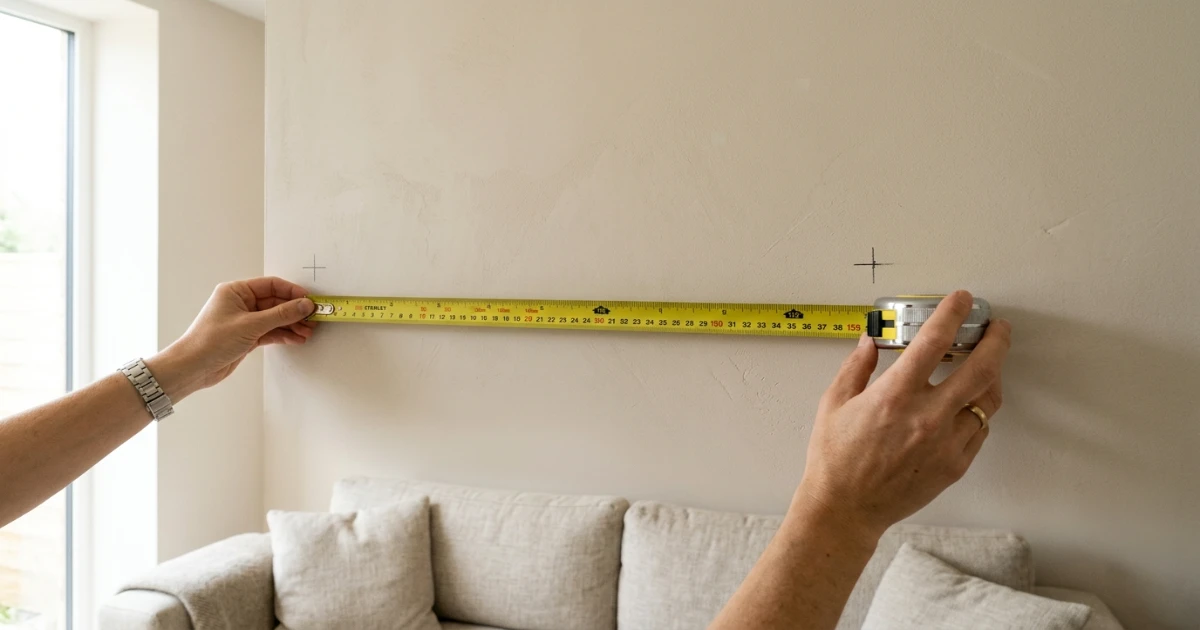
Measure the wall
Start with the full wall width and height. Note any furniture below that affects the visual space.
A metal tape measure gives a more accurate read than a fabric one. Measure at both top and bottom to catch out‑of‑square corners.
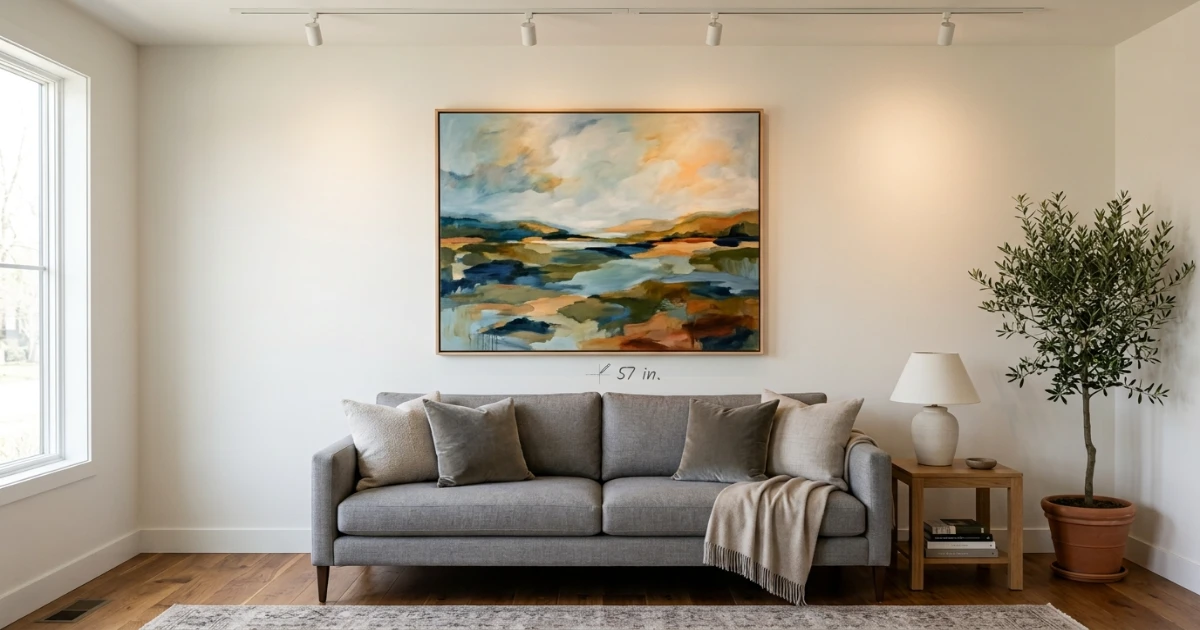
Set the center height
The center of the artwork should sit at 57 to 60 inches from the floor. This is the universal gallery standard.
Mark this point lightly in pencil before measuring anything else. Every other dimension flows from this reference point.
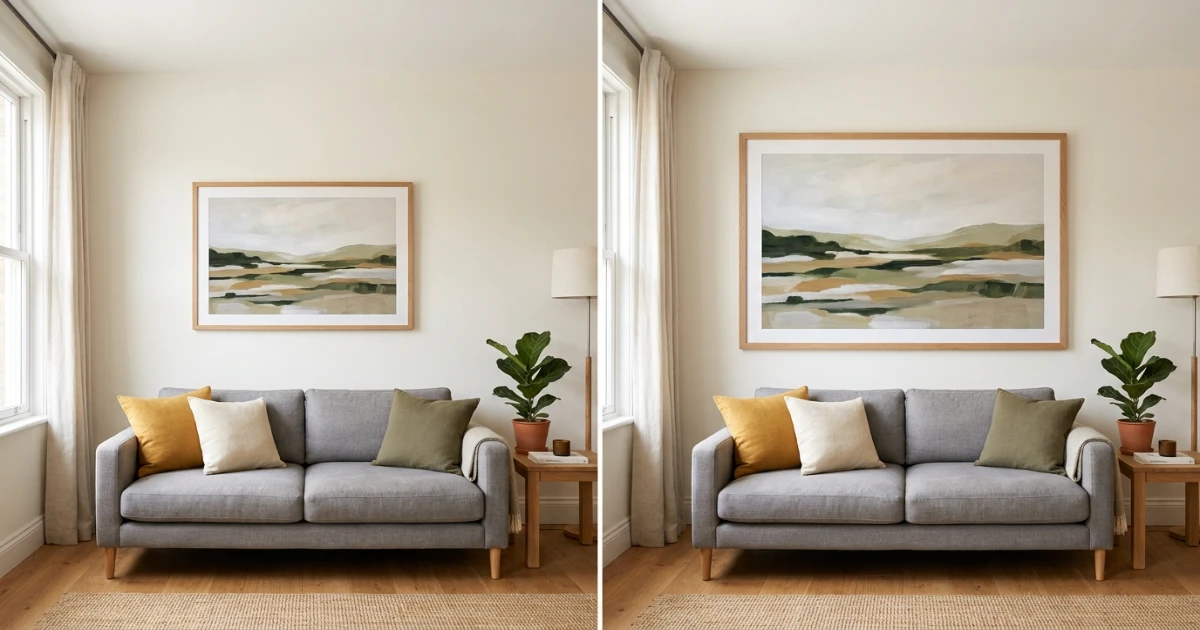
Apply the width ratio
Art that fills 60–75% of the wall width looks intentional. Anything below 50% tends to look undersized.
For multi‑piece arrangements, the total width including gaps should still fall within this range.
How to size wall art — the complete guide.
The most common wall art mistake is buying a piece that is too small for the wall. Undersized art makes the wall look empty and the room feel unfinished. When in doubt, go larger. A piece that fills 65–75% of the wall width almost always looks better than one that fills only 40–50%.
Step 1: Measure the wall
Measure the full width of the wall from corner to corner. Measure the full height from floor to ceiling.
If furniture sits below the art — a sofa, console table or headboard — measure its width separately. The art should span 60–75% of the furniture width for a balanced look.
For an 84‑inch sofa, aim for 50 to 63 inches of art width. For a 60‑inch console, aim for 36 to 45 inches of art width above it.
Step 2: Choose an arrangement
A single large piece is the easiest to get right. It creates one clean focal point that anchors the entire wall.
A diptych works best on wider walls where a single piece would need to be unusually long and narrow. A triptych suits very wide walls, open‑plan living spaces and dining rooms.
A gallery wall is the most personal option. It requires more planning to ensure the overall cluster still reads as one shape filling the 60–75% width target.
Step 3: Apply the 60–75% width rule
Multiply your wall width by 0.6 and by 0.75 to get the ideal art width range. For a 120‑inch wall, that gives you a range of 72 to 90 inches.
Stay within this range and the art will feel proportioned to the wall. Go below 60% and the piece starts to look undersized. Go above 80% and the art can feel cramped.
When furniture sits below the art, use the furniture width as your multiplier instead of the full wall width.
Step 4: Pick an orientation
Landscape orientation suits wide walls and above sofas. Portrait orientation works well on narrow walls and between windows.
Square art is versatile and works almost anywhere. It benefits from a bit more breathing room — aim for the lower end of the width range so the square shape doesn’t feel heavy.
Let the wall’s natural proportions guide you. A wide, low wall usually calls for landscape. A tall, narrow wall between windows usually suits portrait.
Step 5: Hang at the right height
The center of the artwork should sit at 57 to 60 inches from the floor. This is the standard eye‑level height used by museums and galleries worldwide.
For art above a sofa, leave 6 to 10 inches between the bottom edge and the back cushions. For art above a headboard, 4 to 8 inches of clearance is standard.
Always measure from the finished floor surface. Thick rugs or carpet underlay can shift the true floor level by half an inch or more.
Step 6: Account for the frame and mat
A frame adds 1 to 3 inches on each side. A mat adds another 2 to 4 inches. A 24 × 36 inch print with a 3‑inch mat and 1.5‑inch frame ends up roughly 33 × 45 inches.
That is nearly 40% larger than the print alone. Always calculate the framed size when planning placement, not the print size.
Ask the framer for the outside dimensions before you commit to a wall position.
Step 7: Space multi‑panel pieces correctly
For diptychs and triptychs, leave a 2 to 3 inch gap between each panel. This gap should be consistent across all panels.
The total width — panels plus gaps — should still fall within the 60–75% range. Use a spacer block cut to size rather than eyeballing the gap.
Even a quarter‑inch variation between gaps is visible from across the room.
Step 8: Avoid the most common sizing mistakes
Beyond the classic “art too small” error, a few other mistakes come up repeatedly. Hanging art too high is almost as common — the center ends up at 64 or 66 inches instead of 57.
Choosing art based on the print size instead of the framed size is another frequent slip. And for gallery walls, spreading pieces too far apart so the cluster loses its shape is a common error.
Keep the outer edges of the arrangement within the 60–75% width envelope. Maintain consistent spacing between every piece, regardless of its individual size.
Frame and mat styles: wood, metal, floater and gallery
- Wood frame — warm and traditional, suits landscapes, portraits and classic interiors. Available in natural, stained, painted and gilded finishes. Heavier than metal, so check wall anchors on installations above 20 pounds.
- Metal frame — sleek and modern, often used for photography, abstract prints and contemporary gallery walls. Lighter than wood and usually less expensive, but can feel cold in rooms with mostly warm materials.
- Floater frame — the canvas sits inside the frame with a small gap around the edge. Popular for gallery‑wrapped canvases and large statement pieces where the artist’s edge work should remain visible.
- Gallery frame with mat — a wide mat inside a simple frame creates breathing room around the image. Standard mat widths are 2 to 4 inches, with wider mats suited to larger walls and higher ceilings.
Wall art buying rules that prevent a return trip to the framer.
A calculator gives the best starting numbers. But the final purchase still depends on frame width, mat size, furniture clearance and the actual light in the room. These rules cover the details a simple measurement cannot capture.
For most walls, aim for art that fills 65% of the wall width. Hang it with the center at 57 to 60 inches from the floor. Leave 6 to 10 inches of clearance above any furniture below. Choose a frame that adds 1.5 to 3 inches per side and account for mat width before ordering. When unsure between two sizes, the larger option almost always looks more intentional on the wall.
Never buy art smaller than 50% of wall width
Anything below half the wall width will look undersized and disconnected. If budget is tight, a larger print with a simple frame is better than a small print with an expensive frame. Scale always wins over finish when it comes to wall presence.
Always measure the framed size
Online listings often show the print or canvas size without the frame. A 24 × 36 inch canvas in a floater frame with a 2‑inch gap becomes roughly 28 × 40 inches. Confirm outside dimensions before you buy.
Test the placement with paper templates
Before putting a single nail in the wall, tape together sheets of kraft paper cut to the exact framed dimensions. Live with the paper template for at least 24 hours. Check it in morning light, evening light and from every seat.
Match art weight to wall anchors
A large framed piece with glass can weigh 30 to 50 pounds or more. Use wall anchors rated for at least double the art’s actual weight. Whenever possible, drive at least one screw directly into a wall stud.
Finally, always view the art in your own light before framing it for good. Colours shift dramatically between a gallery’s track lighting and your living room’s indirect daylight. Most online retailers offer a 30‑day return window — use it to test the unframed piece in the actual room before investing in custom framing.
Helpful room planning topics.
Wall art rarely stands alone. Once you know your frame size and hanging height, plan the surrounding elements — furniture scale, wall colour, and lighting. Use these supporting pages to plan the rest of the room.
Six things interior designers always check before hanging wall art.
Use the furniture as your width guide
When art hangs above a sofa, console or headboard, size the piece to 60–75% of the furniture width — not the wall width. This ties the art to the piece below it and prevents a disconnected look.
Err on the side of larger
A piece that is slightly too large reads as bold and intentional. A piece that is slightly too small reads as a mistake. Designers consistently push clients toward the upper end of the 60–75% range.
Consider the viewing distance
Art viewed from across the room can be larger and bolder. Art viewed up close benefits from finer detail and can be slightly smaller. Adjust the width ratio up by 5–10% for pieces seen from 10 feet away or more.
Light the art, not just the room
A well‑placed picture light or adjustable ceiling spot makes the art a focal point at night. Budget for at least one dedicated art light per major piece. Position the beam at a 30‑degree angle to minimize glare on glass.
Keep a consistent bottom edge on gallery walls
For gallery walls with mixed frame sizes, align the bottom edges of the lowest row. This creates a clean visual baseline that grounds the entire arrangement, even with diverse frame styles and sizes.
Rotate art seasonally
Once the hardware is in place at the correct height, swapping art is a five‑minute job. Rotate lighter pieces in spring and summer and warmer pieces in autumn and winter. Use the same size template for seasonal swaps.
Wall art sizing questions — answered.
12 calculators for every room decision.
Every tool uses professional designer formulas. Free, instant, no sign-up — just enter your room and get the exact answer.
Bookmark HomeStyle Calculator for every wall in the house.
From a single statement piece above the sofa to a full gallery wall up the staircase, our free tools give you the exact art width, height and hanging height before you order a frame.