Find out How Much House You May be Able to Afford.
Enter your income, monthly debts, down payment and interest rate, and get an instant estimated maximum home price and monthly payment — using the same debt-to-income guidelines lenders commonly reference. A starting point for your own research, not a loan approval.
A common rule keeps total housing costs at or under 28% of gross monthly income, and total debts, including housing, at or under 36%. Down payment size and interest rate both meaningfully shift the maximum price a given budget supports.
This is an educational estimate, not financial or lending advice. Actual loan amounts depend on your credit, full financial picture, and a lender’s specific underwriting guidelines. Speak with a mortgage professional before making a purchase decision.
Estimated home price by income and interest rate.
These estimates assume the standard 28/36 profile, a 10 percent down payment, a 30 year term, minimal existing debt, and typical tax and insurance costs. Use the calculator above for a figure matched to your exact numbers.
| Annual Income | 6% Rate | 7% Rate | 8% Rate | Notes |
|---|---|---|---|---|
| $60,000 | ~$225,000 | ~$205,000 | ~$188,000 | Entry-level budget |
| $80,000 | ~$300,000 | ~$273,000 | ~$250,000 | Typical starter home range |
| $100,000 | ~$375,000 | ~$341,000 | ~$313,000 | Median household range |
| $120,000 | ~$450,000 | ~$410,000 | ~$375,000 | Dual-income household range |
| $150,000 | ~$563,000 | ~$512,000 | ~$469,000 | Move-up buyer range |
| $200,000 | ~$750,000 | ~$683,000 | ~$625,000 | Higher-income range |
Three DTI profiles — and how each shifts your estimate.
Lenders use a range of debt-to-income limits depending on loan type and borrower profile. Here’s what each preset in the calculator represents.
Conservative (25/33)
Keeps housing costs under 25 percent and total debt under 33 percent of gross income, leaving more monthly cushion for savings, emergencies and other goals.
Lower max price, more cushionStandard (28/36)
The most widely referenced conventional guideline, balancing a realistic home price with a manageable share of income going to debt.
Common conventional guidelineAggressive (33/45)
Reflects the higher ratios some loan programs allow for well-qualified borrowers, resulting in a higher estimated max price but a tighter monthly budget.
Higher max price, less cushionAlready have a home?
If you’re planning renovations instead of a purchase, the Room Layout Calculator and other HomeStyle tools can help plan the space itself.
See renovation calculatorsSee how affordability changes by income, rate and debt.
These steps cover the essentials: entering income and debts, setting a down payment and rate, and reading the estimated monthly payment breakdown.
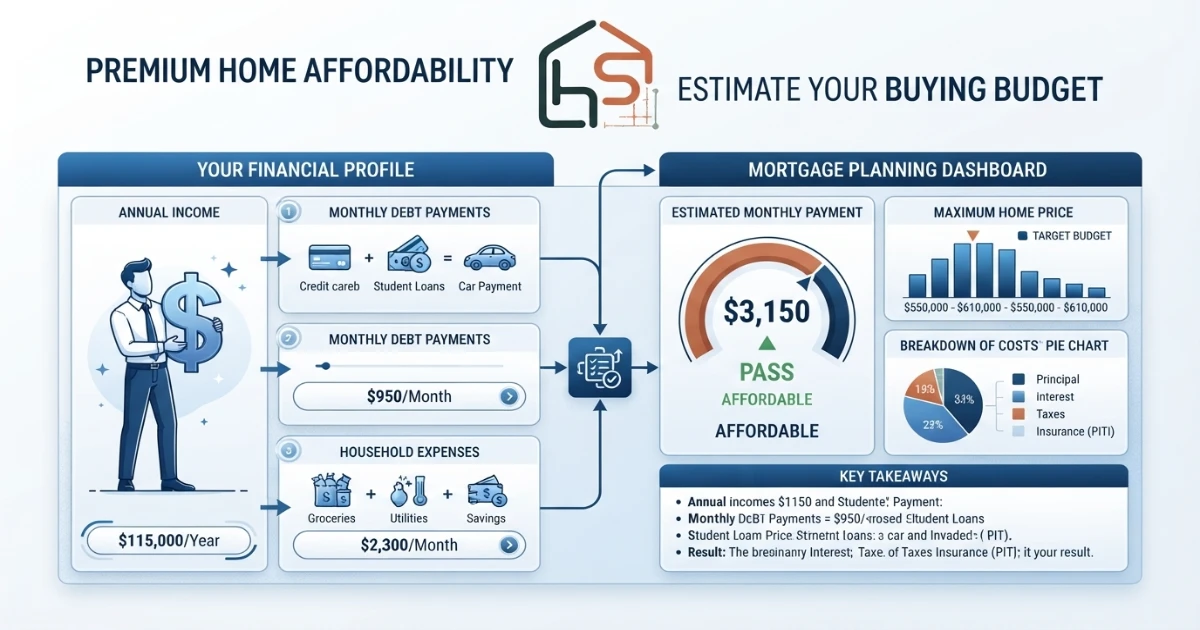
Start with income and debts
Gross income and existing monthly debt payments are the two numbers every affordability estimate is built from.
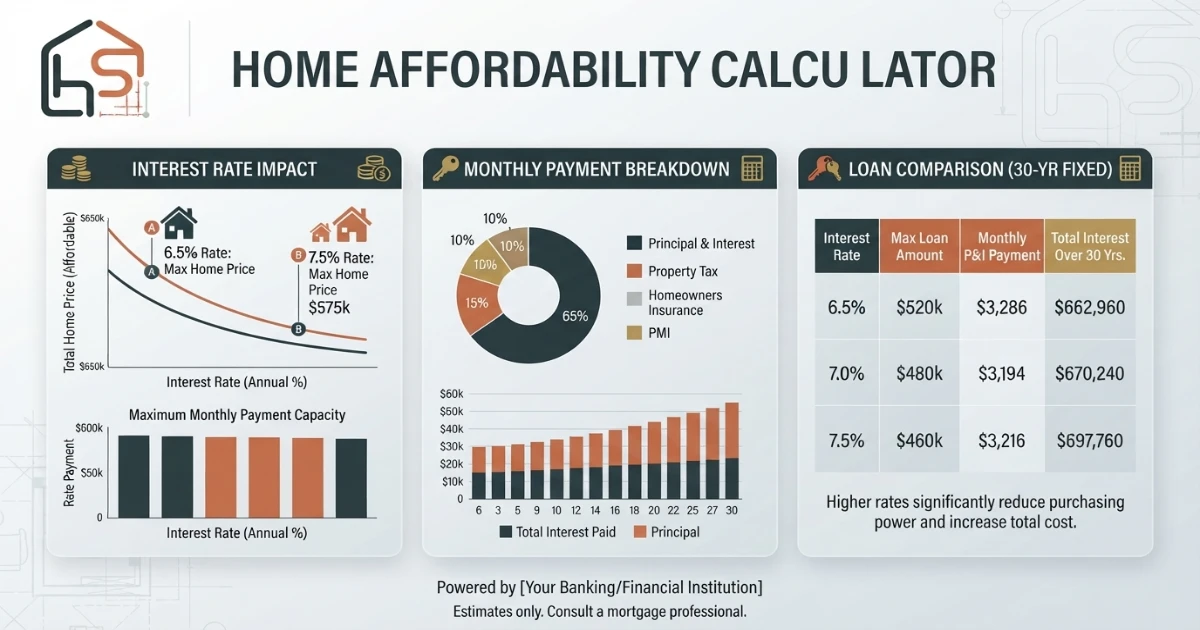
See how rate changes the number
Interest rate has an outsized effect on affordability, often shifting the max price by tens of thousands of dollars per point.
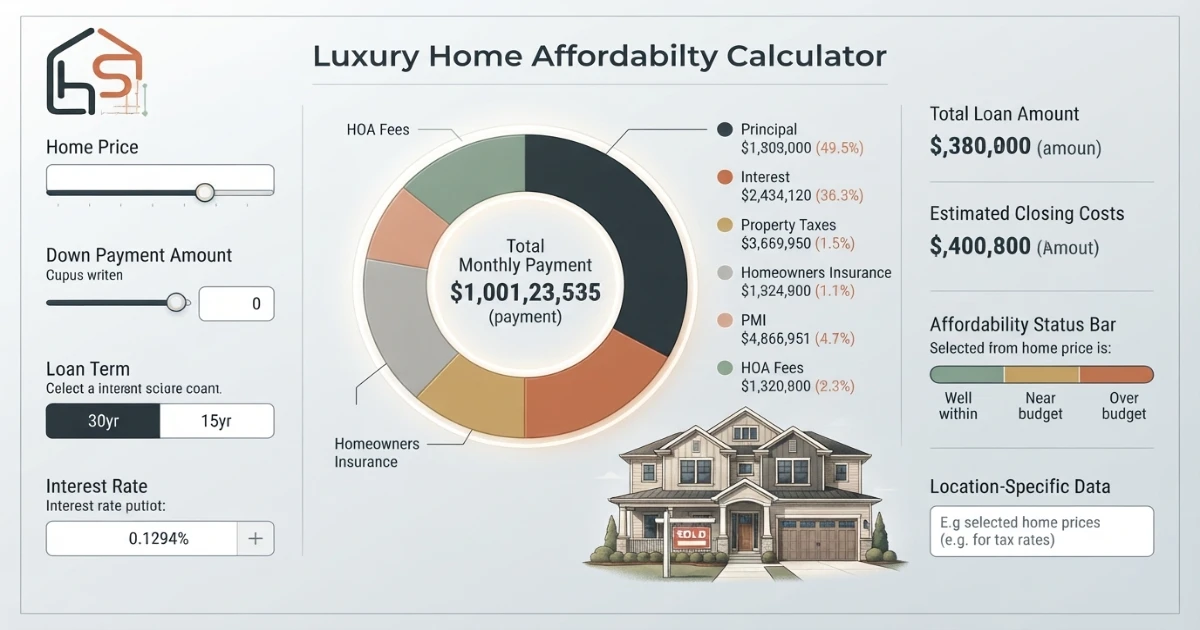
Review the full payment breakdown
Principal, interest, taxes, insurance and HOA dues all add up to the real monthly cost of owning, not just the loan payment.
How home affordability is estimated — the complete guide.
The most common affordability mistake is focusing only on the sale price rather than the full monthly cost of ownership. Two homes at the same price can carry very different monthly payments once property taxes, insurance, HOA dues and loan terms are factored in, and the monthly payment, not the sticker price, is what actually needs to fit a household budget.
Figuring out how much house you can afford involves more moving parts than a single number can really capture, since income, existing debt, down payment, interest rate, property taxes, insurance and even HOA dues all interact to determine what a household can comfortably sustain month to month. This guide walks through each of those pieces individually, then explains how they combine into the estimate the calculator above produces, so the number means something concrete rather than feeling like a black box.
Step 1: Start with gross income, not take-home pay
Affordability guidelines and most lender calculations are based on gross income, meaning income before taxes and other payroll deductions, not the smaller take-home amount that actually lands in a bank account. For a household with more than one income earner, combine all qualifying gross income sources, since most lenders will consider stable income from multiple household members together when evaluating a joint application.
Step 2: Total up existing monthly debt payments
Monthly debt payments typically include the minimum payments on car loans, student loans, personal loans, and the minimum payments listed on credit card statements, not the full balance owed. Recurring expenses like utilities, groceries, subscriptions or childcare are not counted in the debt-to-income calculation used for housing affordability, even though they are real monthly costs a household still needs to budget around separately.
Step 3: Understand the front-end and back-end ratios
The front-end ratio, sometimes called the housing ratio, measures the new home’s total monthly cost against gross monthly income. The back-end ratio, sometimes called the total debt ratio, measures every monthly debt payment combined, including the new housing payment, against that same gross monthly income. Most affordability guidelines set separate limits for each ratio, and the smaller of the two resulting maximum payments is generally the binding constraint on how much home a household can afford.
Step 4: Learn what the 28/36 rule actually means
The widely cited 28/36 rule suggests keeping total housing costs, including principal, interest, property taxes and insurance, at or under 28 percent of gross monthly income, and total debt payments, including that housing cost, at or under 36 percent. This is a general guideline rather than a fixed law, and different loan programs, lenders and individual financial situations can support ratios somewhat above or below these figures.
Step 5: Recognize that DTI limits vary by loan type
Conventional loans often follow ratios in the neighborhood of the 28/36 guideline, though this varies by lender and borrower profile. Government-backed loan programs, such as FHA loans, sometimes allow higher back-end ratios for qualified borrowers, occasionally into the 45 to 50 percent range, reflecting different underwriting priorities. This is why the calculator above offers conservative, standard and aggressive profiles rather than a single fixed ratio, since the “right” limit genuinely depends on the loan program and lender involved.
Step 6: Factor in the down payment
A larger down payment directly reduces the loan amount needed for the same purchase price, which lowers the monthly principal and interest payment for that price point. It can also help a buyer avoid private mortgage insurance, an additional monthly cost often required on conventional loans with less than 20 percent down, which frees up more of the monthly housing budget for the loan itself rather than insurance premiums.
Step 7: Understand how interest rate reshapes the number
Interest rate has an outsized effect on affordability, since it changes the cost of borrowing the same amount of money. A one percentage point increase in rate can reduce the loan amount a given monthly payment supports by roughly 10 percent, which is why the same household budget can translate into a meaningfully different maximum home price depending on when and at what rate they lock in financing.
Step 8: Choose a loan term intentionally
A 30 year loan term spreads payments over more months, which lowers the monthly principal and interest payment and can support a higher purchase price for the same monthly budget, though it also means paying more total interest over the life of the loan. A 15 year term carries a higher monthly payment for the same loan amount but builds equity faster and pays significantly less total interest, generally suiting buyers who can comfortably support the higher payment.
Step 9: Estimate property taxes realistically
Property tax rates vary considerably by location, commonly ranging from under half a percent to well over two percent of assessed value annually depending on the state, county and even specific school district. Since this cost is baked into most escrowed mortgage payments, it directly affects how much loan a given monthly budget supports, and it’s worth researching the actual local rate rather than relying on a single national average.
Step 10: Don’t overlook homeowners insurance and HOA dues
Homeowners insurance costs vary by location, home value, and regional risk factors such as flood or wildfire exposure, and this cost is also typically escrowed into the monthly mortgage payment alongside taxes. Homeowners association dues, where applicable, are an additional fixed monthly cost that reduces the housing budget available for the loan itself, so a home with high HOA dues effectively supports a lower purchase price than an otherwise identical home without them.
Step 11: Budget for closing costs separately from the down payment
Closing costs, covering items like loan origination fees, title insurance, appraisal fees and prepaid escrow amounts, typically run an additional 2 to 5 percent of the purchase price and are generally paid separately from the down payment itself, not drawn from the same funds automatically. A buyer planning a specific down payment amount should budget for closing costs on top of it, not out of it, to avoid a shortfall at closing.
Step 12: Understand that a calculated maximum isn’t a target
An affordability estimate reflects a mathematical ceiling based on common lending guidelines, not a recommendation to spend exactly that amount. Many financial advisors and experienced buyers suggest targeting a payment somewhat below the calculated maximum, preserving room in the monthly budget for maintenance, unexpected repairs, retirement savings, and other financial goals that a strict debt-to-income calculation doesn’t account for.
Step 13: Distinguish an affordability estimate from pre-approval
A home affordability calculator provides a general educational estimate based on the numbers entered and standard rules of thumb. Mortgage pre-approval is a formal process where a lender reviews actual pay stubs, tax returns, bank statements and a credit report to issue a specific, documented maximum loan amount. Treat a calculator estimate as a helpful starting point for house-hunting research, not a substitute for speaking with a mortgage professional before making an offer.
Step 14: Reassess as rates, income or debt change
Interest rates move over time, and a household’s income and debt situation can change between when a rough estimate is first run and when they’re actually ready to make an offer. Revisit an affordability estimate periodically during a home search, particularly if there’s been a meaningful shift in rates, income, or new debt taken on, rather than relying on a number calculated months earlier.
Affordability rules that prevent a stretched budget.
A calculator gives a useful starting estimate, but the final decision still depends on your full financial picture, comfort with the monthly payment, and guidance from a qualified professional. The rules below cover the details worth keeping in mind even after settling on a target price from the calculator above. This is general information, not personalized financial or lending advice.
Keep total housing costs at or under roughly 28 percent of gross monthly income and total debts at or under roughly 36 percent as a starting guideline, then confirm your actual numbers with a mortgage lender before making an offer, since only a formal pre-approval reflects your true documented borrowing capacity.
Budget the monthly payment, not the price
Taxes, insurance and HOA dues can meaningfully change the real monthly cost of two homes at the same sale price.
Budget closing costs separately
Plan for 2 to 5 percent of the purchase price in closing costs on top of, not instead of, your down payment funds.
Leave room below the calculated maximum
A calculated ceiling doesn’t account for savings goals, maintenance costs or other financial priorities specific to your household.
Get formal pre-approval before offering
Only a lender’s documented review of your income, credit and debts reflects your actual approved borrowing capacity.
This tool is provided for general educational purposes and does not constitute financial, lending, tax or legal advice. Consult a licensed mortgage professional, financial advisor or tax professional regarding your specific situation before making a home purchase decision.
Helpful room planning topics.
Once you’ve found and moved into a home, planning the space itself is the next step. Use these supporting pages from the HomeStyle Calculator homepage to plan furniture layout, paint, flooring and more once you’re ready to settle in.
Six things experienced buyers check before setting a budget.
Get pre-approved before house hunting
A formal pre-approval clarifies your real budget and strengthens any offer you make, rather than shopping based on a rough estimate alone.
Shop your mortgage rate across lenders
Interest rates and closing costs can vary meaningfully between lenders for the same borrower profile, so comparing more than one quote is worth the time.
Research local property tax rates directly
Property tax rates vary widely even within the same metro area. Check the specific county or municipality rather than relying on a broad average.
Ask about HOA dues and special assessments
HOA dues can increase over time, and some associations levy special assessments for major repairs, both worth asking about before making an offer.
Keep a maintenance reserve outside the budget
Many advisors suggest budgeting an ongoing reserve for home maintenance and repairs separate from the monthly mortgage payment itself.
Revisit your estimate if rates move
Interest rate changes can shift your affordable price range meaningfully. Rerun the numbers periodically during a longer home search.
Home affordability questions — answered.
More calculators for every home decision.
Once you’ve settled into a home, these room planning tools help with the next set of decisions. Free, instant, no sign-up.
Bookmark HomeStyle Calculator for every stage of home life.
From figuring out a home budget to planning every room once you’re in, our free tools help you make decisions with real numbers.