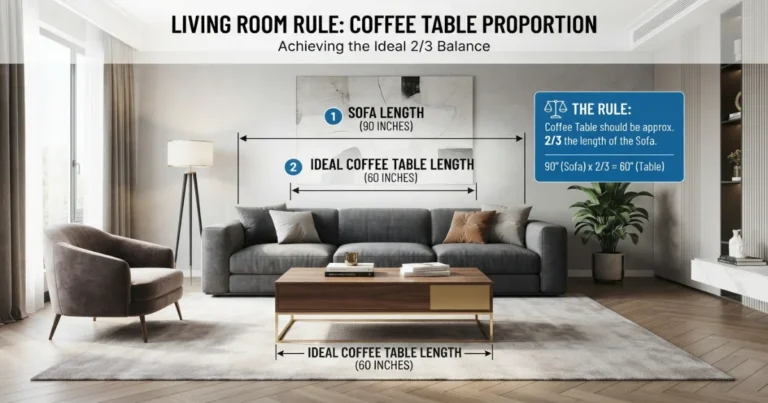
Find out Exactly How Much Fabric Your Reupholstery Project Needs.
Choose your chair or sofa type, count the loose cushions, enter your fabric’s width and pattern repeat, and get an instant yardage recommendation — using the same estimating rules working upholsterers use. No leftover bolts, no coming up short mid-project.
Standard fabric yardage by furniture type.
These estimates assume 54 inch wide solid fabric with a 15 percent waste buffer already included. Use the calculator above for your exact piece — cushion count, width and pattern repeat can shift these numbers meaningfully.
| Furniture | Base Yardage | With 2 Cushions | With Pattern Match |
|---|---|---|---|
| Dining chair (seat) | 1–1.5 yd | — | 1.5–2 yd |
| Armchair | 4.5–5.5 yd | 6–7 yd | 6–8 yd |
| Wingback chair | 6–6.5 yd | 7.5–8.5 yd | 8–10 yd |
| Recliner | 7–7.5 yd | 8.5–9.5 yd | 9–11 yd |
| Loveseat (2-seat) | 6.5–7 yd | 8–9 yd | 9–11 yd |
| Sofa (3-seat) | 9–10.5 yd | 11–13 yd | 12–16 yd |
| Large sofa / sectional | 13–16 yd | 15–19 yd | 18–24 yd |
| Ottoman / bench | 2–2.5 yd | — | 2.5–3.5 yd |
Four fabric patterns — and how they change your yardage.
The single biggest variable in a fabric estimate isn’t the furniture at all — it’s whether the fabric has a pattern that needs to line up across seams. Here is what each type means for your total yardage.
Solid / Textured
No pattern to match, so panels can be cut wherever they fit best on the bolt. This is the most fabric-efficient option and the easiest for a first-time reupholstery project.
Waste factor: 0%Patterned
A standard repeating motif under about 12 inches. Needs modest extra fabric so the pattern lines up from cushion to cushion and across the back and arms.
Waste factor: 15%Large-Scale Print
Bold, oversized motifs over 12 to 24+ inches need careful centering on cushions and the back panel, which can push waste well beyond a third of the base yardage.
Waste factor: 35%Railroaded
Pattern runs sideways along the bolt, letting wide pieces like sofa backs be cut in one piece without seams. Often the most efficient choice for large upholstered pieces.
Waste factor: 20%See how the fabric estimate builds up.
These steps cover the essentials: identifying the furniture panels, counting cushions, and accounting for the pattern repeat before you order fabric.
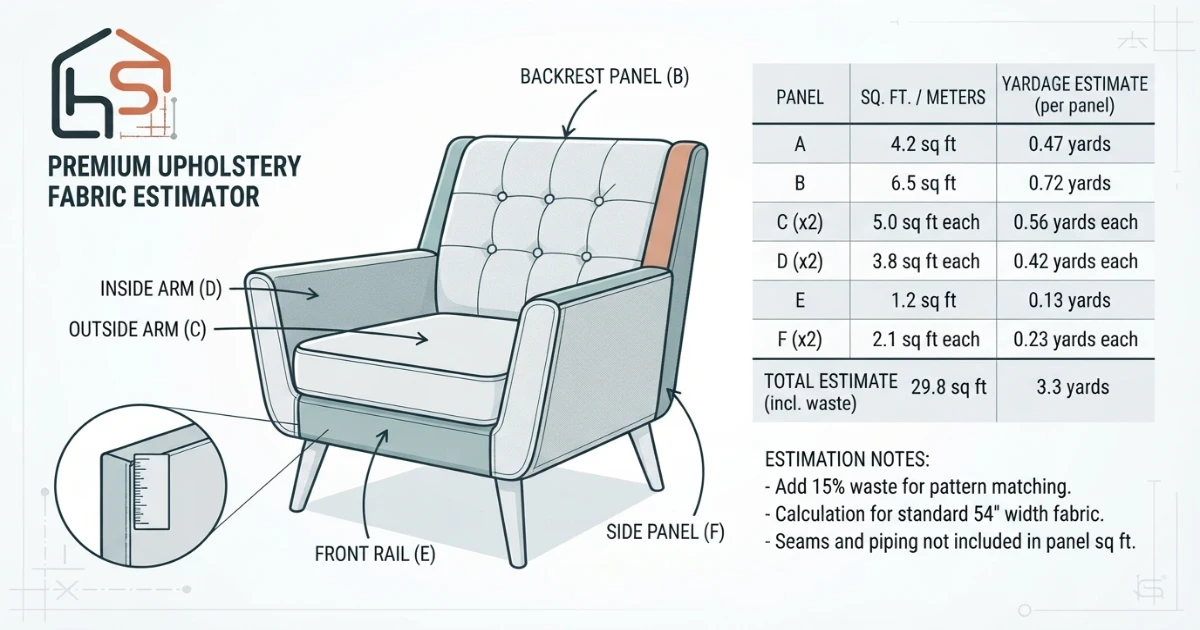
Identify the panels
Arms, back, seat deck, inside back, outside back and skirt are each separate fabric panels that add up to the total yardage.
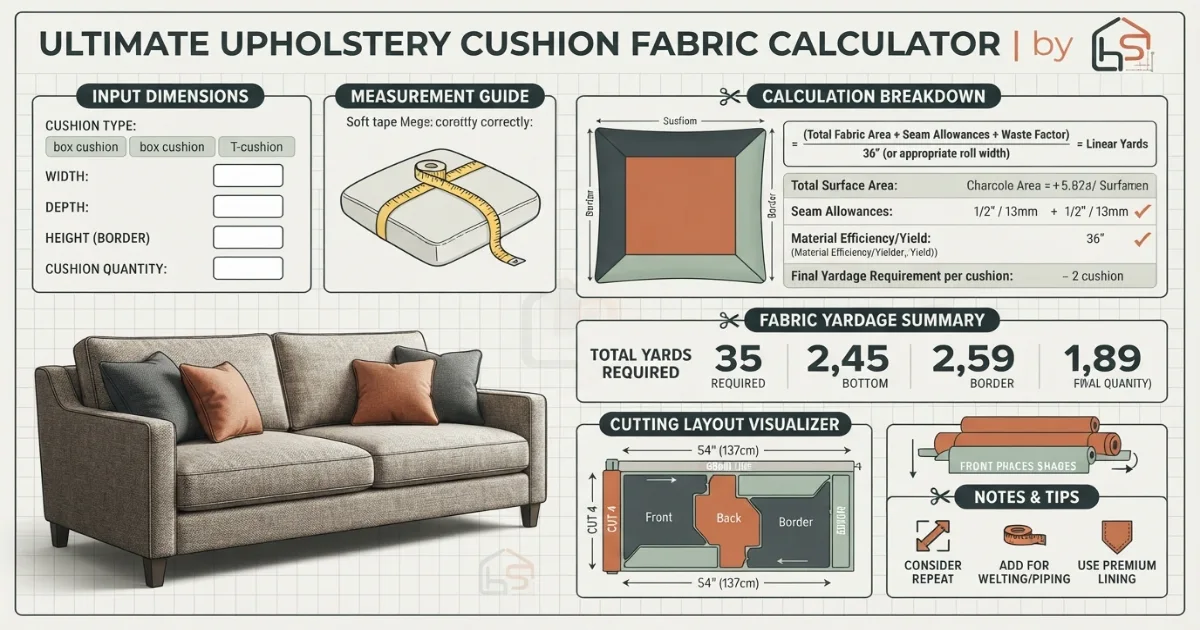
Count the cushions
Every loose seat and back cushion needs its own top, bottom and boxing strip — often the most overlooked part of a fabric estimate.
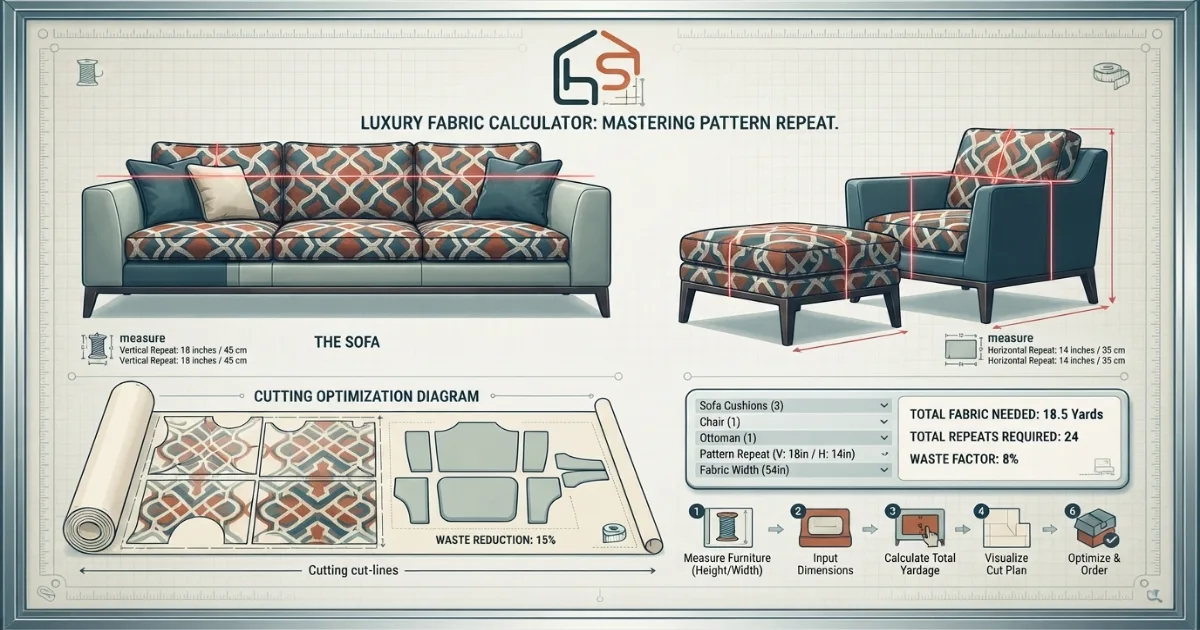
Match the pattern repeat
A large motif needs to land in the same spot on every cushion and panel, which is what drives extra yardage on patterned fabrics.
How to calculate upholstery fabric yardage — the complete guide.
The most common upholstery fabric mistake is estimating from a generic “yards per seat” rule and ignoring pattern repeat, cushion count and fabric width. Two three-seat sofas can need very different yardage depending on whether the fabric is solid or has a bold 27-inch floral repeat. Always confirm furniture type, cushion count, width and repeat together before ordering.
Reupholstering a chair or sofa is one of the most cost-effective ways to update a piece of furniture without replacing it, but the single biggest reason a project stalls midway is running short on fabric. Unlike paint or wallpaper, upholstery fabric usually cannot be perfectly color-matched between dye lots once a bolt is cut, and a mismatched panel on a visible cushion or arm is far more noticeable than a slightly different can of wall paint. Getting the yardage right the first time is worth the extra ten minutes of measuring and calculating before you order.
The good news is that upholstery fabric estimating follows a fairly predictable formula once you break it down into its parts: a base yardage tied to the furniture’s frame size and panel count, an add-on for every loose cushion, an adjustment for the actual width of the fabric bolt you’ve chosen, and a multiplier for any pattern that needs to be matched across seams. This guide walks through each of those parts individually so your final number reflects your actual piece of furniture rather than a generic rule of thumb.
Step 1: Identify the furniture type and its panel count
Every upholstered piece is really a collection of separate fabric panels sewn or stapled together: the inside back, outside back, inside arms, outside arms, seat deck, front rail, and often a boxed skirt around the base. A simple armless chair has far fewer panels than a wingback chair with rolled arms, and a sectional sofa has several times the panel count of a single loveseat. This is why furniture type is the starting point for any estimate — a dining chair seat panel alone might need barely a yard, while a large sectional’s full panel set can run past fifteen yards before cushions are even added.
Chairs with exposed wood frames, such as many dining chairs or slipper chairs with only a seat and sometimes a back panel upholstered, need dramatically less fabric than fully upholstered wingback or club chairs where the entire frame is covered. Sofas scale up from there: a loveseat has roughly the panel count of two chairs joined together, a standard three-seat sofa roughly three, and a large sectional or sofa with a chaise can effectively be treated as four or more seating units combined, each contributing its own arm, back and seat panels to the total.
Step 2: Count every loose cushion separately
Loose cushions are one of the most frequently underestimated parts of a fabric order because they are easy to think of as “included” in the furniture’s base yardage. In practice, each loose seat or back cushion needs its own top panel, bottom panel, and a boxing strip that wraps around the cushion’s edge, plus enough extra for the welt or piping cord that typically finishes the seam. Altogether, a single loose cushion commonly needs somewhere between one and one and a half yards of fabric on its own, even though the cushion itself might only be twenty inches square.
This adds up quickly on furniture with several loose back pillows in addition to loose seat cushions. A three-seat sofa with three loose seat cushions and three loose back cushions is effectively adding six cushion units to the base frame yardage, which can meaningfully change the total from what a quick furniture-type lookup alone would suggest. When in doubt, count cushions generously, since it’s far easier to have a small remnant left over than to discover a shortage after the frame fabric has already been cut and applied.
Step 3: Confirm the fabric’s actual width
Yardage estimates found online or printed in upholstery reference guides are almost always based on a standard 54 inch wide bolt, which is the most common width for mid-range decorator and designer fabrics sold through the trade. Many fabrics, however, are printed or woven on narrower 45 inch or even 36 inch bolts, particularly some imported prints, quilting-weight cottons repurposed for upholstery, and certain heritage or artisanal weaves. Using a narrower bolt means more linear yardage is needed to cover the same total square footage of furniture panels, since each cut length covers less width.
On the other end, some upholstery and drapery fabrics are woven on wider 60 inch bolts, and heavier home-dec textiles occasionally reach further still. Wider fabric can sometimes reduce total yardage needed, particularly on wide panels like sofa backs or sectional seat decks, since a single cut can span the full panel width without piecing two strips together. Always check the width printed on the fabric label or product page rather than assuming the standard 54 inches, since this single number can shift a final yardage estimate by fifteen to twenty percent in either direction.
Step 4: Measure or confirm the pattern repeat
A pattern repeat is the vertical distance between one point in a printed or woven design and the next point where that same motif appears again. Solid, textured and small tonal patterns effectively have no meaningful repeat and can be cut anywhere along the bolt without visual consequence. Traditional florals, stripes, and geometric prints often have repeats in the six to twelve inch range, which requires a modest amount of extra fabric so the pattern lines up consistently from one cushion to the next and across the seams where arm panels meet the back.
Large-scale decorator prints, oversized botanicals, and statement patterns can have repeats of eighteen, twenty-four, or even upward of thirty-six inches. On these fabrics, every cut panel needs to “waste” the portion of fabric between the bottom of one repeat and the start of the next just to keep the motif centered and aligned, which is why bold pattern fabric almost always needs meaningfully more yardage than the same furniture in a solid color. If you don’t already know the repeat size, it’s usually printed directly on the fabric’s spec sheet, selvage edge, or product listing, and can otherwise be measured by hand between two identical points in the printed design.
Step 5: Understand railroaded fabric as a special case
Most fabric is printed or woven so its pattern runs up the length of the bolt, meaning the “right way up” for the design is parallel to the long edge. Railroaded fabric flips this: the pattern runs sideways across the width of the bolt instead. This matters because upholsterers can cut a single wide panel, such as a sofa’s inside back or a sectional’s seat deck, directly across the railroaded bolt without needing to piece together multiple narrower strips to reach the full width, which piecing would otherwise require on a non-railroaded fabric of the same width.
For large furniture with wide, uninterrupted panels, railroaded fabric can meaningfully reduce total yardage compared to the same design printed the traditional way, since it avoids both the wasted partial-width strips and the extra fabric needed to match seams between pieced panels. Not every fabric is available railroaded, and directional patterns, such as fabric with an obvious “up” orientation like tree trunks or standing figures, generally cannot be railroaded without the design appearing sideways once applied, so this option mostly applies to abstract, geometric, or non-directional florals and textures.
Step 6: Apply a waste buffer for cutting, matching and future repairs
Even after the base yardage, cushion add-ons, width adjustment and pattern factor are all calculated, most experienced upholsterers still add a final buffer on top of the theoretical minimum. This buffer covers ordinary cutting waste around imperfect bolt edges, the practical difficulty of positioning every single cut perfectly against a pattern repeat, occasional fabric flaws that need to be cut around, and a small reserve kept aside for future repairs or a cushion cover replacement years down the road.
A ten percent buffer is often enough for solid fabric on a straightforward chair project, while patterned fabric, directional prints, or a first-time DIY reupholstery project benefit from closer to fifteen to twenty percent, since mismatched cuts are more likely when panels need to line up precisely and less experienced hands may waste more fabric working out cutting angles. Professional upholstery workrooms handling large-scale patterns on sectional sofas sometimes push the buffer even higher, particularly when a single flawed cut on an expensive designer fabric would otherwise mean ordering an entirely new bolt from a potentially different dye lot.
Bringing the six steps together
A complete fabric estimate multiplies through all six of these factors in sequence: start with the base yardage for your furniture’s panel count, add yardage for every loose cushion, adjust for your fabric’s actual width against the 54 inch standard, apply a percentage increase for pattern repeat size, apply a further adjustment if the fabric is railroaded, and finally add your chosen waste buffer on top of everything else. Skipping any single step, especially the cushion count or pattern repeat, is almost always the reason a seemingly careful estimate still comes up short once cutting begins.
COM fabric and working with a professional upholsterer
COM, short for “customer’s own material,” describes fabric that you source and purchase directly rather than choosing from an upholsterer’s in-house fabric book. When working with a professional workroom on a COM basis, the yardage figure this calculator produces is exactly the quantity you should order and have shipped to that upholsterer, since they will cut and apply the fabric using their own labor and pattern-matching expertise rather than needing to account for DIY cutting inefficiency in your total.
Most professional upholsterers will confirm a final yardage requirement once they’ve seen the actual piece of furniture in their shop, since frame-specific details like unusually deep cushions, an extra-wide sectional chaise, or a tightly tufted back can shift the number from a general estimate. Ordering slightly over the number a workroom confirms, rather than exactly to the yard, is generally the safer choice given how difficult it can be to source an identical dye lot later if a small shortage is discovered mid-project.
Common upholstery fabric estimating mistakes
- Forgetting loose cushions entirely — a “sofa yardage” figure found online is often just the frame, not the six or more cushion panels that also need coverage.
- Assuming every bolt is 54 inches wide — narrower or wider fabric can shift the true yardage by fifteen percent or more in either direction.
- Ignoring the pattern repeat size — a bold 27 inch floral repeat needs meaningfully more fabric than the same sofa in a solid color.
- Skipping the waste buffer — even a perfect calculation on paper needs 10 to 20 percent extra for real-world cutting and matching.
- Not keeping a repair remnant — a small leftover piece from the same dye lot makes future stains, rips or cushion covers far easier to fix.
Fabric buying rules that prevent a mid-project shortage.
A calculator gives the best starting numbers, but the final purchase still depends on your specific frame details and how the fabric will be cut. The rules below cover details a single furniture-type lookup can’t capture on its own.
For most reupholstery projects, start with the base yardage for your furniture type, add roughly 1 to 1.5 yards per loose cushion, adjust for your fabric’s actual width against the 54 inch standard, add 15 to 35 percent for a pattern repeat depending on its size, and finish with a 10 to 20 percent waste buffer. If the final number falls between two common bolt cuts, always round up rather than down.
Always round up to the next half yard
Most fabric retailers sell in half or quarter yard increments. Rounding your final number up avoids a frustrating return trip for a small remainder.
Buy all yardage from a single dye lot
Even the same fabric name and color code can shift slightly between production runs. Order the full amount at once so every panel comes from the same lot.
Keep a repair remnant
Set aside a half to full yard from your order specifically for future repairs, since matching an exact dye lot years later can be difficult or impossible.
Confirm width before ordering, not after
Fabric width can vary by supplier even within the same pattern family. Always confirm the actual bolt width on your specific product listing before finalizing yardage.
Finally, if you’re working with a professional upholsterer, share your calculated estimate with them before ordering fabric independently — most workrooms are glad to confirm or adjust the number once they’ve measured your specific piece, which can save you from over-ordering an expensive designer fabric.
Helpful room planning topics.
Reupholstering a chair or sofa is often just one piece of a larger room refresh. Once you know your fabric yardage, it helps to plan the surrounding elements at the same time — a rug that complements the new upholstery color, curtains that pick up an accent shade, and paint that ties the whole room together. Use these supporting pages from the HomeStyle Calculator homepage to plan the rest of the room.
Six things professional upholsterers always check before cutting fabric.
Inspect the whole bolt before cutting
Unroll the full length first to spot flaws, color shading, or width inconsistencies that could affect how panels are laid out.
Plan the pattern placement on the seat first
The seat cushion is the most visible panel. Center the pattern there first, then work outward to the arms and back so any imperfect matching happens in less visible spots.
Cut all panels before sewing any of them
Laying out every panel on the bolt first, before cutting begins, prevents running short partway through and discovering the remaining fabric doesn’t allow for proper pattern matching.
Check nap direction on velvets and chenille
Pile fabrics like velvet reflect light differently depending on which way the nap runs. Every panel needs to be cut with the nap running the same direction, or seams will show as visibly different shades.
Order extra welt cord fabric separately
Self-welt piping uses narrow bias-cut strips that are easy to underestimate. Many workrooms calculate welt fabric as its own separate small yardage rather than folding it into the main total.
Test durability before committing to a delicate fabric
High-traffic pieces like family sofas benefit from checking a fabric’s rub count and cleanability rating before ordering, since a beautiful but delicate fabric may need reupholstering again sooner than expected.
Upholstery fabric yardage questions — answered.
13 calculators for every room decision.
Every tool uses professional designer formulas. Free, instant, no sign-up — just enter your room or furniture details and get the exact answer.
Bookmark HomeStyle Calculator for every room in the house.
From a single dining chair to a full sectional reupholstery, our free tools give you the exact fabric yardage before you order.