Find the Perfect Duvet, Comforter or Quilt Size.
Enter your bed size, mattress height and desired drop, and get an instant recommended bedding size — plus the nearest standard retail size to shop for. No more a comforter that looks skimpy or a duvet that swallows the bed.
Recommended width = mattress width + 2× drop. Recommended length = mattress length + drop (plus ~15 in if tucking behind pillows). A queen mattress with standard drop needs roughly a 90×90 in duvet.
Standard bedding sizes by bed size.
These are common retail bedding dimensions assuming a standard 12 inch drop and no pillow tuck. Use the calculator above for a size matched to your exact mattress height and preferences.
| Bed Size | Mattress (in) | Duvet / Comforter (in) | Typical Drop | Notes |
|---|---|---|---|---|
| Twin | 39 × 75 | 68 × 86 | ~14 in sides | Kids / dorm rooms |
| Twin XL | 39 × 80 | 68 × 90 | ~14 in sides | Dorm-length beds |
| Full | 54 × 75 | 79 × 86 | ~12 in sides | Guest rooms |
| Queen | 60 × 80 | 90 × 92 | ~15 in sides | Most common bed size |
| King | 76 × 80 | 104 × 92 | ~14 in sides | Primary bedrooms |
| California King | 72 × 84 | 104 × 98 | ~16 in sides | Taller sleepers |
Four bedding types — and how sizing differs.
Each type follows the same core drop formula but is typically finished, filled, or used differently, which shapes the ideal drop and tuck choice.
Duvet Cover
A removable, washable cover for a duvet insert. Sized to match its insert closely so the insert fills the cover evenly without excess bunching or gaps at the corners.
Match insert size closelyComforter
A finished, filled piece meant to be seen and used without a separate cover. Often sized with a bit more drop and commonly paired with pillow tuck for a polished look.
Standard to long dropQuilt
Thinner and often more decorative than a comforter, frequently layered over a comforter or used alone in warmer climates. Usually suits a shorter, more tailored drop.
Short drop typicalBedspread
Designed to cover the entire bed, often reaching close to the floor on both sides and at the foot. Needs the longest drop of any bedding type, especially on taller beds.
Long drop, near-floorSee how bedding size changes by bed and drop.
These steps cover the essentials: choosing bed size, setting mattress height and drop, and deciding on pillow tuck before you shop.

Start with mattress size
Bed size and mattress height set the base dimensions before drop and tuck are added on top.
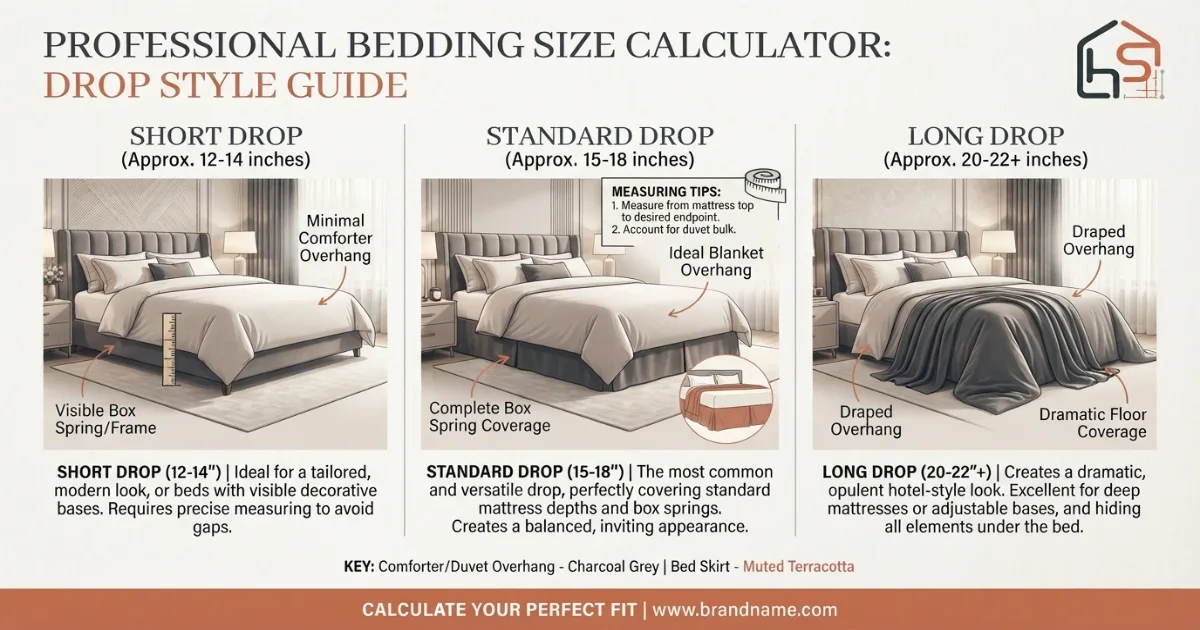
Choose a drop style
Drop style is the single biggest factor in how full or tailored the finished bed will look.
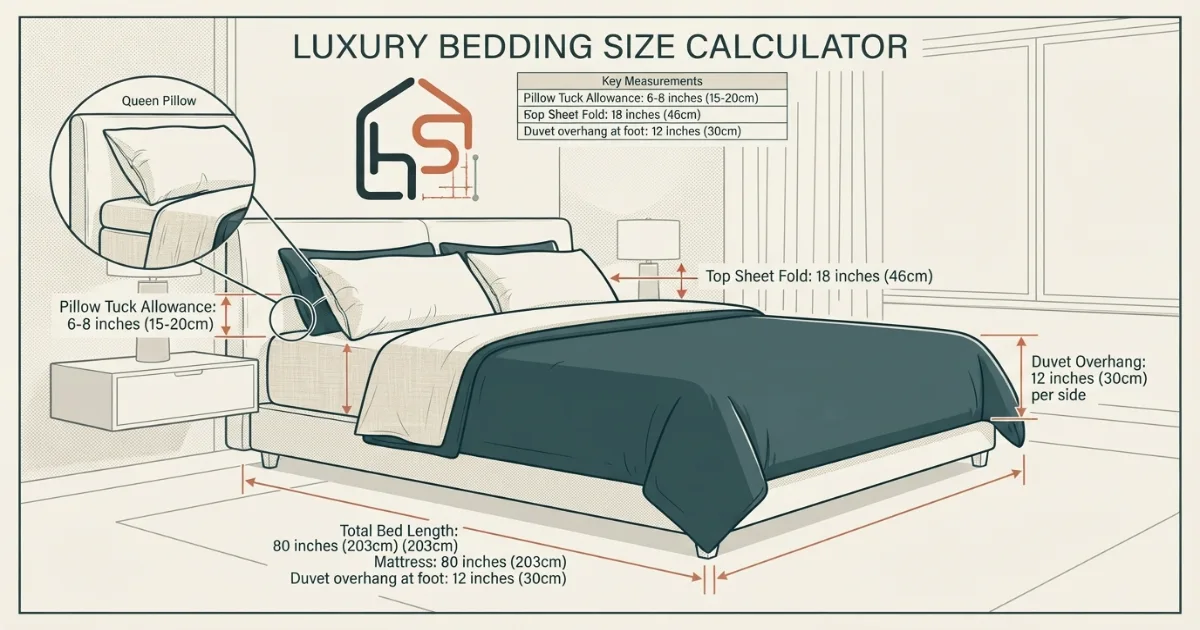
Decide on pillow tuck
Pillow tuck adds meaningful length for a tucked, hotel-style finish at the head of the bed.
How to choose bedding size — the complete guide.
The most common bedding mistake is buying by bed size label alone without accounting for mattress height or the drop style actually wanted. A queen-labeled duvet can still look skimpy on a tall 14 inch mattress, or oversized and bunched on a slim 8 inch one.
Bedding sizing looks deceptively simple because the labels — twin, full, queen, king — feel like a direct match to mattress size, but the actual fit depends on several details the label alone doesn’t capture: how tall the mattress is, how much overhang is wanted on each side, and whether the piece needs extra length to tuck behind pillows. Getting these details right is what separates a bed that looks intentionally styled from one where the bedding looks slightly too small or awkwardly oversized. This guide walks through the full sizing logic behind the calculator above.
Step 1: Start with the mattress dimensions
Every bed size corresponds to a standard mattress width and length: twin at 39 by 75 inches, full at 54 by 75 inches, queen at 60 by 80 inches, king at 76 by 80 inches, and California king at 72 by 84 inches, with twin XL matching twin’s width but extending to 80 inches long. These mattress dimensions are the starting point every bedding calculation builds from, regardless of bedding type.
Step 2: Measure or estimate mattress height
Mattress height, sometimes called depth or profile, commonly ranges from about 8 inches for a simpler, lower-profile mattress up to 14 inches or more for a thick pillow-top or hybrid mattress. A taller mattress uses up more of the bedding’s edge simply covering its own side before any fabric is left to hang past it, so taller mattresses generally benefit from a bit more drop to achieve the same visual overhang as a standard-height mattress would with less drop.
Step 3: Choose a drop style
A short drop of about 8 inches per side gives a tailored, modern look where the bedding sits closer to the mattress edge, often paired with a bed skirt or exposed bed frame. A standard drop of about 12 inches is the most common default, working well for most bedrooms without a bed skirt. A long drop of 18 inches or more gives a fuller, more traditional or luxurious look and can nearly reach the floor on some bed and mattress height combinations, sometimes eliminating the need for a separate bed skirt.
Step 4: Decide on pillow tuck
Pillow tuck is additional length added at the head of the bed, typically around 15 inches, so the comforter or bedspread can be pulled up and folded behind the pillows for a finished, hotel-style look rather than stopping right at the pillow line. This is optional and largely a matter of personal preference and how the bed is styled day to day; duvet covers are less commonly used with pillow tuck than standalone comforters or bedspreads.
Step 5: Calculate recommended width
Add the chosen drop, doubled to account for both sides of the bed, to the mattress width. A queen mattress at 60 inches wide with a 12 inch standard drop needs a recommended bedding width of about 84 inches at minimum, though many standard queen duvets run closer to 90 inches to allow a bit more generous coverage and account for typical mattress heights.
Step 6: Calculate recommended length
Add the chosen drop once, for the foot of the bed, to the mattress length, since the head end is generally covered by the pillows rather than needing full drop coverage on its own. If pillow tuck is included, add that allowance, typically 15 inches, on top of the foot-drop-adjusted length as well, since it affects head-end coverage specifically.
Step 7: Compare against standard retail sizes
Once a custom recommended size is calculated, compare it against the nearest standard retail bedding size, since most bedding is sold in a handful of fixed sizes rather than fully custom dimensions. If the calculated size falls between two standard sizes, sizing up generally gives a safer, more generous result than sizing down, particularly for a taller mattress or a fuller drop preference.
Step 8: Match duvet covers to their insert closely
A duvet cover should closely match the dimensions of the duvet insert it will hold, since a cover significantly larger than its insert leaves the insert bunching and shifting inside, while a cover smaller than its insert won’t zip or button closed properly. When buying a cover and insert separately, from different brands or product lines, double check both listed dimensions rather than assuming the labeled bed size guarantees a matching fit.
Step 9: Consider layering multiple bedding pieces
Many beds layer a duvet or comforter with a lighter quilt or coverlet on top, sometimes folded at the foot of the bed rather than covering the full length. When layering, the top piece is often sized slightly smaller than the base layer intentionally, so a portion of the layer underneath remains visible, which is a deliberate style choice rather than a sizing mistake.
Step 10: Account for bed frame and box spring height for bedspreads
A true bedspread, designed to reach the floor, needs its drop calculated against the combined height of the mattress, box spring or foundation, and bed frame, not the mattress height alone. On a bed with a tall platform frame or a boxspring adding significant height, a bedspread drop calculated only from mattress height will fall noticeably short of the floor.
Bedding fill types and how they affect drape
- Down and down-alternative fill — drapes softly and compresses easily, generally needing the drop dimensions calculated here to achieve the intended overhang once the fill settles.
- Cotton or wool batting quilts — hold their shape with less drape than down, often looking proportionate with a slightly shorter drop than a down comforter of the same labeled size.
- Woven or knit bedspreads — typically the least compressible option, holding a crisp, structured drape that reads accurately to its stated dimensions without much settling over time.
Bedding buying rules that prevent a mismatched bed.
A calculator gives the best starting numbers, but the final purchase still depends on mattress height, drop preference and how pieces layer together. The rules below cover the details worth checking even after settling on a size from the calculator above.
Add your chosen drop, doubled, to mattress width, and add drop once, plus pillow tuck if wanted, to mattress length. When a calculated size falls between two standard retail sizes, size up rather than down.
Never buy by bed size label alone
Mattress height and desired drop both change the ideal bedding size beyond what a simple bed-size label captures.
Match duvet covers to inserts closely
Confirm both listed dimensions when buying a cover and insert separately, rather than assuming a matching bed-size label guarantees a proper fit.
Size bedspreads to total bed height
A true floor-length bedspread needs its drop calculated against mattress, box spring and frame height combined, not mattress height alone.
When between sizes, size up
A slightly larger bedding size is easier to live with than one that comes up short on drop or pillow coverage.
Helpful room planning topics.
Bedding rarely stands alone in a bedroom’s design. Once you know your size, it helps to plan the surrounding elements at the same time — bed frame and mattress size, rug placement beneath the bed, and wall color balanced against the bedding tone. Use these supporting pages from the HomeStyle Calculator homepage to plan the rest of the room.
Six things bedding stylists always check before buying.
Measure your actual mattress, not the label
Mattress height varies by brand even within the same labeled bed size. Measure the real mattress rather than assuming a standard depth.
Wash new bedding before first use
Many natural fibers shrink slightly on the first wash. Pre-washing avoids a surprise fit change right after unboxing.
Use duvet ties or corner loops
Internal corner ties keep a duvet insert from shifting or bunching inside its cover, preserving even drape on all sides.
Check fill weight for the season
A heavier fill weight suits colder climates and winter use, while a lighter fill or all-season option suits warmer rooms year-round.
Layer light-to-heavy front to back
When layering a quilt over a comforter, keep the lighter piece on top and slightly smaller so both layers remain visible and proportionate.
Order a bed skirt separately if needed
A short-drop duvet or comforter often pairs with a separate bed skirt to visually finish the space between the mattress and the floor.
Bedding sizing questions — answered.
More calculators for every room decision.
Every tool uses professional designer formulas. Free, instant, no sign-up — just enter your room and get the exact answer.
Bookmark HomeStyle Calculator for every room in the house.
From a cozy twin bed to a primary suite Cal King, our free tools give you the exact bedding size before you buy.