Know the real cost before you buy a single roll.
Enter your wall dimensions, roll size, pattern repeat and price per roll, and get an instant roll count and total cost — including the waste allowance a pattern repeat actually eats up. No more guessing and no more coming up one roll short mid-install.
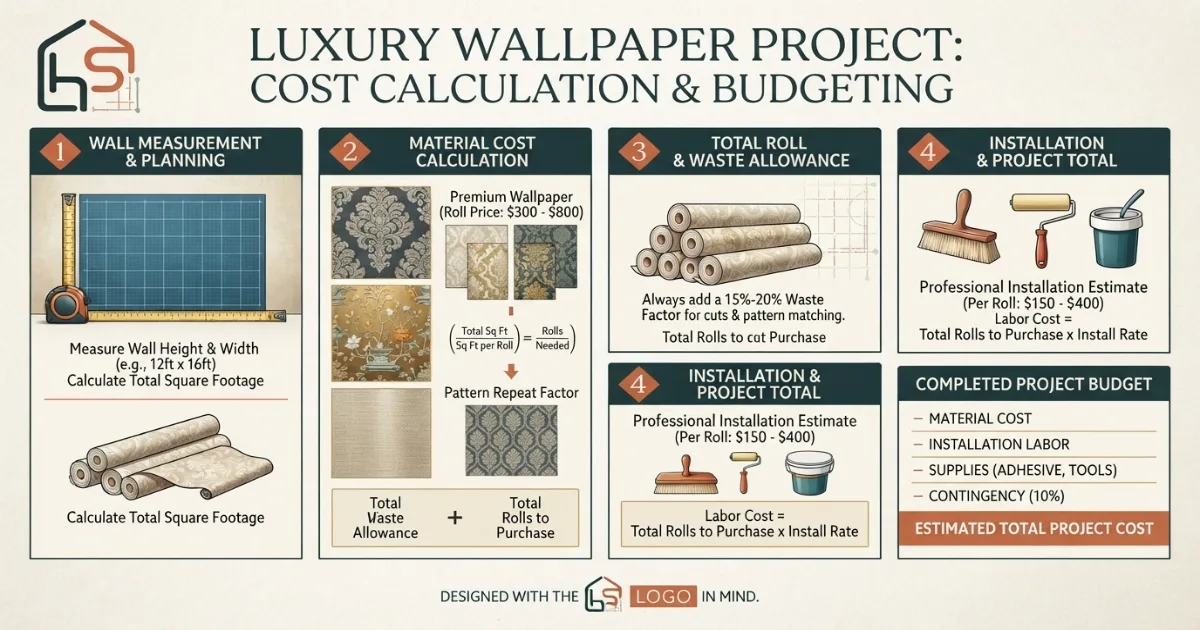
Multiply wall width by wall height for total square footage, add 10 to 25 percent for pattern waste depending on repeat size, then divide by a roll’s usable coverage — typically 25 to 30 square feet after trimming — to get the roll count.
Typical roll counts and cost by room size.
These estimates assume a standard 20.5-inch by 33-foot roll and a straight-match pattern. Use the calculator above for a cost matched to your exact walls and wallpaper.
| Room / Wall | Wall Area | Rolls Needed | Waste Allowance | Notes |
|---|---|---|---|---|
| Accent wall (1 wall) | ~90 sq ft | 2–3 rolls | 10–15% | Least pattern matching needed |
| Small bedroom (4 walls) | ~280 sq ft | 6–8 rolls | 15% | Add extra for closet returns |
| Full living room | ~400 sq ft | 9–12 rolls | 15–20% | More corners, more waste |
| Powder room / half bath | ~120 sq ft | 3–4 rolls | 15% | Buy a full extra roll regardless |
| Nursery (bold repeat) | ~250 sq ft | 7–9 rolls | 20–25% | Large repeats waste more per strip |
| Large open room | ~600+ sq ft | 14–18 rolls | 15–20% | Order in one dye lot |
Four pattern types — and how each changes your cost.
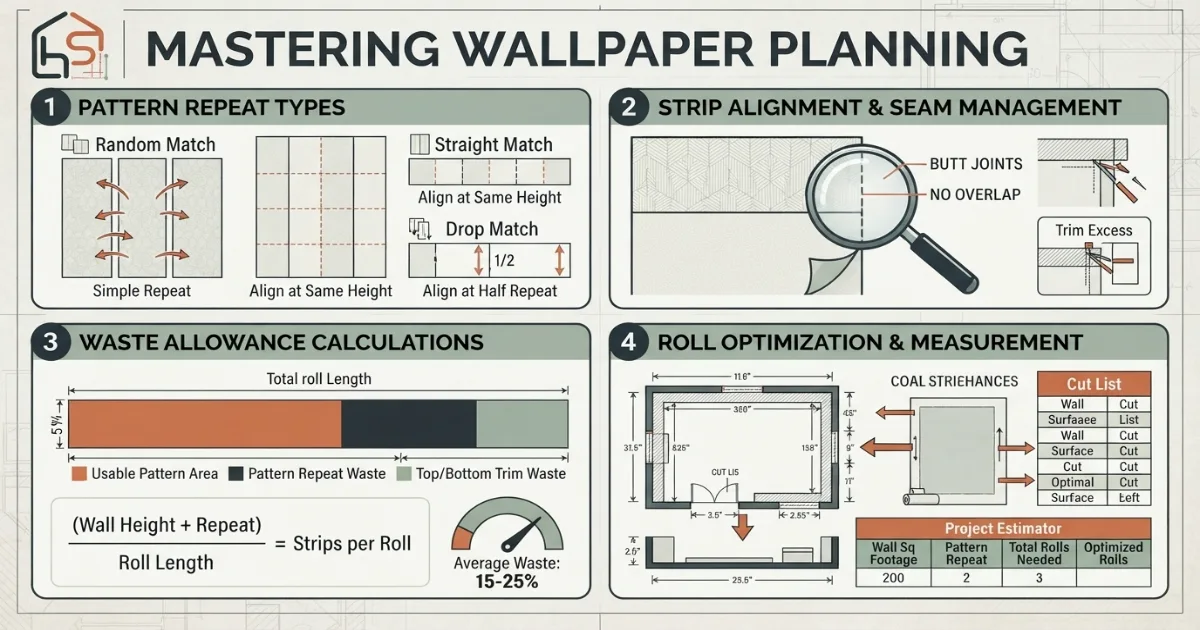
The bigger a wallpaper’s pattern repeat, the more material gets trimmed off between usable strips. Here is what each repeat type means and the waste allowance it typically needs.
No Repeat
A plain texture, solid color, or a random non-repeating design that lines up strip to strip with almost no trimming or matching required.
Waste: 10%Straight Match
The design repeats at the same height across every strip, so pattern elements line up horizontally straight across the wall.
Waste: 15%Drop Match
Alternating strips shift the pattern vertically so the design steps diagonally across the wall, needing more trimmed length per strip.
Waste: 20%Large-Scale Repeat
A bold, oversized motif with a repeat over 20 inches tall, which wastes the most material lining up each large design element.
Waste: 25%See how wall size and pattern repeat change your total.
These steps cover the essentials: measuring the walls, applying the right waste allowance for the pattern, and confirming the roll count before you order.
Measure the walls
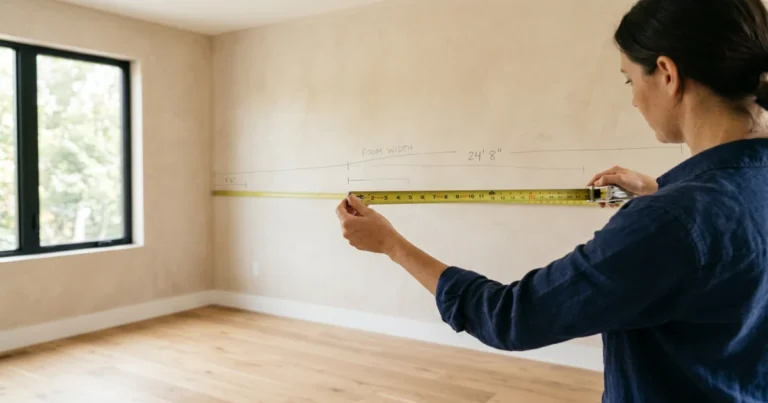
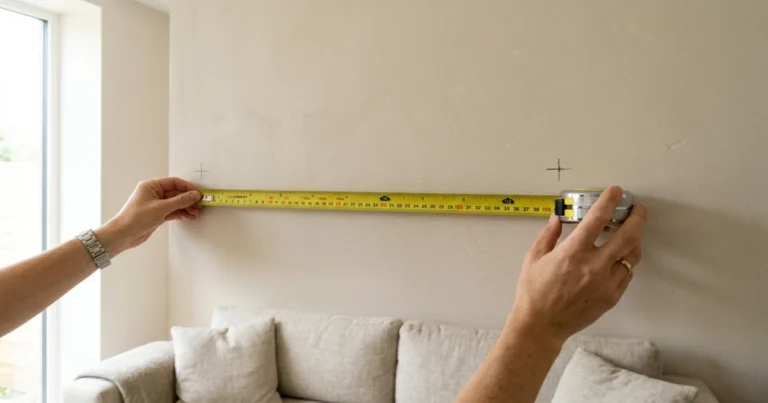
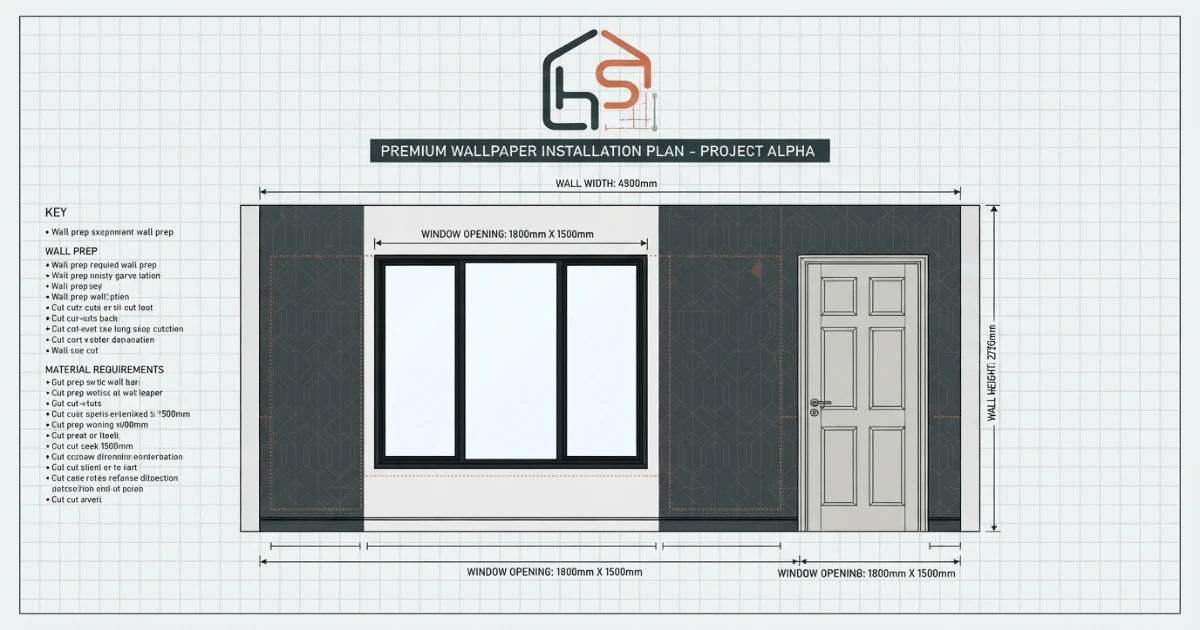
Add up the width of every wall to be papered and note the ceiling height and any large openings.
Apply the right waste allowance
Small or no-repeat patterns waste the least material, while large-scale and drop-match designs need more.
Confirm the roll count
Round up to a full roll and add one buffer roll so a dye-lot mismatch never derails the install.
How to calculate wallpaper cost — the complete guide.
The most common wallpaper budgeting mistake is ordering rolls based on raw square footage alone, without accounting for pattern repeat waste. A roll’s printed square footage and its actually usable square footage after trimming for pattern alignment can differ by 15 to 25 percent, which is exactly the gap that leaves people short mid-project and forced to reorder from a different dye lot.
Step 1: Measure every wall that will be papered
Start by measuring the width of each individual wall in the room, then add those widths together to get the total linear footage of wall you’re covering. Measure the wall height separately, from baseboard to ceiling or to the top of any crown molding, since this determines how many strips fit down a single roll’s length. Note any sloped ceilings, alcoves, or chimney breasts separately, since these irregular sections often need extra trimming and shouldn’t be averaged into a flat rectangular estimate.
Step 2: Decide whether to subtract doors and windows
For a small or standard-sized door and window, most installers skip subtracting the opening entirely, since the material saved is usually offset by the waste created trimming pattern around the opening’s edges. For unusually large openings, such as a sliding glass door, a bay window, or a full wall of windows, subtract that specific area from the total, since the material savings there are large enough to matter and won’t be absorbed by ordinary waste.
Step 3: Understand what a roll actually covers
A standard single roll of wallpaper is about 20.5 inches wide and 33 feet long, which works out to roughly 56 square feet of printed material. However, the usable coverage after trimming the top and bottom of each strip to fit the wall height, and after cutting away any pattern-matching waste, is typically closer to 25 to 30 square feet per roll. Always calculate cost from this usable coverage figure, not the roll’s raw printed square footage, or the estimate will run short.
Step 4: Identify the wallpaper’s pattern repeat type
Check the product listing or sample for the pattern repeat measurement, usually given in inches, and for whether it’s labeled straight match or drop match. A repeat under about 7 inches is considered small and wastes relatively little material strip to strip. A repeat between 7 and 20 inches is a medium repeat and needs a more noticeable waste allowance. A repeat over 20 inches, common in bold botanical or oversized geometric prints, is a large-scale repeat and needs the highest waste allowance of all.
Step 5: Apply the right waste percentage for that pattern
As a general guideline, budget 10 percent extra for a no-repeat or solid-texture wallpaper, 15 percent for a small to medium straight-match repeat, 20 percent for a drop-match pattern, and 20 to 25 percent for a large-scale repeat regardless of match type. This waste allowance gets added on top of the net wall area before dividing by a roll’s usable coverage, not applied after the roll count is already calculated.
Step 6: Calculate the total square footage needed
Multiply the total wall width by the wall height to get the base square footage, subtract any large openings identified in step 2, then multiply the result by one plus the waste percentage from step 5. This final number is the total usable square footage of wallpaper the project actually requires, before it gets converted into a roll count.
Step 7: Convert total square footage into a roll count
Divide the total square footage needed by the roll’s usable coverage figure from step 3, and always round up to the next whole roll, since a wallpaper supplier won’t sell a partial roll and a shortfall mid-project risks a dye-lot mismatch on a reorder. Most professional installers also recommend keeping one full extra roll on hand after the project is finished, specifically for future repairs if a section gets damaged.
Step 8: Understand single rolls versus double rolls
Many wallpaper brands price and package their product as a double roll, which is one continuous unit equal to two single rolls, or roughly 56 square feet doubled to about 112 square feet. Even when buying by the double roll, calculate the project’s needs in single-roll-equivalent square footage first, then convert to the number of double rolls needed at the end, since mixing up the two units is one of the most common overordering and underordering mistakes.
Step 9: Price out material cost per roll
Wallpaper price per roll varies enormously by material and brand, from roughly $25 to $50 per roll for basic vinyl-coated options, $50 to $100 for designer non-woven wallpapers, and well over $150 per roll for grasscloth, silk, or hand-printed papers. Multiply the roll count from step 7 by the price per roll to get the total material cost, before adding any labor.
Step 10: Factor in professional installation labor
If hiring a professional installer rather than doing it yourself, budget an additional $2 to $6 per square foot for standard vinyl or non-woven wallpaper, and $6 to $12 per square foot for grasscloth, murals, or complex pattern-matched installs. Labor pricing is typically quoted per square foot of wall, not per roll, so use the net wall area from step 6 before the waste multiplier when estimating labor separately from material.
Step 11: Budget extra for an accent wall versus a full room
A single accent wall generally needs a lower waste allowance than a full room, since there are fewer corners to turn and less pattern alignment required across adjoining walls. A full room, by contrast, needs pattern to carry correctly around every corner, which typically adds a few extra percentage points of waste compared to papering just one wall in isolation.
Step 12: Confirm the dye lot before ordering everything
Wallpaper rolls are printed in batches called dye lots, and color can vary subtly from one dye lot to the next even with the identical product code. Always confirm every roll for a single project comes from the same dye lot, and order any buffer or future-repair rolls at the same time as the initial order, since finding a matching dye lot months or years later is often impossible.
Step 13: Recheck measurements for irregular walls
Sloped ceilings, stairwells, and rooms with unusual angles need to be measured in individual sections rather than as one average rectangle, since a flat width-times-height calculation will misrepresent the actual square footage in these spaces. Break the space into simple rectangles and triangles, calculate each separately, and add a slightly higher waste allowance for any section requiring diagonal cuts.
Step 14: Decide between peel-and-stick and traditional pasted wallpaper
Peel-and-stick wallpaper is typically priced and sized similarly to traditional rolls but is easier to reposition during installation, which can reduce waste from misaligned strips for a first-time installer. Traditional pasted wallpaper, especially non-woven varieties, often comes in wider roll widths, which can reduce the total number of seams and slightly lower material waste on a large wall.
Step 15: Compare cost against paint before committing
Wallpaper, even at the lower end of the price range, typically costs more per square foot than paint once labor is included, so it’s worth comparing the total project cost against a paint calculator’s estimate if budget is the primary driver. Many homeowners land on wallpapering just one accent wall specifically because it captures the visual impact of a bold pattern at a fraction of the material and labor cost of papering an entire room.
Step 16: Get a final quote before purchasing everything
Once the roll count and material cost are calculated, request a final quote from the retailer or installer that confirms current pricing, any bulk discount for the exact quantity needed, and estimated delivery time, since wallpaper stock and dye lots can sell out. Confirming this before purchasing prevents a mid-project scramble if the exact roll count isn’t available when it’s time to reorder.
Rules that prevent running short mid-project.
A calculator gives the best starting numbers, but the final order still depends on dye lots, wall irregularities, and how the pattern needs to align at every corner. The rules below cover the details worth checking even after settling on a roll count.
Calculate net wall area, add 10 to 25 percent waste depending on the pattern repeat, divide by the roll’s usable coverage, round up to a full roll, and order one extra roll from the same dye lot for future repairs.
Waste allowance comes first
Apply the pattern repeat’s waste percentage to the wall area before dividing by roll coverage, not after the roll count is already calculated.
Round up, never down
Always round the final roll count up to the next whole roll, since suppliers don’t sell partial rolls and a shortfall risks a dye-lot mismatch.
Buy the buffer roll upfront
Order one extra roll from the same dye lot at the time of the initial purchase, specifically reserved for future repairs.
Separate material and labor
Price material by the roll and labor by the square foot of net wall area, rather than combining them into one blended per-roll estimate.
Helpful wall and room planning topics.
A wallpaper budget rarely comes together from roll count alone. Once you know the total cost, it helps to plan the surrounding elements at the same time — trim color, room layout, and how a paint job compares on price. Use these supporting pages from the HomeStyle Calculator homepage to plan the rest of the room.
Six things installers always check before ordering.
Confirm the repeat before you calculate
Check the pattern repeat measurement on the product page or sample swatch before running any waste calculation, since it drives the whole estimate.
Order everything from one dye lot
Buy the full roll count, including the buffer roll, in a single order to guarantee every roll matches in color and shading.
Measure height at the tallest point
Use the tallest measurement on a sloped or vaulted wall so no strip comes up short partway through installation.
Don’t skip the buffer roll
A single damaged strip years later is far more expensive to fix without a matching leftover roll than the small upfront cost of buying one extra.
Get labor quoted separately
Ask an installer to quote labor per square foot of net wall area, so it’s easy to compare against a different wallpaper’s material cost.
Compare against an accent wall first
If budget is tight, price out a single feature wall before committing to papering an entire room with the same design.
Wallpaper cost questions — answered.
More calculators for every room decision.
Every tool uses professional designer formulas. Free, instant, no sign-up — just enter your room and get the exact answer.
Bookmark HomeStyle Calculator for every room in the house.
From a single accent wall to a full-room wallpaper project, our free tools give you the exact roll count, waste allowance and total cost before you order.