Find out Exactly What Your Accent Wall Needs.
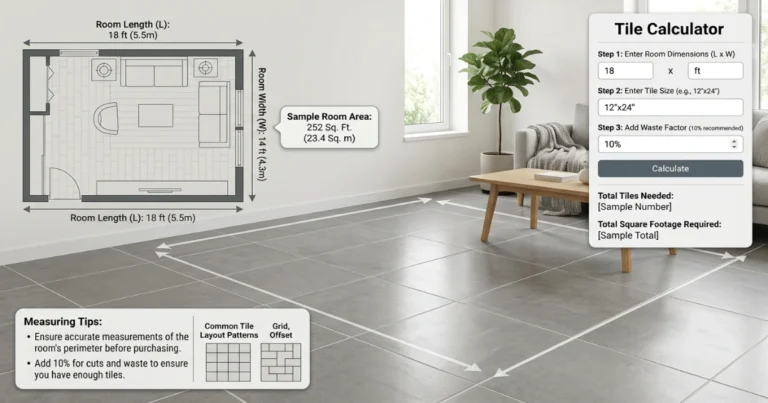
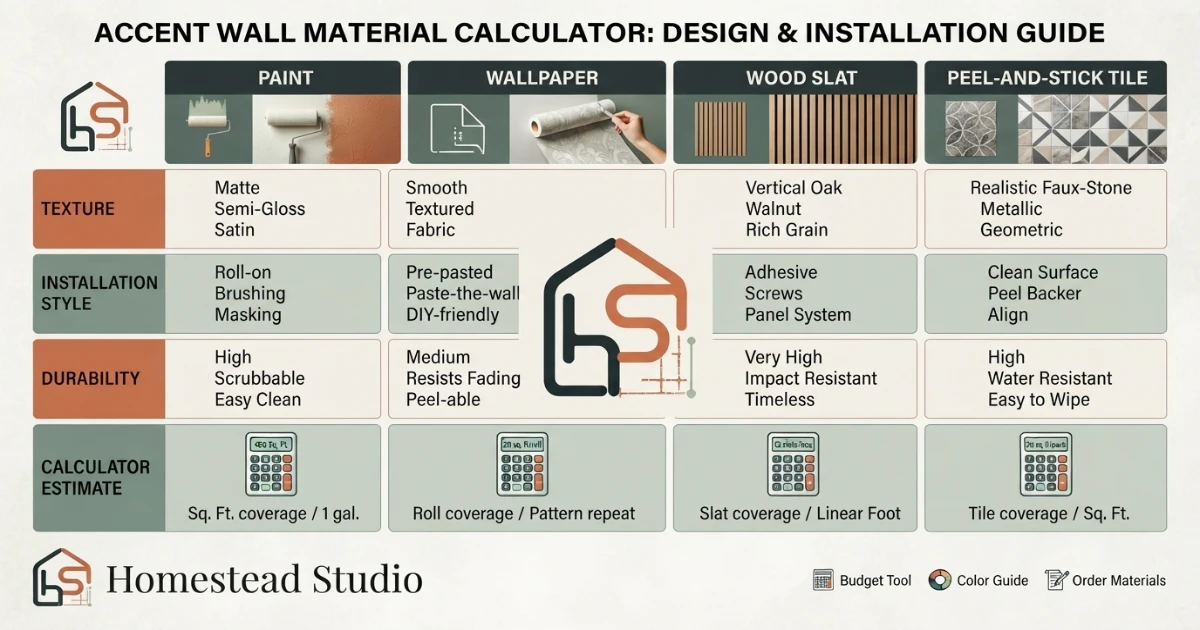
Enter your wall size, pick paint, wallpaper, wood slats or peel-and-stick tile, and get an instant material quantity and cost estimate — one calculator for every popular feature wall treatment. No more juggling four different tools for one wall.
Subtract doors and windows from wall area, then apply your material’s formula: gallons for paint, rolls for wallpaper, board count for wood slats, or tile count for peel-and-stick — each with its own waste or spacing allowance.
Typical material needed by wall size and treatment.
These estimates assume no doors or windows on the accent wall, standard defaults for each material, and moderate waste allowance. Use the calculator above for a total matched to your exact wall.
| Wall Size | Paint (2 coats) | Wallpaper | Wood Slat (3.5 in + 1 in gap) | Peel & Stick (12 in tile) |
|---|---|---|---|---|
| 8×9 ft | 1 gallon | 3 rolls | 18 boards | 60 tiles |
| 10×9 ft | 1 gallon | 3 rolls | 22 boards | 75 tiles |
| 12×9 ft | 1 gallon | 4 rolls | 27 boards | 90 tiles |
| 14×9 ft | 2 gallons | 5 rolls | 31 boards | 105 tiles |
| 16×10 ft | 2 gallons | 6 rolls | 36 boards | 135 tiles |
| 20×10 ft | 2 gallons | 7 rolls | 45 boards | 168 tiles |
Four accent wall treatments — and the formula behind each.
Every material follows its own logic for turning wall area into a shopping list. Here’s what each one is built for.
Paint
A bold or contrasting paint color is the fastest, most affordable way to create a focal wall, needing just gallons and coats to calculate.
Gallons = area × coats ÷ coverageWallpaper
Adds pattern and texture that paint can’t, at a moderate cost increase. Roll count depends on wall area, waste allowance and roll coverage.
Rolls = area × waste ÷ coverageWood Slat
A dimensional, textural look using evenly spaced vertical boards over a backing panel. Board count depends on width and spacing, not area.
Boards = width ÷ (board + gap)Peel & Stick
The most renter-friendly option, low-commitment and removable. Tile count depends on wall area, waste allowance and individual tile size.
Tiles = area × waste ÷ tile areaSee how material quantity changes by treatment.
These steps cover the essentials: measuring the wall, choosing a material, and applying the right waste or spacing allowance before you order.
Measure the wall
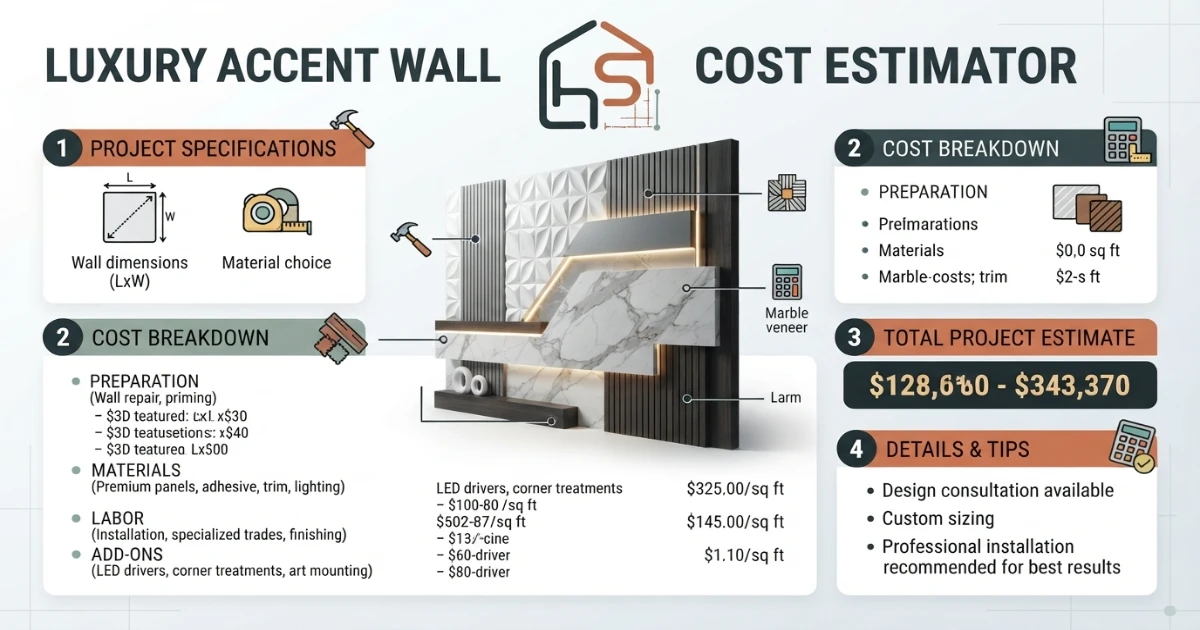
Start with wall width and height, then subtract doors and windows before choosing a material.
Choose a material
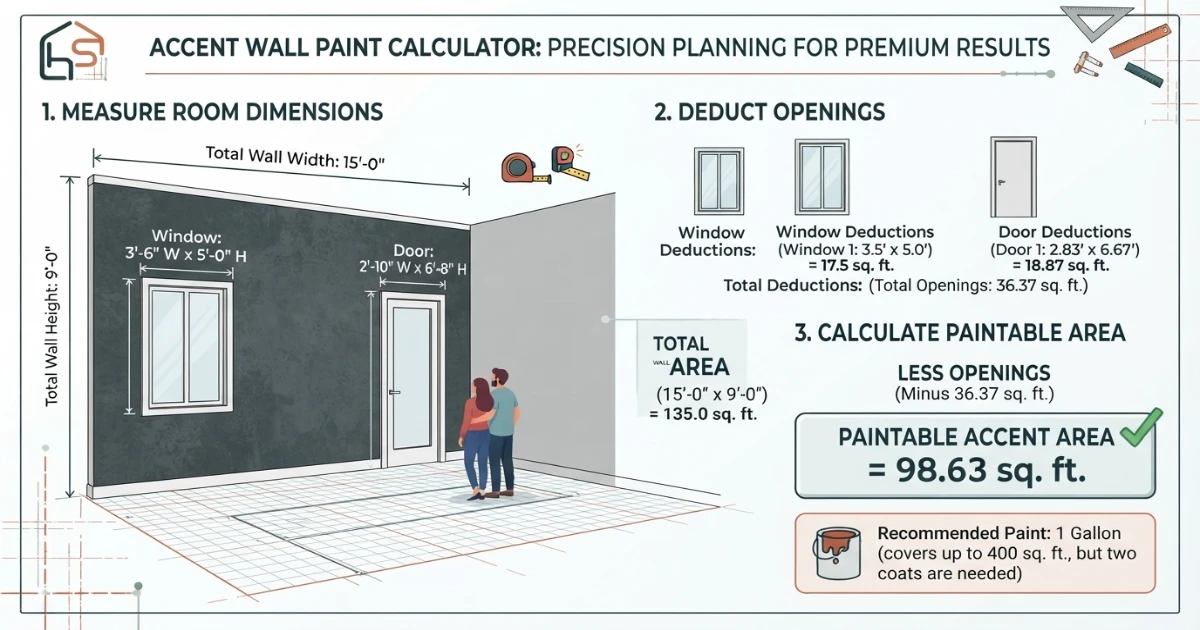
Each material follows its own formula, from simple gallons to board spacing math.
Get a total cost estimate
Comparing material and cost side by side makes it easy to weigh a bold paint color against a textured slat wall.
How to plan and calculate an accent wall — the complete guide.
The most common accent wall mistake is choosing the wrong wall before choosing the material. Even a perfectly calculated material quantity can’t rescue a focal treatment placed on a wall broken up by doors, closets, or awkward angles that weaken its visual impact.
An accent wall is one of the highest-impact, lowest-commitment ways to change a room’s character, since it touches only one surface rather than an entire space, but it still benefits from the same careful measurement and material planning as a full room project. Because four genuinely different materials — paint, wallpaper, wood slats and peel-and-stick tile — all compete for the same “accent wall” search, each with its own totally different material math, this guide walks through all four so you can compare not just the visual effect but the real cost and effort each one requires.
Step 1: Choose the right wall before choosing a material
The best accent wall is usually the one that naturally draws the eye first when entering the room: the wall behind a bed, the wall with a fireplace, or the wall directly opposite the main entry. Avoid a wall interrupted by multiple doors, a closet opening, or an awkward architectural angle, since those interruptions break up the material and weaken the wall’s visual impact regardless of how well the material itself is chosen.
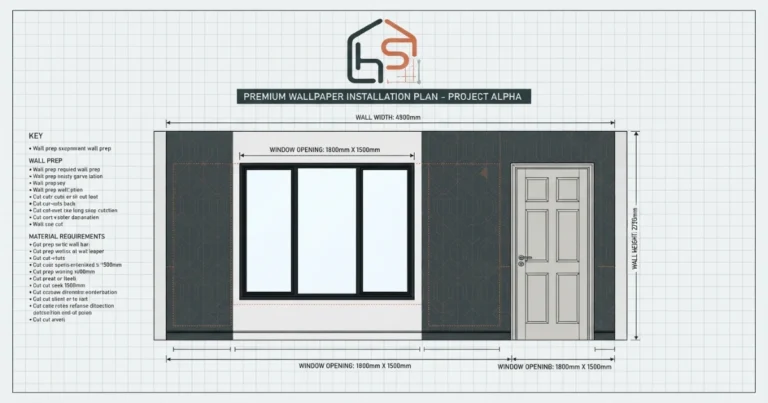
Step 2: Measure the wall and subtract openings
Measure the wall’s width and height, then subtract the area of any doors and windows before calculating material quantity. A standard interior door is roughly 21 square feet and a standard window is roughly 15 square feet, though a wall with more than one door or window may not be the strongest accent wall candidate in the first place, as noted in Step 1.
Step 3: Calculate paint quantity for a painted accent wall
Multiply the net wall area by the number of coats, typically two for a solid, even color, then divide by the paint’s coverage rate, commonly around 350 square feet per gallon per coat. Most single accent walls, even at two coats, need only a single gallon, making paint the lowest-cost and fastest accent wall option by a wide margin.
Step 4: Calculate wallpaper quantity for a papered accent wall
Add a waste allowance of 10 to 20 percent to the net wall area to account for pattern matching and trimming, then divide by the roll’s usable coverage after trimming, commonly around 30 square feet per roll for a standard single roll. Wallpaper with a large pattern repeat needs waste toward the higher end of that range, since more fabric is trimmed away to keep the pattern aligned between drops.
Step 5: Calculate board count for a wood slat accent wall
Divide the wall’s width by the combined width of one board plus your chosen spacing gap between boards, then add one board to account for the starting edge, similar to the stile-count logic used in wainscoting layouts. A tighter spacing gap, around half an inch, uses more boards and creates a denser, more textural look, while a wider gap of one to two inches uses fewer boards for a more open, modern spacing.
Step 6: Calculate tile count for a peel-and-stick accent wall
Add a waste allowance of 5 to 15 percent to the net wall area, then divide by the area of a single tile, based on its width and height in inches converted to square feet. Peel-and-stick tile comes in a range of sizes and shapes, from simple 12 inch squares to more elaborate hexagon or subway-style profiles, which can shift both the tile area calculation and the amount of cutting waste around the wall’s edges.
Step 7: Compare total cost across materials
Once quantity is known for each material, multiply by a realistic price per unit to compare total project cost side by side. Paint is consistently the least expensive option, often 50 to 150 dollars in materials for a single wall. Wallpaper typically runs 150 to 400 dollars depending on pattern and quality. Wood slat and peel-and-stick tile accent walls often run 300 to 900 dollars or more, depending on material quality, board species, and tile finish.
Step 8: Factor in labor and skill level honestly
Paint is the most forgiving material for a first-time DIY project, tolerant of minor technique issues that simply get covered by the next coat. Wallpaper requires more precision, particularly around pattern matching and smoothing out air bubbles. Wood slat walls need accurate measuring and level installation to avoid visibly uneven spacing. Peel-and-stick tile is generally beginner-friendly but benefits from a level first row, since any early misalignment compounds visibly across the rest of the wall.
Step 9: Consider durability and permanence
Paint and wallpaper are both effectively permanent until removed or painted over, with wallpaper requiring more effort to remove than paint requires to repaint. Peel-and-stick tile is explicitly designed to be removable, making it well suited to rental properties or a temporary styling choice. Wood slat walls sit in between, technically removable but typically installed with the expectation of staying for years, similar to a built-in trim feature.
Step 10: Plan lighting for the finished accent wall
A textured material like wood slats or dimensional tile benefits significantly from angled or raking light, which emphasizes the material’s depth and shadow lines, while a flat painted or papered wall reads well under more even, general lighting. If the accent wall is being planned alongside new lighting, consider a wall-wash or accent fixture positioned to highlight texture rather than flatten it.
Step 11: Decide on the wall’s relationship to surrounding walls
An accent wall’s surrounding walls typically stay a neutral or complementary color rather than competing for attention, since the entire point of a focal wall is contrast with its neighbors. When choosing a paint color, wallpaper pattern, or wood tone for the accent wall, hold a sample next to the existing surrounding wall color to confirm real contrast rather than two shades that read as nearly identical once actually installed.
Step 12: Order a small buffer beyond the exact calculated quantity
Add a small buffer beyond the bare calculated minimum for any material — an extra half gallon of paint, one extra wallpaper roll, a couple of extra boards or a handful of extra tiles — to cover cutting mistakes, pattern matching adjustments, or future repairs. This is a modest additional cost compared with a second trip or a mismatched batch ordered later, and it’s particularly worth doing for a bold or hard-to-rematch color or pattern.
Accent wall rules that prevent a second trip to the store.
A calculator gives the best starting numbers, but the final purchase still depends on wall choice, surrounding colors, and how the material will actually be installed. The rules below cover the details worth checking even after settling on a quantity from the calculator above.
Subtract doors and windows from wall area, apply your material’s specific formula with its recommended waste or spacing allowance, then add a small buffer beyond the bare calculated minimum before ordering.
Pick the wall before the material
A wall with multiple doors or windows rarely makes a strong accent wall, regardless of how well the chosen material is calculated.
Confirm real contrast with surrounding walls
Hold a sample of the accent material next to the existing wall color before committing, to confirm genuine visual contrast.
Match waste allowance to material
Wallpaper and tile need a real waste allowance for cutting and pattern matching; paint generally does not beyond rounding up to a full gallon.
Buy a small buffer beyond the minimum
An extra half gallon, roll, board or handful of tiles is cheap insurance against a mismatched reorder later.
Helpful room planning topics.
An accent wall rarely stands alone in a room’s design. Once you know your material and cost, it helps to plan the surrounding elements at the same time — furniture layout around the new focal point, lighting to highlight texture, and the room’s overall color palette. Use these supporting pages from the HomeStyle Calculator homepage to plan the rest of the room.
Six things designers always check before starting an accent wall.
Test the color or material in the actual room
Paint swatches and material samples read differently under a room’s actual lighting than under store lighting or a screen.
Stop the accent at a logical edge
End the treatment at a corner, ceiling line or another natural architectural break rather than an arbitrary point mid-wall.
Plan outlet and switch cutouts early
Mark outlet and switch locations before installing wallpaper, slats or tile, since cutting around them after the fact is far harder.
Start wood slats from the most visible point
Begin slat spacing from the wall’s most visible edge, letting any adjustment fall at a less noticeable corner or edge.
Prime dramatic color changes
A bold, saturated paint color often needs a tinted primer first to achieve full, even coverage in the stated coat count.
Keep leftover material for repairs
A saved paint can, spare roll, extra board or handful of tiles makes future touch-ups far easier to match than reordering later.
Accent wall questions — answered.
More calculators for every room decision.
Every tool uses professional designer formulas. Free, instant, no sign-up — just enter your room and get the exact answer.
Bookmark HomeStyle Calculator for every room in the house.
From a bold painted headboard wall to a full wood slat feature, our free tools give you the exact material and cost before you buy.