8×10 vs 9×12 Rug: Which Size Fits Your Room and Furniture?
Compare an 8×10 vs 9×12 rug by exact dimensions, floor coverage, room size, furniture placement and cost before choosing the smaller 80-square-foot option or the larger 108-square-foot rug.
Written by Rehana K · Originally published July 14, 2026 · Updated July 25, 2026.
Choose 8×10 for a medium room; choose 9×12 for fuller furniture coverage.
An 8×10 rug measures 96 × 120 inches and covers 80 square feet. A 9×12 rug measures 108 × 144 inches and covers 108 square feet.
Choose an 8×10 when the room is medium-sized, front-legs-on placement is acceptable or preserving more visible flooring matters. Choose a 9×12 when the room supports all major furniture legs, a larger dining table needs chair clearance or a king bed needs a more balanced border.
See the 8×10 vs 9×12 rug difference
The furniture footprint stays the same in both diagrams. The larger rug creates more side and foot coverage around the same seating group.
8×10 rug
Compact, efficient and easier to fit in medium rooms.
9×12 rug
More anchoring coverage and a wider furniture landing area.
Which rug fits your room and furniture?
Enter the clear room size and the furniture footprint that should sit on the rug. The checker compares 8×10 and 9×12 without assuming the larger size is always better.
8×10 vs 9×12 result
The recommendation checks both room fit and required furniture coverage.
Checking room and furniture dimensions…
Checking room and furniture dimensions…
8×10 vs 9×12 rug comparison table
Use this table to compare floor area, room fit, furniture coverage and typical room applications.
| Comparison point | 8×10 rug | 9×12 rug |
|---|---|---|
| Dimensions in feet | 8 × 10 ft | 9 × 12 ft |
| Dimensions in inches | 96 × 120 in | 108 × 144 in |
| Dimensions in centimeters | 243.8 × 304.8 cm | 274.3 × 365.8 cm |
| Floor area | 80 sq ft | 108 sq ft |
| Area difference | Baseline | 28 sq ft / 35% larger |
| Typical room scale | Medium | Large |
| Living-room placement | Front legs on | All legs on more often |
| Dining-table range | Often 4–6 seats | Often 6–8 seats |
| Bedroom use | Queen; compact king placement | King; generous queen placement |
| Visible floor border | More exposed flooring | Less exposed flooring |
| Weight and handling | Easier to move | Heavier and harder to rotate |
| Likely price | Usually lower | Usually higher |
Best when the furniture footprint fits within about 8 × 10 feet, front legs can sit on the rug and a larger visible floor border is preferred.
Best when a large sofa group, sectional, king bed or 6–8 seat dining table needs more support without crowding walls or doors.
8×10 vs 9×12 Rug: Complete Room-by-Room Comparison
The 8×10 vs 9×12 rug choice depends on the furniture footprint, visible floor border and whether the rug should support front legs or every major furniture leg.
An 8×10 may fit the room while remaining too small for the seating group. A 9×12 may support the furniture but sit too close to walls, doors or storage.
Use the Rug Size Calculator, review how big an 8×10 rug is, and compare it with the 9×12 rug dimensions guide before ordering.
The difference in one sentence
An 8×10 rug is the efficient medium-room choice; a 9×12 rug is the stronger anchoring choice when the room and furniture footprint can use 28 additional square feet.
8×10 vs 9×12 Rug Dimensions in Feet, Inches and Centimeters
An 8×10 rug measures 8 feet by 10 feet, or exactly 96 by 120 inches. In metric units, it is approximately 243.8 by 304.8 centimeters. Its floor area is 80 square feet.
A 9×12 rug measures 9 feet by 12 feet, or exactly 108 by 144 inches. In metric units, it is approximately 274.3 by 365.8 centimeters. Its floor area is 108 square feet.
The 9×12 is 12 inches wider and 24 inches longer. When centered beneath the same furniture group, that adds approximately 6 inches at each side and 12 inches at each end.
The area increase is 28 square feet, or 35 percent. This difference can determine whether chairs, side tables, sectional returns or rear sofa legs remain on the rug.
8×10 vs 9×12 Rug for a Living Room
In an 8×10 vs 9×12 rug living-room comparison, an 8×10 rug often works with the front legs of the sofa and chairs placed on the rug. This creates a connected seating group without covering most of the floor.
A 9×12 rug is better when the sofa, chairs and side tables should sit fully on the rug. It also works well when a sectional is broad, the chairs sit far apart or the room needs a stronger visual anchor.
Measure the outer furniture footprint rather than the coffee table. The coffee table is usually near the center and does not determine the required rug width. The sofa and chair legs create the real footprint.
For the 8×10 vs 9×12 rug decision in a living room, choose 8×10 when the furniture footprint is roughly 7.5×9.5 feet or smaller. Choose 9×12 when the footprint exceeds the 8×10 dimensions or the all-legs-on arrangement is important.
Small or narrow living room
An 8×10 rug is usually easier to fit in a narrow room because it preserves more exposed flooring beside walls, media units and walkways. A 9×12 may fit lengthwise but crowd the room width.
Do not rotate a rug simply to force it into a room. The longer dimension should normally follow the main room or seating direction. Rotating a 9×12 can create an overly wide rug that remains short in the direction of the sofa.
Large living room or open plan
A 9×12 rug can define the seating zone in a large or open-plan room. The larger footprint helps separate the living area from dining or circulation zones.
In a very large room, even 9×12 may be too small. Measure the full furniture group and use the calculator rather than treating 9×12 as the maximum standard solution.
8×10 vs 9×12 Rug Under a Dining Table
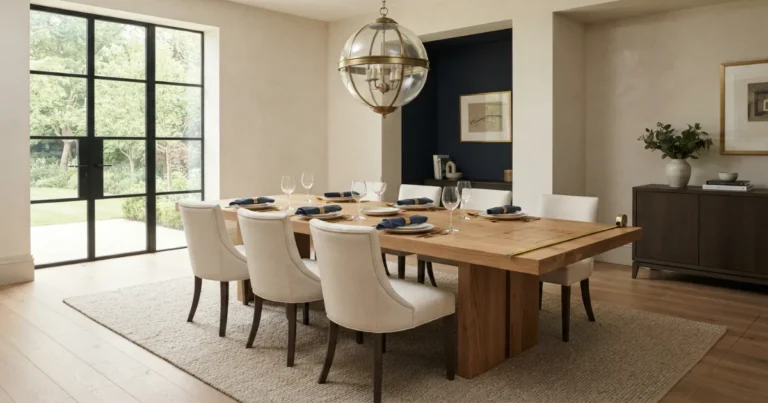
Dining-room sizing depends on chair movement. The rug should extend about 24–30 inches beyond every tabletop edge so the rear chair legs remain on the rug when diners pull back.
For an 8×10 vs 9×12 rug dining decision, an 8×10 rug commonly suits a four- to six-seat table. A 9×12 rug commonly suits a six- to eight-seat table, especially when the tabletop is around 72–96 inches long.
In an 8×10 vs 9×12 rug dining comparison, table length often decides. A 72-inch table on the 10-foot length of an 8×10 leaves 24 inches at each end. On the 12-foot length of a 9×12, the same table leaves 36 inches at each end.
Choose 8×10 when the table and chairs fit within the practical minimum. Choose 9×12 when end chairs, extension leaves or deep upholstered chairs need more room.
For specific six- and eight-chair tables, use the 6-Chair Table Rug Guide and 8-Chair Table Rug Guide.
8×10 vs 9×12 Rug Under a Queen or King Bed
For an 8×10 vs 9×12 rug bedroom decision, bed size and placement determine how much rug remains visible at the sides and foot. An 8×10 rug is commonly used beneath a queen bed and can work beneath a king bed in a lower placement. A 9×12 rug provides more balanced king-bed coverage and a generous queen-bed layout.
For a queen bed, 8×10 often provides a comfortable side landing area without filling the room. A 9×12 can include more of the nightstand zone or support fuller coverage in a large bedroom.
For a king bed, an 8×10 may look narrow, especially beneath a wide frame. A 9×12 gives an additional six inches on each side when centered because it is one foot wider.
In an 8×10 vs 9×12 rug bedroom decision, check door swing, dresser drawers and the visible floor border. A rug can fit beneath the bed but still be too close to storage furniture.
Compare exact bed layouts in the Queen Bed Rug Guide and King Bed Rug Guide.
What Room Size Works With an 8×10 or 9×12 Rug?
In an 8×10 vs 9×12 rug room-fit check, room dimensions do not automatically choose the rug, but they reveal how much floor remains visible. The examples below assume the rug is centered and aligned with the room.
| Clear room size | 8×10 floor border | 9×12 floor border | Likely decision |
|---|---|---|---|
| 10 × 12 ft | 12 in each side and end | 6 in sides, 0 in ends | 8×10 usually fits better |
| 11 × 13 ft | 18 in sides, 18 in ends | 12 in sides, 6 in ends | Either; furniture decides |
| 12 × 15 ft | 24 in sides, 30 in ends | 18 in sides, 18 in ends | 9×12 often looks more anchored |
| 14 × 17 ft | 36 in sides, 42 in ends | 30 in sides, 30 in ends | 9×12 or larger |
Furniture, doors and built-ins can reduce usable floor, so these examples are starting points rather than guarantees.
How much exposed floor should remain?
For an 8×10 vs 9×12 rug purchase, a visible floor border frames the area rug and prevents it from appearing wall-to-wall. There is no single residential border that works in every room. The furniture footprint and circulation are more important than perfect symmetry.
In a compact room, an 8×10 can preserve a healthier visual gap. In a large room, the same rug can look isolated because too much floor remains between the rug and the furniture group.
For the 8×10 vs 9×12 rug choice, compare the shortest floor border. If the 9×12 touches a wall, door or cabinet, it is too large for that orientation. If the 8×10 leaves major furniture legs unsupported, it may be too small.
Furniture placement differences
Front legs on the rug
In the 8×10 vs 9×12 rug comparison, an 8×10 rug often supports the front legs of a sofa and chairs while leaving the rear legs on the floor. This arrangement works well in medium rooms and reduces the required rug footprint.
All furniture legs on the rug
A 9×12 rug is more likely to support the complete sofa and chair footprint. This creates a stronger, unified seating zone and can work particularly well in open-plan rooms.
Floating rug beneath the coffee table
Neither size should be chosen only to float beneath the coffee table when the surrounding furniture sits far away. A disconnected rug can make the seating arrangement look smaller and less intentional.
8×10 vs 9×12 Rug Cost, Weight and Handling
In an 8×10 vs 9×12 rug price comparison, a 9×12 rug usually costs more because it contains 35% more material than an 8×10 of the same construction. Shipping, rug-pad cost and professional cleaning can also increase with size.
The larger rug is heavier and harder to rotate, lift or move beneath furniture. In a rental or frequently rearranged room, the easier handling of an 8×10 may have practical value.
Do not choose the smaller size only to reduce cost when the furniture clearly requires 9×12. An undersized rug may lead to a second purchase and make the original saving irrelevant.
Material and pile considerations
The 8×10 vs 9×12 rug size difference increases the amount of material that must be cleaned and maintained. Low- to medium-pile constructions are easier beneath dining chairs and doors. Washable rugs may have machine-size limitations at 9×12.
The Carpet and Rug Institute cleaning and maintenance guidance includes care considerations for area rugs, including vacuuming techniques for fringe. Check the manufacturer’s label because construction and fiber can change the recommended cleaning method.
Use a rug pad compatible with the floor and cut slightly smaller than the rug. The pad should not create a visible edge or interfere with door clearance.
Clear routes and accessibility-sensitive rooms
Residential rug sizing is not a substitute for an accessibility plan. A larger rug should not reduce a clear walking or mobility route. The U.S. Access Board guide to accessible routes explains clear-route principles for spaces covered by accessibility standards.
For a private home, use the same broad safety principle: choose the 8×10 vs 9×12 rug option that keeps transitions stable and preserves the actual route used by household members.
8×10 vs 9×12 rug for sectionals and large sofas
A sectional changes the decision because its footprint is usually wider and deeper than a standard sofa-and-chair group. Measure the complete outer dimensions of the sectional, including the chaise, corner return and any attached ottoman. Then decide whether only the front legs or the full sectional base should sit on the rug.
In an 8×10 vs 9×12 rug sectional comparison, an 8×10 can work when the chaise and front sofa legs sit on the rug while the rear legs remain on the floor. This placement is useful in a medium room where a 9×12 would approach a wall or block a walkway. Keep the coffee table fully on the rug and make sure the rug extends beyond both ends of the main sofa section.
A 9×12 is usually stronger when the sectional has a broad L-shape, the complete chaise should be supported or a pair of accent chairs sits opposite the sofa. The additional foot of width and two feet of length can connect furniture that would otherwise sit close to the edge of an 8×10.
Do not center the rug beneath the room while leaving it off-center beneath the sectional. Align the rug with the seating group first, then confirm that the resulting exposed floor still looks intentional from the doorway.
Pattern scale and visual weight
Size changes how a pattern appears. A large medallion may feel compressed on an 8×10 but proportionate on a 9×12. A small repeating pattern can feel busier as the rug covers more floor. Compare product photos that show the complete rug rather than assuming the pattern simply repeats without a border or central motif.
In the 8×10 vs 9×12 rug choice, a dark or high-contrast 9×12 can feel visually heavier than its measurements suggest. A light, low-contrast 9×12 may feel calmer and more open. Color does not change physical fit, but it can influence whether the larger size appears balanced in the room.
Check pattern placement beneath furniture. A central motif may disappear under a bed or dining table, while a border may be partly covered by a sofa. The correct size should support the furniture first, but the visible design should still look deliberate.
8×10 vs 9×12 rug shopping checklist
- Measure the clear room rather than the wall-to-wall dimensions shown on a floor plan.
- Measure the complete furniture footprint, including sectional chaises, pulled-back chairs and bed frames.
- Confirm whether the preferred placement is front legs on, all legs on or lower placement beneath a bed.
- Mark both sizes with painter’s tape and view them from the main doorway.
- Open doors, drawers and cabinets while the outlines remain on the floor.
- Check the product’s actual dimensions rather than relying only on the nominal 8×10 or 9×12 label.
- Include the rug-pad dimensions and thickness in the clearance check.
- Compare return shipping and handling costs, particularly for the heavier 9×12 size.
- Check whether the pattern, border and fringe are included in the listed measurements.
- Use the Rug Size Calculator when neither standard option cleanly fits the furniture and room.
When neither 8×10 nor 9×12 is right
Sometimes the furniture footprint falls between the two sizes or the room has an unusual proportion. A long, narrow living room may need a 7×10, 8×12 or custom-size rug. A very large seating group may need 10×14. A compact dining nook may work better without a rug than with an undersized option that catches chair legs.
The 8×10 vs 9×12 rug comparison should not force a choice when both options fail. Choose another standard size, use a custom rug or revise the furniture layout. The best result is the one that supports the intended use, preserves circulation and looks proportionate—not the one that happens to be the more common retail size.
Common 8×10 vs 9×12 rug mistakes
- Comparing only price: the smaller rug is not a saving when the furniture footprint requires the larger size.
- Ignoring the 35% area difference: the size jump is more substantial than one foot of width suggests.
- Measuring the coffee table only: outer sofa and chair legs determine the living-room footprint.
- Ignoring dining chairs: the rear legs need support when chairs are pulled back.
- Using room dimensions without clear-floor measurements: doors and storage reduce the usable area.
- Rotating the rug incorrectly: the longer dimension should usually follow the main furniture or room direction.
- Buying 9×12 because bigger sounds better: the larger rug can crowd walls and doors.
- Buying 8×10 because it is easier: it can make a large seating group look disconnected.
- Skipping the rug pad: the rug may shift or wear unevenly.
- Skipping the tape test: product photos cannot show the proportions of the real room.
How to Test an 8×10 vs 9×12 Rug Before Buying
For an accurate 8×10 vs 9×12 rug test, mark the 8×10 outline first with painter’s tape. Position the furniture as it will be used and check the relationship between every major leg and the tape.
Expand the outline by six inches on each side and twelve inches at each end to represent 9×12. This is the easiest way to see the exact dimensional difference without removing the first outline completely.
View both outlines from the main doorway, then test chair movement, cabinet doors, vents and the primary walking path. Photograph each outline for a side-by-side comparison.
Check the retailer’s listed product dimensions. A rug marketed as 8×10 or 9×12 may be slightly smaller than the nominal size, and fringe may not be included.
Final Decision: Should You Buy an 8×10 or 9×12 Rug?
Choose an 8×10 rug when the room is medium-sized, the furniture footprint fits inside 8×10 feet, front-legs-on placement is acceptable and preserving exposed flooring matters.
For the 8×10 vs 9×12 rug decision, choose a 9×12 rug when the seating group needs all-legs-on coverage, a dining table needs more chair clearance, a king bed needs balanced side exposure or the room feels visually underfilled by 8×10.
In the final 8×10 vs 9×12 rug decision, use the smallest rug that fully supports the intended furniture arrangement—not the smallest rug that can physically enter the room.
Get a measurement-based answer
Enter the room and furniture dimensions in the free Rug Size Calculator. Use this comparison to understand the tradeoffs, then use the calculator for the final recommendation.
Compare 8×10 and 9×12 rugs after measuring
Tape both footprints first, then compare actual dimensions, material, pile height, care instructions and return terms.
Washable 8×10 Area Rugs
Compare medium-room rugs for living rooms, queen bedrooms and compact dining arrangements.
- Confirm exact finished dimensions
- Review washing and drying requirements
- Compare backing, pile height and returns
Washable 9×12 Area Rugs
Compare larger rugs for full seating groups, king bedrooms and 6–8 seat dining tables.
- Check handling weight and delivery access
- Confirm machine-wash or professional-care limits
- Review actual width, length and fringe
Affiliate disclosure: As an Amazon Associate, HomeStyle Calculator may earn from qualifying purchases. Product sizes, prices and availability can change. Confirm the current listing before ordering.
8×10 vs 9×12 Rug FAQs
Direct answers about dimensions, inches, centimeters, room sizes, furniture placement and buying decisions.