Know exactly how much paint to buy — before you open a single can.
Enter your room dimensions, pick a surface type and number of coats, and get an instant gallon estimate — doors, windows, ceiling and trim all factored in, using the same formulas professional painters use.
Paint coverage: gallons needed by room size.
These estimates assume 8 ft ceilings, 2 coats, smooth primed walls, one door, and two windows. Use the calculator above for your exact room.
| Room Size | Wall Area | Gallons (2 coats) | With Ceiling | Buy |
|---|---|---|---|---|
| 10 × 10 ft | 320 sq ft | 1.6 gal | 2.1 gal | 2 gal |
| 10 × 12 ft | 352 sq ft | 1.8 gal | 2.4 gal | 3 gal |
| 12 × 12 ft | 384 sq ft | 1.9 gal | 2.6 gal | 3 gal |
| 12 × 14 ft | 416 sq ft | 2.1 gal | 2.9 gal | 3 gal |
| 14 × 16 ft | 480 sq ft | 2.4 gal | 3.3 gal | 4 gal |
| 16 × 20 ft | 576 sq ft | 2.9 gal | 4.1 gal | 5 gal |
| 20 × 20 ft | 640 sq ft | 3.2 gal | 4.6 gal | 5 gal |
| Open plan (500 sq ft) | ~700 sq ft | 3.5 gal | 5.3 gal | 6 gal |
Three surface conditions — and how each changes your paint quantity.
Wall surface texture affects coverage more than almost any other variable — often more than room size itself. A porous or heavily textured wall can soak up 30 to 50 percent more paint than a smooth, previously painted one, which is why the calculator above asks for surface type before giving a final number. Here is what each surface type means for your gallon count and how to recognise it in your own home.
Smooth / Primed
Standard painted drywall in good condition. Paint spreads evenly and requires the least product — roughly 350 to 400 square feet per gallon per coat.
Coverage: 350–400 sq ft/galTextured / Stucco
Orange-peel, knockdown or stucco finishes trap more paint in their grooves. Expect 20 to 35 percent lower coverage than a smooth wall.
Coverage: 250–300 sq ft/galNew / Unprimed Drywall
Bare drywall and joint compound are highly absorbent. Always apply a dedicated primer coat first, then count it separately from finish coats.
Coverage: 200–250 sq ft/galSee how paint quantities change by room.
These steps show the essentials: measuring wall area, applying two even coats, and buying the right amount before starting.
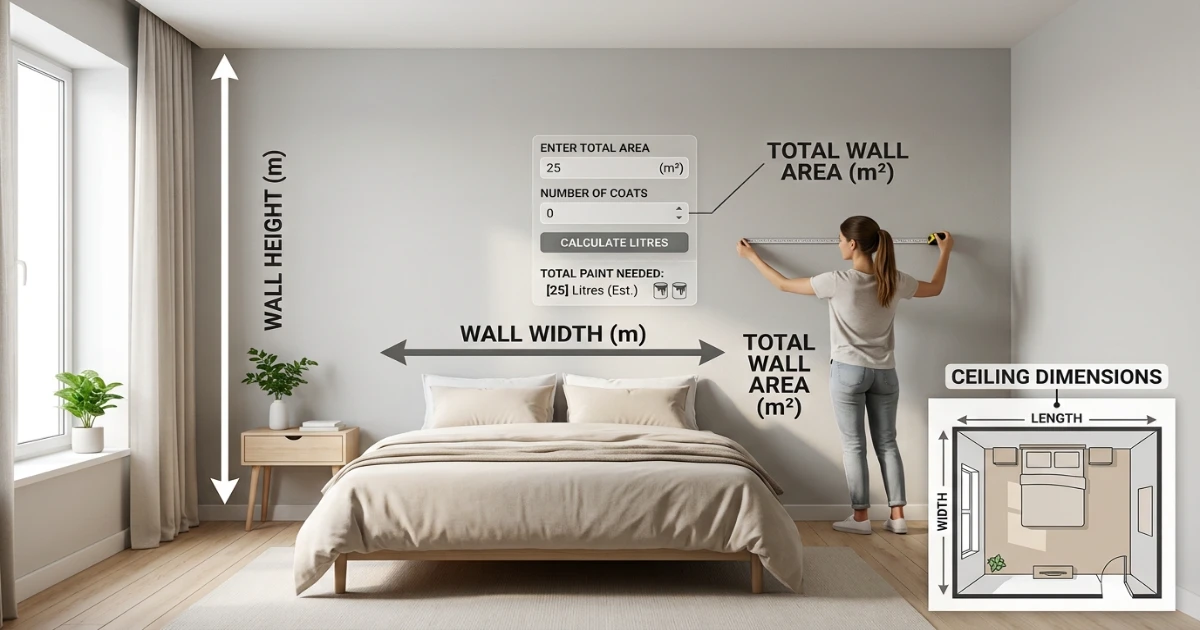
Measure the wall area
Start with room perimeter × ceiling height to get total wall surface.
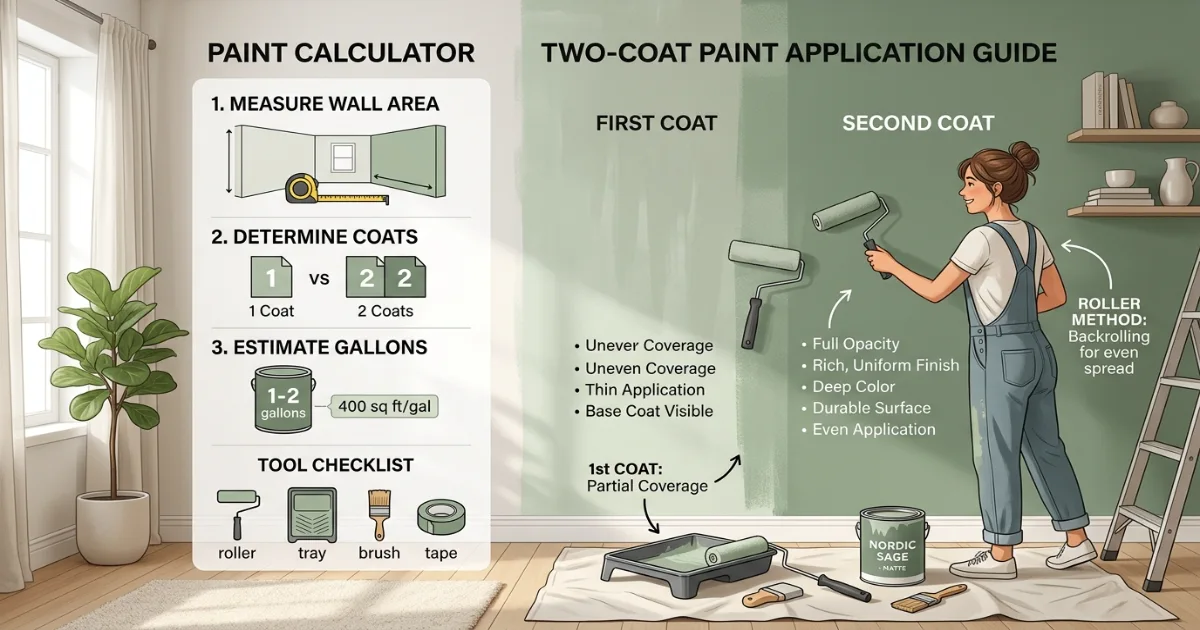
Two coats is standard
One coat rarely covers evenly. Two coats ensure a professional finish.
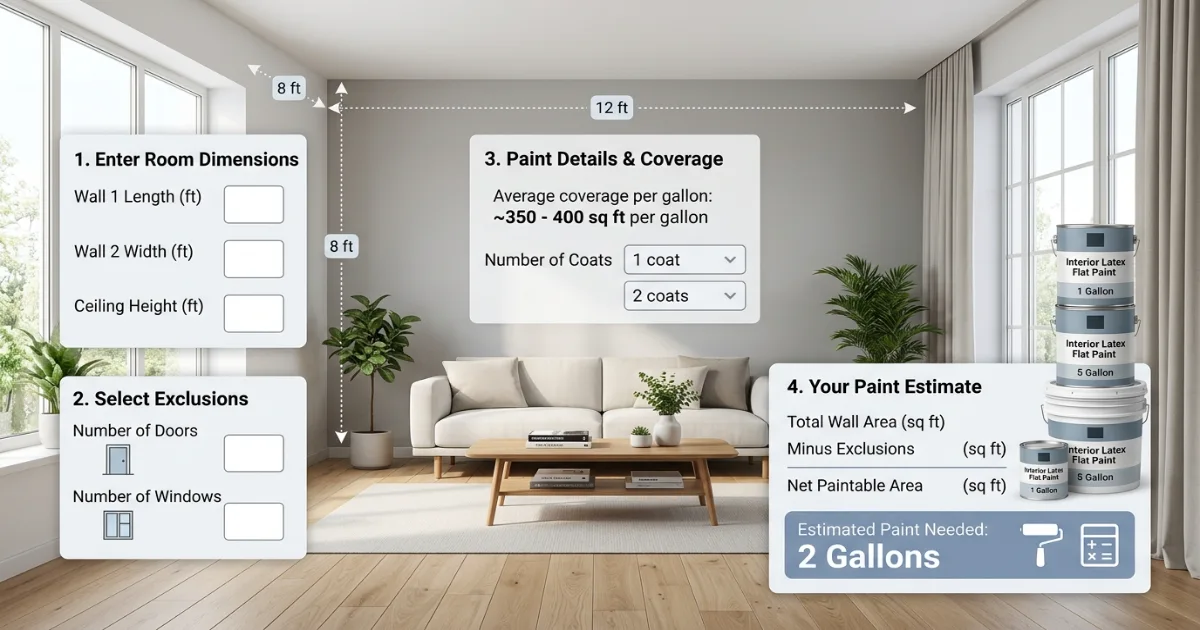
Buy the right amount
The calculator rounds up so you never run short mid-wall.
How to calculate paint quantity — the professional way.
The formula every painter uses: Perimeter × Height = Total Wall Area. Subtract 20 sq ft per door and 15 sq ft per window. Divide by 350–400 sq ft per gallon, then multiply by coats. Always round up — a half-empty gallon is better than a second trip to the store.
Step 1: Calculate wall area
Measure the perimeter of the room: add the length of all four walls. For a 12 × 12 ft room, the perimeter is 48 ft. Multiply by the ceiling height — usually 8 ft — to get 384 sq ft of wall area. For rooms with sloped ceilings, measure each wall individually and add the areas together.
Step 2: Subtract doors and windows
A standard interior door is about 20 sq ft (3 × 6 ft 8 in). A standard window is about 15 sq ft (3 × 5 ft). Subtract these from your total wall area. In a 12 × 12 ft room with one door and two windows, you subtract 50 sq ft, leaving 334 sq ft of paintable wall area. This saves you from buying paint for surfaces that will not be painted.
Step 3: Divide by coverage and multiply by coats
One gallon covers 350–400 sq ft per coat on smooth, primed walls. On textured or unpainted drywall, coverage drops to 250–300 sq ft. Divide your net paintable area by the coverage rate, then multiply by number of coats. For the 12 × 12 ft room: 334 ÷ 375 = 0.89 gallons per coat × 2 coats = 1.78 gallons. Round up to 2 gallons.
Step 4: Add the ceiling (optional)
Ceiling paint is calculated separately. Multiply room length by room width — 12 × 12 = 144 sq ft. At 375 sq ft per gallon, that is 0.38 gallons per coat. With two coats: 0.77 gallons. Use ceiling-specific paint: it has a flat finish and anti-drip formulation.
Step 5: Factor in primer for new or repaired surfaces
New drywall, patched sections, or a wall going from a dark color to a light one all need a dedicated primer coat before the finish colour. Primer is calculated the same way as paint — perimeter × height, divided by coverage rate — but treated as its own separate coat and purchased as its own product, not blended with finish paint.
Step 6: Choose the right sheen for the room
Sheen affects both appearance and durability, not the gallon math, but it does affect which product you buy. Flat and matte sheens hide surface imperfections and suit ceilings and low-traffic bedrooms. Eggshell is the standard for living rooms and hallways because it balances a soft look with easier cleaning. Satin and semi-gloss resist moisture and scuffing, making them the right choice for kitchens, bathrooms, trim, doors and baseboards.
Latex vs. oil-based paint
Most interior walls today are painted with water-based latex (acrylic) paint. It dries fast, has low odour, cleans up with soap and water, and remains flexible enough to resist cracking over time. Oil-based (alkyd) paint is now mostly reserved for high-durability trim, doors and cabinetry, since it lays down a harder, glossier finish but takes longer to dry and requires mineral spirits for cleanup. When calculating quantity, both types follow the same coverage math — perimeter times height, divided by coverage rate, times coats — but oil-based products often list slightly lower coverage per gallon on the can, so always check the label before finalising your order.
When to buy more than the calculator says
- Painting a dark wall a light colour — you may need three coats or a tinted primer
- Highly textured walls — coverage drops by 30–50% on rough surfaces
- Painting ceilings — always buy ceiling-specific paint separately from wall paint
- First-time painting new drywall — primer soaks in heavily; count primer as a separate coat
- Multiple accent walls in different colours — calculate each colour separately
Paint buying rules that prevent an extra hardware-store trip.
A calculator gives the best gallon estimate, but the final purchase still depends on sheen, primer needs, brand coverage claims and how much of the surface actually needs paint. These four rules cover the details a formula alone cannot — the judgment calls that separate a smooth one-trip paint job from a project that stalls halfway through a wall because the can ran dry.
For most rooms, calculate net wall area, divide by the coverage rate for your surface type, multiply by the number of coats, then round up to the next full gallon. Always buy a little extra for touch-ups, and treat primer, ceiling paint and trim paint as separate purchases from your wall colour.
Check the can’s actual coverage
Coverage claims vary by brand, sheen and tint depth. Always check the specific number printed on the can rather than relying only on the general 350–400 sq ft rule.
Buy primer separately
New drywall, stain-blocking needs and major colour changes all call for a dedicated primer. Never substitute primer volume for finish coat volume.
Match sheen to the room’s use
High-moisture and high-traffic rooms need satin or semi-gloss. Low-traffic bedrooms and ceilings can use flat or matte for a softer, more forgiving finish.
Box multiple cans together
If a project needs more than one gallon, mix them in a single large bucket first. This “boxing” step prevents visible colour variation between cans from the same batch.
Two practical tools to use with your paint estimate.
The calculator tells you how much paint to buy. These two supplies help with the next steps: measuring the room accurately and applying the paint with a complete roller setup.
Complete Paint Roller & Tray Kit
A practical starting set for applying wall paint after the calculator gives your gallon estimate.
- Useful for walls, ceilings and room refresh projects
- Look for a 9-inch frame, covers, tray and edging tools
- Choose the roller nap for your wall texture
Laser Distance Measure
Helpful for checking room width, length and ceiling height before entering dimensions into the calculator.
- Faster for large rooms and repeated wall measurements
- Useful for room perimeter and ceiling-height checks
- Keep a metal tape for trim and close-detail measurements
Affiliate disclosure: As an Amazon Associate, HomeStyle Calculator may earn from qualifying purchases. Product prices and availability can change. Check the current Amazon listing before buying.
Helpful room planning topics.
Paint is rarely the only decision in a room refresh. Once you know your gallon count, it helps to plan the rest of the space at the same time — rug scale against the new wall colour, curtain length against the ceiling height, and furniture proportions against the room’s new visual weight. Use these supporting pages from the HomeStyle Calculator homepage to plan the full room around your paint job, including furniture scale, rug sizing, curtain measurements and small-room layout decisions.
Six things professional painters always do.
Measure, do not guess
Use a laser measure or 25 ft tape. Guessing room size is the number one reason people buy too little or too much paint. Measure each wall individually.
Round up to nearest gallon
If the calculator says 1.4 gallons, buy 2 gallons. You need paint for touch-ups, edge cutting, and drips. Running out mid-wall is a costly mistake.
Prime bare drywall first
New drywall absorbs paint at roughly twice the rate. Always prime before painting and count the primer separately from your paint coats.
Box your paint
Pour all gallons into one large bucket and mix. Even paint from the same store can vary slightly between cans. “Boxing” guarantees colour consistency.
Know your sheen levels
Flat hides imperfections but is hard to clean. Eggshell is most popular for living areas. Satin/semi-gloss for kitchens, baths, and trim.
Save leftover paint
Keep at least one quart of each colour in a sealed, labelled container indoors — not in the garage. You will need it for touch-ups within the first year.
Paint quantity questions — answered.
12 calculators for every room decision.
Every tool uses professional designer formulas. Free, instant, no sign-up — just enter your room and get the exact answer.
Bookmark HomeStyle Calculator for every paint project.
From a single accent wall to a whole-house repaint, our free tools give you the exact paint quantity before you buy a single can.