Find out Exactly How much Fabric your Curtains Need.
Enter your window size, fullness ratio, panel count, fabric width and pattern repeat, and get an instant yardage total — using the same math professional workrooms use to cut custom drapery. No more guessing bolts at the fabric store.
Multiply finished width by your fullness ratio, divide by fabric width to get widths needed, then multiply by (drop length + hem/heading allowance, rounded to the pattern repeat) and convert to yards.
Typical yardage by window size and fullness.
These estimates assume a pair of panels (2 total), 54 inch fabric, an 84 inch drop, no pattern repeat and a 14 inch hem and heading allowance. Use the calculator above for a total matched to your exact window.
| Window Width | 1.5x Fullness | 2x Fullness | 2.5x Fullness | 3x Fullness |
|---|---|---|---|---|
| 36 in | 4.5 yd | 5.5 yd | 8 yd | 8 yd |
| 48 in | 5.5 yd | 5.5 yd | 8 yd | 8 yd |
| 60 in | 5.5 yd | 8 yd | 8 yd | 11 yd |
| 72 in | 8 yd | 8 yd | 11 yd | 11 yd |
| 96 in | 8 yd | 11 yd | 11 yd | 16 yd |
| 120 in | 11 yd | 16 yd | 16 yd | 19 yd |
Four fullness ratios — and the look each one creates.
Fullness is the single biggest factor in fabric yardage. Here is what each ratio looks like when closed and which fabric weights suit it best.
1.5x Relaxed
A minimal, tailored fold with the least fabric used. Suits heavier fabrics like velvet or linen that already have visual weight without much gathering.
Least fabric2x Standard
The industry default, giving a soft, gently gathered look that works with almost any fabric weight and suits most living rooms and bedrooms.
Balanced fabric use2.5x Full
A noticeably fuller, more luxurious fold, popular with lightweight and sheer fabrics that need more volume to avoid looking flat when closed.
More fabric3x Luxurious
Maximum drama and volume, typically reserved for formal rooms, sheers, or floor-to-ceiling statement windows where fabric cost is a lower priority.
Most fabricSee how yardage changes by window and fullness.
These steps cover the essentials: measuring the window, choosing fullness and fabric width, and accounting for pattern repeat before you buy.
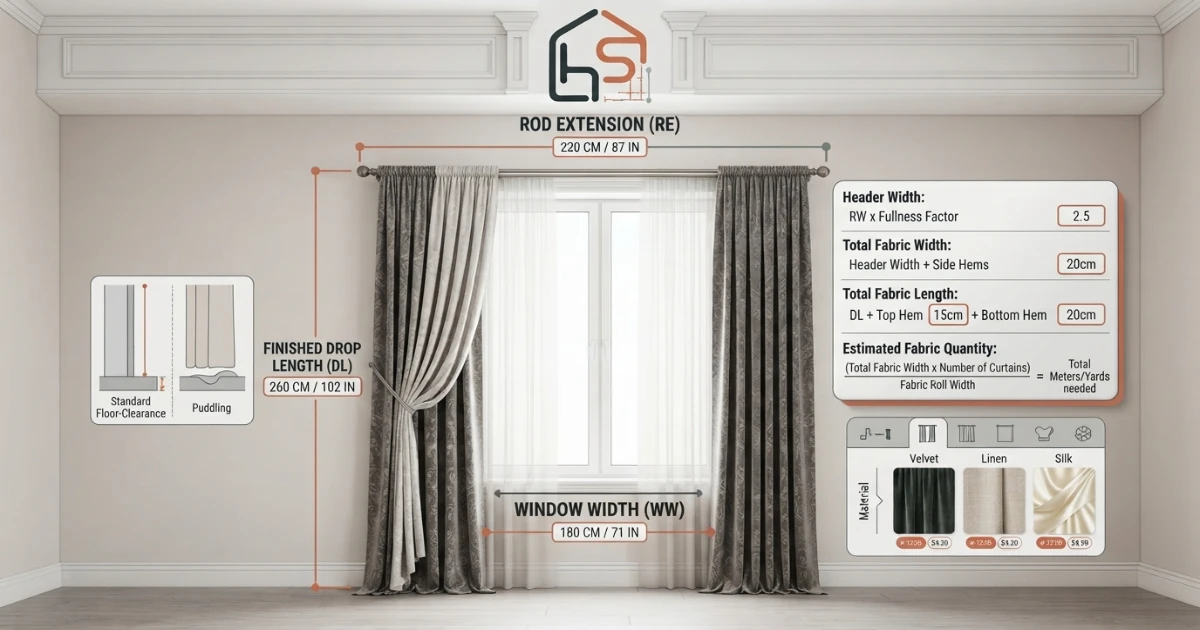
Measure the window
Start with window width, rod extension and drop length before choosing fullness. Rod width, not window width, sets the finished curtain width.
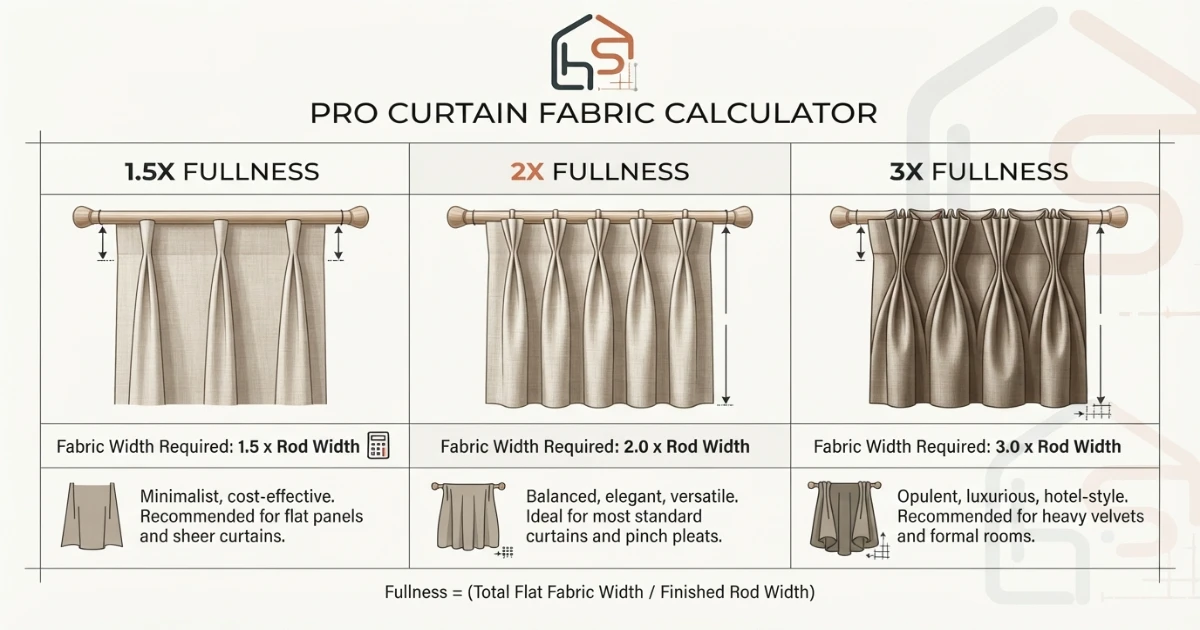
Choose fullness and fabric width
Fullness sets total fabric width needed; fabric bolt width determines how many widths must be seamed together.
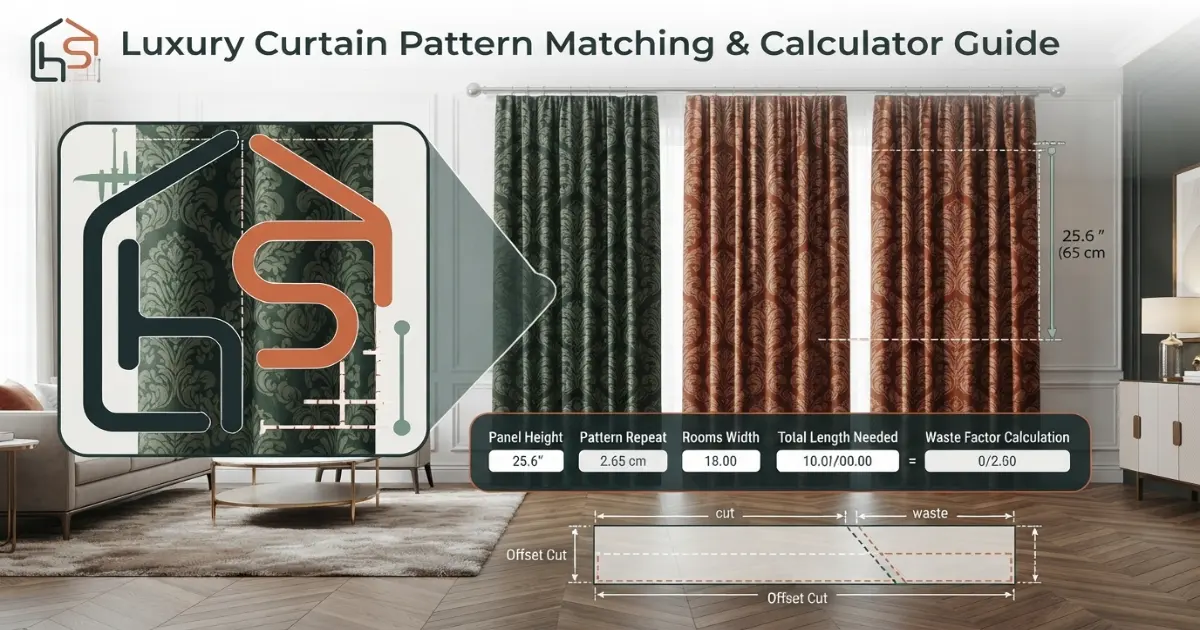
Account for pattern repeat
A printed or woven repeat means rounding cut length up so every seamed width lines up at the same point.
How to calculate curtain fabric yardage — the complete guide.
The most common curtain fabric mistake is calculating yardage from window width alone instead of the finished rod width multiplied by fullness. Skipping fullness entirely, or applying it only to one panel of a pair, is the single biggest source of running short mid-project.
Curtain fabric yardage looks like a simple multiplication problem, but it has more moving parts than most first-time buyers expect: rod width versus window width, fullness ratio, how many fabric widths must be seamed together, pattern repeat matching, and the hem and heading allowance added to every single drop. Getting any one of these wrong tends to compound, since yardage errors multiply across every panel and every seamed width rather than staying small. This guide walks through the full calculation so the number the calculator above gives you matches what a professional workroom would actually cut.
Step 1: Measure rod width, not just window width
Curtains are sized to the rod, not the window glass itself. Measure the window’s width, then add the rod extension on each side — typically 3 to 6 inches per side — to get the total rod width. This wider rod width is what curtains need to fully clear the window when open, letting in maximum light, and it’s the number that should feed into every calculation that follows, not the raw window measurement.
Step 2: Measure the finished drop length
Measure from where the rod will sit down to wherever the curtain should end — the windowsill, just below the apron, the floor, or a slight break or puddle on the floor for a more formal look. This finished measurement, before any hem or heading is added, is the drop length that later gets combined with a hem and heading allowance to determine the actual fabric cut length.
Step 3: Choose a fullness ratio
Fullness ratio determines how much fabric width is gathered into each inch of rod width when the curtain is closed. A 1.5x ratio gives a minimal, tailored fold and uses the least fabric, suiting heavier fabrics like velvet that already read as substantial without much gathering. A 2x ratio is the most common default, giving a soft, evenly gathered look across most fabric weights. A 2.5x to 3x ratio creates a noticeably fuller, more luxurious drape, often chosen for lightweight or sheer fabrics that can look flat and thin without extra volume.
Step 4: Decide on panel count
Most windows use a pair of panels, one on each side, which together need to reach the full rod width times the fullness ratio. A single panel, sometimes used on a narrow window or a side window in a stairwell, only needs to cover its own width times fullness, not the full rod width. Splitting the required total fabric width evenly across the panel count gives the width needed per individual panel.
Step 5: Calculate fabric widths needed per panel
Divide each panel’s required fabric width — its share of total rod width times fullness — by the fabric’s actual bolt width to find how many widths of fabric must be sewn together side by side to reach that target. Always round this figure up to a whole number, since a partial width isn’t usable on its own and still requires cutting a full width of fabric.
Step 6: Choose a fabric width strategically
Standard drapery fabric commonly comes in 54 inch widths, though wider options around 108 to 137 inches are increasingly available, particularly for sheers and some designer fabrics. Wider fabric can mean fewer widths need to be seamed together for the same finished panel, which can reduce both total yardage and sewing labor, even when the wider fabric’s price per yard is somewhat higher than a standard-width equivalent.
Step 7: Add the hem and heading allowance
Add fabric length beyond the finished drop for both the bottom hem and the top heading or rod pocket. A standard bottom hem uses about 8 inches of fabric folded under, while the heading and rod pocket at the top typically need another 6 inches, for a combined allowance of roughly 14 inches per drop. Floor-length curtains with a deliberate puddle at the bottom need extra length beyond this standard allowance, sometimes an additional 2 to 6 inches depending on how much puddle is desired.
Step 8: Round the cut length to the pattern repeat
If the fabric has a printed or woven pattern repeat, round the total cut length — drop length plus hem and heading allowance — up to the next full multiple of that repeat measurement. This ensures the pattern lines up at the same point on every seamed width and on every panel in a pair, which is essential for a professional, intentional-looking result rather than a mismatched, obviously pieced appearance.
Step 9: Convert total fabric length into yards
Multiply the rounded cut length per drop by the total number of fabric widths needed across all panels — not just one panel — to get total fabric length in inches, then divide by 36 to convert to yards. Always round the final yardage up to the nearest half or full yard, since fabric is sold in continuous lengths off the bolt and most retailers won’t cut less than that increment.
Step 10: Add a small buffer for cutting and matching errors
Beyond the pattern repeat rounding already built into the cut length, it’s worth adding a modest additional buffer, often a quarter to half yard per panel, to cover small cutting mistakes, fabric flaws that need to be cut around, or minor measurement adjustments discovered partway through construction. This is particularly worth doing on an expensive or hard-to-rematch fabric, where running short mid-project can mean an unmatched dye lot on a reorder.
Step 11: Plan for railroaded fabric differently
Some fabrics, particularly wide sheers and certain solid drapery fabrics, are designed to be “railroaded,” meaning the fabric is turned sideways so its width runs horizontally across the curtain rather than vertically. Railroaded fabric can sometimes eliminate the need for seamed widths entirely on a single panel, since the fabric’s width itself becomes the drop length, though this only works when the fabric width comfortably exceeds the finished drop length and any pattern doesn’t have a directional orientation that would look wrong sideways.
Curtain length styles and how they change the drop
- Sill length — ends right at or just above the windowsill, a casual, practical choice common in kitchens and bathrooms.
- Apron length — ends a few inches below the sill, at the bottom of the window trim, splitting the difference between sill and floor length.
- Floor length — ends just above the floor, generally considered the most versatile and widely used length for living rooms and bedrooms.
- Puddle length — extends several inches onto the floor for a deliberately soft, formal look, needing extra fabric length beyond the standard hem allowance.
Curtain fabric buying rules that prevent a second trip to the store.
A calculator gives the best starting numbers, but the final purchase still depends on rod width, fullness and pattern repeat working together correctly. The rules below cover the details worth checking even after settling on a yardage total from the calculator above.
Base every calculation on rod width, not window width, apply your chosen fullness ratio to the full rod width across all panels, add a 14 inch hem and heading allowance to the drop, round to the pattern repeat, then convert to yards and add a small buffer.
Measure the rod, not the window
Rod width, including extension on both sides, is what should drive every yardage calculation, not the raw window frame measurement.
Apply fullness to the whole rod width
Split the fullness-adjusted total width evenly across all panels rather than applying the ratio to just one panel of a pair.
Buy fabric from the same dye lot
Fabric color can shift subtly between production runs. Buy all yardage for one project from the same dye lot to avoid a visible mismatch.
Round the pattern repeat up, never down
Always round cut length up to the next full pattern repeat multiple, even if it means buying more fabric than the bare minimum.
Helpful room planning topics.
Curtain fabric rarely stands alone in a room’s design. Once you know your yardage, it helps to plan the surrounding elements at the same time — panel width and rod placement, wall color behind the window, and the room’s overall proportions. Use these supporting pages from the HomeStyle Calculator homepage to plan the rest of the room.
Six things professional workrooms always check before cutting fabric.
Pre-shrink washable fabric first
Wash and dry fabric before cutting if it will ever be laundered, since shrinkage after sewing can throw off carefully matched hem lengths.
Cut all panels from the same bolt
Even solid-color fabric can vary slightly in shade between bolts. Cut every panel for one window from the same continuous length when possible.
Match pattern at eye level, not the floor
When trimming for pattern match, prioritize alignment at eye level where it’s most visible, rather than at the floor where it matters less.
Test drape before finalizing fullness
Pin or clip fabric to the rod at your planned fullness before cutting the final hem, to confirm the fold looks right for that specific fabric weight.
Order a swatch before buying full yardage
Fabric color and texture can look different at full scale in the actual room than a small sample on a screen or in a showroom.
Keep a small remnant for repairs
Save a scrap of leftover fabric after hemming, useful for future repairs or a matching accent pillow without reordering the bolt.
Curtain fabric questions — answered.
More calculators for every room decision.
Every tool uses professional designer formulas. Free, instant, no sign-up — just enter your room and get the exact answer.
Bookmark HomeStyle Calculator for every room in the house.
From a single kitchen window to floor-to-ceiling living room drapery, our free tools give you the exact yardage before you buy fabric.