How wide should curtains be? Calculate the right fullness.
Measure the finished rod, choose 1.5x, 2x, 2.5x or 3x fullness, and calculate the exact total fabric width, panel quantity and number of packages for your window.
Written and reviewed by Rehana K · Measurement-first HomeStyle Calculator method.
Use about 2x the finished rod width for balanced everyday curtains.
How wide should curtains be? Multiply the complete rod width by the desired fullness ratio. Use approximately 1.5x for a lighter look, 2x for balanced folds, 2.5x for soft full curtains and up to 3x for selected sheers or formal treatments.
Calculate from the finished rod, not only the window frame. Divide the fabric target by one panel’s finished width and round up.
Four steps from the bare window to an order-ready treatment
Keep width, mounting height and finished length connected. Each link opens a page already built for this exact curtain workflow.
From finished rod width to the final number of panels
See how fullness changes the same finished rod
Select a ratio to compare the apparent fold depth and stack size. The illustration uses the same window and rod so the width difference remains clear.
A balanced amount for many living rooms and bedrooms.
How wide should curtains be calculator
Enter the frame width, rod extension, selected fullness, panel width and package quantity. The result calculates rod width, fabric target, panel count, packages and actual achieved fullness.
Your curtain-width result
Frame plus both side extensions
Rod width multiplied by target fullness
Balanced center-opening pair
Based on the selected package quantity
Slightly below the 2× target
For a two-panel center opening
Choose wider panels for a closer match
Selected panel width × panel count
How wide should curtains be? Use the finished-rod formula
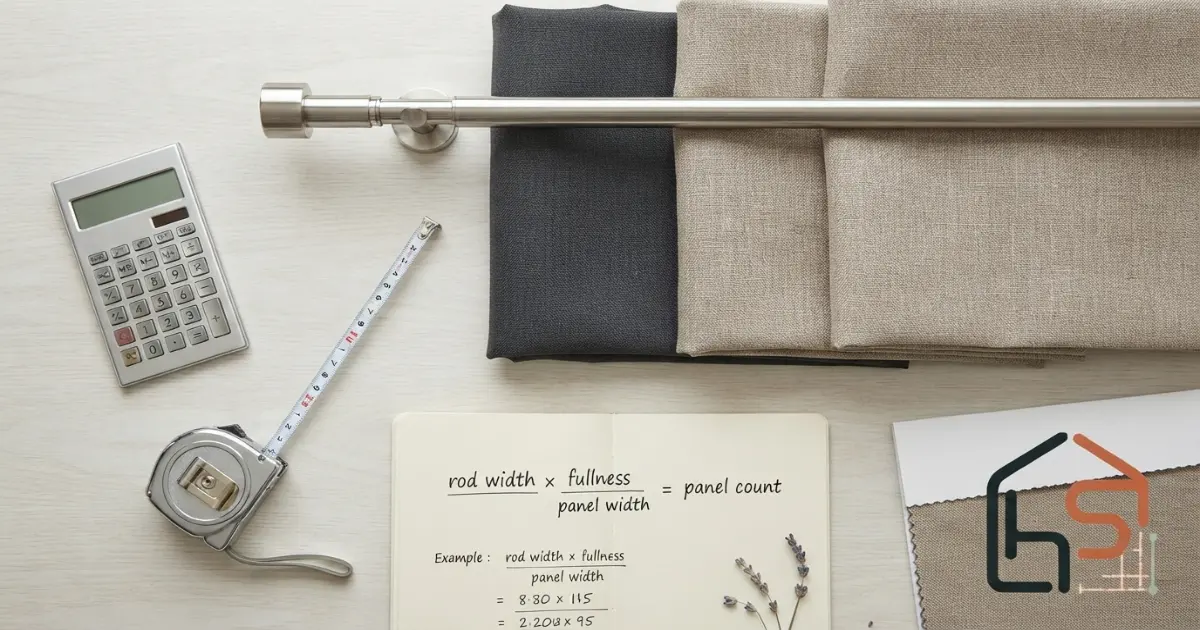
The practical formula is: finished rod width × fullness ratio = total finished curtain width. Divide that total by the finished width of one panel to calculate how many panels are needed. Use the finished rod width because it includes the extension beyond the window frame.
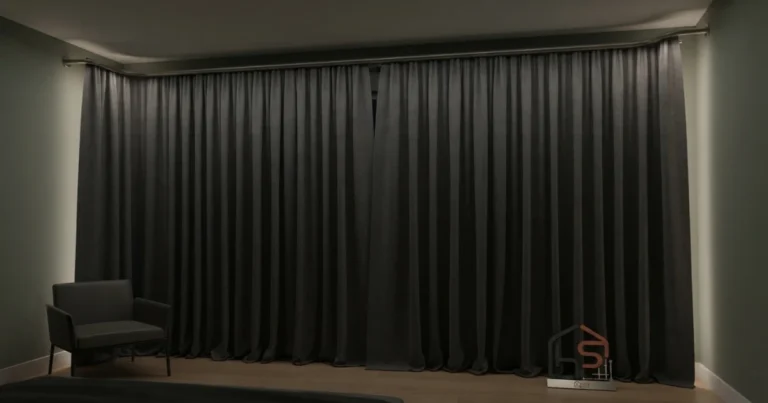
A curtain can have the correct length and still look wrong when it is too narrow. Closed panels should retain visible folds instead of becoming a flat sheet across the window. Open panels should stack into the wall space without covering too much glass. Those two conditions are controlled by rod width, fullness and the number of panels.
For many living rooms and bedrooms, 2x fullness is a dependable starting point. A 72-inch finished rod therefore needs about 144 inches of total finished curtain width. Heavy lined fabric may look full at a slightly lower ratio, while soft sheers often need a richer ratio to create continuous folds.
The one-sentence rule
Measure the complete rod, multiply by the selected fullness ratio, divide by one panel’s finished width and round up—then check how many panels are included in each package.
Measure the finished rod before deciding how wide should curtains be
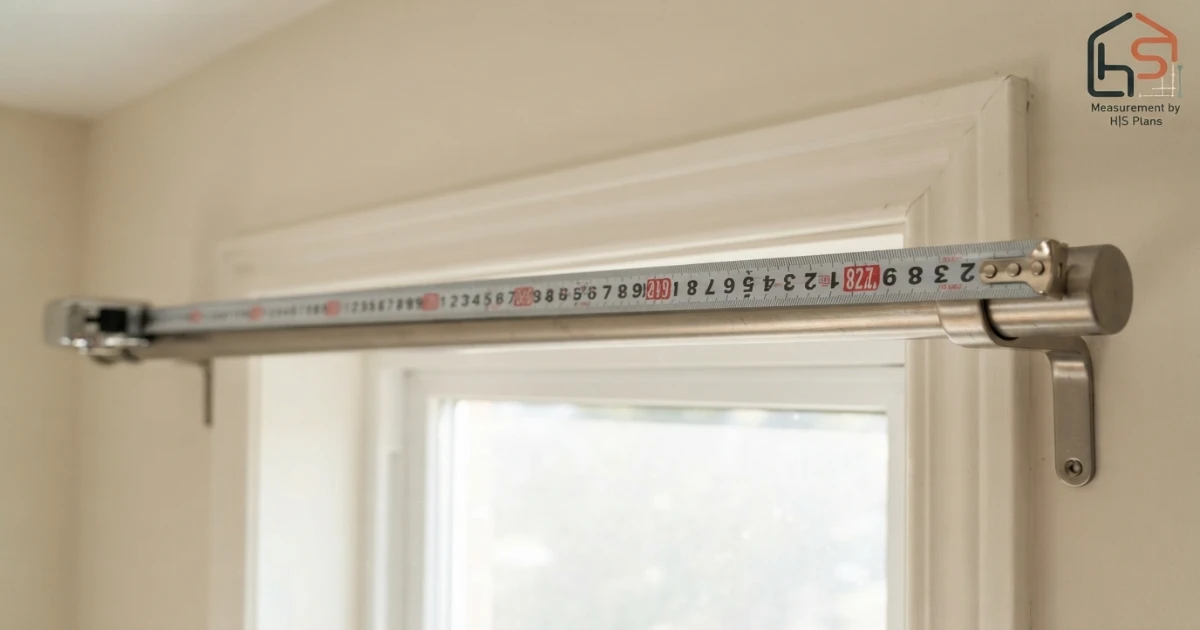
Measure the outside width of the window frame, then add the planned rod extension on both sides. A 48-inch frame with 6 inches of extension on each side creates a 60-inch finished rod. That 60-inch number, not 48 inches, is the basis for the fabric calculation.
Rod extension creates stack-back space. When the curtains are open, part of each panel folds beyond the window frame instead of remaining over the glass. Six inches per side is a useful starting point for many ordinary windows, but wide panels, thick lining, large grommets or deep pleats may need more.
Use Measure Window for Curtains for frame width, return depth, grouped-window and obstacle measurements. When the rod height is still undecided, mark the top line with How High to Hang Curtains before recording the final width.
Why rod width decides how wide should curtains be
Window width describes the frame or opening. Finished rod width describes the complete distance the closed curtains must cover. The rod is normally wider than the frame, so multiplying the window width alone produces less fabric than the installed treatment needs.
Suppose a 60-inch frame uses 8 inches of extension on both sides. The rod is 76 inches. At 2x fullness, the treatment needs approximately 152 inches of total finished fabric. Calculating from the 60-inch frame would produce only 120 inches, leaving the curtains noticeably flatter when closed.
The difference becomes larger on patio doors, grouped windows and wall-to-wall tracks. Use the calculator on this page or the full Curtain Size Calculator so extension, finished rod width, fullness and panel quantity remain connected.
How wide should curtains be at 1.5x fullness?
At 1.5x fullness, the total finished curtain width is one and a half times the finished rod width. A 72-inch rod needs about 108 inches of fabric. This creates light gathering rather than deep folds.
The ratio can work for heavy velvet, thick blackout lining, rental installations with limited stack-back and curtains that remain mostly open. It can also suit a one-way panel on a sliding door when excessive folds would crowd the handle or reduce the usable opening.
A 1.5x ratio may look sparse in lightweight cotton, voile or soft linen-look fabric. Tape the proposed folds or gather the panel on a temporary rod before accepting the lower ratio. A narrow treatment cannot gain fullness after purchase unless more panels are added.
How wide should curtains be at 2x fullness?
Two-times fullness is the balanced default for many homes. Multiply the finished rod width by 2. A 60-inch rod needs about 120 inches of total fabric, while a 90-inch rod needs about 180 inches.
This ratio usually preserves visible folds when the curtains are closed without creating an oversized stack when they are open. It suits many grommet, ring-hung, rod-pocket and pleated ready-made panels, though the header construction can change the visual density.
When product width makes the calculation land between quantities, buy enough panels to meet or slightly exceed the target. Four 52-inch panels provide 208 inches. On a 96-inch rod, that equals about 2.17x fullness, which is generally more useful than two panels providing only 104 inches.
How wide should curtains be at 2.5x fullness?
At 2.5x fullness, a 72-inch rod needs about 180 inches of finished fabric. The richer ratio creates deeper, more continuous folds and can make soft fabric look more substantial.
Use it for lightweight curtains, decorative living-room treatments, selected pinch pleats and many sheers. Confirm that the rod or track can support the extra fabric and that the wall beside the window has enough space for the larger stack.
Richer fullness is not automatically better. Heavy lined panels at 2.5x can become difficult to open, crowd a short rod and overload light-duty brackets. Match the ratio to the fabric rather than applying the same number to every room.
When 3x curtain fullness is appropriate
Three-times fullness creates a formal, highly gathered treatment. A 72-inch track needs about 216 inches of finished fabric. It is most common with lightweight sheers, selected wave systems, narrow pleats and decorative stationary panels.
The ratio requires careful hardware planning. More fabric increases weight, friction and stack-back depth. A track with passing carriers or a ceiling installation may handle the treatment more cleanly than a short decorative rod with large finials.
Do not use 3x simply to improve blackout performance. Side returns, overlap, lining and a second layer often control light more effectively than adding excessive fabric width.
Calculate panel count after deciding how wide should curtains be
After calculating total fabric width, divide by the finished width of one panel. If the total target is 144 inches and each panel is 52 inches wide, the mathematical result is 2.77 panels. Round up to three, then use four when the treatment opens from the center and needs equal panels on both sides.
A one-way draw curtain does not always need an even number. A sliding door may use three panels traveling toward one side, provided the header and track allow the complete stack to move away from the active glass.
The calculator rounds center-opening treatments to the next even number. It also reports the actual achieved fullness after rounding, which helps identify whether the final order is close to the selected ratio or unusually full.
| Finished rod | Fullness | Total fabric target | 52-inch panels | Balanced order |
|---|---|---|---|---|
| 48 in | 2x | 96 in | 1.85 | 2 panels |
| 60 in | 2x | 120 in | 2.31 | 4 panels for center opening |
| 72 in | 2x | 144 in | 2.77 | 4 panels |
| 96 in | 2x | 192 in | 3.69 | 4 panels |
| 120 in | 2.5x | 300 in | 5.77 | 6 panels |
Check whether the listing is one panel, a pair or a set
Retail listings may state 52 × 84 inches but sell only one panel. Another listing may show the same dimensions and include two panels. The width calculation uses the width of one finished panel, while the shopping calculation must use the package quantity.
If four panels are required and the product is sold as a pair, buy two packages. If it is sold individually, buy four units. Confirm the quantity in the title, specifications and package contents rather than relying on the product image.
Order all panels together when dye-lot consistency matters. Record the product width, package quantity and chosen fullness in the Curtain Size Calculator before placing the order.
Header rules that change how wide should curtains be
Header style controls how fabric gathers and moves. Grommets create broad wave-like folds and often look balanced around 1.8x to 2x. Clip rings are flexible and can support roughly 1.8x to 2.2x depending on spacing. Rod pockets create tighter gathers and may need more width in soft fabric.
Pinch pleats are manufactured to a finished heading width. The workroom or product listing may already account for fullness, so calculate from the stated finished coverage rather than multiplying pleated width again. Wave and ripplefold systems also use carrier spacing and tape specifications that should be followed.
| Header | Useful starting ratio | Visual effect | Main check |
|---|---|---|---|
| Grommet | 1.8x–2x | Broad regular waves | Large stack and rod diameter |
| Clip rings | 1.8x–2.2x | Flexible casual folds | Clip spacing and grip |
| Rod pocket | 2x–2.5x | Dense gathered top | Harder daily movement |
| Pinch pleat | Use finished heading width | Structured formal folds | Do not multiply twice |
| Wave / ripplefold | Follow track specification | Even continuous waves | Carrier and tape system |
Fabric weight changes how wide should curtains be
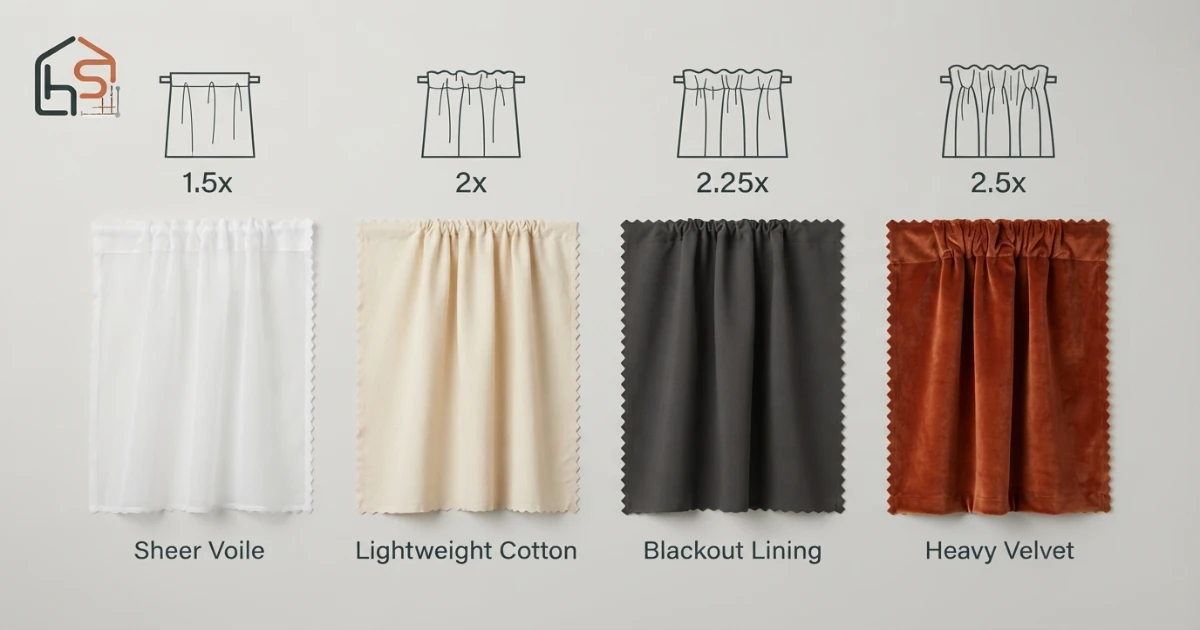
Heavy velvet, interlining and blackout lining create physical volume. These fabrics can look full at a lower ratio and become difficult to stack when too much width is added. Confirm rod capacity, bracket spacing and center support before choosing a rich ratio.
Lightweight voile, cotton and linen-look fabric collapse into smaller folds. They often benefit from 2.2x to 3x fullness, especially when the treatment is expected to look soft and substantial while closed.
Pattern repeat also matters. Additional width may be required to align stripes, checks or large motifs across multiple panels. Custom workrooms normally calculate pattern matching separately from visual fullness.
How wide should curtains be by room?
Living rooms usually suit 2x to 2.5x fullness. The folds should remain visible when closed, while the open stack should not collide with the sofa or cover a large part of the glass. Use the Sofa Size Calculator to check the wall behind the seating area and the Rug Size Calculator when the hem approaches a rug edge.
Bedrooms commonly use 1.8x to 2.2x for lined or blackout panels. The Bedroom Layout Planner helps confirm that nightstands, headboards and heaters do not trap the curtain stack.
Dining rooms can use 2x to 2.5x when panels stay clear of chair movement. Check the clearance around the table with the Dining Table Size Calculator before placing a rich puddle or deep stack near the route.
| Room or opening | Starting ratio | Suitable fabric | Primary clearance check |
|---|---|---|---|
| Living room | 2x–2.5x | Cotton, linen-look, lined | Sofa and glass stack-back |
| Bedroom | 1.8x–2.2x | Blackout or lined | Bedside furniture and heater |
| Dining room | 2x–2.5x | Soft decorative fabrics | Chair pull-out route |
| Sliding door | 1.8x–2.2x | Durable lined panels | Active door and handle |
| Sheer layer | 2.5x–3x | Voile or lightweight sheer | Track capacity and stacking |
How wide should curtains be for sliding doors and wide windows
Wide openings magnify small calculation errors. Measure the complete track or rod, including the section where the panels stack beyond the active door. A center-opening treatment may need four, six or more panels. A one-way draw treatment can use an odd number when all fabric travels toward one side.
Keep the stack away from handles and the active glass. A panel that technically covers the rod may still be impractical if the folds narrow the doorway. Use 1.8x to 2.2x for many heavy door panels and increase only when the available wall and hardware support it.
For the complete frame, handle and return-depth sequence, use Measure Window for Curtains. Calculate the full order in the Curtain Size Calculator.
Stack-back space limits how wide curtains can be
Stack-back is the wall space occupied by the folded curtains when open. More fullness creates a larger stack. Thick lining, grommets and deep pleats increase the stack further. Measure the clear wall beside the window before selecting a very rich ratio.
When wall space is limited, use a lighter ratio, a track with compact carriers, narrower panels or a one-way draw. Do not reduce width below the amount needed to close; adjust the hardware and treatment design instead.
The finished rod should still extend far enough to reveal glass when open. Balance coverage and stack-back rather than optimizing only one of them.
Calculate sheers and blackout curtains as separate layers
A rear sheer track and a front blackout rod may have different widths. Measure and calculate each layer independently. The sheer can use 2.5x to 3x fullness, while the heavier front panels may use 1.8x to 2.2x.
Do not assume both layers need the same number of panels. The rear track may span wall to wall, while the front decorative rod extends only beyond the frame. Header systems and carrier spacing can also differ.
Match the finished length after calculating width. Use the Curtain Length Guide for float, kiss, break and puddle options, and compare the ceiling-specific guides for 8-foot, 9-foot and 10-foot ceilings.
Ceiling height changes length—not the fullness formula
An eight-, nine- or ten-foot ceiling affects panel length and rod position. It does not replace the horizontal calculation. Two rooms with different ceiling heights can use the same rod width and fullness when the windows are the same width.
Choose the vertical line with How High to Hang Curtains, select the finish in the Curtain Length Guide, then calculate width independently from the finished rod.
This separation prevents a common mistake: choosing extra-long panels correctly but buying only one narrow pair for a wide rod.
Asymmetrical windows and unequal wall space
A window near a corner may have more stack-back space on one side than the other. The finished rod can still be centered on the frame, or it can be adjusted when the room design requires a one-way draw. Record the left and right wall returns separately.
Grouped windows should usually share one intentional rod or track line. Calculate the full span, then decide whether the treatment opens from the center, stacks at both outer edges or travels toward one side.
Use painter’s tape to mark the complete closed and open widths before ordering. This reveals conflicts with cabinets, art, switches, vents and doors.
Worked curtain-width examples
Example one: A 48-inch frame with 6 inches of extension on each side creates a 60-inch rod. At 2x fullness, the fabric target is 120 inches. With 52-inch panels, the mathematical result is 2.31 panels, so a center-opening treatment uses four panels.
Example two: A 72-inch sliding door with 8 inches of extension on both sides creates an 88-inch rod. At 2x fullness, the target is 176 inches. Four 50-inch panels provide 200 inches, producing about 2.27x actual fullness.
Example three: A 120-inch wall track with lightweight sheers at 2.5x needs 300 inches of fabric. Six 54-inch panels provide 324 inches, producing 2.7x actual fullness and an even three-panel stack at each side.
| Opening example | Rod width | Selected ratio | Fabric target | Practical order |
|---|---|---|---|---|
| Small bedroom window | 54 in | 2x | 108 in | 2 × 54-in panels |
| Standard living-room window | 72 in | 2x | 144 in | 4 × 52-in panels |
| Wide picture window | 96 in | 2.2x | 211 in | 4 × 54-in panels |
| Sliding door | 88 in | 2x | 176 in | 4 × 50-in panels |
| Wall-to-wall sheer track | 120 in | 2.5x | 300 in | 6 × 54-in panels |
Common mistakes when deciding how wide should curtains be
The first mistake is multiplying the window frame width instead of the finished rod. The second is reading the package width as though it belongs to one panel. The third is buying a single pair without checking whether it reaches the chosen fullness ratio.
Another mistake is using the same ratio for sheer voile and heavy velvet. Fabric weight changes the visual fullness and stack size. Header construction changes it again.
Do not ignore the open position. Curtains can meet the closed-width target and still cover too much glass when stacked. Mark the open stack and check furniture, switches and wall art before buying.
- Measure rod end to rod end after deciding the extension.
- Use finished panel width, not the flat package photograph.
- Round up rather than accepting a visible coverage shortage.
- Round to an even panel count for a balanced center opening.
- Confirm brackets and tracks can support the finished fabric weight.
Final curtain-width buying checklist
Confirm the frame width, extension on each side, finished rod width, selected fullness ratio, one-panel finished width, number of panels per package, header style, lining weight, opening direction and available stack-back space.
Enter the final values into the calculator and save the result. Compare the product description with the measurement diagram. Order enough units to meet the target even when the product photography shows a fuller arrangement.
After the width is correct, finish the vertical plan with the Curtain Length Guide and How High to Hang Curtains. The treatment is order-ready only when width, length, mounting height and hardware all agree.

Two products to compare after calculating width
These search links help compare wide-panel and hardware options. Check the current finished width, package quantity, rod range and weight capacity before ordering.
Extra-Wide Curtain Panels
Compare wider panels when standard 50- to 54-inch panels create an unnecessarily large panel count.
- Verify whether width is per panel or per pair
- Check the finished header width
- Confirm the listed length separately
Heavy-Duty Adjustable Curtain Rod
Use the calculator’s finished rod width and fabric weight to compare suitable adjustable ranges and bracket support.
- Confirm the usable rod range
- Check center-support requirements
- Match rod diameter to the header
Affiliate disclosure: As an Amazon Associate, HomeStyle Calculator may earn from qualifying purchases. Prices, specifications, package quantities and availability can change. Review the current listing before ordering.
Questions about curtain width and fullness
How wide should curtains be for a window?
Measure the finished curtain rod, not only the glass or frame. Multiply the finished rod width by the selected fullness ratio. A 2x ratio is a reliable starting point for many living rooms and bedrooms, so a 72-inch rod needs about 144 inches of total finished curtain width.
Is 2x fullness enough for curtains?
Yes. Two-times fullness creates balanced folds for many ready-made curtains. Lightweight sheers may look better at 2.5x to 3x, while heavy lined or velvet panels can often look full at 1.5x to 2x because the fabric itself creates more bulk.
Should curtain width be based on the window or the rod?
Use the finished rod width. The rod usually extends beyond the window frame to create stack-back space, so calculating from the frame alone can leave the closed curtains too flat or too narrow.
How many curtain panels do I need?
Multiply the rod width by the fullness ratio, divide by the finished width of one panel and round up. When the curtains open from the center, round an odd result up to the next even number so both sides remain balanced.
What fullness ratio should I use for blackout curtains?
A ratio around 1.8x to 2.2x works for many blackout panels. The correct choice depends on lining stiffness, header type and how much overlap is needed. Extra width helps reduce side gaps, but a wraparound rod or layered shade may still be needed for strong light control.
Do grommet curtains need 2x fullness?
Grommet curtains often look balanced around 1.8x to 2x fullness. Very stiff grommet panels may need less, while soft lightweight panels can use more. Count the finished panel width, not the package width, and confirm how many panels are included.
How wide should curtains be for a sliding door?
Calculate from the complete finished rod or track width, including the space needed for the panels to stack beyond the active glass. A 1.8x to 2.2x ratio is practical for many lined door panels, but one-way draw systems do not need an even panel count.
Can curtains be too wide?
Yes. Excessive fullness can make heavy panels difficult to stack, overload the rod and crowd the wall beside the window. Use a richer ratio only when the header, fabric weight, track capacity and available stack-back space support it.
Turn the fullness ratio into a complete curtain order
Calculate rod width, panel length, fullness and panel quantity before buying curtains or hardware.