Loveseat vs sofa size: Best complete comparison
Loveseat vs sofa size usually comes down to width and seating capacity: loveseats commonly measure 52 to 72 inches and seat two, while sofas commonly measure 72 to 96 inches and usually seat three.
Loveseat vs sofa size: choose by usable seating and complete room fit.
Choose a loveseat for two people and tighter rooms. Choose a sofa for three-seat capacity, lounging and guests.
Depth can be similar, so do not assume a loveseat saves floor depth. Compare inside seat width, arm width and the full delivery route.
Compare dimensions, room size, sectional alternatives and rug coverage
Use exact measurements rather than relying on loveseat, apartment sofa or three-seat labels.
Loveseat vs sofa room-fit calculator
Compare both options against the same wall, room depth and seating requirement.
Wall, depth and seating recommendation
Fits selected margins.
Fits selected margins.
Sofa uses more room depth.
Best for current priorities.
Both pieces fit. For two people and balanced priorities, the loveseat preserves more open floor area.
Loveseat vs sofa size comparison chart
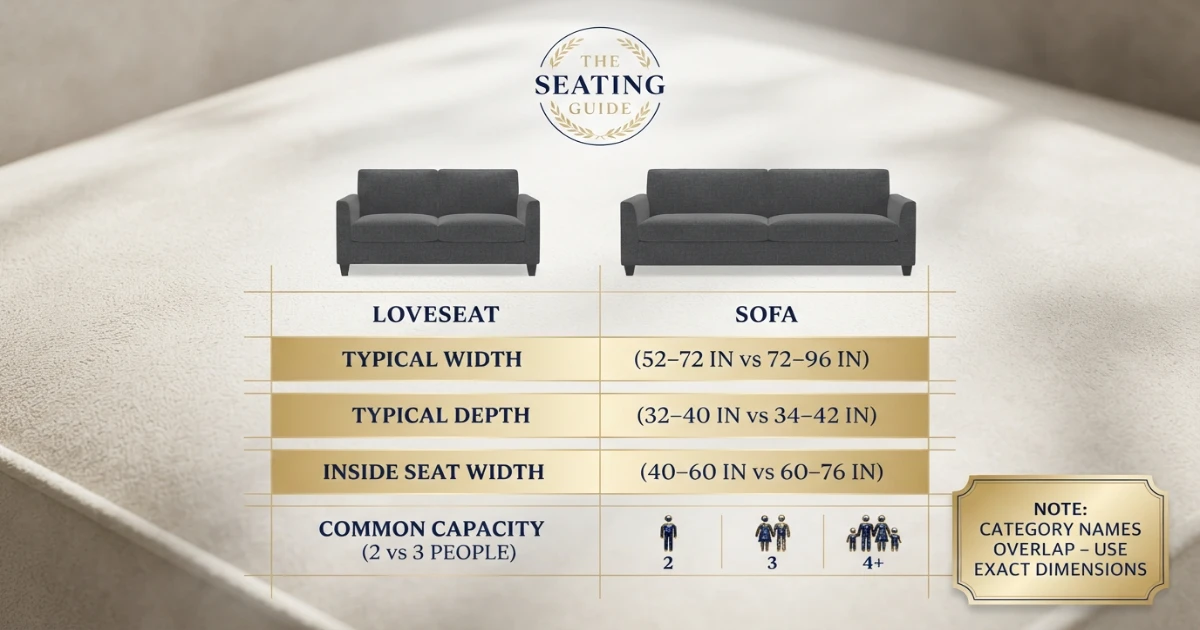
The main difference is width and intended capacity. A loveseat usually seats two people and commonly falls around 52 to 72 inches wide. A sofa commonly seats three and usually measures about 72 to 96 inches wide.
| Comparison | Loveseat | Sofa | Planning impact |
|---|---|---|---|
| Typical width | 52–72 in | 72–96 in | Loveseat saves wall width |
| Typical depth | 32–40 in | 34–42 in | Often similar |
| Typical height | 30–40 in | 30–40 in | Style matters more than category |
| Common capacity | 2 people | 3 people | Inside width decides comfort |
| Inside seat width | 40–60 in | 60–76 in | Arm width changes result |
| Common room | Small / secondary room | Main living room | Use exact layout |
| Delivery difficulty | Usually easier | Usually harder | Check largest dimension |
| Best use | Two-person seating | Family and guests | Choose by daily need |
Best for two people, small rooms, bedrooms, offices and secondary seating.
Best for three-seat capacity, family rooms, guests and everyday lounging.
Complete loveseat and sofa dimensions chart
| Furniture type | Width | Depth | Height | Seats | Best use |
|---|---|---|---|---|---|
| Compact loveseat | 50–60 in | 30–36 in | 30–38 in | 2 | Studio / bedroom |
| Standard loveseat | 60–72 in | 32–40 in | 30–40 in | 2 | Small living room |
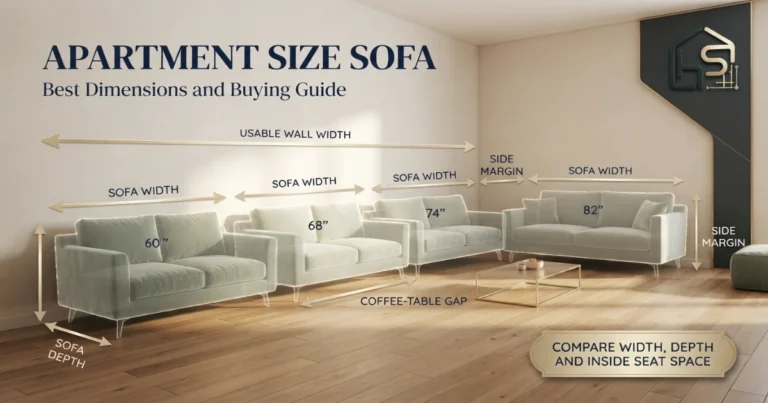
| Apartment sofa | 68–80 in | 32–38 in | 30–38 in | 2–3 | Compact main room |
| Standard sofa | 78–90 in | 34–40 in | 30–38 in | 3 | Typical living room |
| Large sofa | 90–100 in | 36–42 in | 31–40 in | 3–4 | Large living room |
These ranges are planning tools rather than fixed manufacturing rules. Arms, cushions, upholstery and frame style create substantial variation.
A compact loveseat may be only 50 to 60 inches wide, while a generously scaled loveseat can reach 72 to 76 inches. A compact sofa may overlap that same range.
Depth can be nearly identical. A small loveseat can be deeper than an apartment sofa, so choosing the shorter piece does not always save floor depth.
Usable seat width matters more than the label
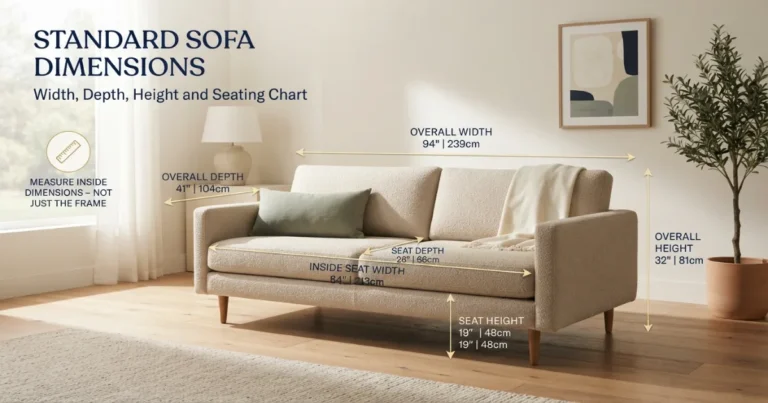
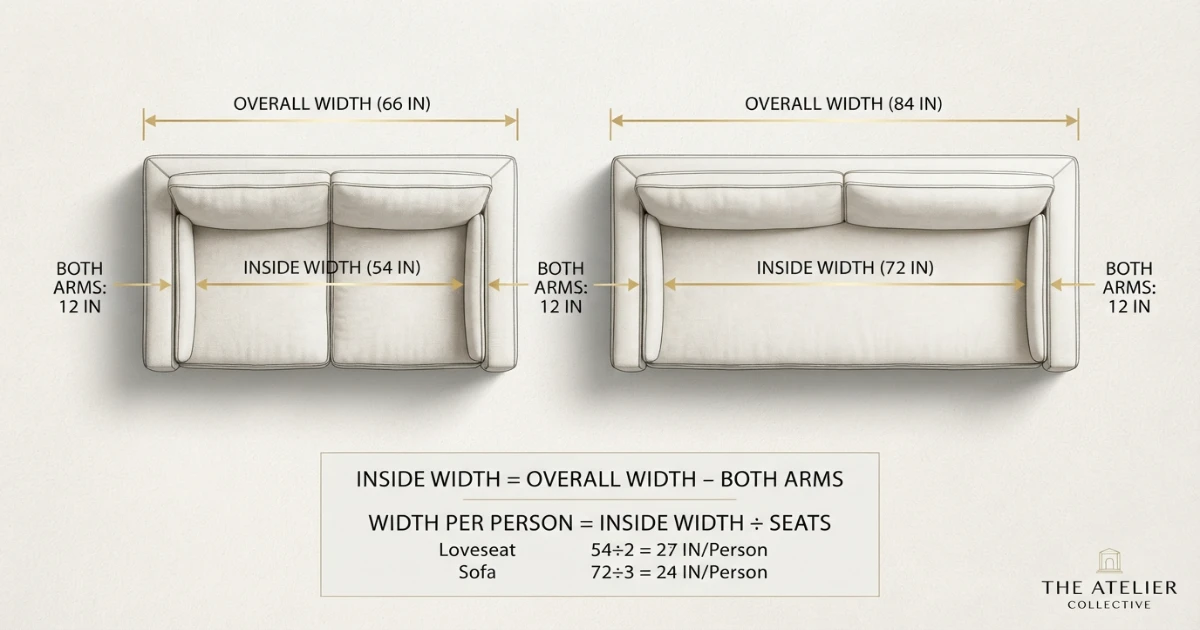
Overall width includes both arms. Inside seat width is the space available between the arms and is the better measurement for real seating capacity.
Usable-seat formulas
A 66-inch loveseat with six-inch arms provides about 54 inches of inside seat width. Two adults receive approximately 27 inches each.
A 70-inch loveseat with ten-inch arms provides only about 50 inches inside, or 25 inches per person.
An 80-inch sofa with five-inch arms provides roughly 70 inches inside and about 23.3 inches per person for three seats.
An 84-inch sofa with ten-inch arms provides 64 inches inside, making three places noticeably tighter.
Real product dimensions show the overlap
Current official product examples demonstrate why labels alone are unreliable. West Elm lists the Auburn Loveseat at 70 inches wide, 31 inches deep and 30.5 inches high, with a 64-inch seat width.
West Elm’s Bogart Loveseat is 60 inches wide and 32 inches deep, showing how two loveseats from the same retailer can differ by ten inches in width.
IKEA’s SALTSJÖBADEN three-seat sofa is approximately 80.75 inches wide and 34.625 inches deep, while IKEA’s KIVIK sofa is about 89.75 inches wide and 37.375 inches deep.
The larger KIVIK provides approximately 70.875 inches of seat width despite its nearly 90-inch overall width. Arms and construction account for a meaningful part of the footprint.
Loveseat vs sofa size by room
A loveseat vs sofa size decision should begin with usable wall width, room depth and the number of people who need a regular seat.
Choose a 50–66-inch loveseat when floor area and circulation are limited.
Use a 60–72-inch loveseat or apartment sofa. Keep depth controlled.
A 72–84-inch sofa usually balances seating and circulation.
A 90–100-inch sofa or sofa-plus-loveseat layout can fit comfortably.
Use the 10×10 Sofa Layout Guide, 12×12 Sofa Layout Guide and 15×15 Sofa Layout Guide for exact square-room examples.
A loveseat is useful when the room serves more than one function. It can preserve space for a desk, dining table, play area or wide circulation path.
A sofa is better when the room’s primary purpose is seating and regular three-person capacity matters.
Which is better for a small living room?
A loveseat is usually easier to place because it saves 12 to 24 inches of wall width compared with a standard sofa.
That difference can create room for a chair, floor lamp, bookcase or wider doorway path.
A compact sofa may still be the better value when three people use the room regularly. Slim arms and shallow depth can make a 72-inch sofa more useful than a 68-inch oversized-arm loveseat.
Wall mounting the television and choosing a compact table can allow the larger seating option without harming circulation.
Which is better for a medium living room?
In a medium room, a standard sofa usually becomes the primary choice because it fills the wall and supports family seating.
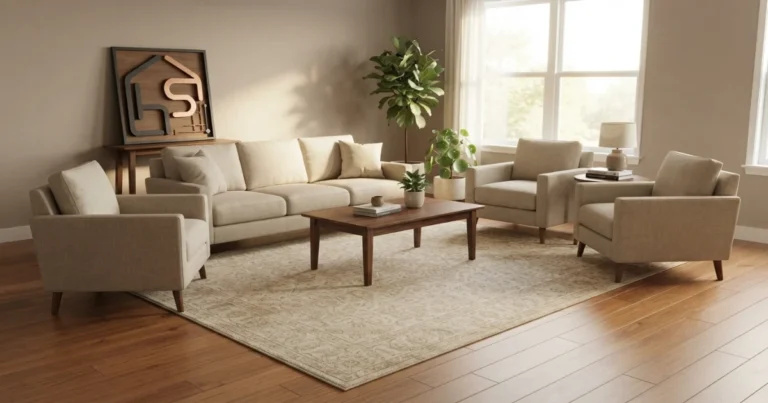
A loveseat can function as secondary seating at a right angle to the main sofa. This creates an L-shaped conversation group without the permanence of a sectional.
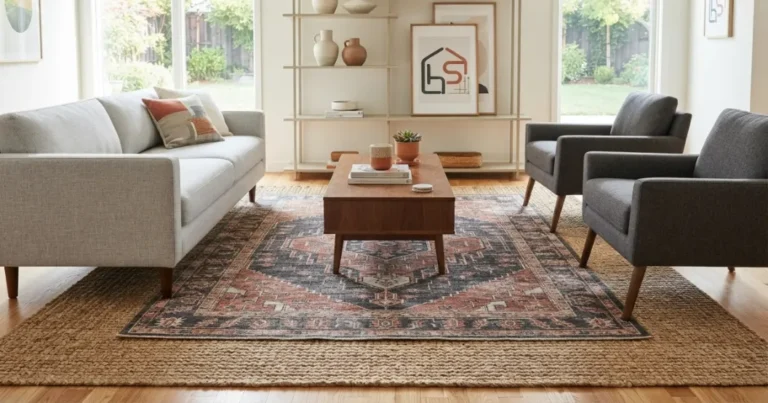
Use an 8×10 or 9×12 rug to connect the pieces. Leave the inside corner open enough for a table or comfortable transition.
If the room needs only two regular seats, a generously sized loveseat plus two chairs may be more flexible than a three-seat sofa.
Loveseat and sofa together in a large room
A sofa and loveseat can work well in rooms around 14×16 feet or larger. Arrange them in an L, across from each other or around a central table.
Choose related scale rather than identical collection names. A low, deep sofa can look mismatched beside a tall, shallow loveseat.
Keep seat height, arm height and visual weight reasonably compatible.
A large rug should connect both pieces. A 9×12 or 10×14 rug works for many arrangements.
Depth comparison
Loveseats and sofas often share the same frame depth within a collection. Width changes, but the back, seat and arm profile remain similar.
Overall depth around 32 to 36 inches is easier for compact rooms. Depth from 37 to 42 inches creates more lounge comfort but uses more floor area.
Seat depth and overall depth are different. Thick back cushions and frame structure reduce the usable sitting area.
Compare the exact product depth with the coffee-table gap, table depth and opposite furniture.
Height, seat height and visual scale
Overall height is usually less important for floor fit but strongly affects room appearance and delivery.
Low backs around 28 to 32 inches create an open modern look. Taller backs around 35 to 40 inches provide more visible support and presence.
Seat height commonly falls around 17 to 19 inches. A low seat can be harder to stand from, while a high seat changes the relationship with the coffee table.
A loveseat and sofa used together should have similar seat heights to maintain a coherent conversation group.
Comfort for two people
A loveseat places two people close together and uses floor area efficiently. It works well for conversation, reading and compact television viewing.
A sofa gives two people more personal space and room to stretch out. It also accommodates a guest without replacing furniture.
For daily use by two adults, compare inside width rather than the nominal seat count. A slim-arm sofa may provide dramatically more comfort.
For one person who likes to lie down, a sofa is usually better because most loveseats are too short for full-body lounging.
Families, children and guests
A sofa is the stronger primary seat for families because it supports more people and often offers a longer continuous cushion.
A loveseat can supplement a sofa or sit in a playroom, bedroom or office.
Children may fit more closely than adults, but purchase decisions should use adult seating needs when the furniture will remain for years.
A bench cushion offers flexible placement, while divided cushions visually assign each seat.
Sleeper loveseat vs sleeper sofa
A sleeper loveseat can provide a twin or compact full sleeping surface while preserving wall space. It suits offices and small guest rooms.
A sleeper sofa typically supports a larger mattress but requires more pull-out clearance.
Measure the furniture when open, not only when closed. Remove or relocate the coffee table before opening the bed.
Sleeper mechanisms add weight and affect delivery. Check packaged dimensions, stairs and elevator limits.
Reclining loveseat vs reclining sofa
A reclining loveseat can include two independent recliners and a center console, making it wider than a simple two-seat loveseat.
A reclining sofa often needs front footrest space for two or three positions and may require rear clearance.
Wall-hugger mechanisms reduce rear movement but do not eliminate the front extension.
Power models need outlet and cable planning. Avoid cords across walkways.
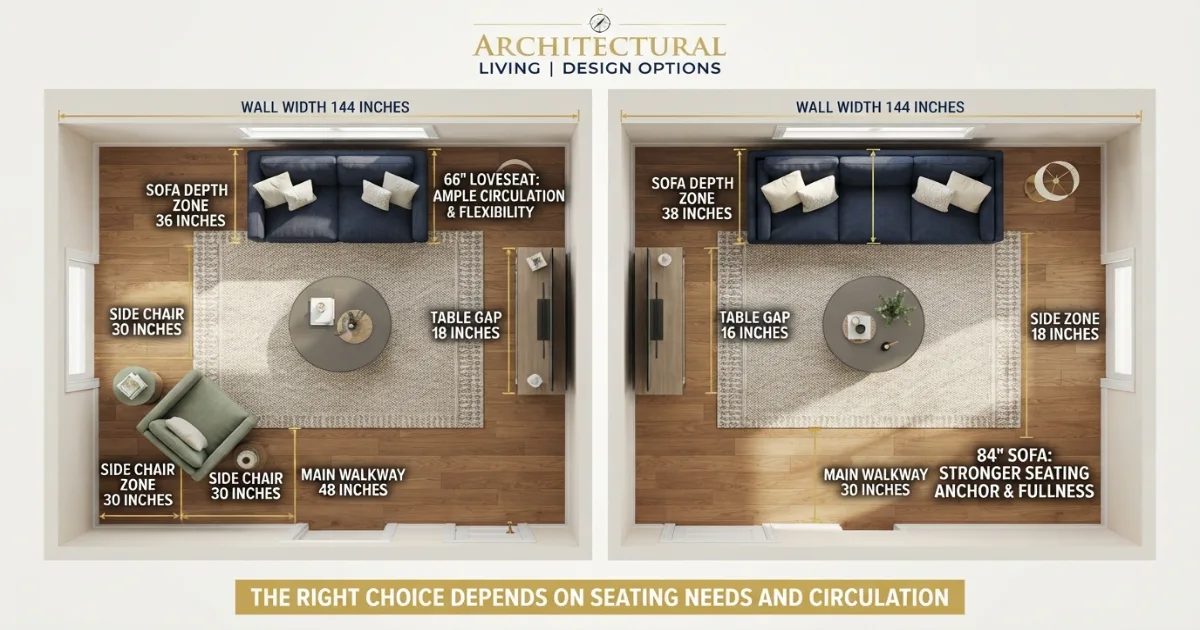
Layout and circulation comparison
The shorter loveseat creates more options for side tables, chairs and storage. The sofa creates more seating but can dominate the only usable wall.
Keep about 14 to 18 inches to the coffee table and 30 to 36 inches on the main route.
When furniture floats, include a rear walkway or console-table depth.
Outline both options on the floor before deciding. The extra twelve inches of a sofa may feel minor on paper but noticeable beside a doorway.
Rug-size impact
A loveseat works with 5×8, 6×9 or 8×10 rugs depending on the complete seating group.
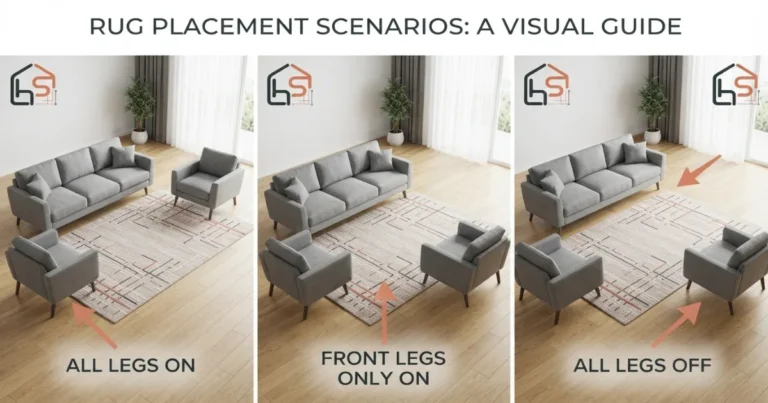
A standard sofa usually needs at least a 6×9 or 8×10 rug for balanced front-leg placement.
A sofa and loveseat together often need a 9×12 or 10×14 rug.
Use the Living-Room Rug Size Guide to compare all-legs, front-legs and floating-table arrangements.
Delivery comparison
For loveseat vs sofa size planning, the shorter option is usually easier to deliver, but depth, height and diagonal clearance must still be checked.
A loveseat is usually easier to carry through doors, stairways and elevators because its width and weight are lower.
Depth and height can still create problems. A short but deep loveseat may be difficult to pivot through a narrow hall.
Measure clear doorway width, doorway height, hall width, ceiling turns, elevator dimensions and diagonal depth.
Confirm whether legs, arms or backs are removable and whether the product arrives assembled or in modules.
Crate & Barrel’s furniture-measurement guidance recommends checking each doorway and hallway from the entry point to the final room.
Cost and value comparison
A loveseat is not always proportionally cheaper. Frame, upholstery, cushions and labor are similar, so reducing width may not reduce price dramatically.
Compare cost per usable seat, material quality, warranty and expected daily use rather than purchase price alone.
A sofa can provide better long-term value when the household regularly needs three seats or lounging space.
A loveseat may provide better value when the alternative is an oversized sofa that forces the room to lose a desk, chair or walkway.
When to choose each option
The best loveseat vs sofa size choice is the piece that meets daily seating needs without sacrificing the room’s main circulation path.
Two regular users, limited wall width, multipurpose room or secondary seating.
Need three seats but room depth and wall width remain limited.
Main family room, guests, lounging and stronger visual scale.
Medium or large room needing an L-shaped conversation layout.
When the next home is uncertain, prioritize adaptable dimensions, neutral styling and replaceable components.
Measure the packaged dimensions and largest rigid component. A product that arrives in boxes can be much easier to deliver than an assembled frame of similar size.
Modular or knock-down construction improves flexibility. Some sofas separate into arms, backs or seat units, while others remain one large frame.
A standard sofa may offer better primary-room value but can become difficult when moving into an apartment with narrow stairs or elevators.
A loveseat is easier to reuse in a bedroom, office, landing or secondary sitting area after a move. Its shorter width makes it compatible with more walls.
Future moves and layout flexibility
Compare fabric durability, cleaning code and replacement-cover availability along with dimensions.
Bench cushions reduce gaps where crumbs collect but may be heavier to rotate. Separate cushions are easier to handle but can shift during use.
Removable and washable covers are useful in homes with children or pets. Confirm whether the entire cover or only cushion covers can be removed.
A loveseat can be easier to move for cleaning and may expose more floor around it. However, deep cushions and fixed covers can make a small piece just as difficult to maintain.
A larger sofa has more upholstery area and usually more cushions to clean, rotate or replace. This may increase long-term maintenance even when the construction is identical.
Fabric, cushions and maintenance differences
Children, pets and lounging habits also change the decision. A longer bench cushion creates more flexible shared space.
Consider how people sit. Two adults who prefer personal space may find a sofa more comfortable than a loveseat, even though both technically provide two places.
For a household of three or more, a sofa usually provides better daily convenience. Guests can be handled with chairs, ottomans or dining chairs when needed.
For one or two regular users, a loveseat plus a movable chair may offer enough capacity while preserving open floor area.
Start with the number of people who use the room every day. Buying for rare large gatherings can leave the room oversized and less comfortable throughout the year.
Choose from daily use, not occasional maximum capacity
Painter’s tape outlines show floor footprint, but temporary boxes or chairs help test height and visual mass.
Use the complete furniture group to judge proportion. A loveseat with two chairs may fill a room more effectively than one long sofa, while preserving flexible seating positions.
Arm style, leg height and back height influence perceived scale. A low sofa on exposed legs can appear lighter than a tall skirted loveseat with rolled arms.
A sofa creates stronger visual weight and often anchors a main living room more successfully. It may look crowded in a bedroom, office or narrow apartment even when the dimensions technically fit.
A loveseat can look undersized on a long empty wall even when it provides enough seating. Side tables, chairs, lamps and artwork can help complete the composition without increasing the upholstered footprint.
Visual proportion and furniture scale
For small-room planning, apartment sofas are useful when three-seat flexibility matters but a standard 84 to 90-inch sofa would dominate the wall.
Compare the listed inside seat width, not only the outer width. The category name does not tell you how much space remains after both arms and back cushions are included.
Apartment sofas frequently use slimmer arms to maximize usable seating within a compact overall width. This can make a 72-inch apartment sofa feel more spacious than a 70-inch loveseat with bulky arms.
The difference is often in cushion layout and intended use. A loveseat may have two distinct seat cushions, while an apartment sofa may use one bench cushion or three visual seat divisions.
Retail category names are marketing labels rather than universal measurement standards. An apartment sofa may be only a few inches wider than a large loveseat, and both can seat two adults comfortably.
Why apartment sofas overlap with loveseats
Step-by-step buying process
Subtract doors, curtains, radiators and openings.
Include the table, opposite furniture and walkway.
Decide whether two or three regular seats are required.
Record width, depth and height for both options.
Check seat width, seat depth, seat height and arms.
Use painter’s tape and temporary tables.
Coordinate the complete room layout.
Check doors, halls, stairs and elevators.
Common loveseat vs sofa size mistakes
- Assuming every loveseat is shallow.
- Assuming every sofa seats three comfortably.
- Ignoring inside seat width.
- Choosing from product name rather than dimensions.
- Forgetting wide arms.
- Measuring the wall but not room depth.
- Ignoring coffee-table and walkway space.
- Buying a loveseat too short for lounging.
- Buying a sofa too large for a multipurpose room.
- Ignoring sleeper or recliner extension.
- Pairing mismatched seat heights.
- Measuring the room but not the delivery route.
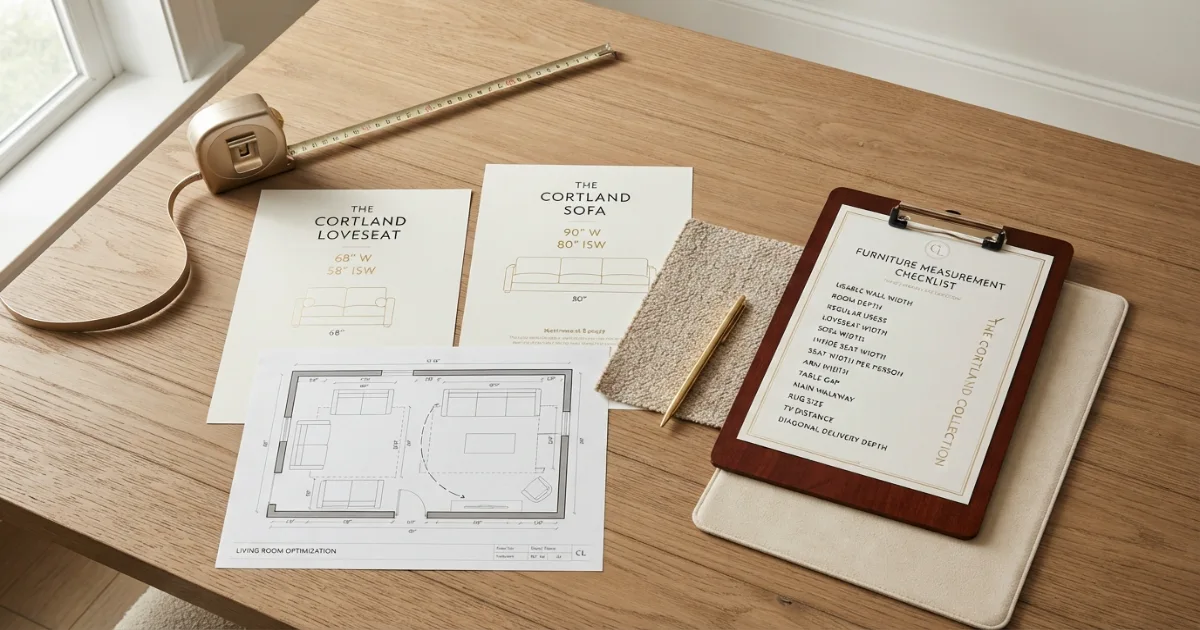
Loveseat vs sofa size buying checklist
- Usable wall width.
- Usable room depth.
- Regular number of users.
- Loveseat overall width, depth and height.
- Sofa overall width, depth and height.
- Inside seat width.
- Seat width per person.
- Seat depth and seat height.
- Arm width and arm height.
- Side tables and curtain space.
- Coffee-table gap.
- Main walkway.
- Rug size.
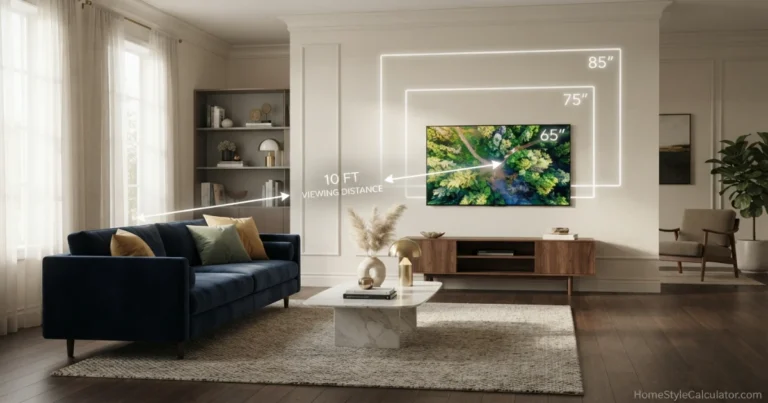
- TV viewing distance.
- Sleeper or recliner clearance.
- Doorway and hallway dimensions.
- Diagonal delivery depth.
- Removable parts and packaging.
- Warranty and return rules.
- Both footprints outlined before purchase.
Final answer: loveseat or sofa?
For loveseat vs sofa size, choose a loveseat when two seats and open floor area matter most. Choose a sofa when three-seat capacity, lounging room and guest seating are more important.
Loveseats commonly measure 52 to 72 inches wide. Sofas commonly measure 72 to 96 inches, but category names overlap.
Compare exact overall dimensions, inside seat width, arm width, room depth, circulation and delivery access before ordering.
Need the right seating size for your exact room?
Use the free Sofa Size Calculator, then compare the recommendation with this guide.
Official product and measurement references
Compare compact loveseats and apartment sofas
Compact Loveseats
Compare 50 to 70-inch loveseats by inside width, arm width, depth and delivery dimensions.
View Loveseats on AmazonApartment and Three-Seat Sofas
Compare 72 to 90-inch sofas by usable seat width, depth, cushions and removable parts.
View Compact Sofas on AmazonAffiliate disclosure: As an Amazon Associate, HomeStyle Calculator may earn from qualifying purchases.
Loveseat vs sofa size FAQs
What is the main size difference between a loveseat and sofa?
A loveseat is commonly about 52 to 72 inches wide and seats two people. A standard sofa is commonly around 72 to 96 inches wide and usually seats three.
Is a 70-inch couch a loveseat or sofa?
A 70-inch piece can be sold as either a large loveseat or compact apartment sofa. Check the manufacturer’s seating description and inside seat width.
How deep is a loveseat compared with a sofa?
Both often fall around 32 to 40 inches deep. A loveseat is not automatically shallower, so overall depth must be compared separately.
Does a sofa always seat three people?
No. Wide arms, cushion divisions and inside seat width affect real capacity. Some compact sofas seat two comfortably, while slim-arm models can seat three.
Which is better for a small living room?
A loveseat is better when circulation and multipurpose space matter most. A compact sofa is better when three-seat capacity is important and the wall supports it.
Can a loveseat and sofa fit in the same room?
Yes. Medium and large rooms can use a sofa and loveseat in an L-shaped conversation layout, provided the corner, rug and walkways remain clear.
How much wall space does a loveseat need?
Add the exact loveseat width plus side clearance for tables, curtains or lamps. A 66-inch loveseat with 6 inches per side needs at least 78 inches of usable wall.
How much wall space does a sofa need?
Add the exact sofa width plus the desired side margins. An 84-inch sofa with 9 inches per side needs at least 102 inches of usable wall.
Which is easier to deliver, a loveseat or sofa?
A loveseat is usually easier because it is shorter and often lighter, but depth, height, diagonal depth, removable legs and the delivery route still matter.
Should I buy a loveseat or sofa for two people?
Choose a loveseat for compact seating and more open floor area. Choose a sofa when both people prefer extra personal space, lounging room or guest seating.