Round vs Rectangle Dining Table: Which Uses Space Better?
Use this round vs rectangle dining table comparison to test the full floor footprint—not just the tabletop—against your room, chairs, traffic and real seating habits.
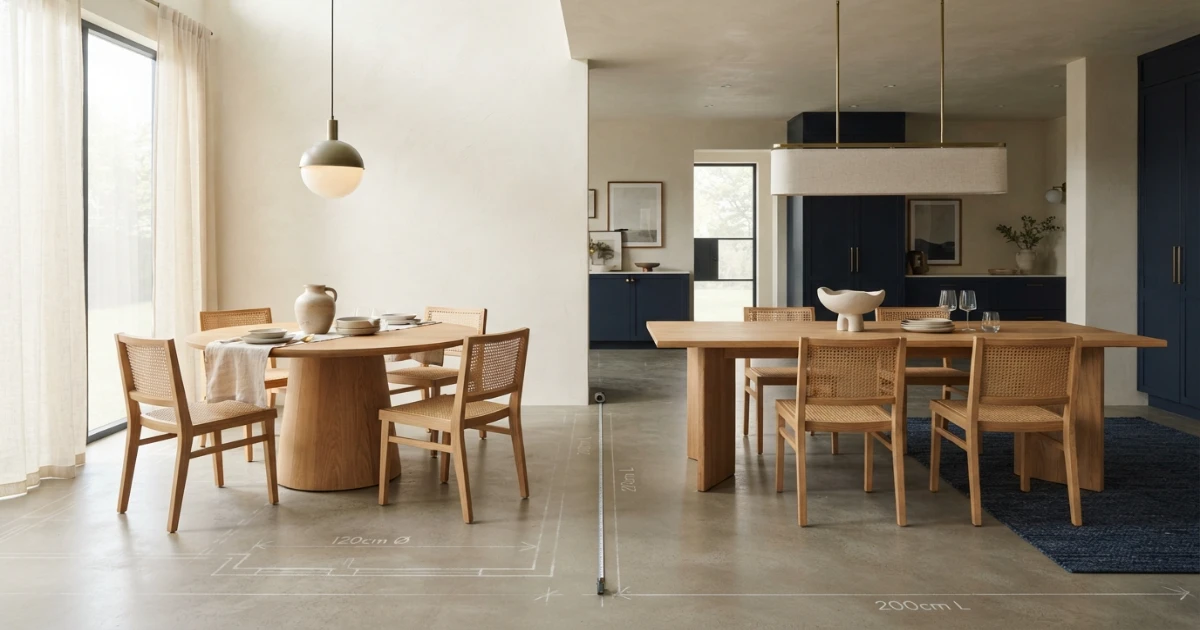
Round or rectangular dining table?
Choose a round table when the usable dining zone is close to square, four to six people need equal conversation, and you want smoother movement around the corners. Choose a rectangular table when the room is longer than it is wide, you need six or more regular seats, want generous serving space, or expect to use extension leaves.
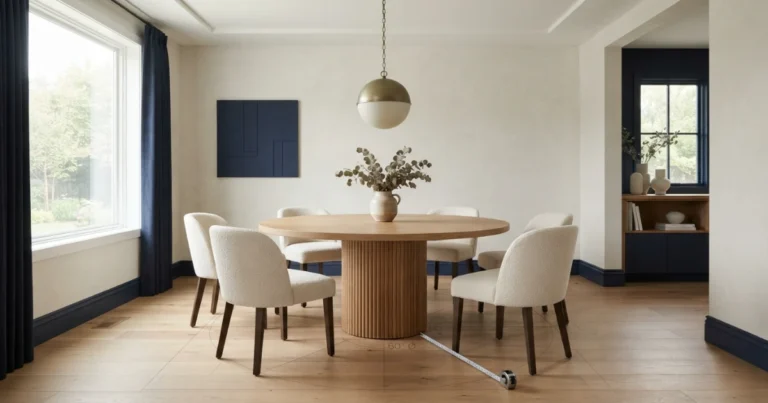
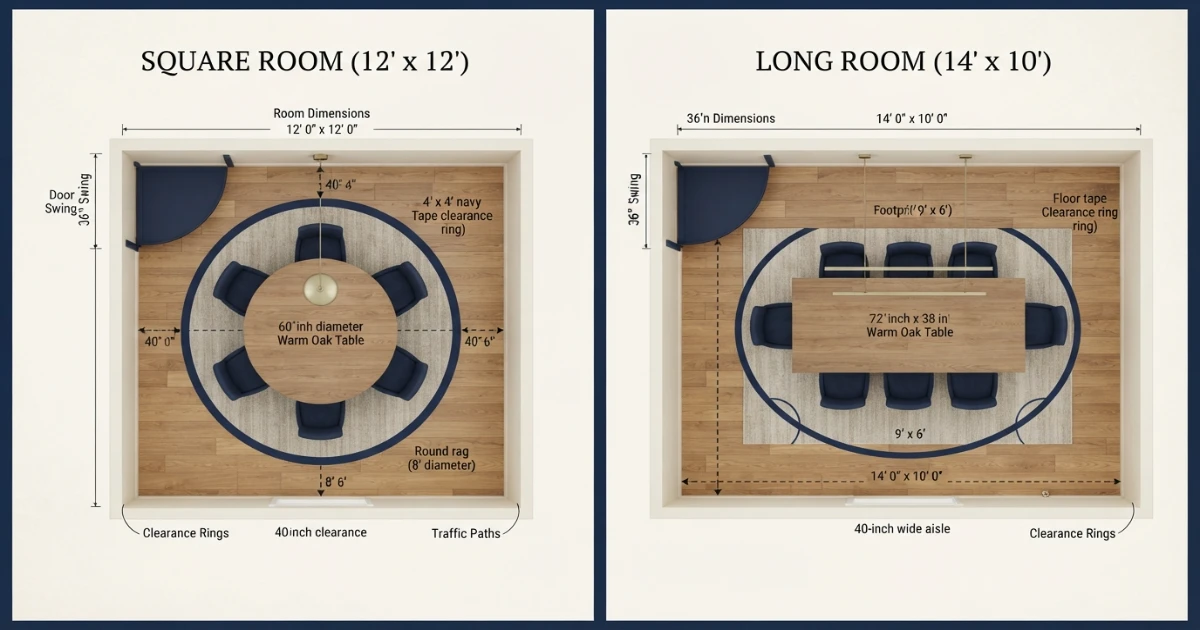
The most reliable round vs rectangle dining table decision comes from adding chair and walking clearance to the tabletop. A 48-inch round table with 36 inches around it needs a 120 × 120-inch zone. A 60 × 36-inch rectangle with the same clearance needs 132 × 108 inches. The rectangle is longer; the round table is wider in the room. Neither shape is universally smaller.
Round vs rectangular dining table comparison chart
A tabletop label tells only part of the story. This chart compares how each shape behaves after chairs, people and routes are added. Treat the dimensions as practical planning ranges; manufacturers do not use one universal seating standard.
| Decision factor | Round table | Rectangular table | Practical winner |
|---|---|---|---|
| Best room shape | Square or nearly square zone | Long, narrow or clearly axial zone | Match the table to the usable zone |
| Corner circulation | No projecting corners; movement feels softer | Corners require deliberate clearance | Round in tight transition areas |
| Large-group efficiency | Diameter grows in every direction | Length grows mainly on one axis | Rectangle for 8–12 people |
| Conversation | No head position; sightlines are more equal | Long tables create farther end-to-end distance | Round for intimate groups |
| Serving surface | Central area can be deep at larger diameters | Long usable runs suit platters and place settings | Rectangle for formal serving |
| Flexible chair count | Pedestal designs can accept an occasional chair | End seats and benches can add flexibility | Depends on base and chair width |
| Extension options | Many become oval when extended | Leaves preserve a familiar long layout | Rectangle for frequent expansion |
| Wall placement | Looks awkward pushed against a wall | Can work nearer a wall when a side is unused | Rectangle for multipurpose rooms |
| Visual effect | Softens boxy rooms and straight cabinetry | Creates order and aligns with islands or rugs | Choose according to surrounding lines |
| Base sensitivity | Pedestal size and stability matter | Corner legs, trestles and aprons affect seats | Measure under-table space |
Size chart for 2 to 12 seats
This round vs rectangle dining table chart gives balanced starting sizes and shows the room zone produced by a 36-inch clearance around the table. Compact chairs may fit a smaller top; wide armchairs, corner legs or generous place settings may require more.
| Seats | Balanced round size | Round room zone at 36″ | Balanced rectangle | Rectangle room zone at 36″ |
|---|---|---|---|---|
| 2 | 36″ diameter | 108 × 108″ | 36 × 30″ | 108 × 102″ |
| 4 | 42–48″ diameter | 114–120″ square | 48–60 × 32–36″ | 120–132 × 104–108″ |
| 6 | 54–60″ diameter | 126–132″ square | 60–72 × 36–40″ | 132–144 × 108–112″ |
| 8 | 66–72″ diameter | 138–144″ square | 84–96 × 38–42″ | 156–168 × 110–114″ |
| 10 | 78–84″ diameter | 150–156″ square | 108–120 × 40–44″ | 180–192 × 112–116″ |
| 12 | 90–96″ diameter | 162–168″ square | 132–144 × 42–48″ | 204–216 × 114–120″ |
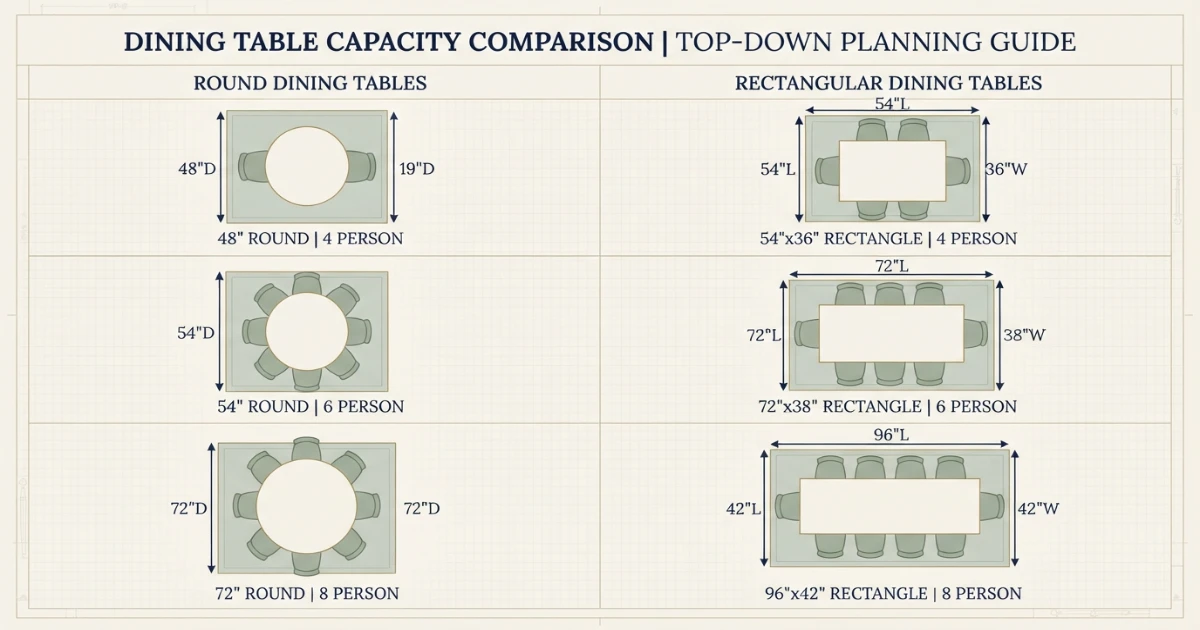
For six people, for example, a 60-inch round top and a 72 × 38-inch rectangle can both be comfortable. The round version needs width in every direction; the rectangle concentrates extra space along its length. That distinction is more useful than arguing that one shape always takes less room.
Which table shape fits your room?
Enter the usable dining zone—not the entire open room. This round vs rectangle dining table checker compares balanced sizes for the same seat count and tests the rectangle in both orientations.
Planning output only. Verify the exact product, chair width, base, apron, leaf and door swing before ordering.
Rectangle uses this long room more efficiently.
Both recommended tables fit with 36 inches of clearance. The room’s long axis favors the rectangular layout, while the round option leaves equal movement around its edge.
Next check: Confirm base placement and actual chair width.
Two useful table types to shop
After completing the round vs rectangle dining table test, use these links to open current Amazon results rather than relying on a price, rating or model that may change. Compare the exact top, base, chair and package measurements with your calculator result.
48-inch round pedestal dining table
A balanced starting point for four regular seats. A central base can reduce corner-leg conflicts and makes occasional chair repositioning easier.
- Check the true diameter and base width.
- Verify knee room where the pedestal flares.
- Allow more room for wide or swivel chairs.
- Confirm total package size for delivery.
Extendable rectangular dining table
A practical choice when everyday capacity is smaller than holiday capacity. Measure both closed and fully extended footprints before buying.
- Check dimensions with every leaf installed.
- Verify leg movement when the table extends.
- Measure usable distance between legs.
- Confirm leaf storage and opening method.
Affiliate disclosure: As an Amazon Associate, HomeStyle Calculator may earn from qualifying purchases. This does not change the price you pay. Product availability, dimensions and specifications can change; verify the live listing.
Why round can feel smaller without always using less floor area
A round vs rectangle dining table footprint can produce a different answer from a tabletop-only comparison.
No corners in the route
A circular edge lets people angle around the table rather than steering past four projecting corners. That makes a tight room feel calmer and reduces visual collision points. The effect is especially useful near a doorway, open-plan transition or breakfast nook.
But a round table’s required zone is square: a 60-inch diameter with 36 inches of clearance needs 132 inches in both directions. The center also becomes harder to reach as diameter increases. Round is therefore most space-friendly when the room is roughly square and the group is modest.
More capacity along one axis
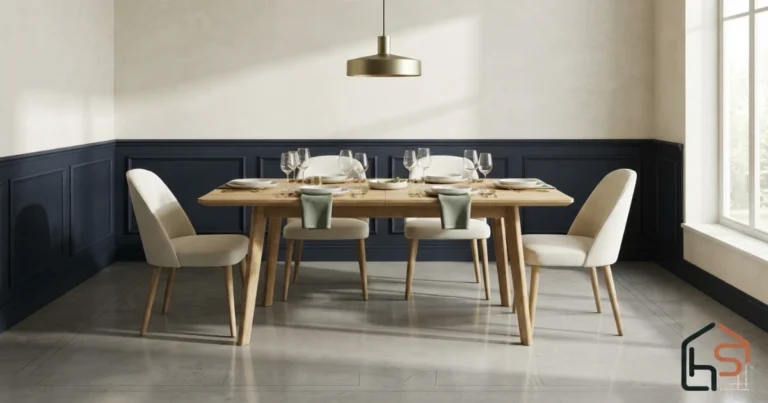
A rectangle adds seats by growing mostly in length. That makes it efficient in a dining room, extension or open-plan zone where one dimension is generous and the other is limited. A 72 × 38-inch table with 36-inch clearance needs 144 × 110 inches, which can work where a 60-inch round table’s 132-inch width cannot.
The trade-off is corner management. A chair, door or through-route that clips a corner can make a mathematically fitting table feel wrong. Orientation is crucial: rotate the rectangle before rejecting it.
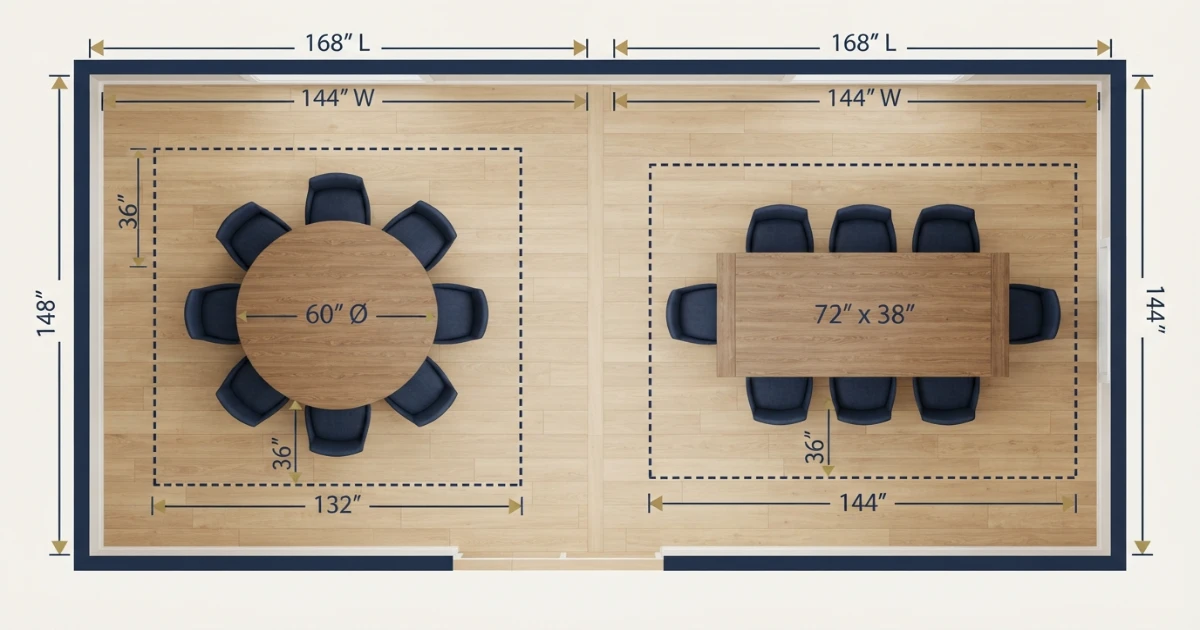
Match the table to the usable room—not the room label
Begin every round vs rectangle dining table decision with the dimensions of the protected dining zone.
Square dining room
A round table usually sits comfortably at the center and repeats the room’s balanced proportions. It can preserve diagonal movement between doors. A square or short rectangle can also work, but a long table may leave unused pockets at the ends while compressing the sides.
Long dining room
A rectangular table usually makes better use of length and maintains predictable side clearances. Align it with the room’s long axis. A round top large enough for the same group may consume too much width and still leave unusable space at both ends.
Open-plan dining zone
First protect the kitchen work aisle and main route. A rectangle can align with an island and define the dining zone; a round table can soften the transition from kitchen to living area. The winner is the shape that stays inside the dining boundary with chairs occupied.
Seating space: why the number on the listing can mislead
A trustworthy round vs rectangle dining table comparison must measure chairs, bases and place settings as well as the top.
A retailer’s “seats six” label may assume narrow armless chairs and close place settings. Room & Board advises considering roughly 18 to 24 inches per chair, while its table finder gives 54 inches as a starting round diameter for six and 60 × 30 inches as a minimum rectangular reference. Those figures are useful context, but your chairs and base determine the real capacity. See the current Room & Board table finder.
At a round table
- Measure circumference at the sitting edge, not the base.
- Check whether chair shoulders overlap when pulled in.
- Allow extra arc width for armchairs.
- Inspect pedestal feet where diners place their shoes.
- Avoid forcing extra seats if plates or elbows overlap.
At a rectangular table
- Measure clear space between legs, not overall length.
- Reserve end depth if using head chairs.
- Check trestle feet against chair legs.
- Allow serving space between opposing place settings.
- Verify apron clearance above knees and chair arms.
IKEA’s current catalog also separates tables by two-, four-, six-, eight- and ten-seat categories, yet products within each category vary by shape and construction. Use capacity filters to shortlist, then measure the exact item rather than treating the category as a dimensional guarantee. Review IKEA’s current dining-table categories.
Pedestal vs legs can reverse the shape decision
The base is often the deciding variable in a close round vs rectangle dining table choice.
Two tabletops with identical dimensions can seat different numbers of people. Base position controls usable chair bays, foot space and how easily an extra person can join.
Round pedestal table
A well-proportioned central pedestal removes four corner legs, so chairs can move around the circumference. This is a genuine advantage in a four- or six-person comparison. However, a wide pedestal foot can occupy the same floor zone as diners’ feet, and a narrow pedestal under a heavy top may feel less stable. Ask for base width, floor contact and load guidance.
Rectangular leg or trestle table
Four legs can create clean individual bays when they sit near the corners, but the space between them—not overall top length—sets side capacity. Trestles often free the corners but can block end chairs. Extension mechanisms may move the legs or leave them fixed. Check both closed and extended arrangements.
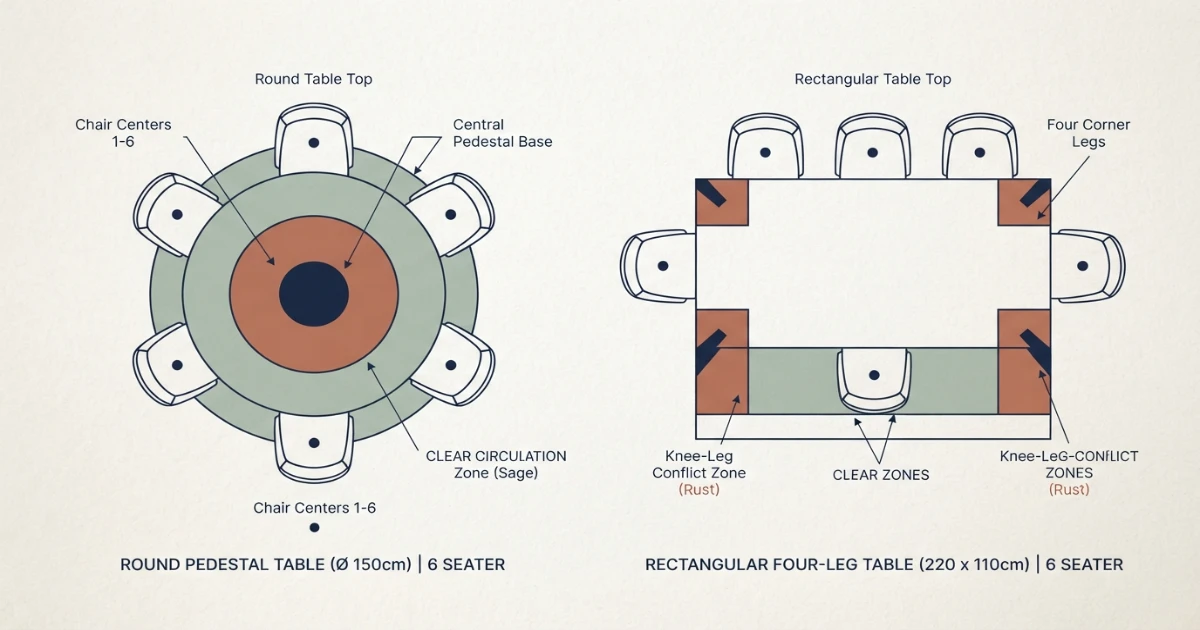
Add the space people use, not only the space furniture occupies
Use the same clearance standard on both options so the round vs rectangle dining table result remains fair.
30 inches: tight
This may let a chair pull out in a constrained room, but it is not a generous shared passage. It suits a low-traffic edge or occasional arrangement only after a real chair test.
36 inches: everyday target
This is a useful planning baseline from the tabletop edge to a wall or fixed obstruction. A diner can sit and stand, although passing behind an occupied chair may still be close.
42–48 inches: active route
Use more clearance where family members regularly walk behind seated diners, near a kitchen path, or where a door, sideboard or serving routine adds movement.
Which shape works better for the way you dine?
The best round vs rectangle dining table answer also depends on meals, hosting, homework and daily traffic.
Conversation and casual meals
Round tables keep everyone oriented toward the center and avoid a formal “head” position. For four to six people, voices and serving dishes remain relatively close. This is helpful for family meals, games and a relaxed breakfast space. The benefit weakens when the diameter becomes so large that diners across the center feel far apart.
Hosting and formal serving
A rectangle gives platters, candles and place settings a long, organized surface. End seats establish a visual head if desired. A leaf can increase capacity without requiring the larger daily footprint all year. If you regularly host eight or more, rectangular is usually the more manageable long-term choice.
Children and busy circulation
Removing corners can make a compact route feel more forgiving, but shape is only one safety factor. Stability, finish durability, glass-edge treatment and tip resistance matter more. Keep enough room for chairs to move without entering a kitchen work path.
Homework and remote work
A rectangular surface separates laptops, papers and meals more easily and can sit against a wall temporarily. A round table supports group collaboration but offers less edge length for independent workstations. Consider outlets, lighting and where a monitor or storage trolley will go.
Five round vs rectangle dining table examples
1. A 10 × 10 ft breakfast room for four
A 48-inch round table plus 36-inch clearance needs exactly 120 × 120 inches. It is mathematically tight but balanced. A 48 × 36-inch rectangle needs 120 × 108 inches and leaves 12 inches along one dimension. Both fit; round improves diagonal movement, while rectangle preserves a slightly wider service strip when oriented carefully.
2. A 9 × 12 ft dining zone for six
A 60-inch round top needs 132 inches in both directions with 36-inch clearance, so it exceeds the 108-inch room width. A 72 × 36-inch rectangle needs 144 × 108 inches and fits exactly along the 12-foot length. Rectangle is the clear geometric winner, although a smaller 54-inch round could be tested with compact chairs and tighter clearance.
3. An 11 × 11 ft room for six
A 60-inch round table needs 132 inches square, matching the room. A 72 × 38-inch rectangle needs 144 × 110 inches and is too long at full 36-inch clearance. The round table wins if the doorway and base work; a more compact 60-inch rectangle may also be possible but gives less surface per diner.
4. A 12 × 16 ft room for eight
A 72-inch round table needs 144 inches square and fits the room width exactly. A 96 × 42-inch rectangle needs 168 × 114 inches, leaving 24 inches of spare length and 30 inches of spare width beyond the required zone. Both fit. Rectangle provides more serving length; round creates an equal conversation arrangement.
5. An open-plan zone beside a 10-foot island
Do not measure from the wall through the kitchen. Establish the protected island work and stool aisle first, then measure the dining zone that remains. A rectangle aligned with the island often creates orderly parallel routes. A round table may work better at the end of the island where turning movement and intersecting paths need softer edges.
How to choose without guessing
- Define the usable dining zone. Exclude kitchen work aisles, open doors, sideboards, radiators, fixed benches and the main route through the room.
- Choose regular capacity. A household of four that hosts eight twice a year may need an extendable table, not a permanent eight-seat footprint.
- Pick candidate dimensions. Use the chart or the Dining Table Size Calculator, then shortlist exact products.
- Add clearance twice. Add the planned chair/walkway allowance to both sides of each table dimension.
- Check hidden restrictions. Measure chair width, leg spacing, apron height, pedestal foot, leaf position and arm clearance.
- Tape two footprints. Mark the round edge and rectangular corners, then mark pulled-chair boundaries. Walk every normal route while another person occupies a chair.
Common comparison mistakes
Comparing top area only
A smaller tabletop area does not guarantee a smaller functional footprint. Add chair pullback and walking clearance before comparing.
Ignoring rectangular rotation
A rectangle that fails in one orientation may fit when rotated. Test both directions while protecting doors and focal alignment.
Believing the seat label
Capacity depends on chair width, table base, legs and place-setting comfort. Verify usable edge length and under-table bays.
Using the total open room
A dining table cannot borrow the kitchen work aisle or the living-room circulation route. Define the zone first.
Forgetting the extended state
An extension table must fit with its leaf open, chairs added and serving routes active—not only in its everyday closed size.
Buying before a tape test
Scaled plans help, but a full-size floor outline reveals corner pinch points, chair collisions and awkward approaches immediately.
Which dining table shape should you buy?
In a round vs rectangle dining table comparison, round is usually the stronger choice for a nearly square room, intimate four-to-six-person seating, a central pedestal and routes that benefit from fewer corners. Rectangle is usually stronger for long rooms, six or more regular seats, end chairs, serving surface and predictable extension.
Do not choose by style alone. Calculate the complete footprint, test the rectangle in both orientations, inspect the base and tape the finalist on the floor. When both fit, choose according to how the room is used: round for equal conversation and softened movement; rectangle for capacity, alignment and adaptable hosting.
Round vs rectangular dining table FAQs
Does a round or rectangular dining table save more space?
A round table usually feels easier in a compact square room because it removes corners and softens circulation. A rectangular table normally uses a long or narrow room more efficiently and provides more usable surface for the same room width. The complete table-plus-clearance footprint decides the real winner.
Is a round table better for a small dining room?
Often, but not automatically. A 42- to 48-inch round table can work well for four in a nearly square zone, especially with a pedestal base. In a narrow room, a 48-by-30- or 36-inch rectangular table may leave a better continuous walkway.
Which table shape seats more people?
Rectangular tables scale to large groups more efficiently because length can increase without making the center too deep. Round tables encourage equal conversation, but diameters above roughly 60 to 72 inches create a wide center and demand a large square room.
What is the best table shape for six people?
A 54- to 60-inch round table or a 60- to 72-inch by 36- to 40-inch rectangular table can seat six. Choose round for a square conversational room and rectangle for a long room, end seating, serving space or frequent extension.
How much clearance should I leave around either table?
Thirty-six inches from the table edge to a wall or fixed obstruction is a useful everyday planning target. Thirty inches is tighter, while 42 to 48 inches is better where people regularly pass behind seated diners. Measure open doors, drawers and nearby furniture too.
Is a round table safer for a busy family?
Its lack of sharp corners can make circulation more forgiving, particularly in a compact multipurpose zone. Safety still depends on a stable base, adequate clearance, non-tipping construction and a surface appropriate for the household.
Are pedestal tables better than four-leg tables?
A central pedestal often gives a round table more flexible chair placement because there are no corner legs. Its base footprint can still collide with feet or chair legs, so check the base diameter, stability and knee clearance rather than assuming every pedestal is better.
Which shape is better for an open-plan room?
A rectangular table can reinforce the long axis of an island or living zone and create clear visual alignment. A round table can interrupt too many straight lines and improve turning space at a transition point. Protect the kitchen and through-route boundaries before styling the dining zone.
Can a round table fit the same number of people in less space?
Sometimes for four people, particularly with a pedestal and compact chairs. For larger groups, the required diameter grows in every direction, so the square room footprint may exceed that of a rectangular table placed along the room’s long axis.
Where can I calculate the correct dining table size?
Use the HomeStyle Calculator dining table size calculator for a general recommendation, then use the comparison checker on this page to test round and rectangular footprints in the same room.