Rug size for small living room: apartment layout guide.
Rug size for small living room planning starts with the usable floor, sofa width, chair position and walking route—not with the coffee table alone.
Written by Rehana K · Published and updated July 17, 2026.
Choose a rug that reaches the seating group without crowding the apartment.
The most practical rug size for small living room layouts is usually 5×7 for a compact accent, 6×9 for a loveseat or small sofa with front legs on the rug, and 8×10 for a larger apartment room that can support fuller furniture coverage. Measure the complete seating footprint, preserve the main walkway, and keep the rug clear of doors, media cabinets and storage. In many apartments, 6×9 is the strongest balance between connection and exposed flooring.
Rug size for small living room guide contents
Jump to the measurement, apartment layout or buying question that matches your room.
Calculate your apartment living room rug
Enter the usable room and seating footprint. The tool suggests the smallest standard rug that supports the selected placement while fitting the room.
Your apartment rug starting point
The calculator checks furniture coverage and the remaining room border.
Minimum working zone for the selected placement.
Oriented with the longer side along the sofa.
The selected rug fits the entered room.
Selected furniture relationship.
Rug size for small living room by apartment setup
This rug size for small living room chart is a starting point; confirm the sofa, chairs, doors and main walking route before buying.
| Apartment setup | Starting rug | Works for | Check before buying | Alternative |
|---|---|---|---|---|
| Reading corner or chair pair | 4 × 6 ft | Two chairs and a small table | Keep the walkway open | 5 × 7 for more connection |
| Loveseat and coffee table | 5 × 7 ft | Compact apartment seating | Front loveseat legs may sit near the edge | 6 × 9 for better anchoring |
| Small sofa with one chair | 6 × 9 ft | Front-legs-on placement | Orient 9 ft side along the sofa | 5 × 8 in a narrow room |
| Small sofa with two chairs | 6 × 9 or 8 × 10 ft | Connected seating group | Chair front legs and media-unit path | Two smaller rugs only for separate zones |
| Compact sectional | 8 × 10 ft | Front sectional legs and coffee table | Measure the chaise and corner return | 6 × 9 for a very tight room |
| Studio apartment living zone | 5 × 7 or 6 × 9 ft | Visual separation from the bed or dining area | Do not block the main studio route | Runner for a long narrow zone |
| Large apartment living room | 8 × 10 ft | Fuller sofa-and-chair coverage | Doors, storage and shortest floor border | 9 × 12 only when the room supports it |
What a small living room rug needs to do
A successful rug size for small living room choice must connect furniture, preserve circulation and respect the apartment scale.
Connect furniture
The rug should visually link the sofa, chairs and coffee table instead of floating far from every furniture leg.
Preserve circulation
The apartment entry, balcony door, media cabinet and main walkway must remain clear after the rug and pad are installed.
Respect room scale
The rug should feel substantial enough to anchor the seating zone without imitating wall-to-wall carpet in a compact room.
Rug size for small living room: the complete apartment method
Rug size for small living room decisions are difficult because compact rooms need two things that seem to conflict: enough rug to connect the furniture and enough exposed floor to keep the apartment open. A rug that is too small can look like a mat beneath the coffee table. A rug that is too large can crowd the walls, interfere with doors and make circulation feel tight.
The correct solution comes from measuring the usable room, identifying the furniture legs that should touch the rug and preserving the shortest path through the room. Apartment listings describe wall-to-wall dimensions, but the clear floor is smaller after a media unit, radiator, storage cabinet, dining edge or balcony door is considered.
Use the calculator above for a starting size, then compare the tape outline with the furniture in place. The Rug Size Calculator handles exact dimensions, while the Living Room Rug Size Guide explains larger and more formal seating plans.
The apartment rule that matters most
Measure the furniture group and the route around it. A rug should connect the seating without becoming an obstacle between the entry, sofa, television and adjacent room.
Step 1: measure the clear living-room floor
Start the rug size for small living room process by measuring the clear width and length after subtracting anything that permanently occupies floor space. Record the media console, built-in shelving, fireplace hearth, radiator, floor vent, apartment entry, balcony door and any dining furniture that shares the room.
Measure the narrowest usable point rather than assuming the room is a perfect rectangle. A sofa may sit in a 10-foot-wide area while a column or cabinet reduces the rug zone to 9 feet. This smaller dimension controls the maximum rug width.
Mark door arcs on a sketch. A low-pile rug can still interfere with a door when a pad is added. The rug edge should not sit directly under a frequently used threshold, and the pad should remain fully hidden beneath the rug.
Step 2: measure the seating footprint
For an accurate rug size for small living room decision, measure the sofa from outside arm to outside arm, then record the depth from the wall or back edge to the front legs. Measure chairs in their real angled positions rather than lining them up for convenience. The furniture footprint includes the distance between pieces, not only the furniture dimensions.
The coffee table should fit comfortably inside the seating group, but it does not determine the rug size for small living room layouts. The outer sofa and chair legs create the working boundary. A 4×6 rug may hold the coffee table while remaining far from every seat, which can make the room feel disconnected.
Step 3: choose the rug placement style
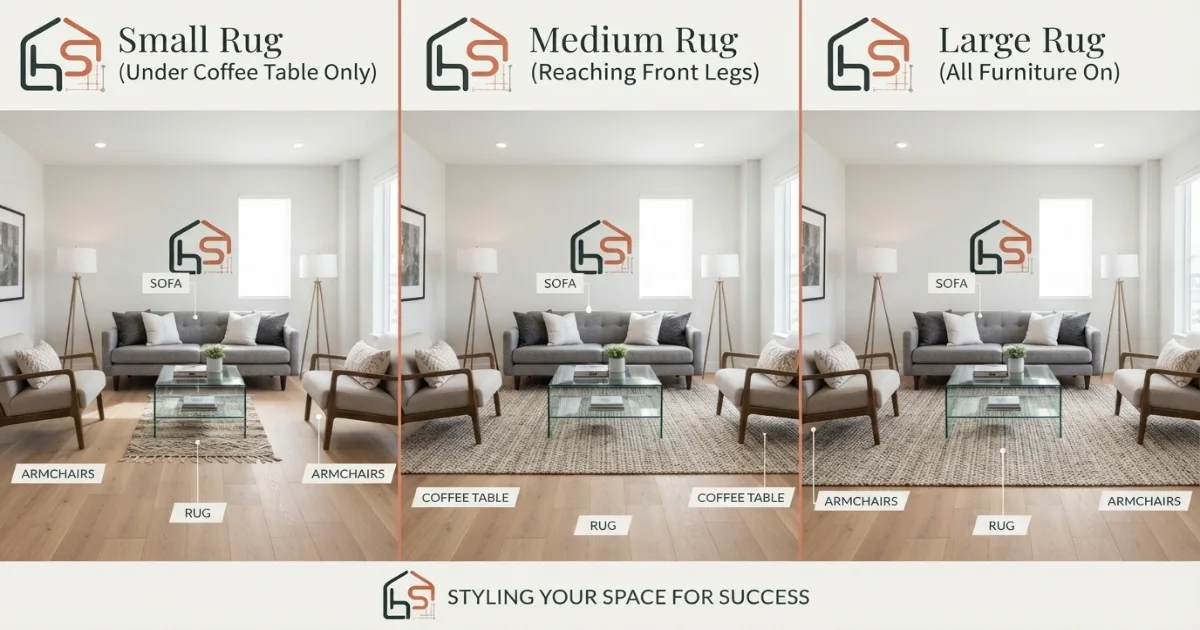
The rug size for small living room layout should match one of three practical placement styles. An accent rug sits beneath the coffee table and leaves surrounding furniture off the rug. A front-legs-on rug reaches beneath the front sofa and chair legs. A full-coverage rug holds most or all major furniture legs.
Front-legs-on placement is the strongest default rug size for small living room designs. It visually connects the seating group without requiring the depth and width of a full-coverage rug. The sofa and chairs should overlap the rug by enough distance that the legs do not sit on a curled edge.
An accent rug can work in a reading nook or deliberately minimal studio, but it should not look like a temporary mat. A full-coverage rug can make a small room feel luxurious when the dimensions permit, yet it must preserve doors, storage and exposed flooring.
Apartment room-size guidance
Apartment dimensions help narrow the rug size for small living room choice. In a room around 8×10 feet, a 4×6 or 5×7 rug may be the practical limit once the sofa, entry and media console are considered. A 6×9 can work only when the room shape and furniture arrangement leave a usable border.
In a 9×11 or 10×12 living room, a 6×9 is often the most flexible rug size for small living room use. It can reach the front legs of a loveseat or compact sofa and still leave visible flooring around the zone. An 8×10 may work in the larger room when the seating group is broad and doors remain clear.
Rug size for a narrow apartment living room
For a narrow apartment, the rug size for small living room should follow the sofa and room direction. A 5×8 or 6×9 may fit better than a wider 8×10 even when the floor area is similar. Do not rotate a rug solely to make the numbers fit; the orientation should support the seating direction.
Keep the shortest floor border visible near the television or opposite wall. When a rug nearly touches the media unit, the room can feel crowded and cables become harder to manage. In a narrow layout, place the front sofa legs on the rug and allow the rear legs to remain on the floor.
Studio apartment rug zoning
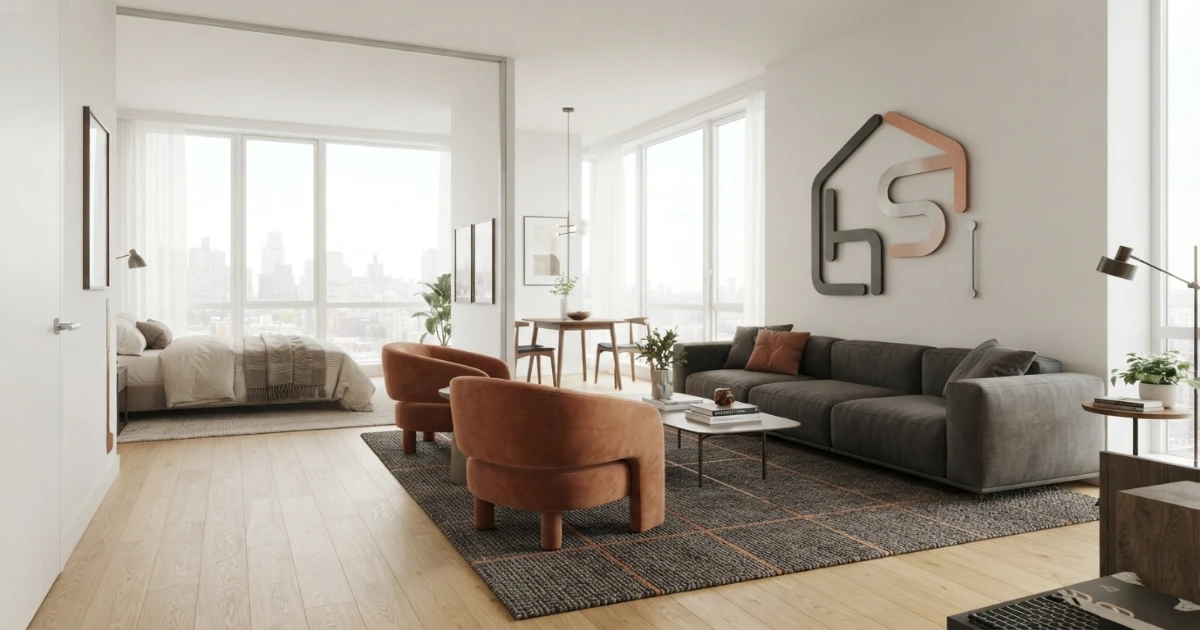
In a studio, the rug size for small living room zone should contain the sofa and coffee table while stopping before the bed or dining area. A 5×7 can define a loveseat area; a 6×9 can create a stronger living zone when the studio has enough width.
Align the rug with the sofa rather than the entire studio. The sleeping and dining areas may follow different directions. Leave a clear path from the entry to the kitchen and bathroom so the rug does not become a barrier.
Rug size for a loveseat
For a loveseat, the rug size for small living room usually begins at 5×7. A standard loveseat commonly measures about 52–72 inches wide. A 5×7 rug can work when the loveseat front legs overlap the 7-foot side, while a 6×9 rug gives more space for chairs.
For a loveseat against a wall, place the longer rug dimension parallel to the loveseat. Allow the rug to extend beyond both arms rather than ending exactly at the furniture width. The additional side border makes the arrangement feel intentional.
Rug size for a standard apartment sofa
With a compact three-seat sofa, the rug size for small living room usually begins at 6×9. A sofa around 72–84 inches wide can place its front legs and one chair on the rug when the 9-foot dimension follows the sofa width.
An 8×10 rug offers more side coverage and can connect two chairs, but it requires a wider clear room. Before upgrading, compare the shortest floor border near the media console, door and adjacent dining area.
Rug size for a small sectional
For a compact sectional, the rug size for small living room must include the chaise or corner return. Measure the outer width and full chaise depth. A 6×9 can work with the front sectional legs on the rug, while an 8×10 often creates a more balanced layout.
Do not center the rug on the empty room when the sectional is asymmetrical. Center it on the seating zone or coffee table, then check whether the rug extends far enough beneath the chaise and opposing chair.
Open-plan apartment living and dining zones
In an open-plan apartment, the rug size for small living room should define one seating zone rather than cover the entire combined room. Stop the living rug before the dining chairs’ movement area and preserve a clear route from the kitchen to the sofa.
Align the rug with the sofa and television. The dining rug, if used, should align with the table. A clear strip of flooring between the two rugs prevents visual merging and preserves the route from the kitchen to the seating area.
Coordinate colors without matching every detail. The Room Color Palette Generator can build a shared palette for the living rug, dining chairs and window treatments.
Room-size examples
These examples assume the rug is centered within the usable seating zone. Real apartments may have less space because of doors, storage and irregular walls.
| Clear room | Likely rug | Floor border | Best layout |
|---|---|---|---|
| 8 × 10 ft | 4 × 6 or 5 × 7 ft | 12–24 in at the shortest edge | Accent or compact loveseat |
| 9 × 11 ft | 5 × 7 or 6 × 9 ft | 12–24 in depending on orientation | Loveseat or small sofa, front legs on |
| 10 × 12 ft | 6 × 9 or carefully tested 8 × 10 ft | 12–18 in with the larger rug | Small sofa plus one or two chairs |
| 11 × 13 ft | 6 × 9 or 8 × 10 ft | 18–30 in | Fuller apartment seating group |
| 12 × 14 ft | 8 × 10 ft | 24 in or more | Small sectional or all-front-legs-on layout |
Rug size by sofa width
Sofa width is a useful shortcut, but chair positions and room depth still matter. The rug should normally extend beyond both sofa arms or connect to the chairs at the sides.
| Sofa width | Compact | Balanced | Full coverage |
|---|---|---|---|
| 48–60 in chair or loveseat | 4 × 6 ft | 5 × 7 ft | 6 × 9 ft |
| 60–72 in loveseat | 5 × 7 ft | 6 × 9 ft | 8 × 10 ft |
| 72–84 in apartment sofa | 5 × 8 ft | 6 × 9 ft | 8 × 10 ft |
| 84–96 in sofa | 6 × 9 ft | 8 × 10 ft | 9 × 12 ft in a large room |
| Compact sectional | 6 × 9 ft | 8 × 10 ft | 9 × 12 ft when the apartment supports it |
Front-legs-on placement
Front-legs-on placement is often the most efficient rug size for small living room arrangement. It connects the sofa and chairs without requiring the full depth of each piece. Place both front sofa legs on the rug and aim for similar overlap beneath the chairs.
The rug should extend beyond the sofa arms when possible. A rug that ends inside the sofa width can make the furniture appear too large for the room. Keep the coffee table fully on the rug and leave comfortable reach from every seat.
Use the tape test to confirm that chair legs do not sit directly on the edge. A few inches of overlap is more stable and visually cleaner.
All-legs-on placement
All-legs-on placement creates a polished rug size for small living room layout, but it requires more width and depth. An 8×10 may support a compact sofa and chairs in a 10×12 or larger clear room, while a 9×12 is rarely needed in a truly small apartment.
Measure the rear sofa legs and side tables. When only the sofa fits but the chairs fall off the rug, the layout is not truly full coverage. Consider front-legs-on placement instead of forcing a larger rug into a tight room.
Full coverage can work well on hard floors when the rug reduces echo and makes the seating zone feel warmer, but the exposed border and doors still need attention.
How much floor should remain visible?
The visible floor border helps confirm whether the rug size for small living room is balanced. The shortest edge should not disappear beneath a door or press against a wall. In many apartments, 8–18 inches of exposed floor at the tightest point looks intentional.
Do not force equal borders when the room is irregular. The rug can sit closer to the sofa wall and leave more space near the media unit or entry. Circulation and furniture function are more important than mathematical centering.
The rug pad should remain slightly smaller than the rug so it does not create a visible edge or catch a foot near the walkway.
Doors, storage and apartment circulation
Open the apartment entry, balcony door, cabinet doors and storage drawers during the tape test. A rug can fit the measured rectangle but fail when a door sweeps across the pile. Low pile reduces interference but does not eliminate it.
Keep the main route stable and clear. The U.S. Access Board accessible-route guidance explains clear-route principles for regulated spaces. Residential rug dimensions are not prescribed there, but the broad idea of maintaining unobstructed movement is useful.
The OSHA walking-working surfaces overview also reinforces the importance of stable walking areas. In a home, avoid curled edges, loose pads and abrupt transitions in the most-used path.
Best material and pile for an apartment living room
Material affects whether the rug size for small living room remains practical. Low- to medium-pile rugs fit more easily beneath sofa legs, doors and compact furniture. Flatweaves preserve door clearance, while a cushioned low pile can improve comfort and sound absorption.
Washable construction is useful in apartments, but check the real cleaning method. An 8×10 washable rug may still be too large for a home washing machine. The Carpet and Rug Institute cleaning guidance provides general care information; the manufacturer’s label remains the final authority.
Use a floor-compatible pad. Natural rubber or felt combinations can reduce movement, but confirm compatibility with vinyl, laminate or finished wood.
Color and pattern in a small room
A rug can make a compact apartment feel calmer or busier. Tonal patterns, small-scale motifs and colors related to the sofa or curtains create continuity. A bold border can visually shrink the usable center, while an all-over pattern can make the full rug area feel more consistent.
Light colors reflect more light but show marks quickly. Mid-tone patterns are forgiving in high-use living rooms. The rug does not need to match the sofa; it should repeat one or two colors from the wider room.
Common rug size for small living room mistakes
- Choosing from the coffee table: the outer seating legs determine the useful footprint.
- Buying 4×6 for a full sofa: it often looks like a mat rather than a room anchor.
- Rotating the rug to force a fit: the long side should normally follow the sofa and room direction.
- Ignoring the apartment entry: the rug and pad can interfere with the main door.
- Centering on the room instead of the seating: irregular apartment layouts need furniture-centered placement.
- Using thick pile near doors: even a correctly sized rug can become impractical.
- Assuming bigger is always better: an 8×10 can crowd storage and circulation.
- Skipping the tape test: product photos do not show the real 5×7, 6×9 or 8×10 footprint.
Small living room rug pre-purchase checklist
- Measure the clear room after accounting for doors, media units and storage.
- Measure the sofa, chairs and the complete seating depth.
- Choose accent, front-legs-on or full-coverage placement before selecting a size.
- Orient the longer rug dimension with the sofa or main room direction.
- Tape the full outline and move through the room normally.
- Open every nearby door, drawer and cabinet.
- Check the retailer’s exact dimensions, pile height and return policy.
- Select a floor-compatible rug pad slightly smaller than the rug.
Final rug size for small living room decision
Choose 4×6 when the rug is intentionally limited to a reading nook or coffee-table accent. Choose 5×7 for a loveseat, two-chair group or compact studio zone. Choose 6×9 as the best general rug size for small living room layouts with a small sofa and front furniture legs on the rug.
For a clearer sense of physical scale, compare How Big Is a 5×7 Rug with How Big Is an 8×10 Rug before choosing the final apartment layout.
Choose 8×10 when the clear apartment room supports fuller furniture coverage and the rug can remain clear of doors, media storage and the main route. Choose no rug—or reconsider the furniture plan—when every standard size either looks disconnected or crowds the room.
The best purchase is the smallest rug that connects the intended furniture while preserving circulation. Tape at least two sizes before ordering and compare them from the apartment entry, sofa and adjacent room.
| Placement | Furniture position | Main benefit | Best use |
|---|---|---|---|
| Accent | Furniture legs remain off the rug | Preserves the most exposed flooring | Reading corner, studio or very small room |
| Front legs on | Front sofa and chair legs overlap the rug | Connects the seating efficiently | Best default for many apartments |
| All legs on | Most major furniture sits fully on the rug | Creates a polished unified zone | Larger apartment rooms |
| No rug | Furniture remains on the hard floor | Protects circulation when no size fits | Very tight rooms or frequent door conflicts |
A balanced 6×9 front-legs-on arrangement
This rug size for small living room top view shows why a 6×9 often connects a compact sofa and chairs without covering the whole room.
Plan the rest of your apartment living room
Use these tools after the rug size for small living room footprint is confirmed.