Rug placement rules: should furniture legs be on or off?
Rug placement rules depend on the room, furniture footprint and movement: use all legs on for full anchoring, front legs on for connection, or legs off for a deliberate accent.
Written by Rehana K · Published and updated July 17, 2026.
Use one consistent furniture-to-rug relationship.
The most reliable rug placement rules are: all legs on for a large or floating furniture group, front legs on for most medium living rooms, all major legs off only for a deliberate accent, and every dining-chair leg on the rug during movement. Bedroom and office placement depend on landing space and chair travel rather than a universal leg rule.
Rug placement rules guide contents
Jump to the room, furniture relationship or placement question that matches your layout.
Check whether furniture legs should be on or off
Enter the room, rug and furniture footprint. The checker evaluates rug fit, coverage and the selected placement goal.
Your furniture-to-rug relationship
The checker uses the best rug orientation and compares it with the entered furniture footprint.
The rug connects the group without full coverage.
Approximate footprint relationship.
The rug fits the room.
Best direction inside the entered room.
Rug placement rules by room and furniture
Use this chart as a starting point, then measure the actual furniture footprint and movement zone. These rug placement rules are planning guides, not substitutes for real dimensions.
| Room or setup | Starting rule | Furniture relationship | Functional check | Alternative |
|---|---|---|---|---|
| Medium living room | Front legs on | Sofa and main chairs share the rug edge | 6–12 in overlap beneath front feet | All legs on with a larger rug |
| Large/open living room | All legs on | Complete seating group inside the rug | Visible rug beyond outer furniture legs | Front legs on when a walkway must remain open |
| Small accent zone | Legs off | Furniture closely frames a central rug | Rug wider than coffee table | Move to front legs on for stronger connection |
| Dining room | All chair legs on | Chairs remain supported when pulled back | 24–30 in beyond the tabletop | Larger or custom rug |
| Bedroom | Bed partly or fully on | Useful side and foot landing area | Symmetrical exposed rug | Two runners beside the bed |
| Home office | Desk and chair path on | Rolling chair stays on one surface | Test pulled-back caster position | Stationary chair with a smaller rug |
All legs on
Best for large rooms, floating seating and a complete furniture island.
Front legs on
Connects sofas and chairs without requiring full furniture coverage.
Legs off
Works only as a deliberate accent with furniture closely framing the rug.
See the furniture relationship before choosing a size and applying rug placement rules
The rule is connection, not a universal number of legs
Rug placement rules are easiest to understand when you stop treating “legs on or off” as a strict decorating law. The real purpose of an area rug is to connect furniture that belongs together, support movement and create a clear room zone. All legs on, front legs on and furniture off can each be correct when the relationship looks deliberate and the room remains usable.
The strongest choice depends on the furniture footprint and the available rug size. A large living room may support every sofa and chair leg on one rug. A medium room often looks more balanced with only the front legs on. A small room may use an accent rug with all furniture off, but the pieces should remain close enough to frame the rug rather than floating far away.
Use the Rug Size Calculator when exact dimensions matter. The broader Interior Size Guide helps coordinate sofas, tables and clear walking paths.
The placement principle that matters most
Keep the furniture-to-rug relationship consistent. A sofa with two front legs on the rug and matching chairs positioned similarly looks intentional; random legs crossing different edges usually look accidental.
All furniture legs on the rug
The all-legs-on layout places the complete sofa, chairs and side tables inside the rug boundary. It creates the most unified and formal seating zone because the rug reads as a platform beneath the entire group. This option is especially useful in large living rooms, open plans and floating furniture arrangements where the seating group is away from the walls.
For these rug placement rules to work, the rug should extend beyond the furniture rather than ending directly under the rear feet. A visible border of roughly 6 to 18 inches beyond the outer furniture legs usually makes the composition feel settled. The exact amount depends on room scale and whether a walkway passes behind the sofa.
The all-legs approach requires a large rug. Measure from the outside edge of one chair to the outside edge of the opposite chair, then include the sofa depth and any side tables that should remain inside the zone. A living room rug guide can help translate that footprint into a standard size.
Front legs on the rug
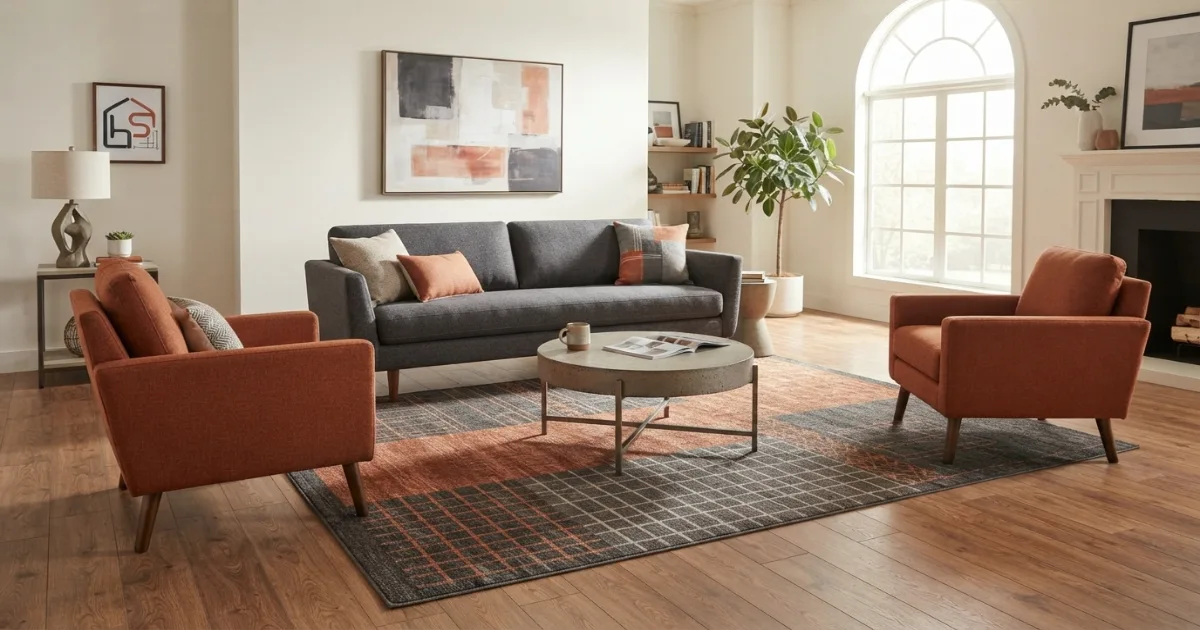
Front-legs-on is the most flexible option for medium living rooms. The rug reaches beneath the front feet of the sofa and chairs while the rear feet remain on the floor. This creates visual connection without requiring the rug to support the complete furniture depth.
Aim for meaningful overlap. A thin edge barely touching the furniture can look hesitant. In many rooms, allowing 6 to 12 inches of rug beneath the sofa base gives the placement enough visual weight. Keep the front legs of the main chairs on the rug as well, particularly when they face the sofa across a coffee table.
These rug placement rules work well with 6×9, 8×10 and 9×12 rugs depending on the sofa width and seating-group depth. Use the Sofa Size Calculator and Coffee Table Size Calculator when the seating group is still being planned.
All major furniture legs off the rug
An off-rug or accent placement keeps the sofa and chairs fully on the surrounding floor while the rug sits beneath the coffee table or in the open center. This is acceptable in a compact room, a reading nook or a layout where a larger rug would block a door. The rug must still relate to the furniture group.
Keep the gap between the rug and seating relatively small and even. When a 5×7 rug sits several feet away from a large sofa, it behaves like an isolated island. When the same rug is framed closely by a loveseat and two chairs, it can read as a purposeful central accent.
Off-rug rug placement rules are not a reason to choose the smallest available product. The rug should be wider than the coffee table and substantial enough to hold the visual center of the room. Compare 5×7 vs 8×10 and 5×8 vs 6×9 before deciding.
When a floating rug looks wrong
A floating rug is not defined only by furniture legs being off. It becomes a problem when the rug is too small, too distant from the seating and unrelated to the room’s main axis. The coffee table may sit on it, but the larger furniture forms a separate ring with no visual connection.
The fix is usually one of three actions: move the seating closer, increase the rug size or switch to a deliberate front-legs-on layout. Do not center the rug in the empty room when the furniture group is offset. Center it on the usable seating arrangement.
The best rug placement rules follow the furniture, not the wall dimensions alone. A room can be rectangular while the active seating zone occupies only one end. Align the rug with that zone and preserve the main walkway.
Living-room rug placement rules
Living rooms allow all three leg relationships, but the sofa and main chairs should share one rule. In a compact room, the front-legs-on arrangement is usually the strongest balance. In a large open room, all legs on creates a complete island. A small accent rug works when the furniture is close and the center needs color or softness rather than full support.
Place the rug’s longer dimension along the main seating or room direction. A standard sofa usually benefits from a rug at least as wide as the sofa and often wider. Avoid a rug that ends well inside the sofa arms unless the design is intentionally a small accent.
Check the small living room rug guide for apartments and the sectional rug guide for L-shaped seating. These pages apply the same rug placement rules to specific furniture footprints.
Sectional sofa: which legs go on?
A sectional creates a wide, asymmetrical footprint. With a compact sectional, placing the front legs of both the main sofa section and chaise on the rug usually creates the cleanest connection. The rug should extend beneath the chaise rather than stopping at its inside edge.
All legs on can work when the room supports a large 9×12, 10×14 or custom rug. Measure the outer sectional width and chaise depth, then include chairs or side tables that belong to the same conversation area. If one furniture piece must remain off the rug, keep the relationship visually balanced rather than allowing one isolated leg to sit on an edge.
These rug placement rules are especially important with a modular sectional because the pieces can shift. Use a compatible rug pad and keep the rug flat beneath the most frequently used seats.
Dining-room rule: every chair leg stays on
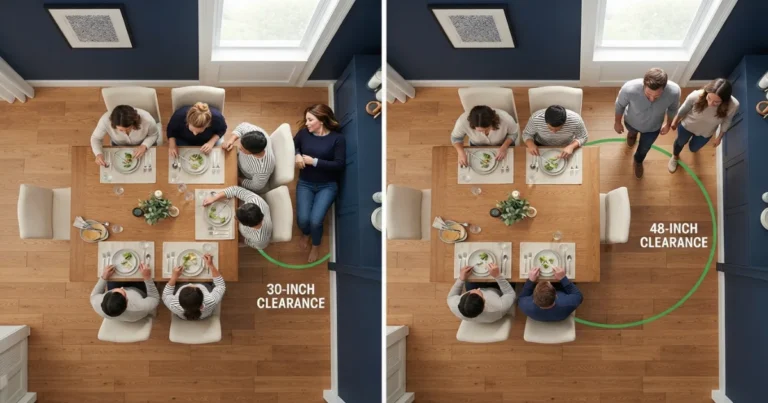
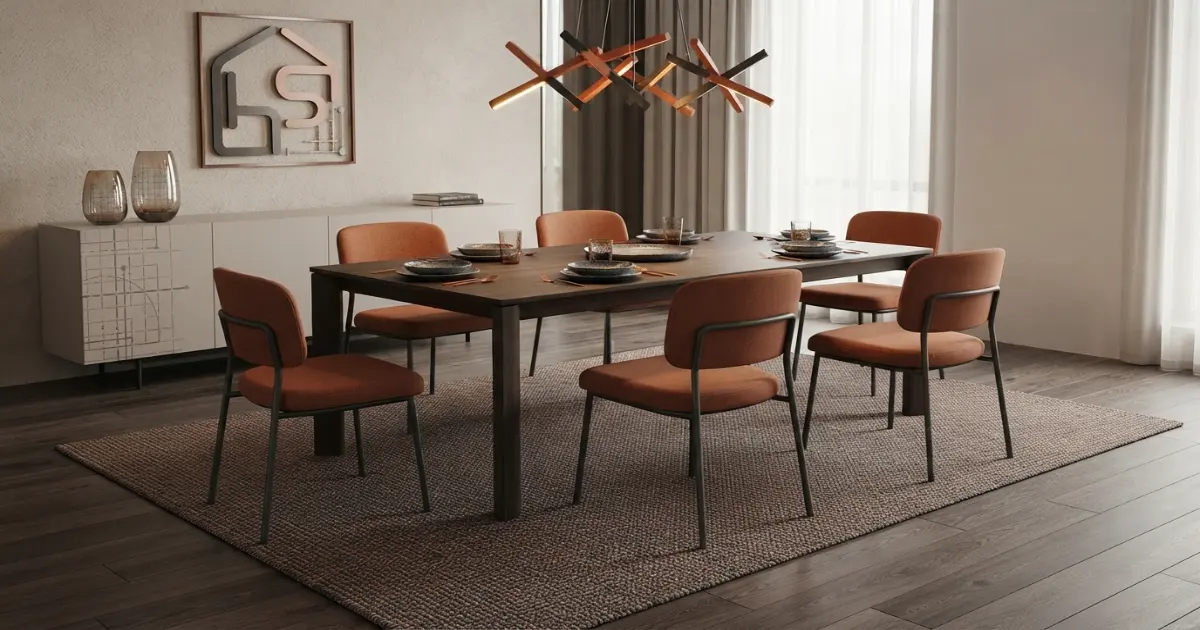
Dining rooms have a stricter functional requirement. All chair legs should stay on the rug when chairs are tucked in and pulled back. A rear chair leg dropping onto the hard floor can catch the rug edge when the chair is pushed forward.
Measure the tabletop and add approximately 24 to 30 inches beyond every edge. Deep upholstered chairs or end armchairs may need more. Measure extension leaves in the position used regularly. The detailed Dining Room Rug Size Guide, 6-Chair Table Guide and 8-Chair Table Guide provide size charts.
Unlike living-room rug placement rules, a partial chair arrangement is rarely successful. A rug that supports only the front chair legs when chairs are tucked in is normally too small for real use.
Bedroom rug placement rules
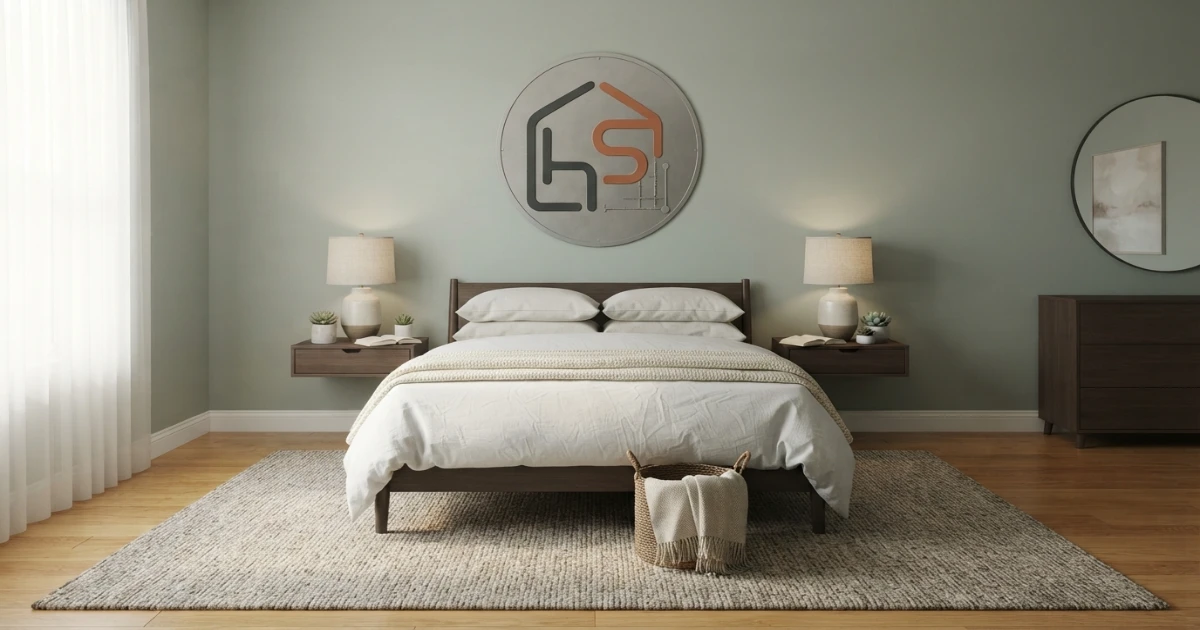
Bedroom placement is based on soft landing space rather than furniture conversation. A large rug can sit beneath the bed and nightstands for full coverage. A lower placement can begin in front of the nightstands and extend beyond both sides and the foot. Two runners can also provide separate side landings.
Nightstands do not have to sit on the rug, but the placement should be symmetrical. When the rug starts below the nightstands, align it evenly beneath the bed and preserve useful coverage where feet touch the floor. A rug that shows only a few inches at the sides is usually undersized.
Apply these rug placement rules with the Twin Bed, Full Bed, Queen Bed and King Bed guides.
Home-office desk and chair placement
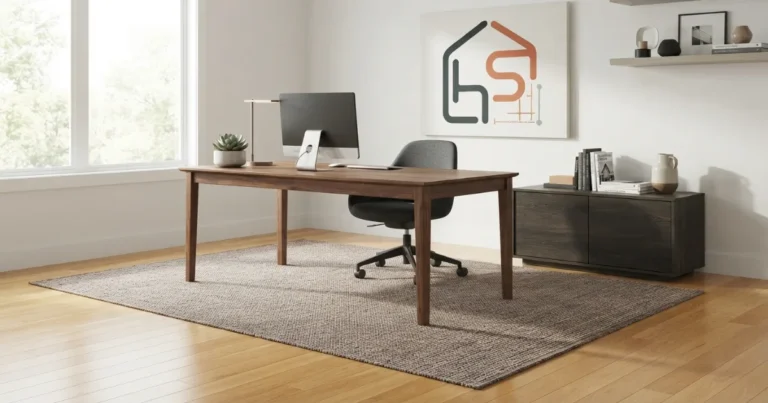
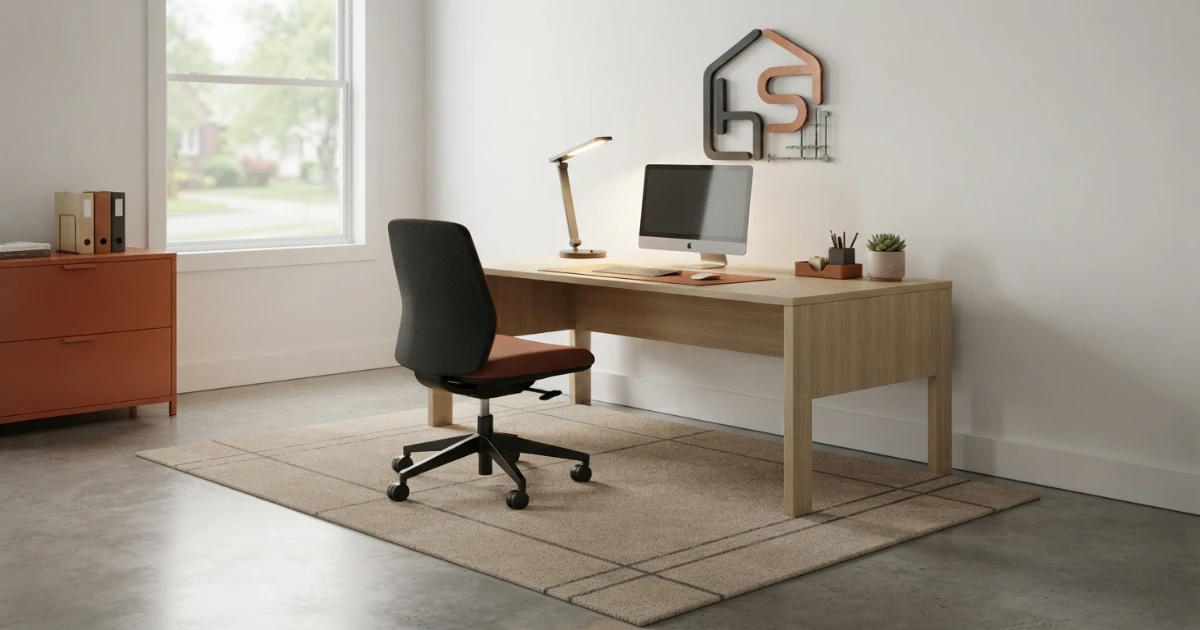
In a home office, the desk can sit fully on the rug, partly on it or just beyond it, but the rolling chair needs a stable movement zone. The chair should not repeatedly cross a thick rug edge during normal work. Include the pulled-back position, not only the tucked-in desk footprint.
A 5×7 rug may work under a compact desk with a stationary chair. A 6×9 or 8×10 rug is often more useful when the desk, chair path and guest chair should share one zone. The Home Office Rug Size Guide includes a dedicated estimator.
Office rug placement rules should also protect cable routes, floor vents and door clearance. Use low pile when casters need to move smoothly and keep the pad hidden inside the rug edges.
Small-room placement without visual crowding
A small room does not automatically need a tiny rug. One sufficiently large rug can make the furniture feel more connected and the floor less fragmented. The mistake is choosing a rug that touches walls, blocks doors or leaves no visible floor border.
Use front legs on when all-legs coverage would crowd the room. Keep the rug aligned with the furniture and leave the main path clear. In a studio, one rug can define the living zone while another smaller rug marks the sleeping or dining zone, but the edges should not collide.
For compact spaces, combine these rug placement rules with the Small Room Design Guide and Standard Rug Sizes Chart.
Open-plan rooms and zone boundaries
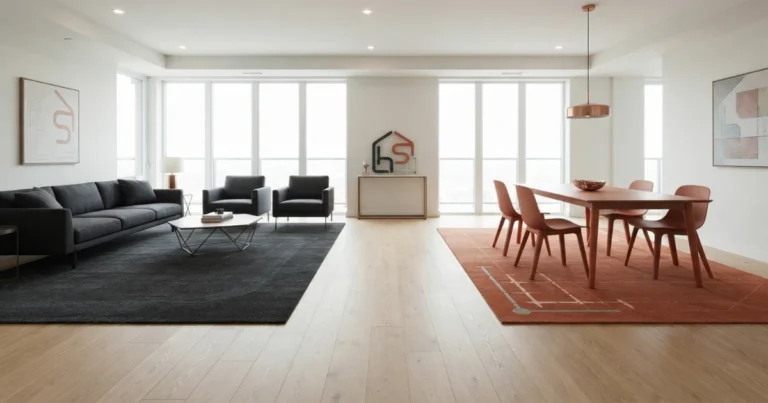
In an open plan, the rug should contain the furniture that belongs to one activity. A living rug may hold the sofa and chairs while a separate dining rug supports the table and pulled-back chairs. Keep a visible strip of floor between the zones so they read as related but distinct.
All legs on is especially useful for a floating seating group because the rug becomes a clear island. Front legs on can work when the sofa backs toward a wall and the rug must leave a broad circulation route behind the chairs.
Open-plan rug placement rules are easier to evaluate from the main entrance and kitchen approach. Photograph the taped outlines before ordering and confirm that the larger rug does not merge two unrelated zones.
Rug orientation: which direction should it run?
Orient the rug’s longer side with the main furniture or room direction. In a living room, this is often parallel to the sofa. In a dining room, it follows the table length. In a bedroom, it usually runs with the bed length, though a crosswise lower placement can work.
Rotating a rug can solve one dimension and create another problem. An 8×10 turned sideways may become wide enough for a sofa but too short for the chair group. Compare both orientations in the room calculator and tape test.
Good rug placement rules preserve the intended leg relationship in both dimensions. A rug cannot be considered “all legs on” when the sofa fits but the opposing chairs fall outside the short edge.
Floor border, walls and circulation
Leave some visible floor between the rug and walls so the rug reads as an area rug rather than accidental wall-to-wall carpet. The exact border is flexible. Small rooms may use 6 to 12 inches, while larger rooms can show 12 to 24 inches or more.
Circulation takes priority over perfect symmetry. A rug may need more space beside a door, buffet or media cabinet than on the opposite side. Do not force equal borders when they interfere with daily use.
These rug placement rules support the broader safety principle of keeping walking surfaces stable and clear. Review the U.S. Access Board accessible-route guidance and the OSHA walking-working surfaces overview when planning accessibility-sensitive routes.
Rug pads and stable furniture edges
A rug pad helps reduce sliding, protects the floor and gives the rug a more stable edge. Select a pad compatible with the floor finish and cut it slightly smaller than the rug so it remains hidden.
Furniture placement can compress one part of the rug more than another. Check that front sofa legs do not sit partly on the raised rug edge. Dining chairs should move across a low, stable surface without repeatedly catching the pad.
The Carpet and Rug Institute maintenance guidance provides general care information. Follow the rug and flooring manufacturers for specific cleaning and pad instructions.
Common rug placement mistakes
- Centering the rug in the empty room: align it with the furniture group instead.
- Mixing random leg positions: use one consistent relationship for the sofa and main chairs.
- Choosing by coffee-table size: the larger seating footprint decides the rug.
- Letting dining chairs fall off: measure the fully pulled-back position.
- Ignoring the rear sofa legs: all-legs placement needs a border beyond them.
- Buying a tiny accent rug for a large group: move the furniture closer or select a larger rug.
- Blocking a doorway: include door swing and pile thickness in the tape test.
- Skipping orientation checks: compare the rug in both directions.
Most failed rug placement rules are not caused by choosing the “wrong” style. They result from using a rug that is too small for the intended style or from failing to test real furniture movement.
How to tape and test the placement
Mark the complete rug outline with low-tack painter’s tape. Position the sofa, chairs, table, bed or desk exactly where they will remain. Tape more than one rug size or leg relationship when the decision is close.
Sit in every chair, pull dining chairs back, roll the office chair, open doors and drawers, and walk the main route. View the outline from the primary entrance. A placement can appear balanced from above but cramped from the doorway.
Take photographs of the all-legs, front-legs and accent options. Comparing images makes the rug placement rules easier to judge and prevents a purchase based on a vague memory of the room.
Final decision: legs on or off?
Choose all legs on when the rug can contain the complete furniture group with a visible border and the room still has clear circulation. Choose front legs on when the room needs connection without the size and cost of full coverage. Choose all major legs off when the rug is a deliberate accent and the seating remains close enough to frame it.
For dining rooms, keep every chair leg on the rug during movement. For bedrooms, prioritize usable side and foot landing space. For home offices, keep the rolling chair path on one stable surface.
The best rug placement rules produce a room that looks connected, moves safely and feels proportionate. Practical rug placement rules also make the final rug size easier to choose. Measure the furniture, select the relationship, tape the outline and use the Rug Size Calculator before ordering.
Room-by-room furniture relationship table
| Furniture setup | Compact rule | Balanced rule | Full-coverage rule |
|---|---|---|---|
| Loveseat and one chair | 5×7 accent | 6×9 front legs on | 8×10 all legs on |
| Standard sofa and two chairs | 6×9 accent/front edge | 8×10 front legs on | 9×12 all legs on |
| Compact sectional | 6×9 coffee-table zone | 8×10 front sectional legs on | 9×12 full sectional footprint |
| Large floating group | 8×10 partial connection | 9×12 front legs on | 10×14 or custom all legs on |
Floor-border and clearance guide
| Clear room condition | Likely border | Placement effect | Best decision |
|---|---|---|---|
| Rug nearly touches walls | Under 6 in | Can feel like undersized carpet | Choose smaller rug or different orientation |
| Compact room | 6–12 in | Efficient and visually framed | Front legs on |
| Medium room | 12–18 in | Balanced exposed floor | Front or all legs on |
| Large room | 18–30 in | Rug needs stronger furniture connection | All legs on or larger rug |
Legs-on-or-off decision table
| Placement | Furniture position | Main benefit | Best use |
|---|---|---|---|
| All legs on | Every main furniture foot inside the rug | Strongest visual anchoring | Large living rooms and open plans |
| Front legs on | Front sofa/chair feet overlap the rug | Connection with efficient rug size | Most medium living rooms |
| All legs off | Furniture frames a central accent rug | Maximum exposed floor | Reading nooks and compact zones |
| Dining chairs on | All legs supported through movement | Stable chair transition | Every dining-table layout |
Keep the complete chair movement path stable
Plan the rug, furniture and room together
Rug placement rules FAQs
These answers summarize the most common rug placement rules and legs-on-or-off decisions.