Find the Perfect Coffee Table Size for Your Sofa.
Enter your sofa length and available room depth, choose a table shape and seating style, and get an instant size recommendation — using the same two-thirds proportion rule professional stagers rely on. No guesswork, no table that blocks the walkway or disappears next to an oversized sofa.
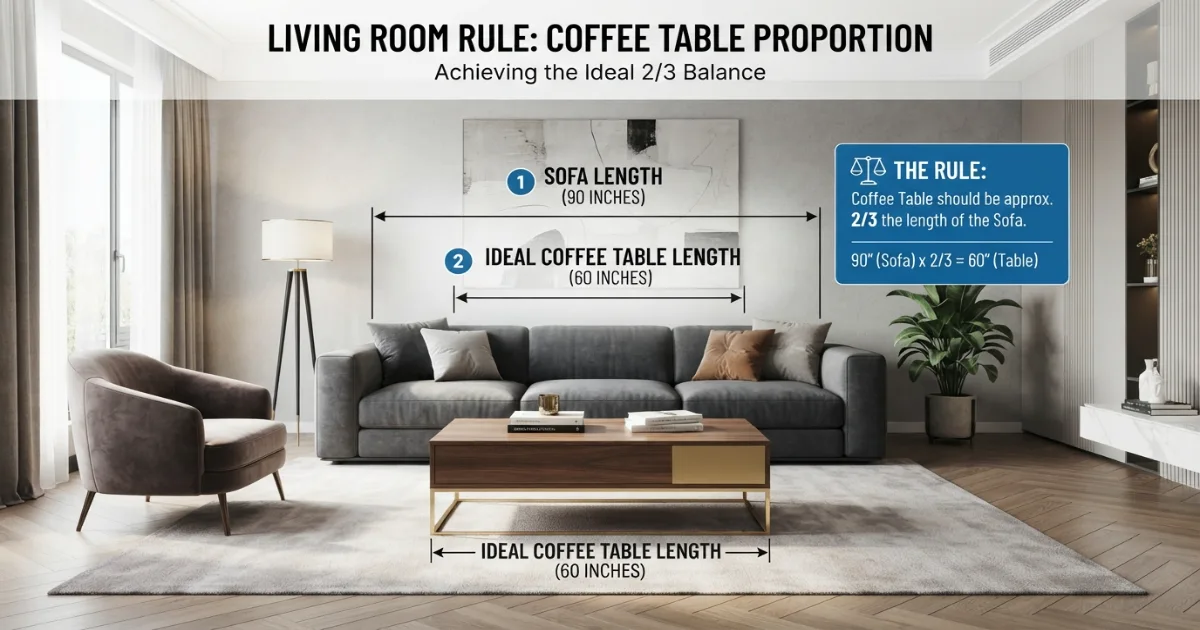
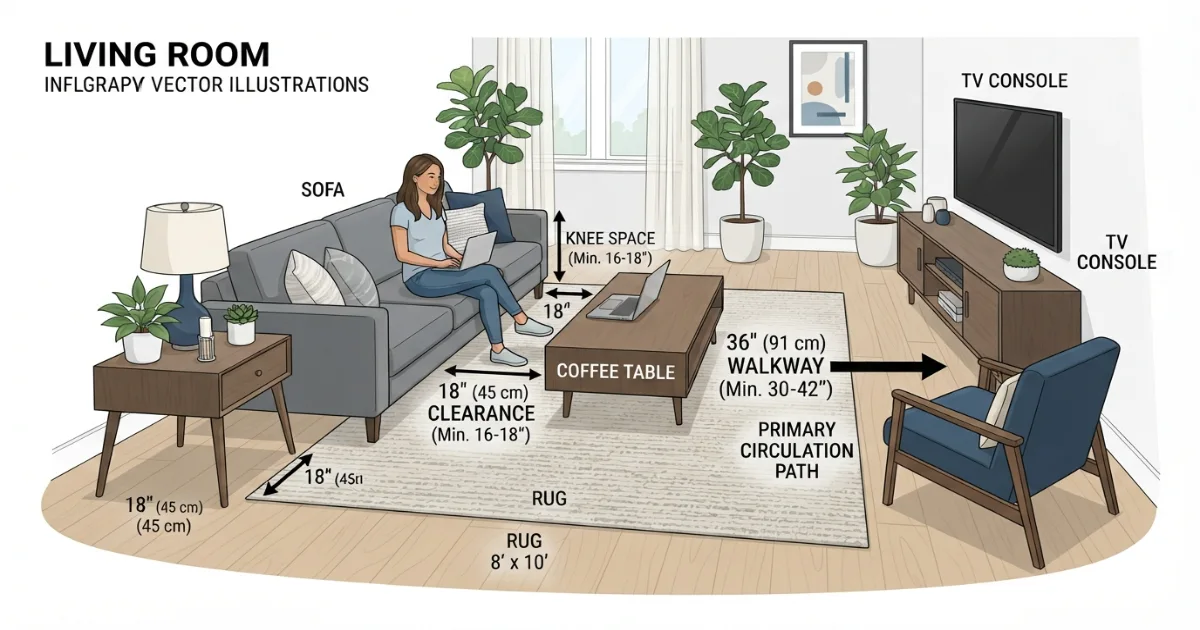
Size your coffee table to roughly two-thirds of your sofa’s length, keep the height within 2 inches of the sofa seat, and leave 14–18 inches of clearance between the table and the sofa. Round or oval shapes suit sectionals and tight walkways best.
Coffee table size by sofa length.
These estimates assume a rectangular table and the standard two-thirds proportion rule, with dimensions shown in both inches and centimeters. Use the calculator above for a recommendation matched to your exact sofa and available depth.
| Sofa Length | Table Length (in) | Table Width (in) | Table Length (cm) | Table Width (cm) | Best Fit |
|---|---|---|---|---|---|
| 60 in (loveseat) | 38–40 in | 18–20 in | 97–102 cm | 46–51 cm | Small round or square |
| 72 in | 46–48 in | 22–24 in | 117–122 cm | 56–61 cm | Compact rectangular |
| 84 in (standard sofa) | 54–56 in | 26–28 in | 137–142 cm | 66–71 cm | Standard rectangular |
| 96 in | 62–64 in | 28–30 in | 157–163 cm | 71–76 cm | Large rectangular or oval |
| 108 in | 70–72 in | 30–32 in | 178–183 cm | 76–81 cm | Oval or two smaller tables |
| 120+ in (sectional) | 72–84 in or square/round | 32–42 in | 183–213 cm | 81–107 cm | Large square or round |
Four coffee table shapes — and the sofa they suit.
Shape affects both proportion and safety. Here is what each shape is built for, how it’s sized relative to the sofa, and which seating style it pairs with best.
Rectangular
The standard choice for long, straight sofas. Its length can echo the sofa’s own length at roughly two-thirds scale, keeping the pairing visually balanced.
Suits: single sofaRound
No sharp corners to bump into, which suits tight walkways, homes with small children, and rooms where multiple people approach the table from different angles.
Suits: sectional, small roomsSquare
A strong match for square or near-square seating arrangements, including U-shaped layouts, since it presents an even edge to seating on multiple sides.
Suits: U-shaped, symmetrical roomsOval
Combines a rectangular table’s presence in front of a long sofa with a round table’s softer, safer edges. A strong pick for larger rooms and open floor plans.
Suits: large or open-plan roomsSee how table size changes by sofa.
These steps cover the essentials: measuring the sofa, choosing a shape, and confirming clearance before you order.
Measure the sofa
Start with total sofa length before choosing a table size. Note the seat cushion height too, since it drives the recommended table height.

Choose a shape
Shape changes both proportion and safety around sharp corners. This is usually the second biggest factor after overall size.
Check clearance
A table that fits the sofa proportionally can still block the room’s main walkway if the available depth is tight.
How to choose a coffee table size — the complete guide.
The most common coffee table mistake is matching the table to the sofa’s full length rather than roughly two-thirds of it. A table the same length as the sofa almost always reads as oversized and leaves too little clearance on either side to walk around comfortably.
A coffee table is one of the few pieces of furniture that people touch, reach across, prop their feet on and set drinks down on every single day.
Yet it is often chosen last and sized almost as an afterthought once the sofa and rug are already in place. Getting the proportions right changes more about how a living room feels than most people expect.
A table that is too large crowds the walkway and makes the seating area feel tight; one that is too small looks lost and fails at being within comfortable reach. This guide walks through the full sizing process step by step.
Step 1: Measure the sofa or sectional
Measure the total length of the sofa from one outside arm to the other. For a sectional, measure the longest straight run of seating. The same measurement applies to loveseats — proportions simply scale down together.
Step 2: Measure the available depth
Measure the space between the front edge of the sofa and whatever sits opposite it — a TV console, accent wall, or walkway. This measurement sets a hard ceiling on how deep the coffee table can be.
A table can be perfectly proportioned to the sofa and still feel wrong if it eats up nearly all of the available depth. Comfortable clearance on both sides is essential.
Step 3: Apply the two-thirds rule
The most widely used starting point is roughly two-thirds the length of the sofa. An 84‑inch sofa suggests a table around 54 to 56 inches long; a 60‑inch loveseat suggests 38 to 40 inches.
This proportion keeps the table from competing with the sofa while still anchoring the seating area. Round and square tables are usually sized a bit smaller, since their footprint reads differently.
Step 4: Choose a shape based on room and safety
Rectangular tables suit long, straight sofas and larger rooms. Round tables remove sharp corners entirely — helpful in homes with children or tight walkways.
Square tables work well with U‑shaped or symmetrical seating. Oval tables offer a rectangular presence with softer edges, and suit larger or open‑plan rooms particularly well.
Step 5: Match the table height to the sofa
A coffee table should generally sit at the same height as the sofa seat cushion, or up to about 2 inches lower. Most standard sofas have a seat height around 17 to 19 inches.
That puts the ideal coffee table height in the 16 to 18 inch range. A table noticeably taller feels awkward to reach across; one dramatically lower can look under‑scaled.
Step 6: Confirm clearance on all sides
Leave roughly 14 to 18 inches between the sofa and the table — close enough to reach a drink without crowding legroom. Also check clearance near a walkway or TV console.
Ideally keep at least 30 inches for a comfortable walking path. A table that satisfies the two‑thirds rule but leaves less than a foot of clearance anywhere is usually too large for that room.
Step 7: Adjust for sectionals and U-shaped seating
A single straight sofa gives a clean measurement, but a sectional or U‑shaped arrangement doesn’t have one obvious edge. In these layouts, a larger square or round table often works better.
Two smaller tables used together can also spread surface area across the group, rather than forcing a single rectangular table to serve seating on two or three sides at once.
Step 8: Avoid the most common coffee table mistakes
Buying a table the same length as the sofa is the most frequent mistake. Ignoring available depth is a close second — a nicely proportioned table can still block a walkway.
Mismatching table height often goes unnoticed until the table is in the room. And choosing a rectangular table for a sectional frequently leaves it serving only one side of the seating group well.
Coffee table material types: wood, glass, stone and metal
- Solid wood — the most classic option, durable and easy to match, though heavier pieces can be harder to reposition.
- Glass top — visually lighter than solid materials, helps a table feel less bulky in a smaller room, but shows fingerprints more easily.
- Stone or stone-look — marble and similar surfaces add a formal feel; natural stone needs sealing to avoid stains.
- Metal frame with a mixed top — a slimmer base with wood, glass or stone gives a lighter visual footprint while staying durable.
Storage and functionality beyond size
Once length, width and height are settled, think about how the table will actually be used. A lift‑top can double as a laptop desk or dining surface — ideal for smaller rooms.
A lower shelf or drawers add storage for remotes and throws without a separate console. Open shelving can also visually anchor a lighter‑looking glass or metal top.
Households that frequently rearrange or host gatherings often do better with a simpler, lighter table that can be pushed aside or paired with nesting tables for extra flexibility.
Coffee tables in small and multi-purpose rooms
In a small room that doubles as a home office or playroom, a coffee table’s footprint competes directly with other uses. A round or oval table, or a nesting set, often works better than a fixed rectangular one.
Lighter materials like glass or a slim metal frame can also help a compact room feel less crowded. For rooms that flex between lounging and gatherings, consider a lightweight table on casters.
A table sized to slide easily under the sofa’s front overhang when not in use can make a flexible room much easier to live with.
Coffee table buying rules that prevent a cramped living room.
A calculator gives the best starting numbers, but the final purchase still depends on room depth, seating style, and how the table will actually be used day to day.
The rules below cover details that a single sofa measurement can’t capture. They’re worth reviewing even after you’ve settled on a size, since a table that looks perfectly proportioned in a photo can still feel wrong once daily foot traffic, pets, kids and entertaining are factored in.
For most living rooms, multiply the sofa length by roughly 0.66 to find a starting table length, keep the table’s height within 2 inches of the sofa seat, and leave at least 14 to 18 inches of clearance. If available depth is tight, prioritize clearance over exact proportion.
Never match table length to sofa length
A table the same length as the sofa reads as oversized and crowds the seating area. Keep it to roughly two-thirds of the sofa’s length as a starting point.
Check available depth before shape
A table proportioned correctly to the sofa can still block a walkway or console if the room’s depth is limited. Confirm clearance on every side before finalizing a shape.
Match height to the sofa seat
Aim for a table height at or up to 2 inches below the sofa’s seat cushion height. A table noticeably taller than the seat is awkward to use day to day.
Choose shape by seating style
Rectangular suits a single straight sofa; square or round often works better for sectionals and U-shaped seating groups with no single obvious edge.
Finally, if the room hosts young children or frequent guests, lean toward a round or oval shape even when a rectangular table would technically fit, since the softer edges reduce bump hazards in a heavily used space.
Helpful room planning topics.
A coffee table rarely stands alone in a living room’s design. Once you know your size, it helps to plan the surrounding elements at the same time — rug placement beneath the seating group, sofa scale against the wall, and lighting balanced around the table. Getting these elements to agree with each other is usually what separates a living room that feels intentionally designed from one that feels assembled piece by piece over time. Use these supporting pages from the HomeStyle Calculator homepage to plan the rest of the room.
Six things home stagers always check before choosing a coffee table.
Tape the outline on the floor
Before buying, tape the table’s exact footprint on the floor in front of the sofa and live with it for a few days. This reveals cramped clearance faster than any measurement on paper.
Sit down and reach for the table
Sit in the usual spot on the sofa and reach toward where the table would sit. If it feels like a stretch or uncomfortably close, adjust the planned distance before ordering.
Consider a tray or nesting tables for flexibility
Nesting tables or a large tray can adapt a single coffee table’s usable surface for entertaining without permanently committing to a larger footprint.
Match the rug before the table
If a rug is also part of the plan, size and place it first, since the coffee table’s ideal position usually falls within the rug’s front two-thirds, not centered dead in the middle.
Check leg style against the rug pile
Delicate or thin table legs can sink unevenly into a thick, plush rug. Confirm the rug pile height suits the table’s leg design before committing to both pieces.
Round up for households with kids or pets
In busy households, a round or oval table with softer edges is often worth choosing even when a rectangular table would technically fit the proportions better.
Coffee table sizing questions — answered.
More free calculators for every room decision.
Every tool uses professional designer formulas. Free, instant, no sign-up — just enter your room and get the exact answer.
Bookmark HomeStyle Calculator for every room in the house.
From a cozy loveseat setup to a full sectional, our free tools give you the exact coffee table size and clearance check before you buy.