Price out curtains before you buy the fabric.
Enter your window count, window size, fullness style, fabric price, rod cost and hardware cost, and get an instant panel count, fabric yardage and total project cost — using the same fullness ratios professional drapery workrooms use. No more guessing how many yards a “full” look actually needs.
Budget 2 to 2.5 times the window’s width in fabric for standard fullness, add roughly 8 to 10 inches per panel for hems, then add $15 to $90 per window for a rod and $10 to $40 per window for hardware on top of the fabric cost.
Typical curtain cost by window type and count.
These estimates assume standard fullness and mid-range fabric. Use the calculator above for a cost matched to your exact windows and fabric choice.
| Window Type | Typical Size | Panels | Fabric Needed | Notes |
|---|---|---|---|---|
| Standard window (1) | 36×84 in | 2 panels | ~7 yards | Most common single-window setup |
| Sliding glass door | 72×84 in | 2 panels | ~13 yards | Extra-long rod recommended |
| Bay window (3 windows) | 3× 30×84 in | 6 panels | ~18 yards | Price each window separately |
| Large picture window | 96×96 in | 3 panels | ~21 yards | Needs a third panel for fullness |
| Layered sheer + drape | 36×84 in | 4 panels | ~14 yards | Roughly doubles fabric cost |
| Whole room (4 windows) | 4× 36×84 in | 8 panels | ~28 yards | Order fabric in one dye lot |
Four fullness styles — and how each changes your cost.
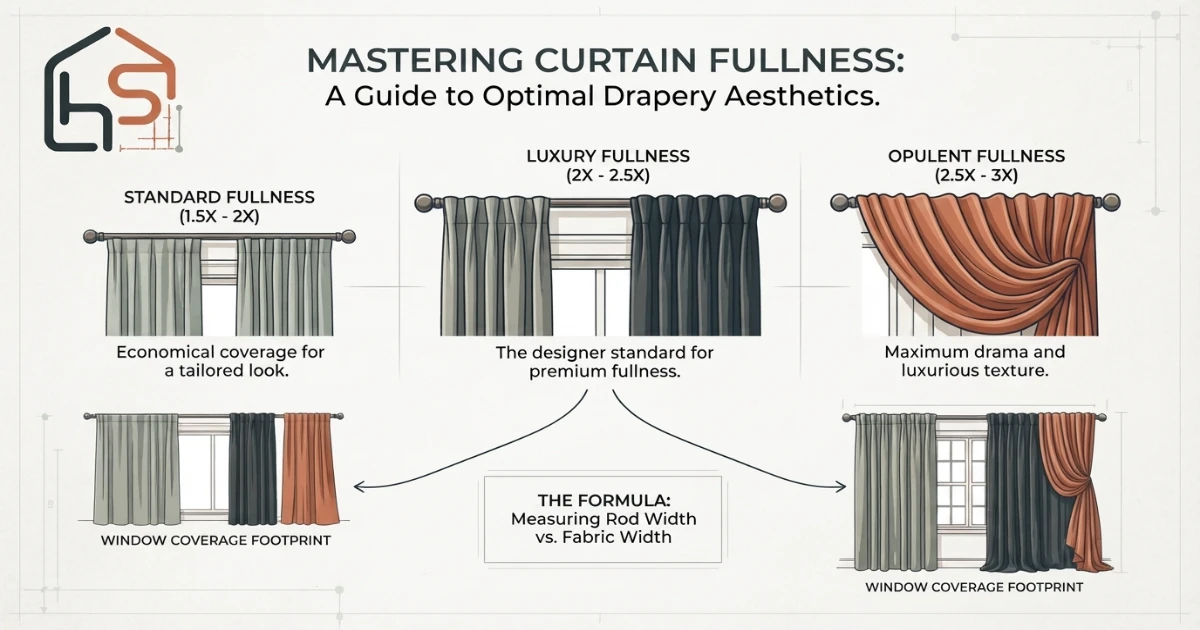
Fullness is how much wider the flat fabric is than the window itself, and it’s the single biggest driver of a curtain project’s fabric cost. Here is what each style looks like and the multiplier it uses.
Standard Fullness
Fabric about 2 to 2.2 times the window’s width, giving soft, even folds without an overly gathered or overly flat look.
Multiplier: 2.0xRelaxed Fullness
A flatter, more tailored panel using less fabric per window, suited to a minimal or modern look with fewer, wider folds.
Multiplier: 1.5xDramatic Fullness
Heavy, closely gathered folds using significantly more fabric, common in formal living rooms and floor-to-ceiling installs.
Multiplier: 2.75xLayered (Sheer + Drape)
A sheer panel behind a heavier drapery panel on a double rod or track, roughly doubling total fabric and hardware cost.
Fabric cost: ~2xSee how window size and fullness change your total.
These steps cover the essentials: measuring the window, applying the right fullness multiplier, and confirming the panel count before you order fabric.
Measure the window
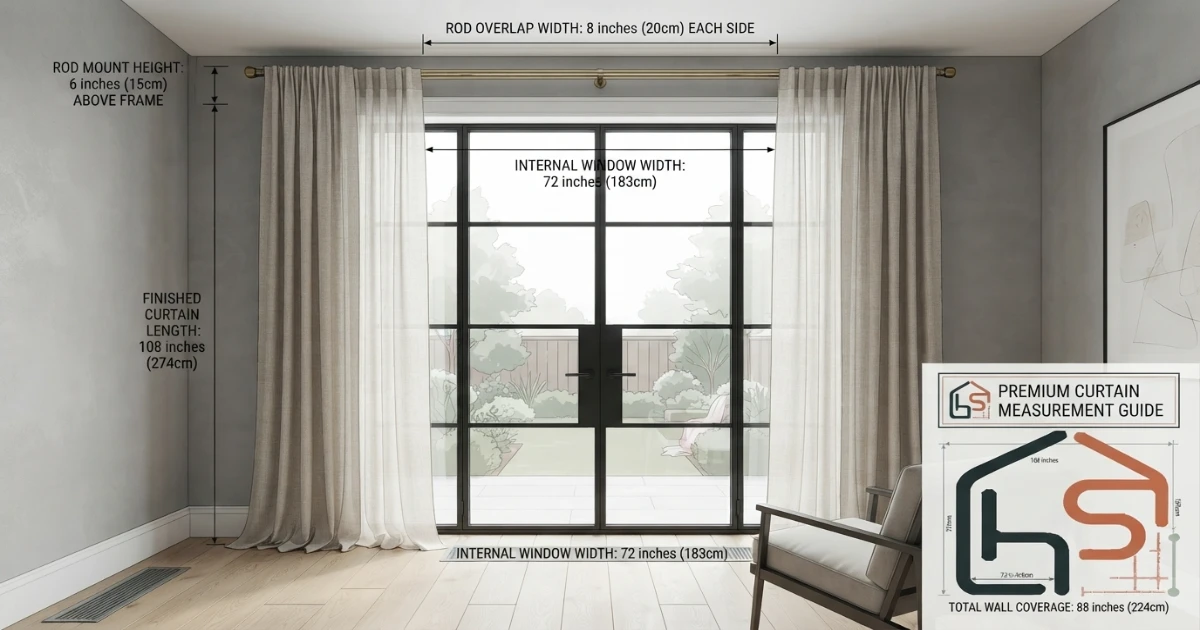
Measure the window’s width and the desired curtain drop from rod to floor or sill.
Apply the right fullness
Relaxed styles use the least fabric, while dramatic and layered looks need significantly more.
Confirm the panel count
Check the fabric width and pattern repeat against the estimate before placing the fabric order.
How to calculate curtain cost — the complete guide.
The most common curtain budgeting mistake is pricing fabric off the window’s width alone, without applying a fullness multiplier. A flat panel cut to exactly the window’s width looks skimpy and stretched once hung, while a properly full panel needs two to nearly three times that width in fabric — which is exactly the gap that blows a “quick estimate” budget by 50 percent or more.
Step 1: Measure every window that needs curtains
Start by measuring each window’s width individually, since even windows that look identical in a room can differ by an inch or two, which adds up once fullness is applied. Measure the curtain length separately for each window, from where the rod will be mounted down to the floor, the sill, or wherever the desired hem falls, since curtain length directly affects both fabric yardage and how the panel visually reads once hung.
Step 2: Decide on a rod mounting height and width
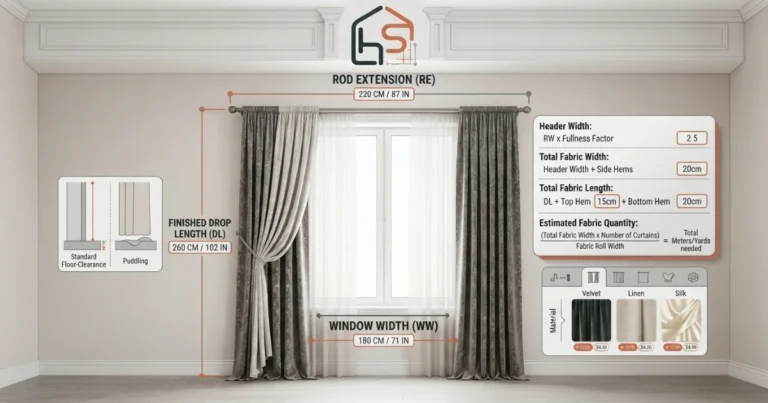
Most designers recommend mounting the rod 4 to 6 inches above the window frame and extending it 4 to 10 inches beyond each side of the window, rather than mounting it flush to the frame’s exact width. This wider, higher mount makes the window look larger and lets the panels stack fully off the glass when open, but it also increases the effective width used in the fullness calculation, so measure the planned rod width, not just the window frame.
Step 3: Choose a fullness style based on the desired look
Relaxed fullness, around 1.5 times the window’s width, gives a flatter, more tailored panel that suits a minimal or modern room and uses noticeably less fabric. Standard fullness, around 2 to 2.2 times the width, is the most common choice and gives soft, even folds without looking sparse or overly gathered. Dramatic fullness, around 2.5 to 2.75 times the width, creates heavy, closely spaced folds often used in formal living rooms or floor-to-ceiling installations, and uses considerably more fabric than the other two styles.
Step 4: Understand standard fabric bolt width
Most drapery fabric comes on a bolt that’s about 54 inches wide, though some specialty fabrics run narrower, around 45 inches, or wider, up to 118 inches for certain sheers and linens. The bolt width determines how many fabric widths need to be sewn together side by side to reach the total fullness width required for a window, so always confirm this measurement for the specific fabric being considered rather than assuming the 54-inch standard.
Step 5: Calculate the total fullness width needed
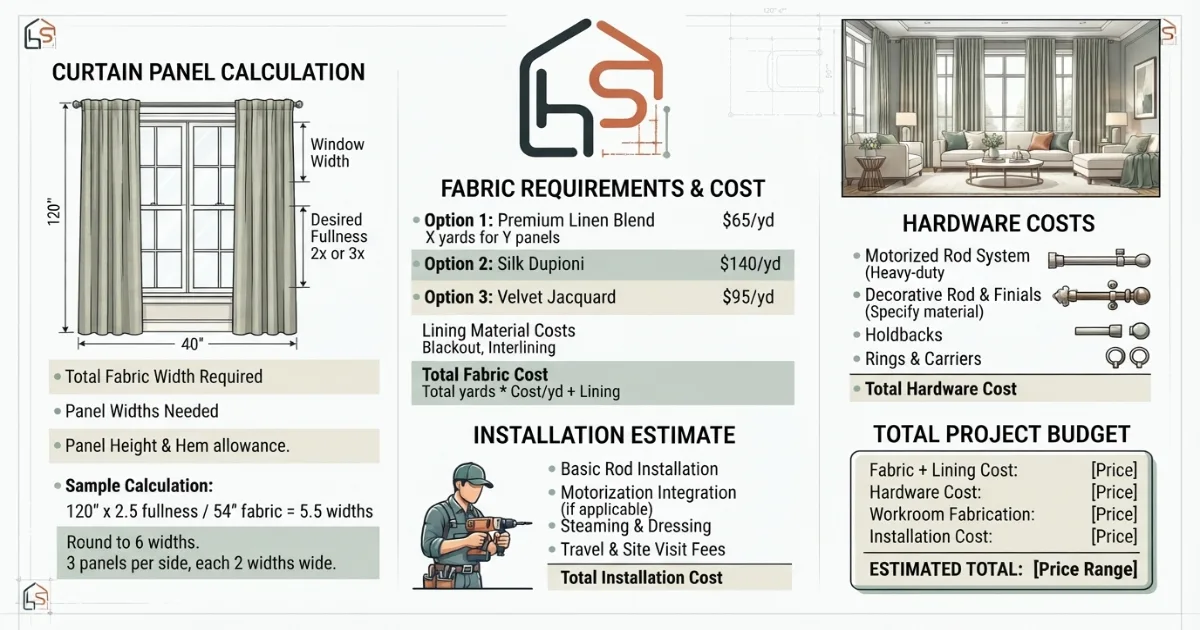
Multiply the planned rod width by the chosen fullness multiplier to get the total flat fabric width required across both panels combined. For example, a 40-inch-wide rod at standard 2x fullness needs 80 inches of flat fabric total, split between the two panels that will hang on either side.
Step 6: Convert fullness width into fabric widths and yardage
Divide the total fullness width from step 5 by the fabric’s bolt width, and round up to the next whole number, since a partial fabric width still requires cutting a full width off the bolt. Multiply that number of widths by the curtain length plus roughly 8 to 10 inches for the top heading and bottom hem, then divide the result by 36 to convert from inches into yards, which is how most drapery fabric is priced and sold.
Step 7: Add extra yardage for a pattern repeat
If the fabric has a printed pattern with a visible repeat, add extra length equal to roughly one full pattern repeat for every fabric width beyond the first, since each width needs to be cut so its pattern lines up with the width next to it. A fabric with a large, bold repeat can add a meaningful amount of extra yardage on a wide window using several fabric widths per panel.
Step 8: Price the fabric cost
Multiply the total yardage calculated in steps 6 and 7 by the fabric’s price per yard to get the material cost. Budget fabrics typically run $8 to $20 per yard, mid-range designer fabrics run $20 to $50 per yard, and high-end silks, velvets, or hand-printed linens can run well over $75 to $150 per yard, so fabric choice alone can swing a project’s total cost by several multiples.
Step 9: Decide whether to add blackout or thermal lining
Blackout or thermal lining typically adds $5 to $15 per yard on top of the base fabric cost, either sewn in as a separate lining layer or purchased as a pre-lined fabric option that bundles the two together. Lining also adds body and a more finished drape to lightweight fabrics, so it’s sometimes chosen for its look even in rooms where blackout function isn’t the primary goal.
Step 10: Price the rod and mounting hardware
A basic curtain rod typically costs $15 to $40 per window, a decorative rod with finials and rings runs $40 to $90, and a heavy-duty rod for an extra-wide window or a motorized track system can run $100 or more per window. Multiply the chosen rod’s price by the number of windows in the project to get the total rod cost.
Step 11: Price additional hardware separately from the rod
Hardware beyond the rod itself, such as rings, brackets, tiebacks, and holdbacks, typically adds another $10 to $40 per window depending on style and finish. Some rod sets bundle rings and brackets into the base price, so check what’s included before adding this as a separate line item to avoid double-counting.
Step 12: Add a layered look’s extra cost if wanted
A layered treatment, with a sheer panel behind a heavier drapery panel, essentially doubles the fabric requirement since it’s a full second set of panels rather than an add-on to the first. It typically also needs a double rod or a two-track hardware system, which adds another $20 to $60 per window on top of the single-rod hardware cost, so budget a layered look at roughly twice the fabric cost plus extra hardware.
Step 13: Factor in professional installation labor
Professional installation, including mounting the rod at the correct height and hanging the finished panels, typically costs $20 to $60 per window depending on wall material, rod weight, and whether custom drapery hardware is involved. This is usually quoted separately from the fabric and rod material cost, so ask for a labor-only quote if comparing installers or deciding between DIY and professional installation.
Step 14: Budget a bay or multi-window wall correctly
Treat each window in a bay or multi-window wall as its own individual calculation, with its own width, panel count, rod, and hardware, rather than averaging the whole wall into one flat number. This is important because a bay window’s individual panes are often different widths, and each needs its own fullness calculation to avoid an uneven, mismatched final look.
Step 15: Budget an oversized picture window separately
A very wide picture window or sliding door often needs three or more panels rather than the standard two, simply to keep each individual panel from becoming too wide and heavy to gather and hang properly. Split the total fullness width evenly across the chosen panel count rather than cramming the same fullness ratio into just two oversized panels.
Step 16: Get a final fabric and hardware quote before ordering
Once the yardage, panel count, and hardware needs are calculated, request a final quote confirming current fabric pricing, dye lot availability across the full yardage needed, and rod or hardware lead times, since custom hardware and specialty fabrics can have longer delivery windows than off-the-shelf options. Confirming this before ordering prevents a mismatched dye lot or a delayed installation date.
Rules that prevent a blown curtain budget.
A calculator gives the best starting numbers, but the final order still depends on the fabric’s actual bolt width, pattern repeat, and how the rod is mounted. The rules below cover the details worth checking even after settling on a fabric.
Calculate fabric width using a fullness multiplier of 1.5 to 2.75 times the rod width depending on style, convert to yardage using the fabric’s actual bolt width, then add rod and hardware cost per window on top of the fabric total.
Fullness comes before fabric price
Apply the fullness multiplier to the rod width before converting to yardage, not after estimating cost from the window’s raw width.
Measure the rod width, not the frame
Use the planned rod width, which extends beyond the window frame, as the base measurement for every fullness calculation.
Confirm the fabric’s actual bolt width
Check the specific fabric’s bolt width rather than assuming the 54-inch standard, since narrower or wider bolts change yardage significantly.
Separate material and labor
Price fabric, rod, and hardware as material cost, and quote installation labor separately per window for an accurate comparison.
Helpful window and room planning topics.
A curtain budget rarely comes together from fabric cost alone. Once you know the total, it helps to plan the surrounding elements at the same time — panel width, room layout, and how the finished window treatment reads against the wall color. Use these supporting pages from the HomeStyle Calculator homepage to plan the rest of the room.
Six things drapery workrooms always check before cutting fabric.
Mount the rod before final measuring
Install brackets first and measure the actual rod width in place, rather than estimating from the window frame alone.
Order all fabric from one dye lot
Buy the full yardage needed, including any buffer, in a single order to avoid subtle color shifts between panels.
Check the pattern repeat before cutting
Confirm the repeat measurement on a large-pattern fabric before cutting multiple widths, so the design lines up seam to seam.
Don’t skimp on fullness for a formal room
A flatter, under-full panel reads as an afterthought in a formal space, while proper fullness reads as intentional even in budget fabric.
Get labor quoted per window
Ask an installer to quote labor per window rather than a flat project rate, so it’s easy to compare costs across different rooms.
Consider a layered look for one focal window
If budget is tight, reserve a layered sheer-and-drape treatment for the room’s single focal window rather than every window in the space.
Curtain cost questions — answered.
More calculators for every room decision.
Every tool uses professional designer formulas. Free, instant, no sign-up — just enter your window or room and get the exact answer.
Bookmark HomeStyle Calculator for every room in the house.
From a single accent window to a full-room curtain refresh, our free tools give you the exact panel count, yardage and total cost before you order fabric.