Sleeper sofa dimensions: Best open and closed chart
Sleeper sofa dimensions must be checked twice: once as everyday seating and again with the bed fully open. Full and queen pull-outs commonly extend about 85 to 95 inches from the sofa back before adding a usable access path.
Sleeper sofa dimensions: plan the closed sofa and fully open bed separately.
Closed depth is commonly 36–44 inches. Fully open depth is often 85–95 inches for full and queen pull-outs.
Add a practical access zone, move the coffee table completely out of the mechanism path and keep the room door usable.
Combine sleeper dimensions with room fit, depth and delivery access
Confirm both room modes, then verify the mattress, mechanism, movable furniture and entry route.
Sleeper-sofa open and closed fit calculator
Enter exact closed and open measurements, room depth, opposite furniture and access targets.
Closed width, open depth and sleep-mode access
Per side in seating mode.
Open bed plus front access.
After open bed and opposite furniture.
Both modes pass.
The 74-inch queen sleeper fits closed and leaves the selected access zone when open. Move the coffee table fully away before conversion.
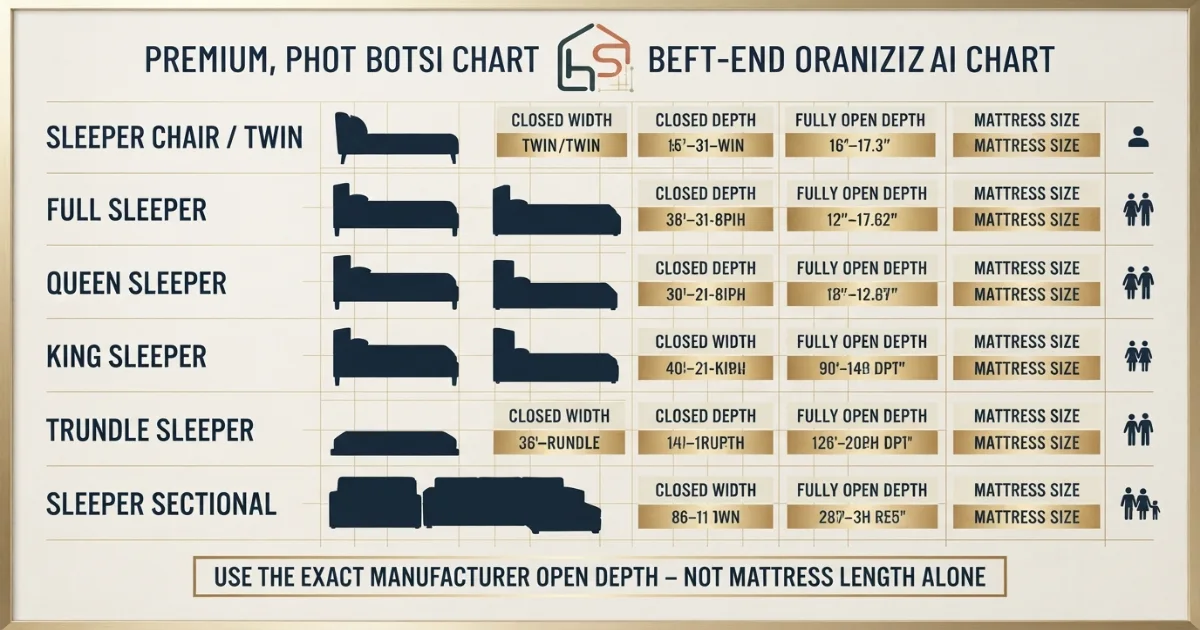
Sleeper sofa dimensions: complete open and closed chart
Sleeper sofa dimensions must be checked in two modes. Closed dimensions determine everyday seating fit, while fully open dimensions determine whether the bed can unfold without hitting a coffee table, TV console, wall or circulation route.
| Sleeper type | Typical closed width | Typical closed depth | Typical fully open depth | Mattress or sleep deck | Sleepers |
|---|---|---|---|---|---|
| Sleeper chair / twin | 49–60 in | 35–41 in | 82–90 in | 32–39 × 70–75 in | 1 |
| Full sleeper sofa | 65–80 in | 37–42 in | 85–92 in | 50–54 × 70–75 in | 1–2 |
| Queen sleeper sofa | 72–90 in | 38–44 in | 87–95 in | 58–60 × 72–80 in | 2 |
| King sleeper sofa | 84–100 in | 39–45 in | 88–98 in | 72–76 × 72–80 in | 2 |
| Trundle sleeper | 72–96 in | 35–42 in | 65–90 in | Varies by lift-out deck | 1–2 |
| Sleeper sectional | 90–130 in long side | 55–100 in chaise | 80–100 in bed zone | Full or queen equivalent | 2 |
Office, nursery or one-person guest bed.
Compact two-seat sofa with one-to-two-person bed.
Most common adult guest-room alternative.
Closed sleeper-sofa dimensions
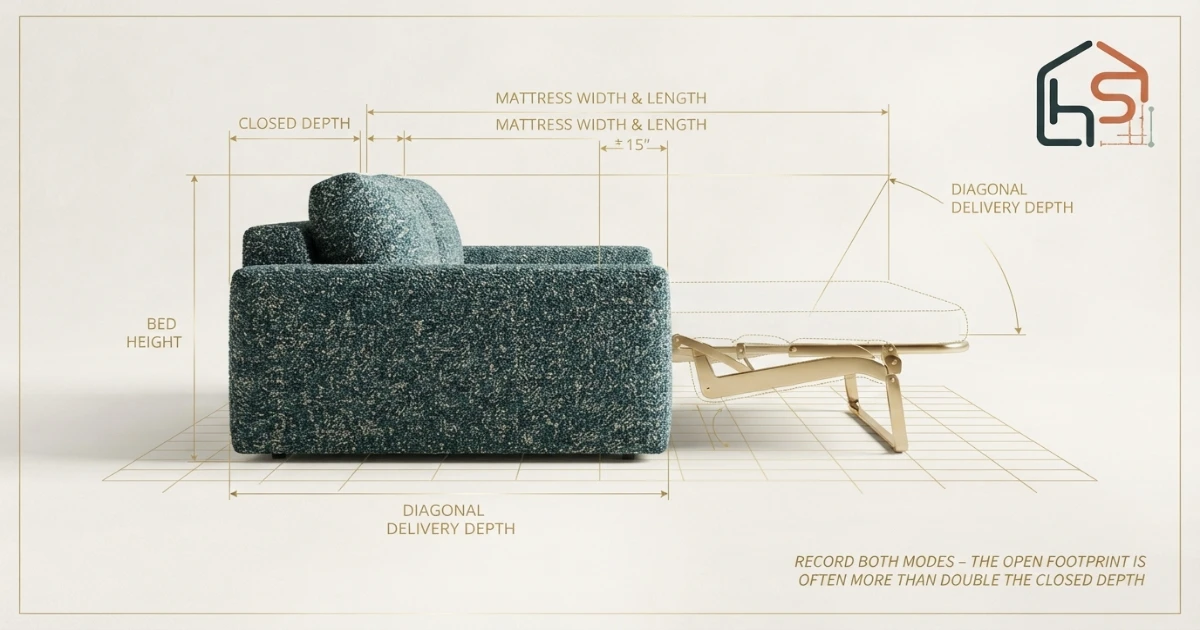
Closed width is measured from the outermost left point to the outermost right point. Closed depth runs from the front edge to the deepest rear point, and overall height runs from the floor to the highest rigid or upholstered point.
A twin sleeper chair or compact sofa may be approximately 49 to 60 inches wide. Full sleepers commonly fall around 65 to 80 inches, while queen sleepers often span 72 to 90 inches.
Closed depth commonly falls around 36 to 44 inches because the frame must contain a mattress or sleep platform. Modern trundle and fold-flat designs can differ substantially.
The sofa can fit the wall while still being too deep for the room. Add the coffee-table zone, opposite furniture and everyday walkway before deciding.
Fully open sleeper-sofa dimensions
Fully open depth is measured from the back-most sofa point to the furthest front point of the mattress, platform or mechanism.
Traditional pull-out sleepers commonly extend to roughly 85 to 95 inches. Some compact twin products open to about 87 inches, while extra-long mattresses or large mechanisms may need more.
Measure the furniture in the exact selected configuration. A product family may offer twin, full and queen versions with different frames and open depths.
Do not calculate open depth by adding the closed depth and mattress length. Part of the mattress may overlap the sofa frame, and mechanism geometry changes the result.
Official open-and-closed examples
| Official example | Closed width | Closed depth | Open depth | Mattress or bed size | Planning lesson |
|---|---|---|---|---|---|
| Pottery Barn Ember Twin | 53 in | 39.5 in | 87.5 in | 36 × 71.5 in | Compact twin |
| Pottery Barn Ember Full | 69 in | 39.5 in | 87.5 in | 52 × 71.5 in | Compact full |
| West Elm Harris Queen | 74 in | 39 in | 90 in | 60 × 72 in | Slim queen footprint |
| Pottery Barn PB Comfort Full | 78 in | 39 in | 90 in | 52 × 72 in | Traditional pull-out |
| Crate & Barrel Fuller Queen | 72 in | 39 in | Verify full open plan | Queen, 80 in length | Compact-width queen |
| IKEA FRIHETEN | 88⅝ in | 41⅜ in | Pull-out platform | 56¾ × 78⅜ in | Nontraditional platform bed |
Pottery Barn lists the Ember Twin at 53 inches wide and 39.5 inches deep when closed, expanding to 87.5 inches deep when open. Its full and queen versions share that listed open depth while increasing width.
West Elm lists the Harris Queen Sleeper at 74 by 39 inches closed and 74 by 90 inches in sleeper mode, with a 60-by-72-inch mattress.
Pottery Barn’s PB Comfort Full is 78 by 39 inches closed and 78 by 90 inches open. The open footprint is more than twice the closed depth.
Crate & Barrel’s Fuller demonstrates that a queen sleeper can fit within a 72-inch sofa width, while IKEA’s FRIHETEN uses a platform-style conversion and a bed area approximately 56¾ by 78⅜ inches.
Room-depth formula for a sleeper sofa
A queen sleeper that opens to 90 inches plus a 24-inch access path needs approximately 114 inches of usable room depth from the back of the sofa.
In a 12-foot room, 144 inches of depth leaves about 30 inches beyond a 90-inch sleeper and 24-inch access zone. A 16-inch TV console on the opposite wall would reduce that remaining depth.
For rooms with doors or emergency routes, preserve a safe path even when the bed is open. Do not block the only exit.
Sleeper-sofa mattress dimensions
Sleeper mattresses often differ from standard residential mattresses. Width and length can be several inches smaller, especially in full and queen mechanisms.
Twin sleeper mattresses commonly measure approximately 32 to 39 inches wide and 70 to 75 inches long. Full sleeper mattresses are often around 50 to 54 inches wide.
Queen sleeper mattresses commonly fall around 58 to 60 inches wide and 72 to 80 inches long. Check sheet compatibility rather than assuming standard queen sheets fit perfectly.
Mattress thickness often falls around 4 to 6 inches in traditional mechanisms, but modern platform and air-over-coil systems vary.
Pull-out, trundle, click-clack and platform mechanisms
A conventional pull-out stores a folded mattress and metal or wood support frame inside the sofa. The mattress unfolds forward in several sections.
A trundle sleeper slides forward from below the seat and may lift to align with the seat cushions. Its open footprint can be shorter than a conventional pull-out but wider across the seating platform.
A click-clack or futon-style sofa folds the back flat. Open depth depends on the combined seat and back dimensions and may extend both forward and backward.
A platform sleeper may pull a hidden deck outward and use existing cushions to form the sleep surface. IKEA’s FRIHETEN is an example of a nontraditional platform conversion.
Mechanism type affects open depth, mattress feel, furniture weight, maintenance and the place where bedding is stored.
Measurements to record before buying
- Closed overall width, depth and height.
- Fully open overall width, depth and height.
- Mattress width, length and thickness.
- Inside seating width and seat depth.
- Bed height from floor.
- Mechanism projection and handle clearance.
- Diagonal delivery depth.
- Weight and largest packaged component.
- Removable legs, backs or arms.
- Required side and front access.
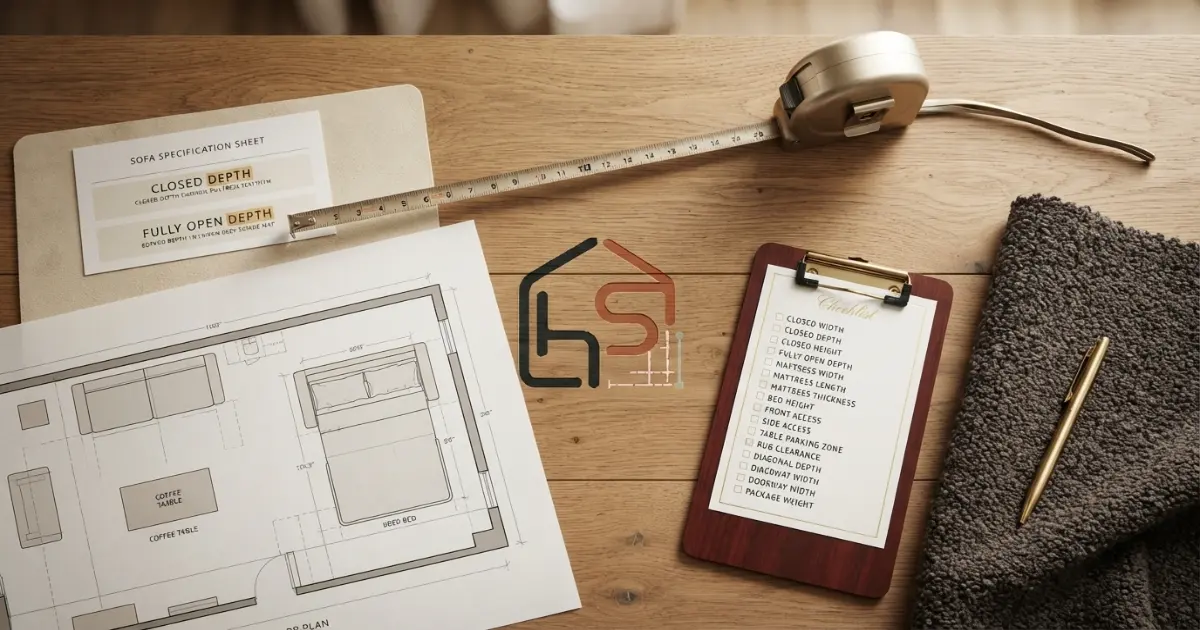
A complete sleeper sofa dimensions diagram should show both modes. Save the exact product page or specification sheet for the selected mattress size and upholstery configuration.
Twin sleeper dimensions and best use
A twin sleeper chair or compact sofa usually works for one guest. Closed width commonly falls around 49 to 60 inches, making it useful in an office, nursery, bedroom or studio.
Open depth can still approach 85 to 90 inches. Compact width does not mean compact sleep-mode depth.
Choose a twin when the room is narrow but long enough for the open mattress and access. Confirm that the sleep surface length suits the expected user.
Full sleeper dimensions and best use
Full sleepers commonly measure approximately 65 to 80 inches wide when closed and can provide two-person seating.
The mattress may be around 50 to 54 inches wide and 70 to 75 inches long. Two adults can use some full sleepers temporarily, but personal space is limited.
A compact full model is often the best compromise for a 10×10 office or guest room because it saves wall width compared with a queen.
Queen sleeper dimensions and best use
A queen sleeper commonly measures 72 to 90 inches wide and around 38 to 44 inches deep when closed.
Open depth often falls around 87 to 95 inches. Mattress width is typically near 60 inches, while length may be 72 to 80 inches.
Queen sleepers suit main living rooms, larger offices and multipurpose guest rooms where two adult sleepers are expected.
Use exact open measurements because a compact 72-inch queen sleeper and a traditional 87-inch queen sleeper can occupy similar front-to-back space.
King sleeper dimensions and limitations
King sleeper sofas are less common and generally wider, heavier and more expensive than queen models.
Closed width may reach approximately 84 to 100 inches. The open depth can approach or exceed queen-sleeper depth depending on the mechanism.
Delivery, floor load, mechanism operation and room access deserve extra attention. A queen sleeper plus an additional guest solution may be more flexible.
Sleeper sectional dimensions
A sleeper sectional combines long-side width, chaise or return length and a temporary pull-out bed area.
Measure the closed L or U shape and then the bed zone when extended. A sleeper sectional can block the open side that normally serves as the main walkway.
Some sectionals use a full or queen pull-out beneath the sofa section; others use a lift-up trundle that aligns with the chaise.
Use the Sectional Size Guide for long-side, return and orientation measurements.
Trundle and lift-up sleeper dimensions
A trundle sleeper slides outward and may rise to seat height. The bed surface can be formed from the trundle plus existing cushions.
Closed depth may resemble a standard sofa, while open depth depends on how far the trundle projects.
Leave enough clearance for the user to pull the mechanism straight out. A rug edge or thick carpet can affect operation.
Storage chaises and trundles may compete for the same floor area when open.
Sleeper sofa in a 10×10 room
A 10×10 room has 120 inches of depth before furniture and wall details reduce the usable area.
A sleeper opening to 87.5 inches leaves 32.5 inches from the sofa back line to the opposite wall. That may be enough for access only when the opposite wall remains clear.
A coffee table must usually move out of the bed footprint. Choose nesting tables, a lightweight ottoman or a table with a defined storage location.
Use the 10×10 Sofa Layout Guide for closed-mode furniture planning.
Sleeper sofa in a 12×12 room
A 12×12 room provides 144 inches of depth. A queen sleeper opening to 90 inches leaves 54 inches before adding opposite furniture.
A 16-inch console leaves 38 inches, which can support a practical front access zone.
This room size can handle many full and queen sleepers if the coffee table moves and door swings remain clear.
Use the 12×12 Sofa Layout Guide for the everyday seating mode.
Sleeper sofa in a 15×15 room
A 15×15 room provides 180 inches of depth and supports queen sleepers, large sleepers and sleeper sectionals more comfortably.
The room can preserve side access, a front walkway and furniture storage during sleep mode.
Do not use the extra space to add a coffee table that is too heavy to move. Sleep-mode conversion should remain practical.
See the 15×15 Sofa Layout Guide for large-room sofa and sectional planning.
Sleeper sofa in a studio apartment
A sleeper sofa can replace a separate guest bed or function as the primary bed in a studio, but daily conversion changes the buying priorities.
Choose a mechanism that opens easily, provides accessible bedding storage and leaves a safe route to the entry and bathroom.
Measure the room with the bed open before placing a dining table, desk or storage cabinet.
For nightly use, mattress support, replacement availability and mechanism durability matter more than occasional-guest convenience.
Where does the coffee table go?
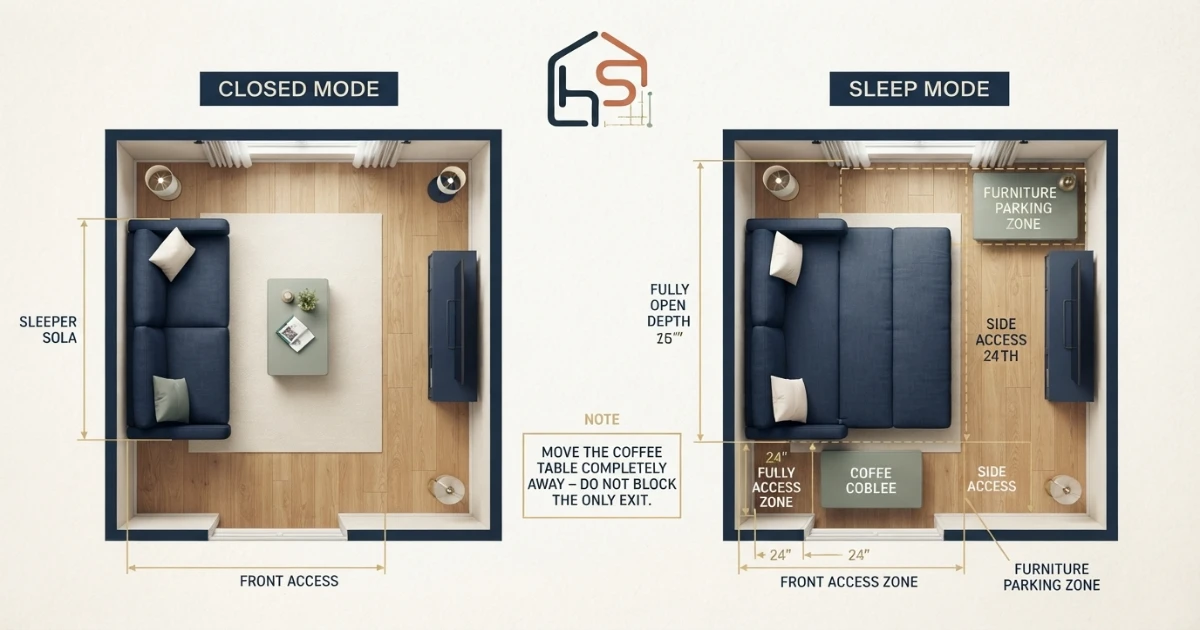
Most pull-out sleepers occupy the coffee-table zone. Decide where the table will move before buying the sofa.
Nesting tables can separate and store beside the sofa. Lightweight ottomans can move against a wall or function as luggage benches.
A heavy stone or storage table may make conversion inconvenient and encourage users to avoid opening the bed.
Mark the parking footprint for every movable item in sleep mode.
Front and side access
A 24-inch front access zone is a useful minimum planning target, while about 30 inches is more comfortable.
Preserve at least one usable side of the bed for entry, bedding changes and nighttime movement.
Do not block the room’s only door, emergency route, radiator or required building access path.
Accessibility requirements vary by project and user. Follow applicable local standards when an accessible route is needed.
Rug placement under a sleeper sofa
A rug can stay beneath the sofa, but its pile and edge should not interfere with pull-out legs, wheels or trundle movement.
Place the rug so the mechanism opens smoothly without catching a raised edge.
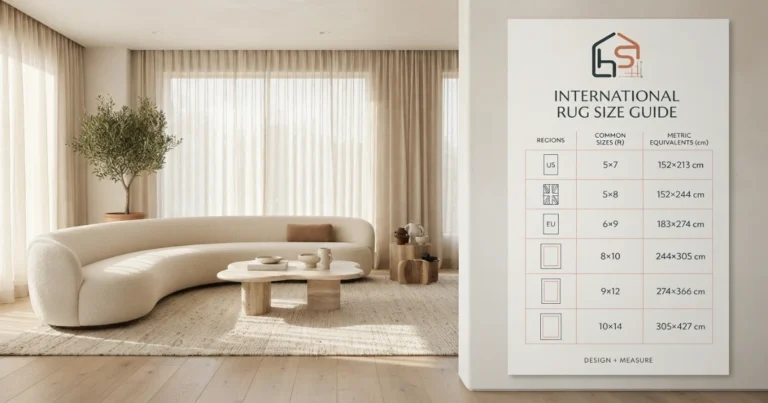
An 8×10 rug suits many compact sleepers, while a 9×12 rug can anchor a queen sleeper and chairs in everyday mode.
Use the Living-Room Rug Size Guide for front-leg and full-group arrangements.
Mattress thickness and guest comfort
Traditional sleeper mattresses are thinner than many standard bed mattresses because they must fold into the frame.
Memory foam, gel foam, innerspring, air-over-coil and platform cushions create different support and storage requirements.
A thicker mattress is not automatically better if it prevents the mechanism from closing or exceeds the manufacturer’s design.
Use only approved replacement mattresses with the correct dimensions and folding pattern.
Bedding and storage planning
Sheets may need sleeper-specific dimensions because a queen sleeper mattress can be shorter than a standard queen.
Store sheets, pillows and a lightweight blanket close to the sofa so conversion does not require moving through the home.
Some sleeper sectionals include chaise storage. Straight sleepers may need a nearby cabinet, ottoman or under-console basket.
Remove bedding before closing when the manufacturer instructs it. West Elm specifically warns against folding certain mattresses into the sofa with sheets or blankets attached.
Sleeper-sofa delivery dimensions
Sleeper mechanisms add substantial weight and rigidity. A sleeper with compact width can still be difficult to carry or pivot.
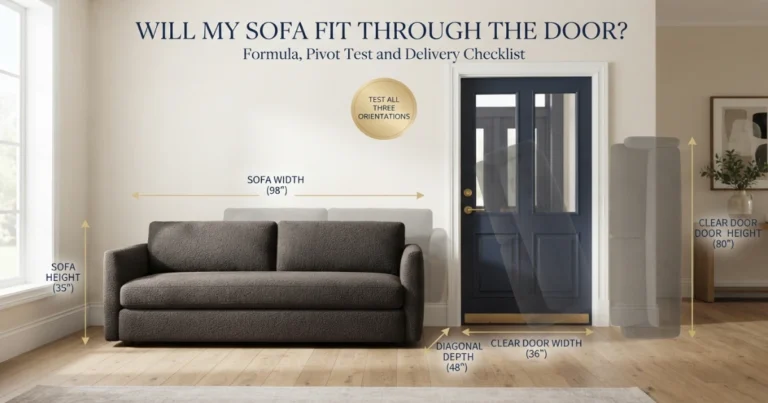
Record width, height, closed depth, diagonal depth, packaged dimensions, weight and removable parts.
Measure every doorway, hallway, stair landing, elevator and final-room opening.
Use the Will My Sofa Fit Through the Door Guide for horizontal, rotated and on-end preliminary checks.
Some premium sleeper systems can be disassembled for narrow passages, but this must be confirmed from official instructions or the delivery team.
Weight, flooring and operation
Sleeper sofas are generally heavier than standard sofas of similar width. The internal frame, mattress and hardware add weight.
Use appropriate floor protection and enough trained people for delivery. Do not drag a heavy sleeper across finished flooring.
Check that the room floor is level so the mechanism opens and the sofa remains stable.
Repeated conversion requires clear handles, straps and floor space. Test the operation before accepting delivery.
Everyday sofa comfort
A sleeper sofa must work as seating even when the bed is rarely used. Compare seat depth, height, cushion support and frame feel.
Traditional folded mechanisms can make the seat firmer. Modern platform systems may feel more like conventional sofas.
Test sitting near the center and arms. The sleeper frame can change support across the width.
Choose the everyday sofa comfort first when guests use the bed only occasionally.
Occasional guests versus nightly sleeping
For occasional guests, compact size, easy conversion and convenient storage may be more important than maximum mattress thickness.
For weekly or nightly use, prioritize mattress support, replacement availability, frame durability and access around the open bed.
A sofa bed used every night should open without requiring several heavy furniture moves.
Review warranty and usage guidance for the exact mechanism.
How to compare sleeper sofas online
Open the detailed dimensions section and look for both “overall closed” and “overall open.” Do not rely on mattress size alone.
Verify the selected twin, full, queen or king configuration because width and open dimensions may change within one collection.
Check mattress dimensions, seat depth, diagonal depth, packaged weight, removable legs and delivery service.
Read custom-order and return rules carefully. Upholstery and mattress upgrades may have limited cancellation rights.
Which sleeper size should you choose?
Choose for one guest, office or the smallest wall width.
Choose for compact two-seat furniture and occasional one-to-two-person use.
Choose for two adult guests and a main living-room sofa.
Choose for family seating, storage and a large open bed zone.
Step-by-step sleeper-sofa buying process
Include side tables, curtains and circulation.
Record the sofa back line to the opposite wall.
Twin, full, queen, king or sectional sleep deck.
Use the exact selected configuration.
Protect the room route in sleep mode.
Plan the coffee table and ottoman parking zone.
Mark closed and open modes with painter’s tape.
Verify width, length, thickness and sheets.
Check doors, halls, stairs, elevators and packages.
Test operation and confirm the exact order.
Common sleeper sofa dimensions mistakes
- Checking only the closed sofa footprint.
- Using mattress length as the total open depth.
- Forgetting a front access path.
- Blocking the room door when the bed is open.
- Choosing a heavy coffee table with no parking space.
- Assuming sleeper mattresses match standard bed sizes.
- Ignoring side access for bedding changes.
- Placing a thick rug where the mechanism catches.
- Measuring a sectional without the pull-out bed zone.
- Ignoring the weight and delivery diagonal.
- Ordering a queen when a full better suits the room.
- Closing the mechanism with prohibited bedding attached.
- Buying before testing closed and open modes.
Sleeper sofa dimensions buying checklist
- Closed overall width.
- Closed overall depth.
- Closed overall height.
- Fully open width.
- Fully open depth.
- Fully open height.
- Mattress width.
- Mattress length.
- Mattress thickness.
- Bed height from floor.
- Inside seat width.
- Seat depth and height.
- Front access clearance.
- Side access clearance.
- Coffee-table parking space.
- Rug and mechanism clearance.
- Bedding storage.
- Diagonal delivery depth.
- Door, hallway, stair and elevator measurements.
- Package dimensions, weight and removable parts.
Final answer: how much space does a sleeper sofa need?
Sleeper sofa dimensions should always be recorded in closed and fully open modes. Twin sleepers commonly open to roughly 82 to 90 inches, while full and queen sleepers often extend about 85 to 95 inches from the sofa back.
Add approximately 24 to 30 inches of practical access where the room allows, and preserve a usable path to the door.
Verify mattress size, mechanism type, movable-furniture storage and delivery dimensions before ordering.
Need to confirm everyday sofa size as well?
Use the free Sofa Size Calculator, then compare the result with the closed and open sleeper footprints.
Official sleeper-sofa references
- Pottery Barn Ember: twin, full and queen closed/open dimensions
- West Elm Harris: 74-inch queen sleeper and 90-inch open depth
- Pottery Barn PB Comfort: full and queen closed/open measurements
- Crate & Barrel Fuller: compact 72-inch queen sleeper example
- IKEA FRIHETEN: sofa and platform-bed measurements
Two sleeper-sofa categories to compare
Compact Twin and Full Sleeper Sofas
Compare compact sleepers by closed width, fully open depth, mattress length and delivery dimensions.
View Compact Sleepers on AmazonQueen Sleeper Sofas and Sofa Beds
Compare queen pull-outs and platforms by open depth, mattress support, mechanism and sofa comfort.
View Queen Sleepers on AmazonAffiliate disclosure: As an Amazon Associate, HomeStyle Calculator may earn from qualifying purchases.
Sleeper sofa dimensions FAQs
What are standard sleeper sofa dimensions?
Sleeper sofa dimensions vary by mattress size and mechanism. Compact twin models may be about 50 to 60 inches wide, full sleepers around 65 to 80 inches, and queen sleepers around 72 to 90 inches.
How deep is a sleeper sofa when closed?
Many pull-out sleeper sofas are about 36 to 44 inches deep when closed. Trundle and click-clack models can be shallower or deeper depending on construction.
How deep is a sleeper sofa when open?
A conventional pull-out sleeper often extends to about 85 to 95 inches from the back of the sofa when fully open. Some extra-long mattresses or mechanisms need more.
How much clearance do I need in front of a sleeper sofa?
Use the fully open depth plus a practical walking or access zone. About 24 inches is a useful minimum access target, while 30 inches is more comfortable when the room allows it.
What size is a queen sleeper sofa mattress?
Many sleeper-sofa queen mattresses are approximately 60 inches wide and around 72 to 80 inches long, but they may differ from standard bed mattresses.
Can a sleeper sofa fit in a 10×10 room?
A twin or compact full sleeper can fit many 10×10 rooms if the coffee table moves and the fully open bed leaves safe access.
Can a queen sleeper sofa fit in a 12×12 room?
Often yes. A queen sleeper that opens to roughly 88 to 92 inches can fit within a 144-inch room depth, but opposite furniture and walkways must be controlled.
Is a sleeper sectional bigger than a normal sectional?
The closed footprint can be similar, but the pull-out or lift-up bed creates a larger temporary footprint. Measure long side, chaise, open bed area and circulation.
Will sleeper sofas fit through standard doors?
Not automatically. Sleeper mechanisms add weight and rigidity. Compare width, height, depth, diagonal depth and removable parts with every doorway, hallway, stair and elevator.
What is the difference between a pull-out and trundle sleeper?
A pull-out unfolds a mattress and frame from inside the sofa. A trundle rolls or slides forward and often lifts to align with the seat, creating a different open-depth pattern.