Apartment size sofa: Best dimensions and buying guide
An apartment size sofa commonly measures about 65 to 80 inches wide. The strongest choice combines compact width with manageable depth, efficient arms, useful inside seating and a delivery format that fits every doorway and elevator.
Apartment size sofa: choose 65–80 inches for the easiest balance.
Choose 65–72 inches for compact two-person seating or 73–80 inches for a more complete everyday sofa.
Depth around 31–36 inches is easier for studios and narrow rooms. Check inside seat width and the complete delivery route.
Combine compact sofa size with depth, room layout and delivery access
Choose from exact dimensions, then coordinate the table, rug, television, curtains and entry route.
Apartment-sofa room-fit calculator
Enter exact sofa, room, table zone and seating needs.
Size category, capacity and room clearance
Based on width.
Per side.
After the furniture line.
Room and seating targets pass.
A 72-inch compact sofa fits the entered room for two users.
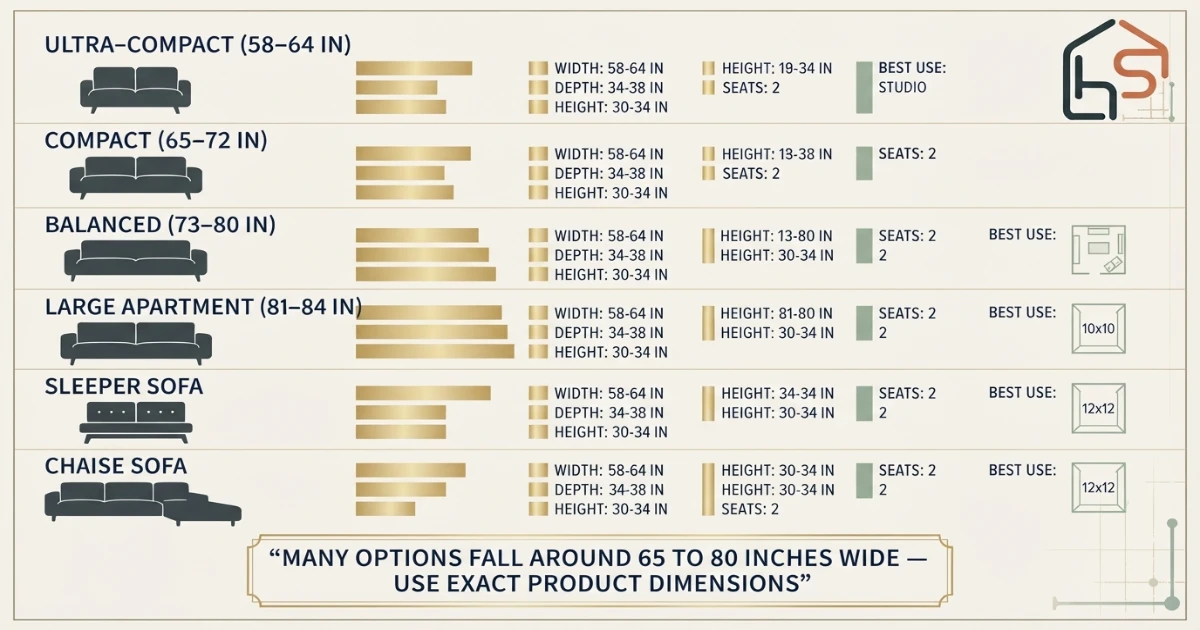
Apartment size sofa complete dimensions chart
An apartment size sofa is a reduced-scale sofa designed to provide useful seating without occupying the wall and floor area of a large conventional model. The category has no single universal standard, so exact measurements matter more than the label.
| Furniture type | Width | Depth | Height | Seats | Best use |
|---|---|---|---|---|---|
| Ultra-compact sofa | 58–64 in | 30–35 in | 29–36 in | 2 | Studio, office, bedroom |
| Compact apartment sofa | 65–72 in | 31–38 in | 29–38 in | 2–3 | Studio or 10×10 room |
| Balanced apartment sofa | 73–80 in | 32–40 in | 30–38 in | 2–3 | Main apartment living room |
| Large apartment sofa | 81–84 in | 33–41 in | 30–39 in | 3 | Larger apartment or 12×12 room |
| Apartment sleeper sofa | 64–82 in | 34–41 in closed | 31–38 in | 2–3 | Living room plus guests |
| Apartment chaise sofa | 72–96 in long side | 55–70 in chaise | 28–38 in | 3–4 | Open-side compact layout |
Studio, office, bedroom or maximum open floor area.
Strong two-person range for small main rooms.
Everyday apartment seating with occasional third place.
Three-seat appearance when depth and access allow it.
What makes a sofa apartment size?
Crate & Barrel describes a small sofa as a full-size sofa silhouette with less length and depth, and notes that apartment sofa is another term for a small sofa.
Retailers apply the label differently. One model may be shorter, another shallower, and another may use slim arms to create more inside seating within the same width.
Evaluate overall width, overall depth, height, inside seat width, arm width, seat depth, seat height and delivery dimensions.
The final piece should also preserve the apartment’s main path, door swing, window access, table zone and television distance.
Official apartment-sofa examples
| Official example | Width | Depth | Height | Inside seat | Planning lesson |
|---|---|---|---|---|---|
| West Elm Oliver | 72 or 82 in | 32 in | 30 in | 62 or 72 in | Shallow modern apartment option |
| Crate & Barrel Lounge Apartment | 73 in | 41 in | 37 in | Check exact selection | Compact width but medium-deep footprint |
| Pottery Barn Turner Apartment | 64 or 70 in | 39 in | 35–37 in | 50 or 51 in | Compact width with substantial depth |
| IKEA SÖDERHAMN | 78 in | 39 in | 32⅝ in | 73¼ in | Slim arms and broad inside width |
West Elm’s Oliver illustrates a shallow approach: the collection includes 72 and 82-inch widths with 32-inch overall depth.
Crate & Barrel’s Lounge 73-inch Apartment Sofa is compact in width but about 41 inches deep, showing that apartment width does not guarantee a shallow footprint.
Pottery Barn’s Turner includes compact apartment widths around 64 or 70 inches with about 39-inch depth, depending on configuration.
IKEA’s SÖDERHAMN is about 78 inches wide with very slim arms and more than 73 inches of listed seat width, demonstrating how arm design changes capacity.
Choose width from usable wall space
Start with usable wall width rather than total wall length. Subtract doors, curtain stacks, radiators, floor lamps and circulation zones.
A 60-inch sofa leaves useful space in a studio but may feel close for two adults who prefer personal room.
A 68 to 72-inch model is a strong two-person choice and can provide occasional third seating when arms are slim.
A 73 to 80-inch sofa creates a more conventional main-room appearance without reaching the scale of a 90-inch sofa.
An 81 to 84-inch model can work in a larger apartment, but depth and delivery should be checked carefully.
Depth matters as much as width
Overall depth around 31 to 34 inches is easiest for narrow rooms and studios. Depth around 35 to 38 inches supports balanced mixed use.
A 39 to 41-inch sofa can still be marketed for apartments because the width is compact, but it consumes more front-to-back floor area.
Use the Sofa Depth Guide to compare compact, standard and deep seating.
Apartment room-depth formula
A 34-inch sofa, 15-inch gap, 20-inch table and 12-inch console use 81 inches. A 41-inch sofa with the same arrangement uses 88 inches.
The seven-inch difference can decide whether the room keeps a full walkway or forces the table off-center.
Usable seat width and slim arms
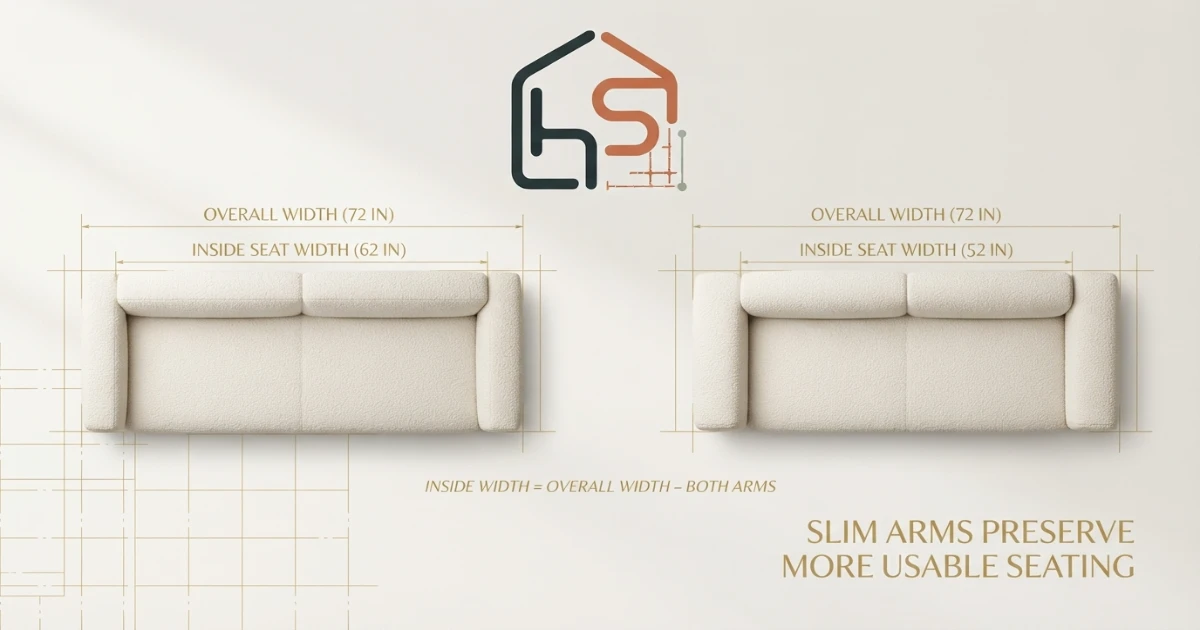
Inside seat width is the space between the arms. It predicts real capacity more accurately than overall width or cushion count.
Subtract both arms from overall width. A 68-inch sofa with two five-inch arms provides about 58 inches inside.
A 72-inch sofa with two ten-inch arms provides only 52 inches inside. The wider sofa may offer less practical seating.
Slim track arms, recessed arms and armless modules improve efficiency. Rolled and shelter arms consume more width.
Bench cushions allow flexible placement, while divided cushions visually assign each seat.
Two-seat versus three-seat capacity
Many compact sofas comfortably seat two adults even when product photography shows three cushion divisions.
For three regular adult seats, look for roughly 66 to 72 inches of inside width, supportive cushions and efficient arms.
For two adults, inside width around 50 to 60 inches can be comfortable depending on body size and sitting style.
Buy for daily users. Occasional guests can use a chair or ottoman instead of forcing an oversized sofa into the room.
Apartment sofa versus loveseat
Categories overlap. A 68-inch piece might be sold as a large loveseat, apartment sofa or compact sofa.
A loveseat is usually designed around two seats. An apartment sofa may use sofa-like proportions, slimmer arms or a longer bench cushion.
Use the Loveseat vs Sofa Dimensions Guide to compare capacity and usable width.
Choose a loveseat when open floor area matters most. Choose the sofa when lounging length or occasional third-seat use matters.
Apartment sofa versus standard sofa
A standard sofa often measures about 78 to 96 inches wide, although categories overlap.
The apartment version may save width, depth or both. It may also arrive in smaller packages or use removable legs.
A standard sofa is better when the room is the household’s primary gathering area and regular three-seat capacity matters.
Use the Standard Sofa Dimensions Chart for broader ranges.
Apartment sofa versus compact sectional
A compact chaise sectional provides lounging but uses a long side plus a projecting chaise.
A straight apartment sofa is easier to combine with a movable chair or ottoman and is usually simpler to deliver.
Choose a sectional when the return fits away from the entrance. Choose a straight sofa when flexibility and future moves matter.
Use the Sectional Size Guide for long-side and chaise measurements.
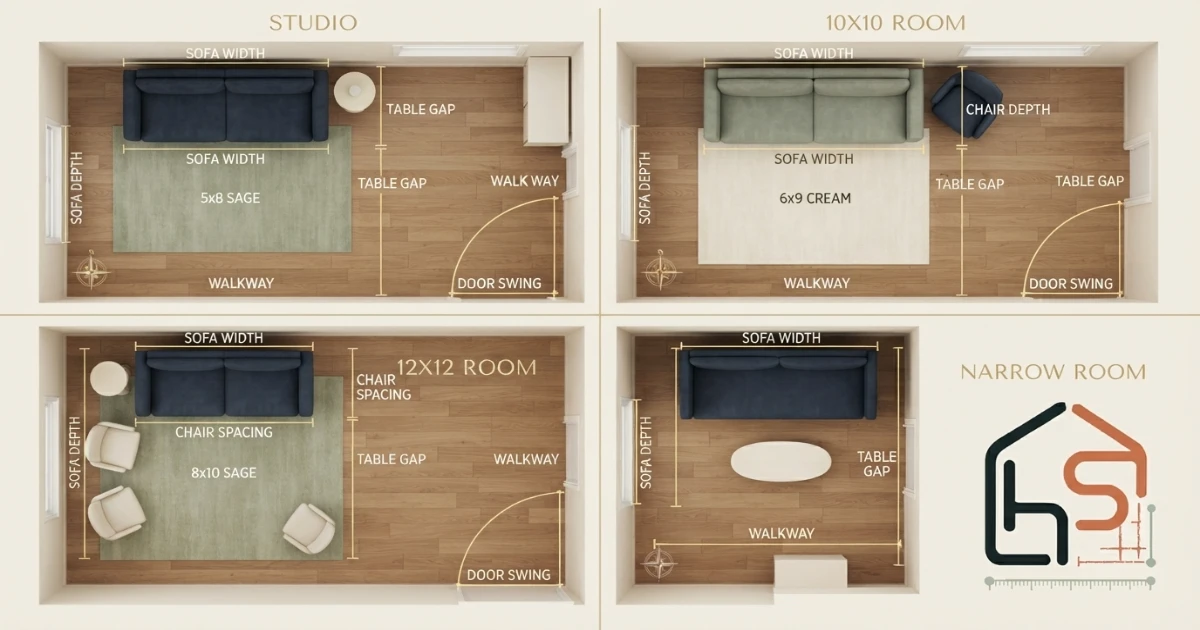
Best sofa size for a studio apartment
A 58 to 68-inch sofa is a practical starting range for many studios. It creates seating without dividing the entire open room.
Depth around 30 to 35 inches is easier to combine with dining, sleeping and circulation zones.
Use one compact side table or nesting tables instead of two end tables.
A sleeper can replace a guest bed, but the open mattress footprint must be outlined.
Raised legs and visible floor help the furniture feel lighter.
Apartment sofa in a 10×10 living room
A 60 to 72-inch sofa fits many 10×10 rooms. A 66 or 72-inch model balances seating with a compact table and one chair.
Keep depth around 31 to 36 inches when possible and protect about 30 inches on the main path.
Use the 10×10 Sofa Layout Guide for complete examples.
A wall-mounted television and shallow console can recover several inches.
Apartment sofa in a 12×12 room
A 72 to 80-inch sofa works comfortably in many 12×12 rooms and leaves space for chairs or side tables.
An 82 to 84-inch option can fit when depth and circulation are controlled.
Use an 8×10 rug for many layouts or 9×12 for fuller coverage.
See the 12×12 Sofa Layout Guide for table and TV-console relationships.
Apartment sofa in a narrow living room
Depth is the priority. A 78-inch sofa that is 32 inches deep may fit better than a 68-inch sofa that is 41 inches deep.
Use a narrow oval, rectangular or nesting table and keep opposite furniture shallow.
A long bench cushion can visually lengthen the room without adding depth.
Place the sofa on the uninterrupted long wall and preserve the route between doors.
Floating an apartment sofa in an open plan
A compact sofa can separate living and dining zones. Include a 30 to 36-inch path behind it when the route is used regularly.
The finished back, seams and cushions become visible, so inspect them before buying.
A slim console can reinforce the boundary but must be added to the footprint.
Align the sofa with the rug, island or ceiling line so the division feels intentional.
Apartment sleeper sofas
Compact sleeper sofas combine seating and guest use, but closed dimensions tell only half the story.
Measure the fully open mattress and allow room to move around it. The coffee table needs a regular relocation point.
Sleeper mechanisms add weight and may change seat firmness or overall depth.
Check mattress size, sleeping length, support, package size and delivery before buying.
Storage and multifunction designs
Lift-up chaises, drawers and modular storage help apartments use hidden volume.
Measure the open lid or drawer path. Storage is not useful when the coffee table blocks access.
Heavy bedding affects operation and weight. A straight sofa plus storage ottoman may be more flexible.
Seat depth, height and back support
Compact dimensions should not force poor posture. Compare seat depth, seat height, back pitch and cushion firmness.
Seat depth around 20 to 22 inches suits upright mixed use. Deeper seats encourage lounging but may need lumbar pillows.
Seat height around 17 to 19 inches works for many adults. Very low sofas can be harder to stand from.
Test the sofa with every regular user when possible.
How to make a compact sofa look intentional
Choose a rug large enough to anchor the sofa rather than a tiny rug under only the table.
Use vertical curtains, artwork and lamps to balance the shorter horizontal furniture.
Exposed legs and slim arms feel lighter than a skirted model with bulky cushions.
Do not fill every side gap. Negative space helps the apartment feel larger.
Rug size with an apartment sofa
A 5×8 rug can work with an ultra-compact sofa, but a 6×9 or 8×10 rug usually creates a stronger group.
Place at least the sofa’s front legs on the rug when possible.
A sofa plus chair often benefits from 8×10. A compact sofa plus loveseat may require 9×12.
Use the Living-Room Rug Size Guide for placement options.
TV distance and console depth
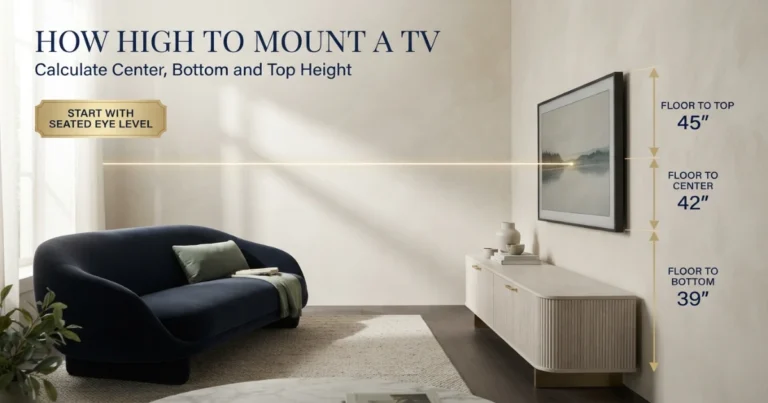
Measure from the seated eye position rather than the wall. A deep sofa moves the user farther from the screen.
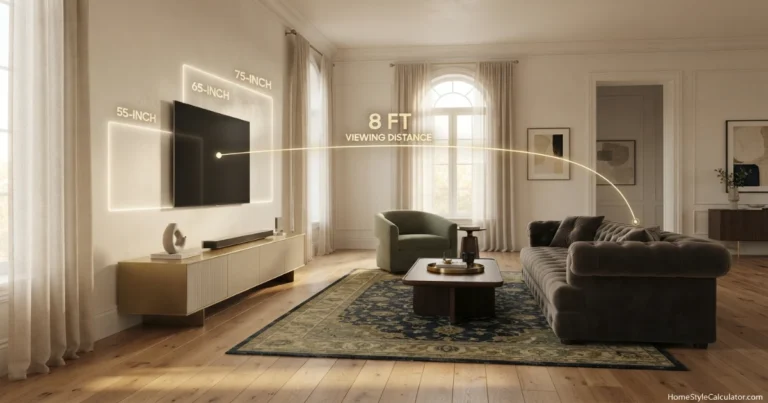
Use the TV Size Calculator for the actual distance.
A shallow console or wall mount preserves room depth. Use the TV Stand Size Guide for console dimensions.
Keep speakers, towers and cables out of the only walkway.
Windows, curtains and radiators
An apartment sofa often sits under a window because wall options are limited.
Leave room for curtain stacks, radiator airflow, vents and access to locks.
Do not place upholstery directly against a heat source.
Use the Curtain Size Calculator before committing to a wide sofa below a window.
Apartment delivery and doorway fit
Compact width helps delivery but does not guarantee success. A short deep sofa can still be difficult to pivot through a hallway.
Record width, height, depth, diagonal depth, removable legs and package dimensions.
Measure every clear door, hallway, stair, elevator and final-room entrance.
Use the Will My Sofa Fit Through the Door Guide for horizontal, rotated and on-end formulas.
Flat-pack and modular products can be easier because the largest package is smaller than the assembled sofa.
Fabric, leather and maintenance
Performance fabric and removable covers are useful where the sofa receives daily use.
Leather creates a tailored appearance but can show scratches and needs appropriate care.
Loose covers may increase visual bulk. Tight upholstery can make the same dimensions appear lighter.
Check cleaning code, cushion rotation, replacement-cover availability and warranty.
Best features for renters and future moves
Renters benefit from removable legs, modular construction, neutral styling and adaptable dimensions.
A 68 to 76-inch sofa is easier to reuse in an office, bedroom or secondary room than a 90-inch frame.
Reversible cushions and replaceable covers can extend useful life across multiple homes.
A practical apartment size sofa should suit more than one possible wall when a move is likely.
How to compare apartment sofas online
Filter by exact width first, then read depth, height, seat width and delivery measurements.
Do not rely on photographs. Wide-angle images can make both the sofa and room appear larger.
Compare inside seat width, arm width and seat depth to understand capacity and comfort.
Read return rules carefully for made-to-order upholstery and custom depth choices.
Save the exact selected configuration because dimensions can vary within one collection.
Price and long-term value
A small sofa is not automatically inexpensive because frame construction, cushions, fabric and labor remain substantial.
Compare price per usable seat, warranty, repairability, cover replacement and expected daily use.
A slightly wider sofa can offer better value when it prevents the need for another chair.
A narrower sofa can offer better value when it preserves a desk, dining area or safe walkway.
Common apartment buying scenarios
One-person studio: choose 58 to 64 inches with a shallow frame, one side table and a 5×8 or 6×9 rug.
Couple in a 10×10 room: choose 65 to 72 inches with at least 50 to 58 inches of inside width.
Small family: choose 73 to 80 inches with slim arms and add one movable chair rather than a fixed sectional.
Frequent overnight guest: choose a compact sleeper only after outlining the open mattress and relocation space for the table.
Frequent mover: choose removable legs, modular packaging and a width that can serve as a future office or bedroom sofa.
Narrow railroad apartment: prioritize 31 to 34-inch depth and keep the television wall as shallow as possible.
Which apartment sofa size should you buy?
Studios, offices, bedrooms and maximum open space.
Two regular users and compact main living rooms.
Balanced everyday seating and occasional third-seat use.
Three-seat capacity where room and delivery remain comfortable.
Step-by-step apartment-sofa buying process
Subtract doors, curtains, radiators and circulation.
Include sofa, table, console and walkway.
Compare 58–64, 65–72, 73–80 and 81–84 inches.
Prefer 31–36 inches when easy placement is the priority.
Subtract both arms from overall width.
Check seat depth, height, pitch and cushion firmness.
Mark sofa, table, rug and walkway.
Open sleepers, chaises and storage.
Check doors, halls, stairs, elevators and packages.
Confirm the exact selected dimensions before ordering.
Common apartment size sofa mistakes
- Choosing from the apartment label without reading dimensions.
- Measuring total wall width instead of usable width.
- Assuming compact width means shallow depth.
- Ignoring inside seat width and bulky arms.
- Buying for rare guests instead of regular users.
- Using an oversized coffee table.
- Blocking the only circulation route.
- Forgetting sleeper or storage opening space.
- Choosing a sectional without outlining the chaise.
- Ignoring rug and TV relationships.
- Measuring the room but not the elevator or hallway.
- Ordering custom upholstery before delivery verification.
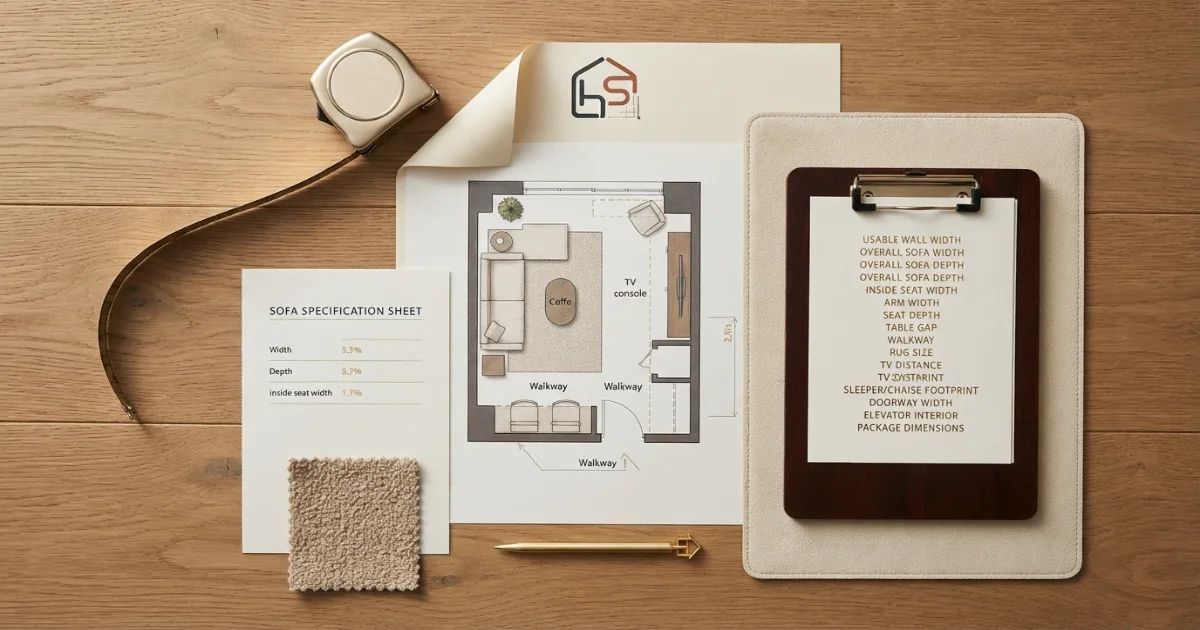
Apartment size sofa buying checklist
- Usable wall width.
- Usable room depth.
- Overall sofa width.
- Overall sofa depth.
- Overall sofa height.
- Inside seat width.
- Arm width.
- Seat depth.
- Seat height.
- Regular users.
- Side clearance.
- Coffee-table gap.
- Coffee-table depth.
- Opposite furniture depth.
- Main walkway.
- Rug size.
- TV viewing distance.
- Sleeper, chaise or storage footprint.
- Doorway, hallway, stair and elevator access.
- Package dimensions and removable legs.
Final answer: best apartment sofa dimensions
An apartment size sofa commonly works best between 65 and 80 inches wide, with overall depth around 31 to 38 inches for easier planning.
Choose 58 to 64 inches for studios and secondary rooms, 65 to 72 inches for compact two-person seating, 73 to 80 inches for balanced everyday use and 81 to 84 inches when three-seat capacity matters.
Compare exact inside width, depth, special features and delivery access before ordering.
Need the right sofa size for your exact apartment?
Use the free Sofa Size Calculator, then compare the recommendation with this guide.
Official apartment-sofa references
- Crate & Barrel: apartment sofa as a reduced-scale small sofa
- West Elm Oliver: official 72 and 82-inch compact sofa dimensions
- Crate & Barrel Lounge: official 73-inch apartment-sofa example
- Pottery Barn Turner: official apartment configuration dimensions
- IKEA SÖDERHAMN: official 78-inch slim-arm sofa measurements
Two apartment-sofa categories to compare
58–72 Inch Compact Sofas
Compare ultra-compact and compact sofas by inside width, depth and package dimensions.
View Compact Sofas on Amazon73–82 Inch Apartment Sofas
Compare balanced models with two-to-three-seat capacity, slim arms and compact frames.
View Apartment Sofas on AmazonAffiliate disclosure: As an Amazon Associate, HomeStyle Calculator may earn from qualifying purchases.
Apartment size sofa FAQs
What is an apartment size sofa?
An apartment size sofa is a reduced-scale version of a full-size sofa, usually with less width and sometimes less depth. Many practical options fall around 65 to 80 inches wide.
What are standard apartment sofa dimensions?
A useful planning range is about 65 to 80 inches wide, 32 to 39 inches deep and 30 to 38 inches high. Exact products can be smaller, wider or much deeper.
How many people fit on an apartment sofa?
Most apartment sofas seat two adults comfortably, while slim-arm models around 72 to 82 inches may seat three. Inside seat width matters more than the product label.
Is a 72-inch sofa good for an apartment?
Yes. A 72-inch sofa is a strong compact choice when its depth, arms and delivery dimensions suit the room.
Can an 80-inch sofa fit in a small apartment?
Often yes, especially in a 10×10 or 12×12 living room. Check usable wall width, sofa depth, table zone, walkway and doorway access.
What sofa depth is best for an apartment?
Overall depth around 31 to 36 inches is easiest to place. A 37 to 41-inch sofa can work when the coffee table and opposite furniture are compact.
Is an apartment sofa the same as a loveseat?
Not always. Categories overlap, but apartment sofas often use sofa-style proportions and may provide two-to-three-seat capacity, while loveseats are usually designed for two.
Should I choose slim arms for a small sofa?
Slim arms preserve more inside seat width. A narrower slim-arm sofa can provide more usable seating than a wider sofa with bulky arms.
Can an apartment sofa include a sleeper?
Yes. Compact sleeper sofas can provide guest space, but the fully open bed depth and heavier delivery dimensions must be measured.
How do I know whether an apartment sofa will fit through the door?
Compare sofa width, height, depth and diagonal depth with every clear doorway, hallway, stair and elevator measurement. Package dimensions may be more relevant for flat-pack models.