5×8 vs 6×9 rug: which size fits better?
Compare dimensions, floor coverage, room fit and furniture placement before choosing the compact 5×8 or the slightly larger 6×9 area rug.
Written by Rehana K · Published and updated July 14, 2026.
Choose 5×8 for a compact accent; choose 6×9 for more usable furniture coverage.
In a 5×8 vs 6×9 rug comparison, the 6×9 is 1 foot wider, 1 foot longer and 14 square feet larger.
Choose a 5×8 rug for a compact living-room accent, small office, bedside placement or very small dining table. Choose a 6×9 rug when the rug should reach more furniture legs, support pulled-back chairs or provide a fuller landing area around a full or queen bed. The 6×9 covers 35% more floor area, so the difference is noticeable without being as dramatic as the jump from 5×7 to 8×10.
See the 5×8 vs 6×9 rug difference
The furniture stays in the same position. The 6×9 adds about six inches of visible rug on every side when both sizes are centered.
5×8 rug
Compact, efficient and useful for a small defined area.
6×9 rug
More useful around chair legs, beds and small furniture groups.
Which rug fits your room and furniture?
Enter the clear room size and the footprint that should sit on the rug. The checker compares 5×8 and 6×9 without automatically choosing the larger rug.
5×8 vs 6×9 result
The recommendation checks both room fit and furniture coverage.
Checking room and furniture dimensions…
Checking room and furniture dimensions…
5×8 vs 6×9 rug comparison table
Compare dimensions, coverage, furniture use and practical room applications before buying.
| Comparison point | 5×8 rug | 6×9 rug |
|---|---|---|
| Dimensions | 5 × 8 ft | 6 × 9 ft |
| Floor area | 40 sq ft | 54 sq ft |
| Difference | Smaller baseline | 14 sq ft larger |
| Typical room role | Compact accent | Small-room anchor |
| Living-room placement | Coffee table or small chair zone | Front legs of compact sofa/chairs |
| Dining-table range | Often 2–4 seats | Often 4 seats; some compact 6-seat sets |
| Bedroom use | Bedside, twin or lower full-bed placement | Full bed; compact queen placement |
| Visible floor border | More exposed floor | More connected coverage |
| Weight and handling | Easier to move | Slightly heavier |
| Likely price | Usually lower | Usually moderately higher |
5×8 vs 6×9 rug: the complete room-by-room guide
The 5×8 vs 6×9 rug comparison is more subtle than many standard rug comparisons because the dimensions differ by only one foot in each direction. Even so, the 6×9 covers 14 more square feet, which can determine whether front furniture legs, dining-chair rear legs or a bed-side landing area remain on the rug.
A 5×8 usually behaves like a compact accent or a small-zone anchor. A 6×9 can perform the same job with more breathing room and is often easier to use beneath a small sofa group, full bed or compact dining set. The correct choice depends on the furniture footprint, the room border and how much of the furniture should sit on the rug.
Use this comparison for the commercial decision, then enter exact dimensions in the Rug Size Calculator. For other standard comparisons, visit 5×7 vs 8×10 Rug and 8×10 vs 9×12 Rug.
The difference in one sentence
A 5×8 preserves more floor and works as a compact accent, while a 6×9 adds six inches of rug around each side when centered and covers 35% more area.
5×8 vs 6×9 rug dimensions and area difference
A 5×8 rug measures 5 feet wide and 8 feet long. It covers 40 square feet. A 6×9 rug measures 6 feet wide and 9 feet long, covering 54 square feet.
In the 5×8 vs 6×9 rug comparison, the larger rug adds one foot to both dimensions. When centered in the same position, this creates approximately six additional inches of rug on each side and six additional inches at each end.
The total difference is 14 square feet, or 35% more area. This is enough to change furniture placement without turning the 6×9 into a dramatically different room-scale rug.
5×8 vs 6×9 rug for a living room
In a 5×8 vs 6×9 rug living-room comparison, a 5×8 rug works beneath a coffee table, between two compact chairs or in front of a small loveseat. It may not reach the front legs of a standard sofa and opposing chairs.
A 6×9 provides an additional foot of width and length, making it more likely to reach the front sofa legs and connect a small chair. It is still compact enough for many apartments and narrow living rooms.
In a 5×8 vs 6×9 rug living-room decision, choose 5×8 when the rug is mainly an accent. Choose 6×9 when the furniture should look connected rather than arranged around a floating central rug.
Compact apartment seating
Both sizes can work in an apartment, but layout matters. A 5×8 may preserve a clear path near an entry or media unit. A 6×9 can make a small sofa-and-chair group feel more finished.
Tape both outlines. Six inches of extra rug around each edge can be the difference between a chair leg landing fully on the rug and sitting directly on the edge.
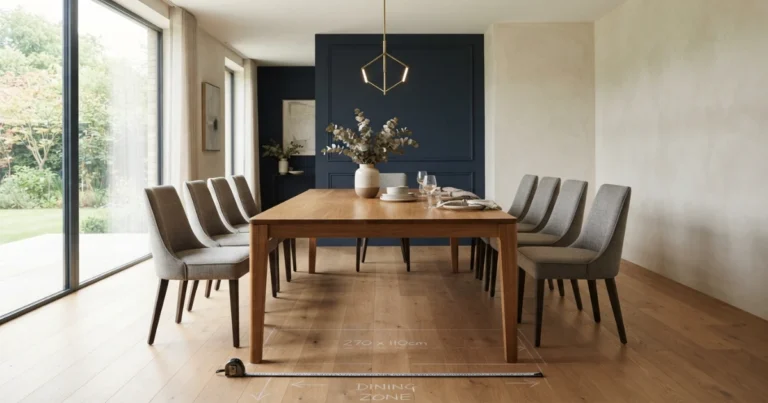
5×8 vs 6×9 rug under a dining table
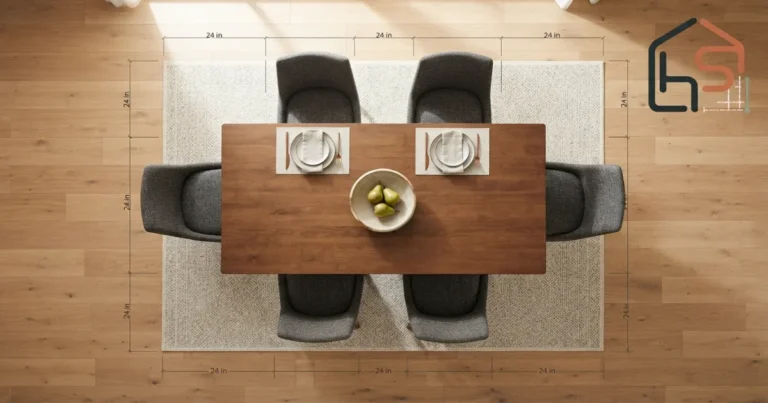
Dining rugs should extend about 24–30 inches beyond each table edge so the rear chair legs remain on the rug when diners pull back.
For a 5×8 vs 6×9 rug dining decision, a 5×8 can work beneath a very compact two- to four-seat table. A 6×9 gives more chair space and is often a stronger choice beneath a standard four-seat rectangular table.
For a 48-inch-long table, a 5×8 leaves 24 inches at each end when the 8-foot dimension follows the table length. A 6×9 leaves 30 inches at each end. That six-inch difference can noticeably improve chair movement.
In the 5×8 vs 6×9 rug dining decision, check both table length and width. A rug that is long enough can still be too narrow for pulled-back side chairs.
5×8 vs 6×9 rug in a bedroom
In a 5×8 vs 6×9 rug bedroom comparison, a 5×8 works beside a bed, at the foot or beneath a twin bed. It can also sit beneath the lower portion of a full bed when the room is compact.
A 6×9 is better beneath a full bed because it adds side and foot coverage. It can work beneath the lower portion of a queen bed, though an 8×10 often creates a more balanced queen-bed layout.
For the 5×8 vs 6×9 rug bedroom choice, decide whether the rug is an accent or a bed anchor. A 5×8 is easier to position as an accent; a 6×9 is more useful when both sides of the bed need a soft landing.
See the Twin Bed Rug Guide, Full Bed Rug Guide and Queen Bed Rug Guide for exact placements.
5×8 vs 6×9 rug room-size examples
| Clear room size | 5×8 floor border | 6×9 floor border | Likely decision |
|---|---|---|---|
| 8 × 10 ft | 18 in sides, 12 in ends | 12 in sides, 6 in ends | 5×8 preserves more floor |
| 9 × 11 ft | 24 in sides, 18 in ends | 18 in sides, 12 in ends | Either; furniture decides |
| 10 × 12 ft | 30 in sides, 24 in ends | 24 in sides, 18 in ends | 6×9 often anchors better |
| 11 × 13 ft | 36 in sides, 30 in ends | 30 in sides, 24 in ends | 6×9 or larger |
These examples assume centered rugs and clear rooms. Furniture, doors and storage can reduce usable floor.
Exposed floor and visual proportion
In the 5×8 vs 6×9 rug choice, a 5×8 leaves more visible flooring and can feel lighter in a compact room. A 6×9 reduces the floor border and creates a stronger room zone.
In the 5×8 vs 6×9 rug decision, check the shortest floor border. When a 6×9 approaches a door or wall, the 5×8 may fit better. When a 5×8 leaves furniture legs unsupported, the 6×9 is usually more functional.
Furniture placement differences
Accent placement
A 5×8 works as a central accent beneath a coffee table, reading chair group or compact office desk. The surrounding furniture can remain off the rug.
Front legs on the rug
A 6×9 has a better chance of reaching the front legs of a loveseat or small sofa and one or two chairs. The additional six inches around each side can improve the connection.
All legs on the rug
Neither size is normally large enough for a full standard living-room group with all legs on the rug. Use the calculator when that is the required placement.
5×8 vs 6×9 rug price, weight and handling
In a 5×8 vs 6×9 rug price comparison, a 6×9 generally costs more because it contains 35% more material. The difference in shipping and rug-pad cost is usually moderate rather than dramatic.
A 5×8 is easier to carry, rotate and clean. A 6×9 remains manageable for many households but may exceed the capacity of a home washing machine, even when marketed as washable.
Do not choose the smaller rug only for price when the extra foot of width and length solves a chair or furniture-placement problem.
5×8 vs 6×9 rug for offices and entry areas
For a 5×8 vs 6×9 rug office decision, a 5×8 can define a small desk, console or reading zone without reaching a doorway. It works well when the chair movement is limited and the desk does not need to sit fully on the rug.
A 6×9 is more useful when a rolling office chair needs a longer path or when the desk, guest chair and storage should feel connected. Measure the chair in its pulled-back position.
In an entry, either size can work only when the door clears the rug and pad. The 5×8 is easier to keep away from thresholds, while the 6×9 can create a stronger statement in a wide foyer.
Kids’ rooms and guest rooms
In a 5×8 vs 6×9 rug kids-room comparison, a 5×8 creates a compact play or reading area and is easier to move for cleaning. A 6×9 gives children more continuous soft floor and can sit beneath a twin or full bed.
In a guest room, the 5×8 works beside the bed or at the foot. The 6×9 is better when the rug should support the lower portion of the bed and provide coverage on both sides.
Door clearance, vents and rug pads
For an accurate 5×8 vs 6×9 rug fit check, measure the gap beneath swinging doors and include the pad thickness. A size can fit the room outline but still interfere with a door when the pile is thick.
Do not cover floor vents unless permitted by the system and product guidance. Mark vents during the tape test so the final placement reflects the real room.
For the 5×8 vs 6×9 rug choice, verify actual product dimensions because nominal sizes can vary. Fringe may also extend beyond the listed field.
Material and maintenance
The Carpet and Rug Institute cleaning and maintenance guidance includes useful care information for carpet and area rugs. Follow the manufacturer’s label because fiber and construction change the appropriate cleaning method.
Use a rug pad compatible with the floor and cut slightly smaller than the rug. The pad should not create a raised edge or interfere with door clearance.
Clear walking routes and stable transitions
The larger rug should not reduce a clear walking route. The U.S. Access Board accessible-route guidance explains clear-route principles for spaces covered by accessibility standards.
In a private home, use the same broad principle: choose the 5×8 vs 6×9 rug option that remains flat and preserves the path actually used by household members.
5×8 vs 6×9 rug shopping checklist
- Measure the clear room after accounting for doors, storage and vents.
- Measure the complete furniture footprint, not only the coffee table.
- Decide whether the rug is an accent or a furniture anchor.
- Tape both outlines and view them from the main doorway.
- Check pulled-back dining chairs and office-chair movement.
- Verify the retailer’s actual dimensions and return policy.
- Include the rug pad in cost, thickness and clearance checks.
- Confirm that the longer dimension follows the main room or furniture direction.
Quick decision matrix
| Your situation | Better starting size | Reason |
|---|---|---|
| Small reading or coffee-table zone | 5×8 | Preserves more exposed flooring |
| Compact sofa with front legs on rug | 6×9 | Adds useful width and length |
| Small two- to four-seat dining table | 5×8 or 6×9 | Chair clearance decides |
| Standard four-seat table | 6×9 | More likely to support pulled-back chairs |
| Bedside or twin-bed accent | 5×8 | Compact and easy to position |
| Full bed or compact queen placement | 6×9 | Provides better side and foot coverage |
| Large sofa group | Larger than 6×9 | Neither size may connect all furniture |
When neither size is right
A room may need 4×6, 7×9, 8×10 or a runner instead. A long narrow room may not suit either proportion, while a large seating group may make both options look undersized.
The 5×8 vs 6×9 rug comparison should not force a choice. Use the Rug Size Calculator when the furniture footprint or room border fails both options.
Nominal sizes, handmade rugs and retailer variations
Rug labels such as 5×8 and 6×9 are usually nominal categories rather than guaranteed finished measurements. One product may measure 4 feet 10 inches by 7 feet 8 inches, while another may be slightly larger. Handmade rugs can vary more because weaving, washing and finishing affect the final dimensions.
In a 5×8 vs 6×9 rug comparison, a few inches can matter when chair legs, a doorway or a narrow floor border are already close to the limit. Read the product specifications instead of relying only on the category name. Confirm whether the dimensions include fringe and whether the retailer lists an acceptable manufacturing tolerance.
Check the return policy before ordering. A rug can be expensive to send back, and oversized packaging may require a freight-style return. Photograph the taped room outline and compare it with the exact product measurements before purchasing.
Rug corners, curling and placement stability
A correctly sized rug should remain stable in the real furniture layout. Corners that sit directly in a traffic path can curl or lift, especially when the rug is lightweight or has been tightly rolled. Furniture placement can help hold a rug flat, but it should not be used to hide an unsafe edge.
A quality rug pad can improve grip and cushioning. The pad should be compatible with the flooring and slightly smaller than the rug so it remains hidden. When comparing a 5×8 vs 6×9 rug, remember that the larger pad adds cost and may increase total thickness beneath a door or rolling chair.
Allow a newly delivered rug to relax according to the manufacturer’s instructions. Avoid aggressive heat or improvised adhesives that may damage the rug or floor. If a corner remains raised, contact the retailer or manufacturer for product-specific guidance.
Renters, future moves and budget priorities
A 5×8 is easier to carry through stairs, elevators and narrow doorways. It can be reused in a bedroom, office, entry or reading area after a move. This flexibility makes it attractive for renters and households that rearrange rooms frequently.
A 6×9 is still manageable but performs more like a small-room anchor. It may offer better long-term value when the current layout needs the extra coverage and a future room could also use it beneath a full bed or compact seating group.
Budget should be considered after functional fit. In the 5×8 vs 6×9 rug decision, saving money on the smaller size is useful only when the furniture placement remains stable and visually connected. If the 5×8 leaves important chair or sofa legs outside the rug, the 6×9 may be the more economical choice over the life of the room.
Common 5×8 vs 6×9 rug mistakes
- Assuming one foot makes no difference: 6×9 adds 14 square feet.
- Using 5×8 under a table without chair clearance: rear legs can fall off the rug.
- Buying 6×9 without measuring doors: the extra foot can affect circulation.
- Measuring only the coffee table: outer furniture legs decide the required footprint.
- Ignoring orientation: the longer rug side should follow the main furniture direction.
- Skipping the rug pad: the rug can shift or wear unevenly.
- Ignoring actual product dimensions: nominal sizes can vary.
- Skipping the tape test: product photos cannot show real room proportions.
How to tape 5×8 and 6×9 outlines
Mark the 5×8 outline first and place the furniture in its real position. Check whether the rug reaches the intended legs or landing area.
Expand the outline by six inches on each side and six inches at each end to represent 6×9. This clearly shows the one-foot increase in both dimensions.
Open doors and drawers, pull chairs back and walk the main route. Photograph both outlines from the doorway before deciding.
Final 5×8 vs 6×9 rug buying decision
In the final 5×8 vs 6×9 rug choice, choose 5×8 when the rug is an accent, the room is tight, the furniture footprint fits comfortably and preserving exposed floor matters.
For the 5×8 vs 6×9 rug decision, choose 6×9 when the extra six inches around every side improves chair clearance, furniture connection or bed-side coverage without crowding the room.
In the final 5×8 vs 6×9 rug decision, choose the smallest size that fully performs the intended job—not simply the least expensive option.
Get a measurement-based answer
Enter the room and furniture dimensions in the free Rug Size Calculator. Use this comparison to understand the one-foot difference, then use the calculator for the final recommendation.
5×8 vs 6×9 rug FAQs
Direct answers about dimensions, room fit, furniture placement and buying decisions.