Standard curtain sizes chart: lengths, widths and how to choose
Use this complete standard curtain sizes chart to compare common ready-made lengths, panel widths, ceiling-height ranges, room applications and fullness requirements before you order.
Written and reviewed by Rehana K · HomeStyle Calculator measurement-first method.
The most common ready-made curtain lengths are 63, 84, 95 or 96, 108 and 120 inches.
Standard curtain sizes are not universal, and the label alone does not tell you whether a panel will fit. Short lengths such as 45 and 54 inches suit café, sill or apron treatments. Eighty-four inches is a common floor-length starting point, while 95 or 96, 108, 120 and 144 inches support progressively higher mounting positions and taller walls.
Many single ready-made panels are about 42 to 54 inches wide, but wide and extra-wide panels are also sold. Calculate width from the usable rod span and desired fullness—not from the glass width alone.
Use the right HomeStyle Calculator page for every curtain measurement
The standard size chart identifies the likely product range. These connected guides confirm the exact length, width, rod span and panel count.
Standard curtain sizes from first measurement to final order
Standard curtain length finder
Enter the actual attachment-point height, floor finish and hardware offset. The tool estimates the required drop and recommends the closest workable standard length.
A 96-inch panel gives enough fabric for a clean tailored hem.
See how standard curtain lengths change the mounting position
Select a common ready-made length. The visual is a proportion guide—not a replacement for measuring the actual attachment point and floor.
Standard curtain lengths chart
Ready-made curtain lengths are produced in recurring size groups, but not every retailer carries every length. The chart below is a practical market reference rather than a universal manufacturing standard. A product may be listed as 95 inches instead of 96, or may skip intermediate lengths such as 72 and 90 inches entirely.
| Listed length | Typical use | Common installation note | Metric reference |
|---|---|---|---|
| 45 in | Café, small kitchen or short sill treatment | Measure around sink, counter and splash zones | 114 cm |
| 54 in | Sill or apron-length window | Useful where furniture sits below the opening | 137 cm |
| 63 in | Shorter bedroom, office or rental treatment | Can look incomplete on a clear wall | 160 cm |
| 72 in | Intermediate drop where offered | Confirm availability before planning the rod height | 183 cm |
| 84 in | Common floor-length ready-made panel | Works best when the measured drop is near 84 inches | 213 cm |
| 90 in | Intermediate high-mounted treatment | Useful between 84 and 95/96 when available | 229 cm |
| 95–96 in | Higher floor-length installation | Common choice for many eight-foot rooms after measuring | 241–244 cm |
| 108 in | Extra-long panel or nine-foot room | Supports a near-ceiling rod and tailored hem | 274 cm |
| 120 in | Ten-foot wall or very high rod | Check fabric weight and rod strength | 305 cm |
| 144 in | Very tall wall, loft or two-story space | Often needs heavier hardware or custom finishing | 366 cm |
Standard curtain panel widths chart
Length receives most of the attention, but panel width determines whether the curtains close, gather properly and stack outside the glass. A standard panel width is not the same as the width of the complete treatment. The number printed on the package normally describes one finished panel.
| Single-panel width | Size category | Where it may work | Buying warning |
|---|---|---|---|
| Approximately 42–45 in | Narrow standard panel | Small windows or multiple-panel arrangements | A pair may still be under-full on a wide rod |
| Approximately 50–54 in | Common standard panel | Many bedroom and living-room windows | Verify whether the package contains one or two panels |
| Approximately 63–72 in | Wide panel | Larger windows or reduced panel count | Heavy wide panels need suitable rods and brackets |
| Approximately 84–100 in | Extra-wide panel | Patio doors, sliding doors and broad openings | Check stack-back and center closure |
| Over 100 in | Specialty or custom-width panel | Large doors, walls and commercial-style tracks | Confirm seam placement, weight and track capacity |
Because widths vary by product, use the exact finished width in the listing. Decorative photos often show several panels, while the package may contain only one. Read the panel count, width per panel and total package width separately.
How to measure for a standard curtain size
Choose the rod or track position before selecting a length. Mark the proposed line with painter’s tape and measure from the point where the fabric will begin to the desired hem position. This attachment point may be the bottom of a ring, the hook position on a track, the inside top of a grommet or the rod-pocket line.
Measure at the left, center and right. Floors can slope, ceilings can vary and old trim may not be level. For a float finish, use the shortest practical floor measurement so the curtain clears the floor across the entire span. For a touch, break or puddle, make a deliberate allowance rather than allowing excess fabric to occur by accident.
Do not select a curtain from the visible glass height. The panel usually begins above the frame and may continue to the floor. The correct vertical measurement therefore includes the wall area above and below the window.
Standard curtain sizes by ceiling height
Ceiling height is a planning clue, not a substitute for measuring. A panel with the same listed length as the ceiling cannot normally hang from the ceiling and still clear the floor because the track, ring or header changes the usable drop. The best chart therefore gives a likely shopping range rather than one guaranteed length.
| Ceiling height | Likely shopping range | Typical rod approach | Confirm before buying |
|---|---|---|---|
| 7 ft | 72–84 in | Above frame or moderate high mount | Exact attachment point and floor finish |
| 8 ft | 84–96 in | Standard high or near-ceiling mount | Whether 84 will look short and whether 96 needs hemming |
| 9 ft | 96–108 in | High or near-ceiling mount | Ring drop, track position and floor clearance |
| 10 ft | 108–120 in | High wall or near-ceiling mount | Hardware capacity and exact hem allowance |
| 12 ft | 120–144 in | Tall-wall or architectural treatment | Custom need, panel weight and installation access |
In an eight-foot room, 84 inches may suit a rod mounted several inches above the frame, while 95 or 96 inches can support a higher rod. In a nine-foot room, 108 inches is often considered, but it may still require hemming. A ten-foot room commonly leads shoppers toward 120 inches. The actual drop always controls the final decision.
Standard curtain sizes by room
The same window size can require a different curtain treatment depending on furniture, moisture, heat sources, privacy needs and traffic. Use room type to screen the likely length, then measure the exact installation.
| Room or opening | Common size direction | Practical concern | Best planning note |
|---|---|---|---|
| Living room | 84–108 in floor-length panels | Main-wall proportion and furniture clearance | A higher rod often benefits from the longer size |
| Primary bedroom | 84–108 in, often lined or blackout | Light gaps and nightstand clearance | Coordinate length with side return and overlap |
| Child’s bedroom | 63–96 in depending on safety and furniture | Cord safety, climbing and dragging fabric | Use secure hardware and deliberate floor clearance |
| Kitchen | 24–54 in café, sill or apron treatment | Water, heat, counters and cleaning | Keep fabric clear of burners and wet work zones |
| Dining room | 84–108 in floor-length panels | Chair movement, vents and sideboards | Use a clean float or light touch for easy movement |
| Home office | 63–96 in depending on desk placement | Desks, cables, radiators and rolling chairs | A clear wall can support full length; blocked walls may not |
| Sliding door | 84–108 in length with wide or multiple panels | Handle clearance, traffic and stack-back | Width and operating direction are as important as length |
| Tall entry or loft | 120–144 in or custom | Weight, installation height and access | Confirm the hardware system before ordering fabric |
How header style changes the listed size
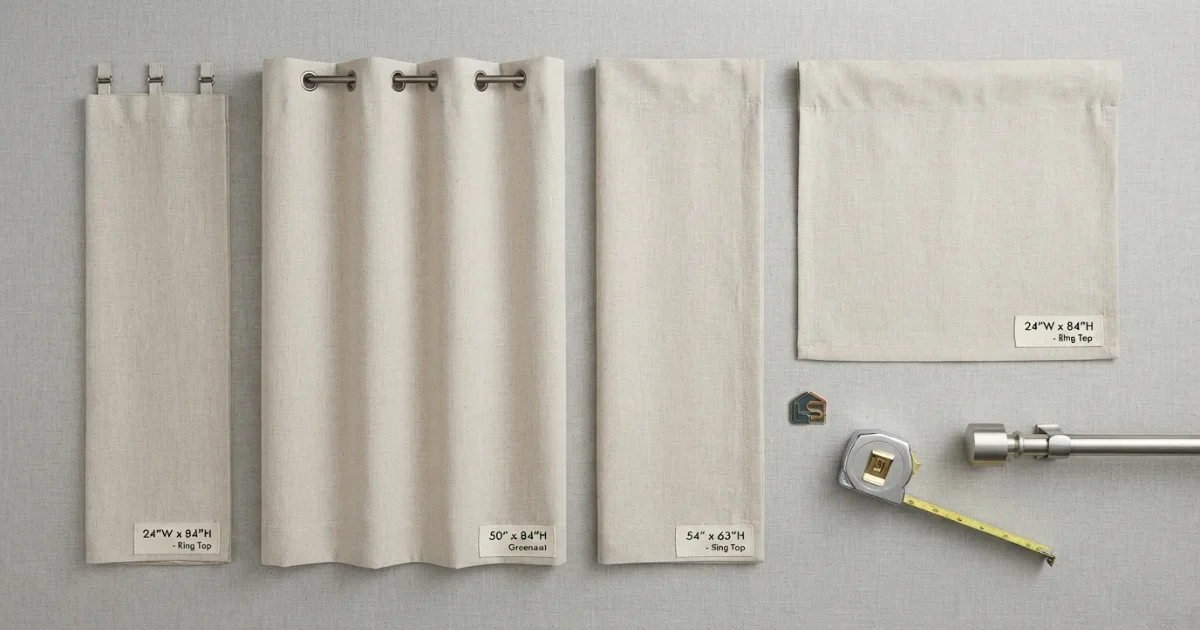
Two panels with the same listed length can finish at different heights because the header determines where the fabric hangs relative to the rod. Use the product measurement diagram whenever available.
| Header type | Where to measure from | Common sizing issue | Adjustment potential |
|---|---|---|---|
| Grommet | Inside top of grommet or actual fabric drop point | Fabric above the rod opening reduces usable drop | Limited after rod height is fixed |
| Rod pocket | Pocket line rather than absolute top edge | Decorative header may sit above the rod | Small changes through rod diameter and pocket position |
| Back tab | Actual top support line behind the panel | Panel can hang slightly differently from the product photo | Moderate through rod position |
| Clip ring | Bottom of clip where fabric begins | Ring and clip lower the panel below the rod | Useful fine adjustment through clip placement |
| Pinch pleat or hook | Hook position or track carrier | Hook setting changes the top and bottom finish | Often offers controlled fine tuning |
Standard width does not equal the correct fullness
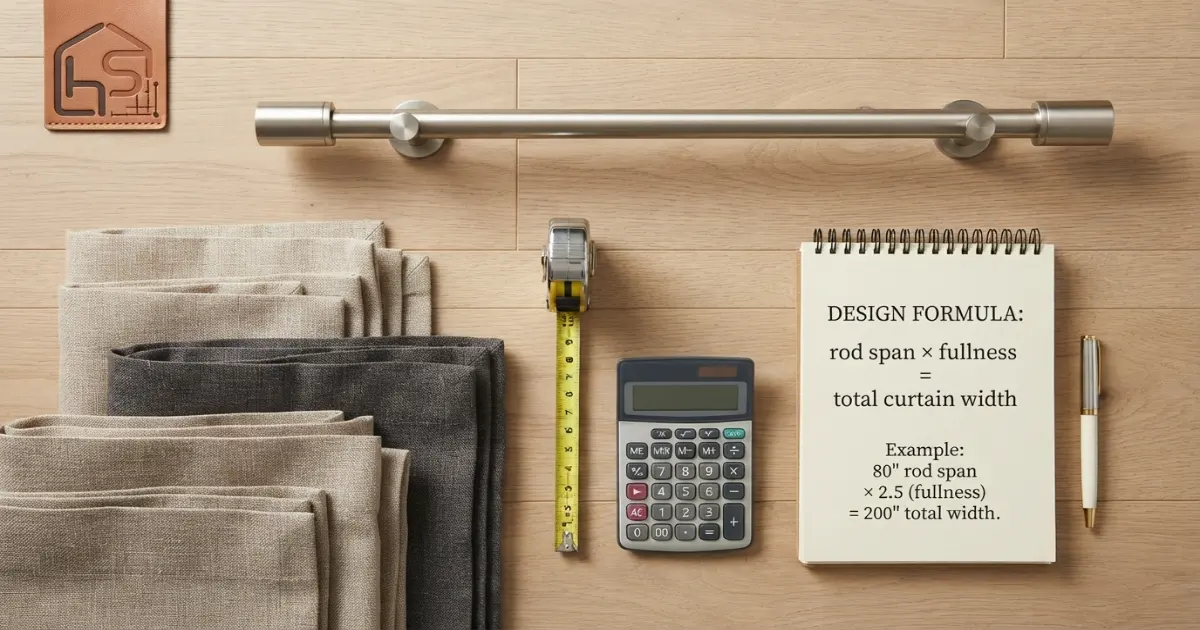
Curtain width is a calculated requirement, not a single standard answer. Start with the usable rod span between the outer stopping points, excluding decorative finials. Multiply that span by the desired fullness. A restrained tailored treatment may use about 1.5 times fullness, a common gathered treatment often uses about 2 times, and sheer or highly gathered styles may use 2.5 times or more.
Suppose the usable rod span is 72 inches and the desired fullness is 2 times. The treatment needs about 144 inches of combined finished panel width. Two 52-inch panels provide only 104 inches, which is not enough. Three panels provide 156 inches but may create an odd center arrangement. Four panels provide 208 inches and may be fuller than necessary. The best solution may be a wider panel, a different fullness target or a custom pair.
Header construction affects fullness. Grommets create broad waves and can look thin when the panel width is only slightly greater than the rod. Pinch pleats contain built-in fullness, so the product’s finished pleated width may be more important than the flat fabric width. Sheers normally need more gathering to avoid looking sparse.
Floor finish changes the required standard length
A float finishes slightly above the floor and is usually the easiest result to maintain. A light touch meets the floor without obvious excess. A small break adds a controlled fold, while a puddle places several extra inches on the floor. Each finish changes the required fabric drop.
If the attachment point is 95 inches above the floor, a half-inch float needs about 94.5 inches of usable drop. A 95- or 96-inch panel is the logical starting size. A small break may require about 96.5 inches, which could push the choice toward 108 inches if the shorter panel does not provide enough fabric after header deductions.
Busy rooms generally benefit from a float or light touch. Puddled curtains gather dust, can catch under furniture and require frequent arranging. They are better treated as a decorative decision than as the default floor-length standard.
When 45, 54, 63 and 72-inch curtains make sense
Short curtains are not automatically wrong. They are useful where the window sits above a sink, counter, radiator, desk, built-in bench or cabinet. They also support café treatments that cover only the lower portion of a window while preserving daylight above.
The stopping point must look intentional. A sill-length curtain commonly finishes around the sill, while an apron-length curtain may finish just below the trim. A random gap between the hem and floor can make a standard panel look as though the wrong size was ordered.
Kitchen and bathroom applications require extra care. Keep fabric away from burners, heating appliances, standing water and damp surfaces. Follow all appliance and ventilation clearance requirements. Where moisture is persistent, washable materials and shorter hems are often easier to maintain.
Sixty-three-inch curtains are frequently used because they are readily available, but they can visually divide a clear wall. Use them when the room function or obstruction supports the shorter line—not only because the size appears first in a product menu.
When 84, 90 and 95 or 96-inch curtains work best
Eighty-four inches is one of the most familiar ready-made lengths. It can create a clean floor-length treatment when the attachment point is positioned accordingly. The common mistake is mounting the rod high and then expecting an 84-inch panel to reach the floor. The result may stop several inches short.
Ninety-inch panels can bridge the gap between 84 and 95 or 96 inches, but availability is less consistent. When a preferred fabric is not sold in 90 inches, buy the next longer size and hem it rather than moving the rod to suit the product.
Ninety-five and 96 inches are often treated as neighboring retail standards. The one-inch difference can matter when the desired finish is exact, but manufacturing tolerance, steaming and fabric relaxation may create similar variation. Measure the delivered pair before making permanent alterations.
These lengths commonly suit bedrooms, living rooms and dining rooms with standard or moderately high rods. Their suitability comes from the measured drop, not from a room label.
When 108, 120 and 144-inch curtains are appropriate
Extra-long panels allow the rod or track to move higher while maintaining a continuous line to the floor. A 108-inch panel is commonly associated with nine-foot rooms or dramatic high mounting. A 120-inch panel often enters consideration around ten-foot walls, while 144 inches supports very tall rooms, lofts and two-story spaces.
Longer fabric is heavier. Confirm the rod diameter, bracket count, wall anchors and track capacity. A decorative rod that works for two lightweight 84-inch panels may flex under several lined 120-inch panels.
Installation access also matters. Tall brackets may require ladders, scaffolding or professional installation. Plan steaming, cleaning and future removal before choosing a treatment that is difficult to reach.
Patterns and borders become more visible on long panels. Check pattern repeat, seam placement and whether two panels align. Custom work may be more appropriate when a large motif must finish at the same height across several panels.
When standard curtain sizes are not enough
Standard sizes are convenient, but custom curtains solve dimensions that cannot be corrected cleanly through hemming. Consider custom sizing when the opening is unusually tall or wide, when several adjacent windows need exact alignment, when the fabric has a decorative border, or when the required width would create awkward panel joins.
Custom sizing can also help with bay windows, angled ceilings, stage-style tracks, two-story rooms and commercial openings. Measure every segment independently. Do not assume one bay measurement applies to the neighboring section.
A longer ready-made panel is often enough when only the hem needs adjustment. Pin the proposed fold, hang the panel, steam it according to the care label and allow it to settle. Cut only after confirming the final line from the doorway and primary seating position.
Ready-made versus custom rule
Use ready-made curtains when the nearest longer size can be hemmed without damaging the lining, border or pattern. Use custom sizing when both length and width require significant correction or when alignment matters across multiple openings.
How fabric weight, lining and care affect size
Lightweight sheers may relax after steaming and can appear slightly longer once the wrinkles fall out. Heavy velvet, blackout fabric and interlined curtains can settle under their own weight. Allow the panels to hang before marking the final hem.
Natural fibers may shrink after washing. Polyester usually changes less, but heat can still affect coatings, linings and fusible materials. Follow the care label before altering the curtain. Where washing is permitted and shrinkage is expected, pre-treat the panels before the final hem.
Blackout coatings and bonded linings can make hemming more difficult. Bottom weights, lead chains, decorative trim and separate lining layers may need specialist handling. Inspect the construction before assuming a 120-inch panel can be shortened easily to any dimension.
Fabric opacity also changes the width requirement. A thin sheer treatment often needs more fullness for privacy and visual substance, while a heavy patterned curtain may look balanced with less gathering.
Standard sizes for blackout curtains
Blackout performance depends on coverage, not only the fabric label. The curtain should extend above, below and beyond the glass. A floor-length panel can reduce the lower light gap, but side returns, center overlap and top coverage are equally important.
Choose the rod height and extension first, then calculate length and width. A high rod with an 84-inch blackout panel may leave a bright gap at the floor. A correctly measured 96- or 108-inch panel may provide better vertical coverage, but it still needs enough width to overlap the frame and meet at the center.
For shift workers, nurseries and media rooms, consider a wraparound rod or track, generous side extension and a layered treatment. Confirm that the curtain can open without blocking vents, radiators or door operation.
Worked standard curtain size examples
Example one: The fabric attachment point is 83.5 inches above the floor and the desired float is 0.5 inch. The required drop is 83 inches. An 84-inch panel provides about one inch for adjustment and is the natural standard starting size.
Example two: The attachment point is 94.5 inches above the floor. Clip rings lower the fabric by 1.5 inches and the desired float is 0.5 inch. The usable drop is approximately 92.5 inches. A 95- or 96-inch panel can be hemmed for a tailored result.
Example three: A near-ceiling track in a nine-foot room places the fabric start 106.5 inches above the floor. A half-inch float requires a 106-inch drop. Choose 108 inches and hem approximately two inches.
Example four: A kitchen window needs an apron-length finish 52 inches below the rod pocket. A 54-inch curtain gives a small adjustment allowance. A 63-inch panel would require a deeper hem and may place the design border incorrectly.
Example five: A 72-inch usable rod span needs 2 times fullness. Required combined width is 144 inches. Two 52-inch panels total 104 inches and are too narrow. Two 72-inch wide panels or another combination close to 144 inches is more appropriate.
Example six: A sliding-door rod spans 108 inches and needs 1.8 times fullness. Required combined width is approximately 194 inches. Two 100-inch extra-wide panels provide 200 inches and are a practical starting point, subject to stack-back and door-handle clearance.
Example seven: A ten-foot wall has a fabric attachment point 118 inches above the floor. A light touch needs approximately 118 inches. A 120-inch panel offers a small hem allowance; 108 inches is visibly short.
Example eight: A rental rod sits only 80 inches above the floor and cannot be moved. An 84-inch panel can be temporarily hemmed. Buying 96 inches may add unnecessary bulk unless the panels will be reused in a future room.
Common standard curtain size mistakes
The first mistake is treating a standard length as a design rule. Manufacturers produce convenient product increments, but the room should determine the rod position and finished hem. Do not lower a well-proportioned rod only to make an 84-inch panel reach the floor.
- Do not measure only the glass or window frame height.
- Do not assume the listed package contains a pair.
- Do not ignore the difference between flat panel width and finished pleated width.
- Do not choose from ceiling height without measuring the attachment point.
- Do not forget rings, clips, grommets, hooks and rod-pocket placement.
- Do not cut the hem before the curtain has been steamed and allowed to settle.
- Do not use a short panel where a floor-length design was intended.
- Do not overlook furniture, radiators, vents, counters and door handles.
Another common mistake is comparing products by length while ignoring width. A beautifully measured 96-inch panel still fails if the pair cannot close across the rod or looks flat when drawn. Complete both the vertical and horizontal calculations before ordering.
Standard curtain sizes buying checklist
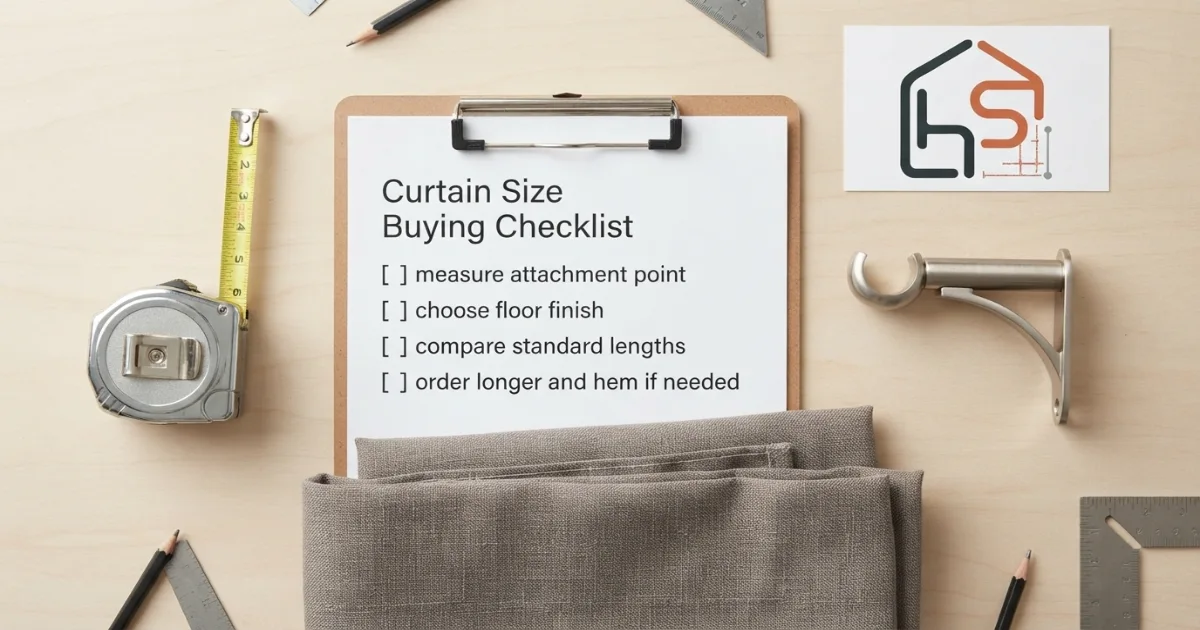
Record the attachment-point height, floor finish, hardware type, shortest left-center-right drop, usable rod span, desired fullness, panel width, panel count, fabric weight, care method and package quantity.
Check whether the product length is measured from the absolute top edge or from the functional hanging point. Review the header diagram, lining, pattern placement, bottom weights and alteration limits. For wide panels, verify rod capacity and bracket spacing.
Mark the proposed rod and hem lines with painter’s tape. View them from the doorway, main seating position and adjacent room. Then enter the complete measurements into the Curtain Size Calculator before ordering.
Two practical product categories to compare after checking the chart
Search links are used because color, fabric, header, panel width, package quantity and available lengths change. Confirm every current listing before ordering.
Ready-Made Curtain Panels in Multiple Lengths
Compare products that offer several standard lengths in the same fabric so the selected size does not force a change in color, header or room style.
- Confirm width per panel and panel count
- Check every available length in the same color
- Review lining, care and shrinkage information
Curtain Measuring and Hemming Supplies
Compare tape measures, removable hem tape and sewing supplies when the nearest standard panel needs a controlled final adjustment.
- Use a rigid metal tape for wall measurements
- Match hemming method to fabric and lining
- Test heat-sensitive materials in a hidden area
Affiliate disclosure: As an Amazon Associate, HomeStyle Calculator may earn from qualifying purchases. Product specifications, prices and availability can change. Review the current listing before ordering.
Standard curtain sizes FAQs
What are the most common standard curtain sizes?
Common ready-made lengths include 45, 54, 63, 72, 84, 90, 95 or 96, 108, 120 and 144 inches. Availability varies by manufacturer, fabric, color and header type, so confirm the exact product range before planning the rod position.
What is the standard width of one curtain panel?
Many ready-made panels are approximately 42 to 54 inches wide. Wide and extra-wide products may be 63, 72, 84, 100 or more inches wide. Use the exact finished width shown for one panel and verify whether the package contains one or two panels.
Are 84-inch curtains considered standard?
Yes. Eighty-four inches is one of the most familiar ready-made floor-length sizes. It works only when the measured attachment-point-to-floor drop is close to 84 inches; it may look short when the rod is mounted high.
Should I buy the exact measured curtain length?
Choose the standard size that supports the desired finished drop. When the measurement falls between sizes, the next longer panel is usually safer because it can be hemmed. Check borders, lining and bottom weights before altering.
How wide should curtains be compared with the rod?
Combined curtain width is commonly about 1.5 to 2.5 times the usable rod span, depending on fabric, header and desired fullness. Sheers may need more fullness, while structured pleated curtains use their finished pleated width.
Do grommet and rod-pocket curtains measure differently?
Yes. The header changes where the usable fabric drop begins. Measure from the actual grommet, pocket, hook, ring or clip position, or follow the manufacturer’s measurement diagram.
What standard curtain length is best for an eight-foot ceiling?
Eighty-four, 90 and 95 or 96 inches may all work depending on the rod height, header and floor finish. Measure from the actual fabric attachment point instead of choosing from ceiling height alone.
What should I do when no standard size fits?
Choose the next longer size and hem it when the construction allows. Use custom curtains when both length and width need major correction, when pattern alignment matters or when decorative borders and linings cannot be altered cleanly.
Turn the standard curtain size into an exact order
Calculate rod width, finished panel length, fullness and quantity before buying curtains or hardware.