Find the Right Fan Size and Mount for Any Room.
Enter your room’s width and length, ceiling height, room type and ceiling type, and get an instant blade span, downrod length and mounting placement — using the same sizing rules electricians and lighting showrooms rely on. No more fans that look undersized in a great room or clip the ceiling on a low bedroom.
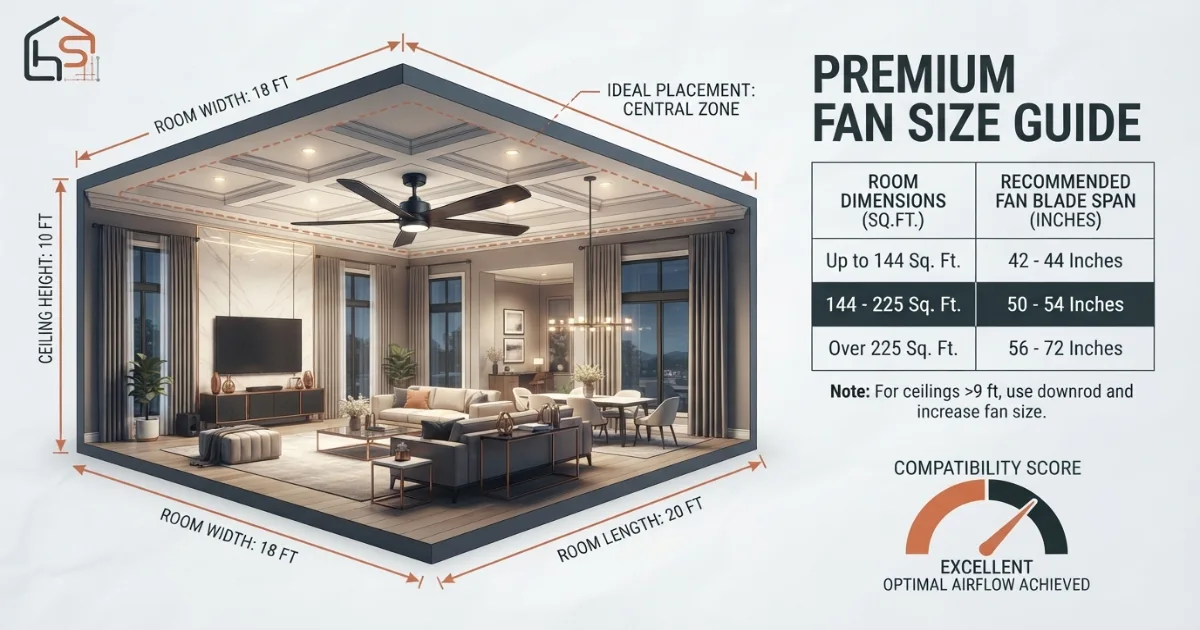
Match blade span to room area — 29 to 36 inches under 75 square feet, 36 to 42 inches up to 144 square feet, 44 inches up to 225 square feet, and 50 to 54 inches or larger beyond that — then add roughly 6 inches of downrod for every 2 feet of ceiling height above 8 feet.
Standard blade span guidelines by room size.
These estimates assume a standard flat ceiling around 8 to 9 feet. Use the calculator above for a size and downrod matched to your exact room and ceiling height.
| Room Size | Square Footage | Blade Span | Downrod (9ft ceiling) | Notes |
|---|---|---|---|---|
| Small bathroom / nook | Under 75 sq ft | 29–36 in | None (flush mount) | Hugger style recommended |
| Small bedroom / office | 75–144 sq ft | 36–42 in | 6 in | Most common bedroom size |
| Medium bedroom / dining | 144–225 sq ft | 44 in | 6 in | Standard mid-size room |
| Large living room | 225–400 sq ft | 50–54 in | 6 in | Consider higher CFM rating |
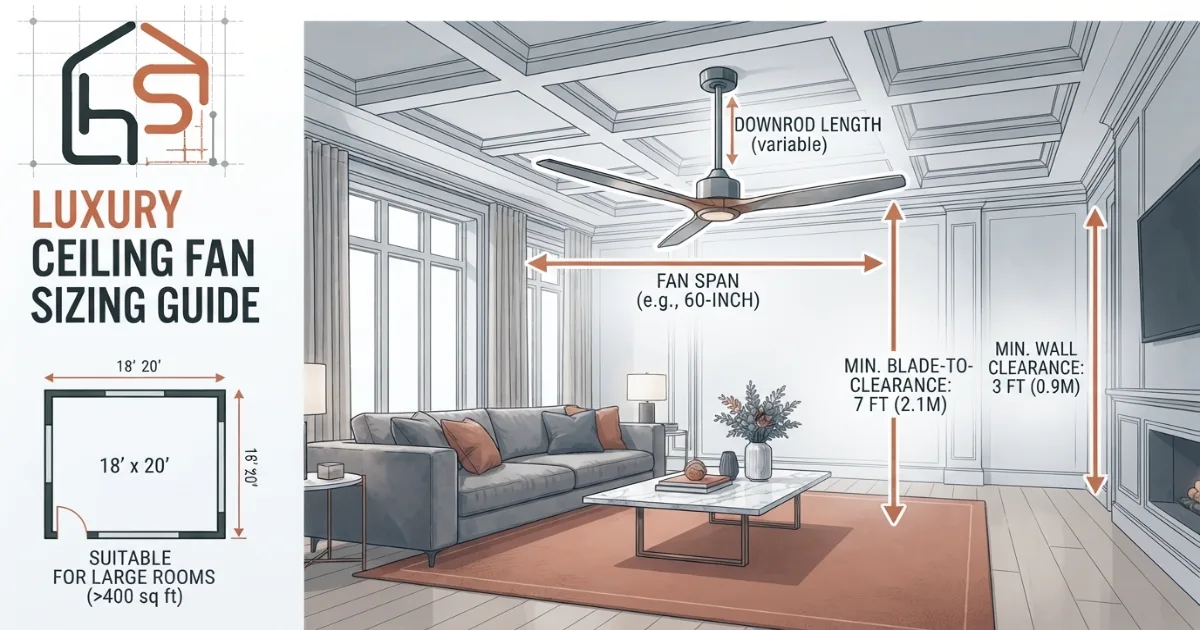
| Great room / open plan | Over 400 sq ft | 60 in or dual fans | 6–12 in | Two fans often more even |
| Covered outdoor patio | Varies | Match indoor sizing | Varies by ceiling | Damp or wet-rated required |
Four common room types — and the fan rule each one follows.
What a room is mainly used for, and whether it’s covered or exposed to the elements, changes the sizing and rating rule that applies to it. Here is what each room type is built for.
Bedroom
Sized for quiet nighttime airflow, usually a smaller blade span with a low-noise motor and a light kit for reading light control.
Blade span: 36–44 inLiving Room
Sized to move air across a larger, higher-traffic space, often with a bigger blade span and stronger CFM rating than a bedroom.
Blade span: 44–54 inGreat Room
Large open-plan spaces often need one oversized fan or two mid-size fans working together for even, room-wide airflow.
Blade span: 54–60 in or dualOutdoor Patio
Needs the same size logic as an indoor room, plus a damp or wet weather rating to withstand humidity and direct exposure.
Rating: Damp or wetSee how room size and ceiling height change your fan.
These steps cover the essentials: measuring the room and ceiling, applying the right blade span and downrod formula, and confirming clearance before you buy.
Measure the room and ceiling
Measure the room’s width and length, and the ceiling height at the planned fan location.
Apply the right downrod length
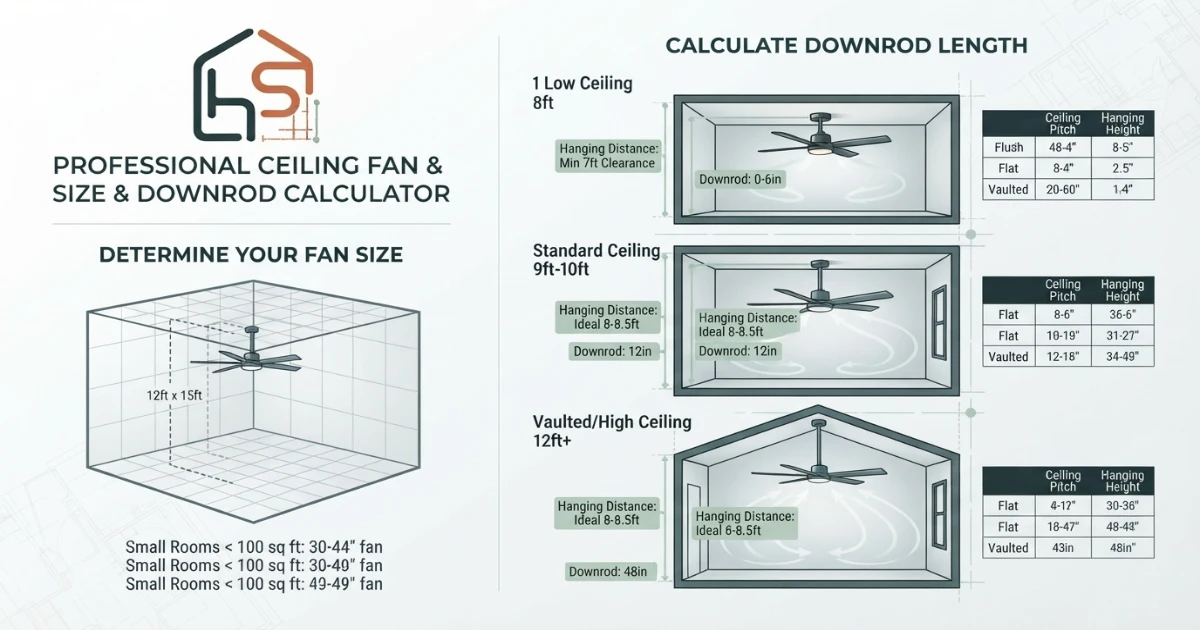
Taller ceilings need a longer downrod to bring the blades down to the ideal airflow height.
Confirm the clearance
Check blade height against the floor and wall clearance against nearby furniture before installing.
How to size a ceiling fan — the complete guide.
The most common ceiling fan mistake is choosing a blade span based on style preference alone, without matching it to the room’s actual square footage. An undersized fan in a large room struggles to move enough air and looks visually lost on a big ceiling, while an oversized fan in a small room creates uncomfortably strong drafts and can leave too little wall clearance for safe, quiet operation.
Step 1: Measure the room’s square footage
Multiply the room’s width by its length to get the total square footage, since blade span recommendations are based almost entirely on this number rather than the room’s shape or ceiling style. For an irregularly shaped room, estimate the square footage of the largest usable rectangle within the space, similar to how furniture layout is planned around the room’s dominant rectangle.
Step 2: Match blade span to that square footage
As a general guideline, a room under 75 square feet needs a blade span of about 29 to 36 inches, a room between 75 and 144 square feet needs 36 to 42 inches, a room between 144 and 225 square feet needs about 44 inches, and a room between 225 and 400 square feet needs 50 to 54 inches or larger. A room over 400 square feet often benefits more from two mid-size fans working together than one oversized single fan.
Step 3: Measure the ceiling height at the exact fan location
Measure straight down from the ceiling to the floor at the specific spot the fan will be centered, not just at the room’s tallest or most convenient point, since a vaulted or stepped ceiling can vary meaningfully across a single room. This measurement is what determines the downrod length needed to bring the blades down to a comfortable, effective height.
Step 4: Understand the minimum blade clearance code requirement
Most building codes require at least 7 feet, or 84 inches, of clearance between the floor and the lowest point of the fan blades, both for safety and to keep the blades out of reach. This is a minimum, not a target — a fan mounted right at 7 feet often feels close overhead in a room with any furniture like a tall bookshelf or a canopy bed nearby.
Step 5: Know the ideal blade height for actual airflow
While 7 feet is the code minimum, most fan manufacturers and electricians recommend a blade height of 8 to 9 feet from the floor for the best balance of airflow and headroom in a typical room. This height range moves air effectively through the room’s occupied zone without feeling like it’s hovering directly overhead.
Step 6: Calculate the downrod length needed
As a general rule of thumb, add about 6 inches of downrod for every 2 feet of ceiling height above the standard 8-foot baseline, so a 9-foot ceiling typically needs around 6 inches, a 10-foot ceiling needs around 12 inches, and a 12-foot ceiling needs around 18 inches. Most fans include a short standard downrod out of the box, but taller ceilings need a specific longer downrod purchased separately to hit the ideal blade height.
Step 7: Use a flush or hugger mount for low ceilings
A ceiling at 8 feet or lower generally can’t accommodate a downrod at all without pushing the blades below the 7-foot minimum clearance, so a flush-mount or hugger-style fan, which attaches the fan body directly to the ceiling with little to no drop, is the standard choice for these spaces. Hugger fans do move slightly less air than a downrod-mounted fan of the same blade span, since they sit closer to the ceiling where airflow is less efficient.
Step 8: Plan differently for a vaulted or sloped ceiling
A vaulted or sloped ceiling needs an angled mounting kit specifically designed to keep the fan’s motor housing level even though the ceiling surface itself is angled. The downrod on a vaulted installation also needs to be long enough that the blades clear the sloped ceiling surface as they rotate, which often means a slightly longer downrod than the same ceiling height would need on a flat ceiling.
Step 9: Center the fan in the room whenever possible
A ceiling fan works best mounted at or near the room’s geometric center, since this gives the most even airflow distribution in every direction. In a room where a perfectly centered mount isn’t possible due to existing wiring or structural obstructions, prioritize keeping the fan as close to centered as the electrical box location allows.
Step 10: Maintain proper wall and obstruction clearance
Keep the blade tips at least 18 to 24 inches away from any wall, and ideally further in a larger room, both for safety and so the blades aren’t chopping air that’s already hitting a nearby wall. If a light fixture, another fan, or a ceiling beam is nearby, maintain at least 30 inches of separation between the fan blades and that other fixture.
Step 11: Consider CFM rating alongside blade span
Blade span alone doesn’t guarantee good airflow — CFM, or cubic feet of air moved per minute, is the more direct measure of a fan’s actual performance. As a general guideline, look for a fan rated to move at least 4,000 to 5,000 CFM for a small to medium room and 6,000 CFM or more for a large room, since two fans with an identical blade span can have meaningfully different CFM ratings depending on motor strength and blade pitch.
Step 12: Check for reversible motor direction
Nearly all modern ceiling fans include a reversible motor, which spins the blades counterclockwise in warmer months to push air straight down for a cooling breeze, and clockwise in colder months to pull air up and recirculate warm air pooled near the ceiling back down along the walls. Confirm this reverse switch is present and easy to access, whether it’s a physical toggle on the fan body or a setting on a remote control.
Step 13: Match the rating to indoor, damp, or wet conditions
A fan used entirely indoors only needs a standard dry-rated listing, but a fan installed in a bathroom, a screened porch, or any covered outdoor space with humidity exposure needs at least a damp-rated fan, and a fan exposed directly to rain or spray needs a wet-rated fan. Installing a dry-rated fan outdoors risks motor corrosion and electrical failure well before its expected lifespan.
Step 14: Confirm the electrical box is fan-rated
A standard light fixture electrical box isn’t rated to support the weight and motion load of a spinning ceiling fan, so confirm the box at the installation point is specifically listed as fan-rated, or have an electrician install one, before mounting any fan regardless of its size or weight.
Step 15: Factor in a light kit if one is wanted
Many ceiling fans include an integrated light kit, which adds a small amount of extra downrod-equivalent height and weight to account for in the blade clearance calculation. If ambient lighting is a priority for the room, factor the light kit’s added drop into the blade height check in step 5, since the light fixture typically hangs slightly below the blades themselves.
Step 16: Get a final confirmation before purchasing
Once blade span, downrod length, and mounting type are settled, confirm the specific fan model’s included downrod length against what the room actually needs, since fans often ship with only a short standard downrod that may not be long enough for a taller ceiling. Buying the correct extension downrod at the same time as the fan avoids a delayed installation waiting on a separate part.
Rules that prevent an undersized or too-low fan.
A calculator gives the best starting numbers, but the final choice still depends on the exact ceiling height at the fan location, nearby obstructions, and whether the space is fully indoors. The rules below cover the details worth checking even after settling on a blade span.
Match blade span to room square footage, add downrod length based on how far above 8 feet the ceiling sits, keep at least 7 feet of floor clearance and 18 to 24 inches of wall clearance, and confirm the fan’s weather rating matches the space.
Size comes from square footage
Match blade span to the room’s actual square footage first, then adjust for style preference, not the other way around.
Downrod follows ceiling height
Calculate downrod length from the ceiling height at the exact fan location, not the room’s average or tallest point.
Never go below 7 feet clearance
Treat 7 feet of floor-to-blade clearance as an absolute minimum, and target 8 to 9 feet for the best airflow.
Match the rating to the space
Confirm dry, damp, or wet rating against the room’s actual humidity and weather exposure before buying.
Helpful room and lighting planning topics.
A ceiling fan rarely comes together as a standalone decision. Once you know the blade span and downrod, it helps to plan the surrounding elements at the same time — lighting layered around it, room layout, and the ceiling height feeding into other fixtures. Use these supporting pages from the HomeStyle Calculator homepage to plan the rest of the room.
Six things electricians always check before installing.
Confirm the box is fan-rated first
Check the electrical box before buying the fan, since a standard light box isn’t rated for a spinning fan’s load.
Measure ceiling height at the exact spot
Measure directly at the planned mounting point, not the room’s average height, especially under a sloped section.
Buy the extension downrod upfront
Order the correct longer downrod at the same time as the fan, since the included one is often too short for tall ceilings.
Don’t undersize for a great room
A single fan sized for a bedroom looks and performs poorly in an open-plan great room — size up or plan for two fans.
Check the reverse switch before buying
Confirm the fan has an accessible reverse switch or remote setting for winter and summer airflow direction.
Rate outdoor fans for the actual exposure
A covered but open patio still needs at least a damp rating — don’t assume covered means dry-rated is enough.
Ceiling fan sizing questions — answered.
More calculators for every room decision.
Every tool uses professional designer formulas. Free, instant, no sign-up — just enter your room and get the exact answer.
Bookmark HomeStyle Calculator for every room in the house.
From a quiet bedroom fan to a covered outdoor patio, our free tools give you the exact blade span, downrod length and mounting placement before you buy.