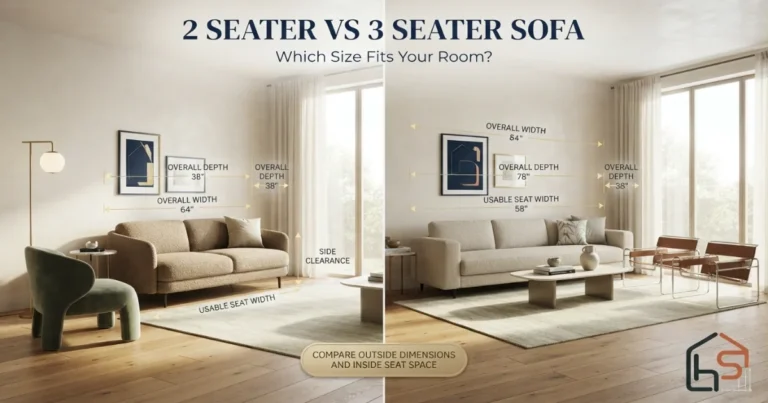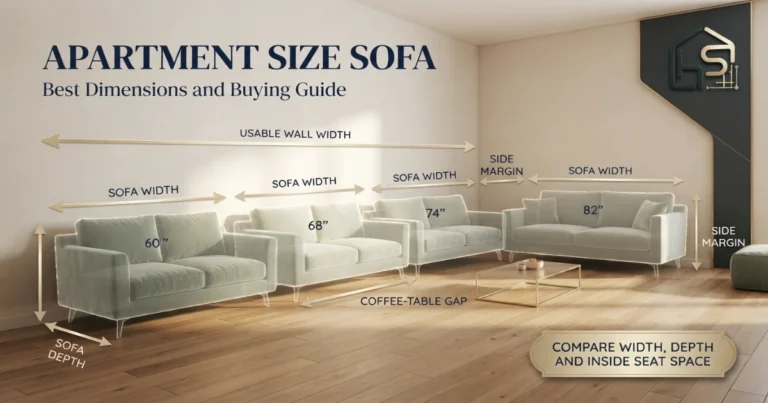
Sofa depth guide: Best complete standard vs deep seats
This sofa depth guide compares compact, standard, medium-deep, deep and extra-deep seating by overall footprint, usable seat depth, user comfort, room clearance and delivery fit.
Sofa depth guide: standard is 35–38 inches; deep is usually 43–46 inches.
Choose standard depth for upright mixed use and compact rooms. Choose deep seating for lounging, taller users and larger rooms.
Always check usable seat depth because thick back cushions can make a deep overall sofa feel surprisingly shallow.
Combine depth with width, room size, sectionals and rug placement
Choose comfort and posture first, then verify the complete room footprint and delivery path.
Sofa-depth and room-fit calculator
Enter room depth, sofa dimensions, table zone, user height and sitting style.
Category, room fit and posture guidance
Based on overall depth.
After sofa, gap, table and console.
Fits mixed everyday use.
Walkway target is preserved.
A 38-inch sofa with a 22-inch usable seat is a balanced mixed-use option for this room.
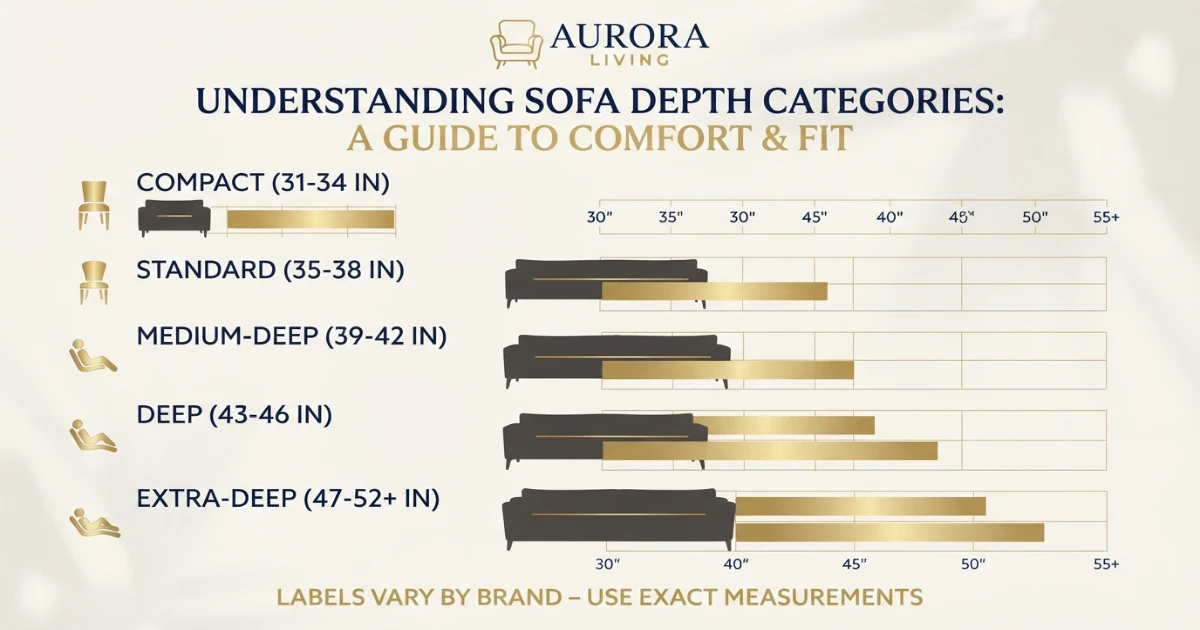
Sofa depth guide complete chart
This sofa depth guide separates overall depth from usable seat depth. Overall depth determines how much floor the furniture occupies; usable seat depth determines how the body sits.
| Depth category | Overall depth | Typical usable seat depth | Posture | Best use |
|---|---|---|---|---|
| Compact | 31–34 in | 18–21 in | Upright | Apartments, offices, conversation |
| Standard | 35–38 in | 20–23 in | Mixed use | Typical living rooms |
| Medium-deep | 39–42 in | 21–24 in | Relaxed | Family rooms |
| Deep | 43–46 in | 23–26 in | Lounging | Large rooms, movie rooms |
| Extra-deep | 47–52+ in | 25–30+ in | Daybed-like | Very large rooms, curl-up seating |
Upright seating and tight rooms.
Balanced everyday use.
Relaxed family seating.
Lounging and movie rooms.
Daybed-like curl-up seating.
Overall depth versus usable seat depth
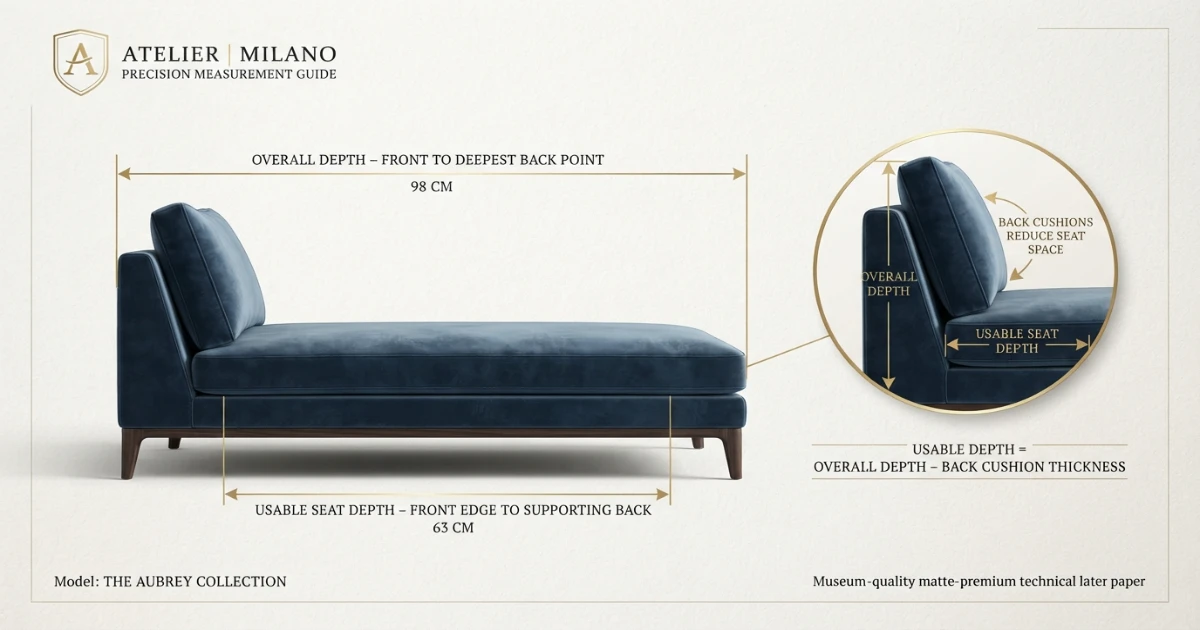
Overall depth is measured from the front-most point of the sofa to the deepest point at the back. This includes the frame, cushions and any rear projection.
Usable seat depth is measured from the front edge of the seat cushion to the surface that supports the user’s back. A lumbar pillow reduces usable depth further.
Two sofas can both measure 41 inches overall while feeling completely different. One may have a thick loose back and 20 inches of usable seat depth; another may have a tight back and 25 inches.
Four depth measurements to record
Product pages may list seat depth with or without lumbar pillows. Read notes carefully and compare the showroom configuration with the published measurement.
Real product examples show why labels vary
IKEA lists the KIVIK sofa at 37⅜ inches overall depth with a 23⅝-inch seat depth. That combination provides a relatively generous usable seat within a standard-to-medium overall footprint.
West Elm’s Harmony sofa is listed at 41 inches overall depth and a 21-inch seat depth in one standard configuration. The collection is marketed for deep comfort, yet back pillows meaningfully change usable space.
West Elm also offers Harmony depth choices including petite 36 inches, standard 41 inches and extra-deep 47 inches on current modular configurations.
Pottery Barn’s York deep-seat sofa lists 43.5 inches of overall depth including lumbar pillows, while Crate & Barrel’s Lounge Deep products can reach 46 inches.
These examples show why “deep” is a collection-specific description rather than a universal threshold.
Sofa depth by room size
| Room | Practical sofa depth | Table gap | Table depth | Opposite furniture | Starting recommendation |
|---|---|---|---|---|---|
| 10×10 room | 31–35 in | 14–16 in | 18–22 in | 12 in wall-mounted/shallow | Compact or standard |
| 12×12 room | 34–40 in | 14–18 in | 20–26 in | 12–18 in | Standard or medium-deep |
| 15×15 room | 36–44 in | 14–18 in | 24–36 in | 14–20 in | Standard through deep |
| Open plan | 36–48 in | 14–20 in | 24–40 in | Varies | Any, with circulation check |
A 10×10 room usually benefits from compact or standard depth. A 12×12 room can support medium-deep seating when the table and console remain controlled.
A 15×15 room can support deep seating more comfortably, especially when the sofa floats or the opposite wall uses shallow furniture.
Open-plan rooms may support extra-deep sofas, but circulation behind and around the furniture must be included.
How sofa depth uses room space
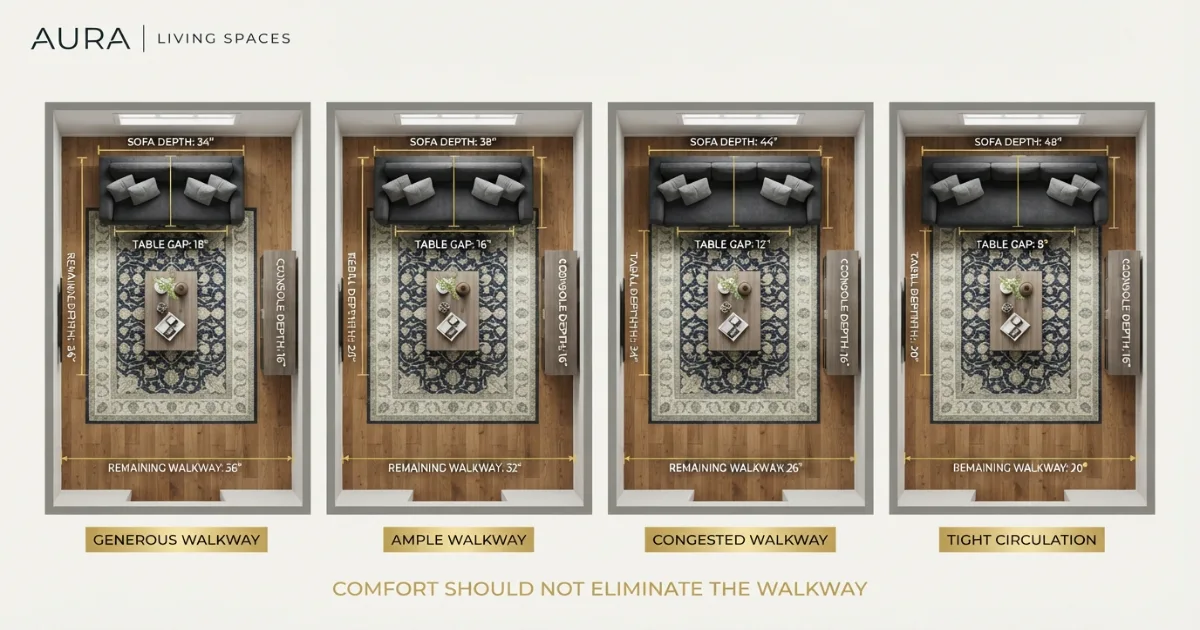
Add the sofa depth, sofa-to-table gap, coffee-table depth, opposite furniture and required walkway along the same front-to-back line.
A 36-inch sofa, 16-inch gap, 24-inch table and 16-inch console use 92 inches before any additional circulation.
A 44-inch sofa with the same arrangement uses 100 inches. In a 12-foot room, the remaining depth drops from 52 inches to 44 inches.
An extra-deep 48-inch sofa leaves 40 inches in the same example. It may still fit, but the visual and functional difference is substantial.
Outline every option before purchase because cushions, reclining motion and wall gaps can add to the listed depth.
When standard-depth seating is better
Standard overall depth around 35 to 38 inches is the most versatile choice for conversation, television, reading and occasional lounging.
It works with more coffee tables, leaves wider walkways and fits through delivery routes more easily than extra-deep furniture.
Standard seats are often better for users who want their feet on the floor and back supported without extra pillows.
They are also useful in formal rooms, offices, narrow family rooms and layouts where the sofa floats with a path behind it.
Standard does not mean uncomfortable. Cushion construction, pitch and lumbar support can create relaxed comfort without extreme depth.
When deep seating is better
Deep overall depth around 43 to 46 inches suits lounging, movie nights, curling up and taller users.
It provides more room for cross-legged sitting and sharing the sofa with children or pets.
Deep seating works best when the room has enough front-to-back space and the coffee table can remain reachable.
Removable back pillows increase flexibility. Users can add support for upright sitting and remove it for lounging.
A deep sofa may replace the need for a chaise or ottoman, which can offset some of its larger footprint.
User height and leg support
Shorter users may struggle with deep seats because their knees do not bend at the front edge while their back reaches the cushion.
Taller users often appreciate deeper seats, but seat height and back pitch remain important.
For mixed-height households, use removable lumbar pillows and medium-deep seating rather than the maximum depth.
Test with normal posture: back supported, knees comfortable and feet placed as intended. Also test standing up from the seat.
Do not choose seat depth from height alone. Flexibility, posture, pain, footwear and sitting habits all influence comfort.
Choose depth from sitting style
Choose 18–21-inch usable seat depth and a supportive back.
Choose 20–23 inches with removable pillows.
Choose 22–25 inches and softer back support.
Choose 24–30 inches with enough room depth.
A sofa used for working on a laptop needs different support from a sofa used primarily for movies. The most comfortable showroom pose may not match daily use.
Seat height changes how depth feels
A low, deep seat creates a reclined posture and can be harder to stand from. A higher seat makes the same depth feel more upright.
Seat height around 17 to 19 inches works for many adults. Low-profile sofas may fall below this range, while supportive traditional sofas may be higher.
Measure to the top of the cushion under normal compression. Very soft cushions can feel lower than the published dimension.
The coffee table should remain comfortable relative to the compressed seat height.
Back cushions and lumbar pillows
Thick back cushions reduce usable seat depth. Loose cushions may compress or shift, changing the experience over time.
A tight-back sofa usually preserves more usable space within the same overall depth.
Lumbar pillows can convert a deep seat into a more upright seat, but they also occupy storage and need regular adjustment.
Check whether decorative pillows are included in the official seat-depth measurement.
Removable cushions provide the most flexibility for households with different body sizes and sitting styles.
Arms, frame and rear projection
Arm width affects overall width, while frame and back construction affect depth. Rolled backs and loose cushions can project farther than a slim modern frame.
Reclining mechanisms may require a gap from the wall even when the sofa is not visibly deep.
A sofa with exposed legs can feel visually lighter than a skirted sofa of the same footprint.
Measure the deepest physical point, not only the floor-level base, because upper cushions must clear the wall and delivery opening.
Coffee-table spacing with deep sofas
Keep about 14 to 18 inches between the seat edge and coffee table. Deep sofas do not require a larger gap automatically, but seat posture changes reach.
A user sitting far back in a deep seat may find a low table difficult to reach. Nesting tables or C-shaped side tables can help.
Oversized coffee tables combined with deep sofas quickly consume room depth. Consider an oval, round or narrow rectangular table.
Movable ottomans can provide lounging support without permanently filling the center.
Depth and TV viewing distance
Deeper sofas move the user’s eyes farther from the screen when the back remains against the same wall.
The change may be four to twelve inches compared with compact seating. This can affect screen-size choice in small rooms.
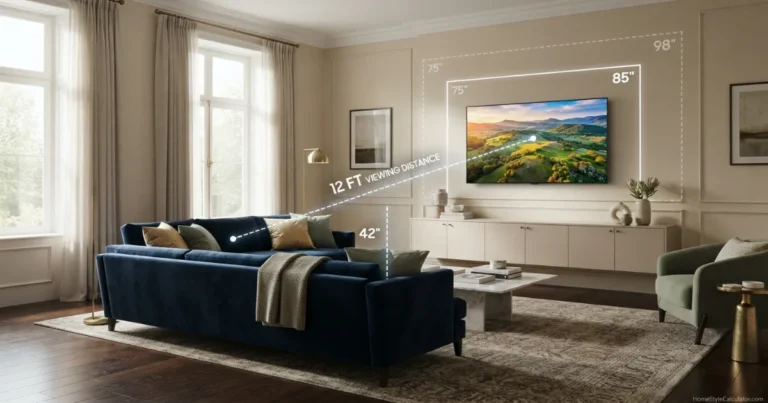
Use the TV Size Calculator from the actual seated eye position rather than wall-to-wall room length.
When the sofa floats, adjust its position to balance rear circulation and viewing distance.
Deep sectionals and chaise seating
Sectionals combine standard seat depth with longer returns or chaises. Do not confuse chaise length with regular overall depth.
A 43-inch-deep sectional with a 70-inch chaise uses two different front-to-back measurements.
Outline the complete L or U shape and preserve access to the coffee table.
Use the Sectional Size Guide for long-side, return and orientation planning.
Sleeper-sofa depth
Sleeper sofas may have standard closed depth but require 80 to 90 inches or more when the bed opens.
Measure the open mattress, mechanism and walkway around it. The coffee table needs a regular relocation point.
The folded mechanism can affect seat firmness and usable depth.
Sleeper sofas are heavy, so delivery and floor protection need extra attention.
Reclining-sofa depth
Reclining sofas need front footrest clearance and may need rear movement space.
Measure the fully reclined depth, not only the closed dimension. The footrest can collide with a coffee table that appears well spaced when closed.
Wall-hugger mechanisms reduce rear travel but still require front extension.
Power recliners need outlet and cable planning away from walking paths.
Deep sofas in small rooms
A deep sofa can work in a small room when it replaces other pieces and the opposite furniture is shallow.
Use slim arms, exposed legs and a visually light frame to reduce perceived bulk.
Choose nesting tables or a movable ottoman instead of a large fixed coffee table.
Wall mounting the television can recover console depth, but door swings and circulation still need protection.
See the 10×10 Sofa Layout Guide for compact-room examples.
Standard versus deep in a 12×12 room
A 12×12 room supports standard and medium-deep sofas comfortably. Deep seating can fit when the table and opposite console remain controlled.
A 38-inch sofa with a 24-inch table provides more flexible circulation than a 46-inch sofa with a 30-inch table.
Use painter’s tape to compare both footprints, then place temporary boxes at cushion height.
See the 12×12 Sofa Layout Guide for complete arrangements.
Deep seating in a 15×15 room
A 15×15 room can support 43 to 46-inch deep sofas and large sectionals more easily.
Floating layouts can use a 30 to 36-inch rear walkway and still preserve a generous front seating zone.
A 10×14 rug often anchors the larger footprint better than a small rug.
See the 15×15 Sofa Layout Guide for large-room examples.
Room-clearance comparison
The same room changes dramatically as sofa depth increases. The furniture can fit mathematically while circulation, table reach and visual balance become progressively tighter.
Delivery and diagonal depth
Crate & Barrel’s delivery guide recommends recording diagonal depth for sofas and sectionals, then measuring all doors and halls to the final room.
A deep sofa can be difficult to pivot even when the doorway is wider than the sofa height.
Measure clear doorway width after hinges and trim, hallway width, ceiling height, stair landings and elevator dimensions.
Confirm whether legs, arms or backs are removable and whether the sofa arrives boxed or assembled.
Keep packaging until the sofa is placed and inspected.
How to test sofa depth in a showroom
Sit in your normal position rather than posing at the front edge. Check whether your back reaches support and whether your feet rest comfortably.
Try upright conversation, relaxed television viewing, cross-legged sitting and standing up.
Remove and add lumbar pillows to understand the available range.
Test every regular household user. One person’s ideal deep seat can be another person’s unsupported posture.
Photograph the product label and exact configuration so the delivered model matches the tested depth.
How to buy sofa depth online
Read the complete dimension diagram and product notes. Look for overall depth, seat depth, seat height, back-cushion thickness and diagonal delivery depth.
Check whether seat depth is measured with lumbar pillows, without pillows or to the frame.
Compare multiple configurations within the same collection. Petite, standard and extra-deep options may share nearly identical product images.
Review return rules, especially for made-to-order depth and upholstery combinations.
Outline the footprint and recreate usable seat depth with a chair, wall and pillows before ordering.
Evaluate width and depth together through the calculator, then choose the dimension that supports the room’s main function.
When the room is wide and open but the users strongly prefer lounging, a deep sofa can provide better comfort without harming circulation.
When the room has a narrow front-to-back dimension, prioritize compact depth even if a longer sofa fits the wall.
A narrow deep sofa may be perfect for two people who lounge daily. A wide shallow sofa may be better for conversation, guests and upright sitting.
Width determines seating count, but depth determines posture and floor use. In some rooms, choosing the correct depth matters more than adding another seat.
When depth should take priority over sofa width
A practical sofa depth guide should therefore compare comfort, usable floor area and daily posture before treating deeper seating as an automatic upgrade.
When the room is small, use one deep sofa instead of combining it with a bulky loveseat or fixed chaise. Movable chairs and ottomans preserve flexibility.
Limit the number of oversized throw pillows. Too many pillows reduce usable depth and create a cluttered appearance.
Use vertical elements such as tall lamps, curtains and artwork to balance the wide horizontal mass.
Choose a rug large enough to anchor the full depth. A small rug under only the table can make the sofa look even larger.
Keep surrounding furniture visually lighter than the sofa. Use slim-leg side tables, open-base coffee tables and fewer bulky storage pieces.
How to style a deep sofa without crowding the room
Compare the showroom sample’s age with the expected new-product feel. A well-used display sofa may feel softer and deeper than a newly delivered model.
Leather cushions may relax and develop a deeper sit over time. Some woven cushions soften as the foam, fiber and fabric break in.
Tufting and buttoned backs may reduce the supporting surface slightly, while loose pillow backs can move forward and reduce usable seat depth.
Tightly tailored leather or performance fabric creates a cleaner edge and can make a deep sofa feel visually lighter.
Loose slipcovers, thick chenille and plush upholstery add softness and visual volume. They can make a standard-depth sofa appear deeper and heavier than its measurements suggest.
How upholstery changes perceived depth
Choose the furniture for the most frequent users, then use pillows or an ottoman to accommodate occasional preferences.
Seat height also matters. A high seat can make a deep sofa easier for shorter users to stand from, while an extremely low seat exaggerates the lounging posture.
Separate back cushions create more flexibility than one fixed tight back. Each user can adjust support without changing the full sofa.
The taller user can remove the pillows to access more seat depth, while the shorter user can add support and keep the knees closer to the front edge.
One fixed seat depth rarely fits every person perfectly. A household with short and tall adults often benefits from a medium-deep sofa with removable lumbar pillows.
Choosing depth for a mixed-height household
Online shoppers should read construction details and reviews for firmness context, but the official dimensions remain the primary planning measurements.
When testing, sit for several minutes instead of judging the first few seconds. Cushion recovery, body position and lumbar support become clearer after the materials settle.
Back cushions also compress. Feather-and-down blends often allow the user to sink farther back, while dense foam maintains a more defined supporting surface.
A soft deep sofa can therefore feel deeper than its listed measurement. A firm sofa with the same usable seat depth can feel more upright because the hips remain higher and closer to the front edge.
Published seat depth is measured on an unloaded sofa, but soft cushions compress when someone sits down. As the seat cushion compresses, the body may settle lower and slide farther toward the back.
How cushion compression changes real seat depth
Step-by-step sofa-depth buying process
Record the full front-to-back furniture line.
Upright, mixed, relaxed or lounging.
Classify compact through extra-deep.
Account for back and lumbar cushions.
Test feet, knees, back support and standing.
Protect reach and circulation.
Measure the fully open footprint.
Use tape and temporary boxes.
Check diagonal depth, doors, halls and elevators.
Common sofa depth guide mistakes
- Confusing overall depth with seat depth.
- Assuming every 41-inch sofa feels deep.
- Ignoring thick back cushions.
- Choosing depth from room width alone.
- Forgetting coffee-table and console depth.
- Buying deep seats without testing short users.
- Ignoring seat height and back pitch.
- Forgetting recliner extension.
- Measuring a sleeper only when closed.
- Using a deep sofa with an oversized table.
- Ignoring actual eye-to-TV distance.
- Measuring the room but not the delivery route.
- Ordering a custom depth before outlining it.
Sofa depth guide buying checklist
- Room depth and usable sofa wall.
- Overall sofa depth.
- Usable seat depth.
- Seat height.
- Back-cushion thickness.
- Lumbar-pillow effect.
- Primary user heights.
- Upright versus lounging use.
- Sofa-to-table gap.
- Coffee-table depth.
- Opposite furniture depth.
- Main walkway.
- Floating rear walkway.
- TV viewing distance.
- Recliner open depth.
- Sleeper open depth.
- Diagonal delivery depth.
- Door, hall, stair and elevator dimensions.
- Return and custom-order rules.
- Standard and deep footprints outlined before purchase.
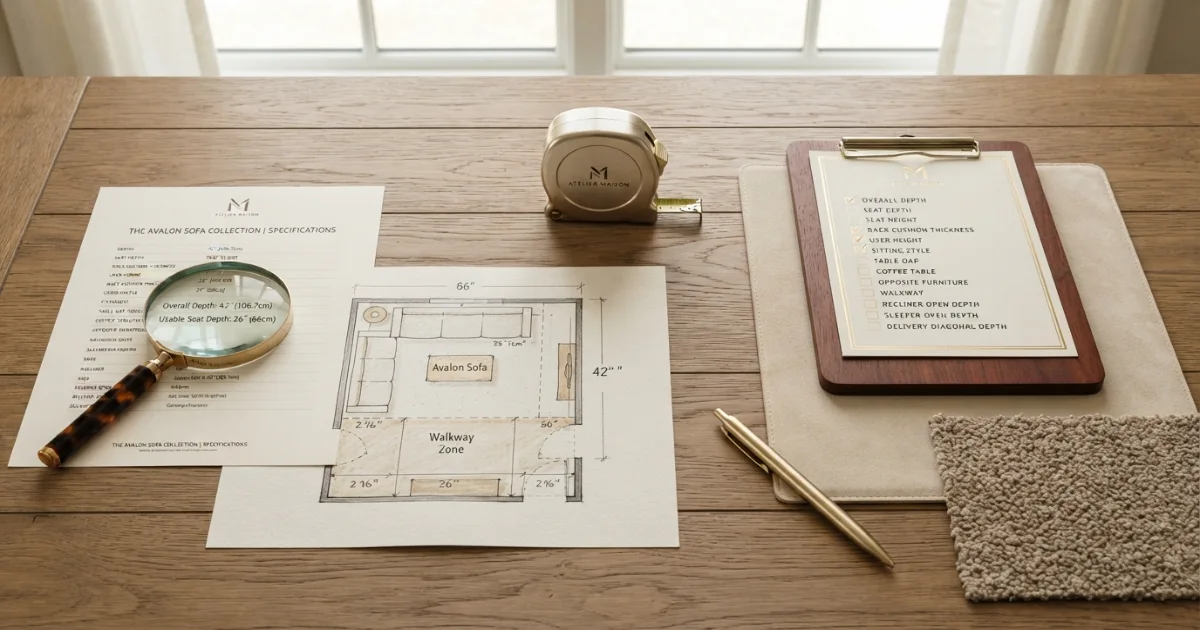
Final answer: standard or deep sofa?
Use this sofa depth guide to separate floor footprint from sitting comfort. Standard overall depth is commonly 35 to 38 inches, medium-deep is 39 to 42 inches and deep seating is around 43 to 46 inches.
Choose standard depth for upright mixed use, compact rooms and easier circulation. Choose deep seating for lounging, taller users and rooms with enough front-to-back clearance.
Always compare usable seat depth, cushion configuration, seat height, open mechanisms and diagonal delivery depth before ordering.
Need a depth recommendation from your exact room?
Use the free Sofa Size Calculator, then compare the recommendation with this guide.
Official product and measurement references
Compare standard-depth and deep-seat sofas
Standard-Depth Sofas
Compare 35 to 38-inch sofas by usable seat depth, cushion thickness, arm width and delivery dimensions.
View Standard-Depth Sofas on AmazonDeep-Seat Sofas
Compare 43-inch and deeper sofas by seat depth, lumbar pillows, room footprint and removable parts.
View Deep-Seat Sofas on AmazonAffiliate disclosure: As an Amazon Associate, HomeStyle Calculator may earn from qualifying purchases.
Sofa depth guide FAQs
What is standard sofa depth?
Standard overall sofa depth is commonly about 35 to 38 inches. Exact depth varies by frame, back cushions, arms and upholstery.
What is considered a deep sofa?
Overall depth around 43 to 46 inches is generally considered deep. Some retailers also offer extra-deep versions around 47 inches or more.
What is the difference between sofa depth and seat depth?
Overall depth measures the complete sofa from front to deepest back point. Seat depth measures the usable sitting surface from the front edge to the supporting back cushion.
What seat depth is best for upright sitting?
Usable seat depth around 20 to 22 inches works well for many adults who prefer upright conversation, reading or working.
What seat depth is best for lounging?
Usable seat depth around 23 to 26 inches supports relaxed sitting, curling up and lounging. Very deep seats may need lumbar pillows.
Are deep sofas good for short people?
They can be comfortable for lounging, but shorter users may not reach the backrest while keeping their feet on the floor. Removable back or lumbar pillows can help.
Are deep sofas good for tall people?
Yes, taller users often appreciate deeper usable seats and longer lounging space, provided the seat height and back support also fit.
How much room does a deep sofa need?
Add the exact sofa depth, about 14 to 18 inches to the coffee table, the table depth, opposite furniture and the required walkway.
Does a deep sofa fit through a standard doorway?
Not always. Compare overall height, depth, diagonal depth, removable legs and packaging with every doorway, hall, stair and elevator turn.
Should I buy standard or deep seating?
Choose standard depth for upright mixed use and compact rooms. Choose deep seating for lounging, taller users and rooms with enough front-to-back clearance.