Layering rugs sizes: the right base-to-top ratio.
Layering rugs sizes becomes simple when the base solves the furniture layout and the top rug stays clearly smaller, stable and visually intentional.
Written by Rehana K · Published and updated July 18, 2026.
Make the top rug 50–65% of the base area for the safest starting point.
For most layering rugs sizes, the top rug should be clearly smaller in both directions and leave about 6–18 inches of the base visible.
Pair 4×6 over 6×9, 5×7 over 8×10, 6×9 over 9×12 or 8×10 over 10×14. Keep the flatter rug underneath, avoid furniture legs landing unevenly on a thick top edge and tape both outlines before buying.
Balanced visual example
An 8×10 base with a 5×7 top covers 44% of the area and leaves an even 18-inch border.
Layered rug sizing, ratios and placement
Use the links below to move from the base-rug decision to the final top-rug pairing.
Do your base and top rug sizes work together?
Enter both rug sizes. The checker calculates width ratio, length ratio, area share and the centered visible border.
Layering rugs sizes result
The top rug must stay smaller than the base and the base must still fit the room.
Top width ÷ base width.
Top length ÷ base length.
Top area compared with base area.
Approximate side and end border.
Layering rugs sizes by top-rug area share
Use the area share with the visible border and furniture placement. Percentage alone cannot judge every shape.
| Top-rug share | Overall look | Typical visible border | Best use | What to watch |
|---|---|---|---|---|
| Under 35% | Small accent | Wide base exposure | Hide, sheepskin, round accent | May look disconnected |
| 35–50% | Subtle layering | 12–24 in often possible | Pattern highlight and texture contrast | Top must still relate to furniture |
| 50–65% | Balanced layering | 6–18 in commonly useful | Most living rooms and bedrooms | Check both width and length |
| 65–75% | Statement layering | Narrower base border | Large pattern field | Can begin to look nearly equal |
| Over 75% | Framed look | Very narrow border | Deliberate near-full overlay | Alignment must be precise |
Layering rugs sizes: the complete base-to-top guide
Layering rugs sizes works best when the bottom rug solves the room layout and the top rug adds color, pattern or texture without competing with the furniture footprint. The base layer should feel intentional even if the decorative rug is removed. That means it must be wide enough for the sofa arrangement, bed, dining table or office chair path. The top layer can then be selected for visual emphasis rather than basic coverage.
The most useful starting point for layering rugs sizes is a top rug that covers roughly 50–70% of the base rug area. The top layer should also be smaller in both width and length. Area percentage alone is not enough: a long narrow runner can have the right area but the wrong proportions for a rectangular base. Compare width ratio, length ratio and the visible border together.
Before layering, confirm the base size with the room-specific rug size calculator. Then use this guide to check the second rug rather than shrinking the base just to make the layered effect fit.
The priority order
Furniture coverage first, stable walking surface second, visible base border third, and decorative pattern last. A beautiful top rug cannot correct an undersized base.
The best base-to-top rug ratio
There is no universal percentage that fits every room, but three ratio bands are useful. A top rug covering about 35–50% of the base area creates a subtle accent. A 50–65% top layer gives the clearest balanced effect. A 65–75% top layer feels bolder and more continuous, but the base border becomes narrower.
For most layering rugs sizes, the width and length ratios should also remain below about 85%. When a top rug reaches 90% of the base in both directions, only a thin outline remains visible. That can work for a deliberate framed look, but it is less forgiving if the rugs are not perfectly aligned.
Use the ratio as a diagnostic, not a strict design law. A patterned heirloom rug may deserve a larger share of the base, while a small sheepskin or round rug can cover far less and still look complete.
Accent layer
More base texture remains visible. Best for a small patterned rug, hide shape or reading-zone highlight.
Balanced layer
The safest starting range for clear contrast, useful borders and a top rug that still feels substantial.
Statement layer
Creates stronger pattern coverage. Check that at least a purposeful strip of the base stays visible.
How to calculate layering rugs sizes
Calculate the top-rug area share by dividing the top rug area by the base rug area and multiplying by 100. An 8×10 base has 80 square feet. A 5×7 top has 35 square feet, so it covers 43.75% of the base area. A 6×9 top over a 9×12 base covers 54 of 108 square feet, exactly 50%.
Next calculate the centered border. Subtract the top width from the base width, divide by two and convert to inches. Repeat for length. An 8×10 base with a 5×7 top leaves 18 inches at the sides and 18 inches at the ends. That equal border makes the pairing feel calm and deliberate.
When the top rug is offset, the border will not be equal. Use the calculator as the starting geometry, then shift the top layer only when the furniture composition gives the offset a reason.
Common standard-size rug pairings
Standard pairings make layering rugs sizes easier because you can compare real products rather than inventing custom dimensions. The table below shows useful starting combinations. Actual rugs may be several inches smaller than their nominal label, so confirm product measurements before ordering.
| Base rug | Top rug | Area share | Visual effect | Best room |
|---|---|---|---|---|
| 6 × 9 ft | 4 × 6 ft | 44% | Balanced compact layer | Office, nook or small bedroom |
| 8 × 10 ft | 5 × 7 ft | 44% | Clear border on all sides | Living room or queen bedroom |
| 8 × 10 ft | 5 × 8 ft | 50% | Longer top with narrower side border | Narrow seating group |
| 9 × 12 ft | 6 × 9 ft | 50% | Even 18-inch border | Large living room or king bedroom |
| 9 × 12 ft | 5 × 8 ft | 37% | More base texture visible | Pattern accent or coffee-table zone |
| 10 × 14 ft | 8 × 10 ft | 57% | Strong statement layer | Large open-plan seating zone |
Layering rugs sizes in a living room
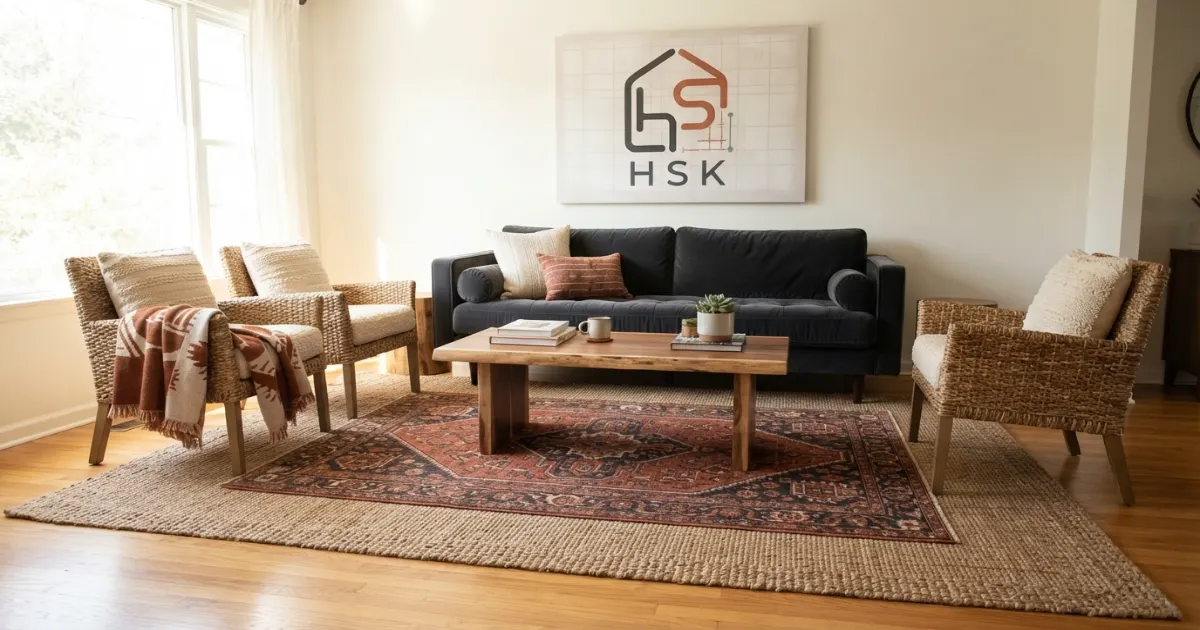
In a living room, size the base from the sofa and chairs. The base should follow the same furniture-leg rule you would use for a single rug. In many rooms, that means the front legs of the sofa and major chairs sit on the base. In a larger room, the full seating group may fit on it. Review the front-legs-on and all-legs-on rules before choosing the decorative layer.
The top rug usually sits inside the conversational zone, often beneath the coffee table and extending toward the front furniture legs. It does not have to reach every seat. A 5×7 over an 8×10 works well when the top pattern should be visible around the coffee table. A 6×9 over a 9×12 creates a fuller statement.
For layering rugs sizes in an open seating group, align the top rug with the coffee table or main sofa rather than the full architecture. This prevents a decorative offset from looking accidental.
Layering rugs sizes under a bed
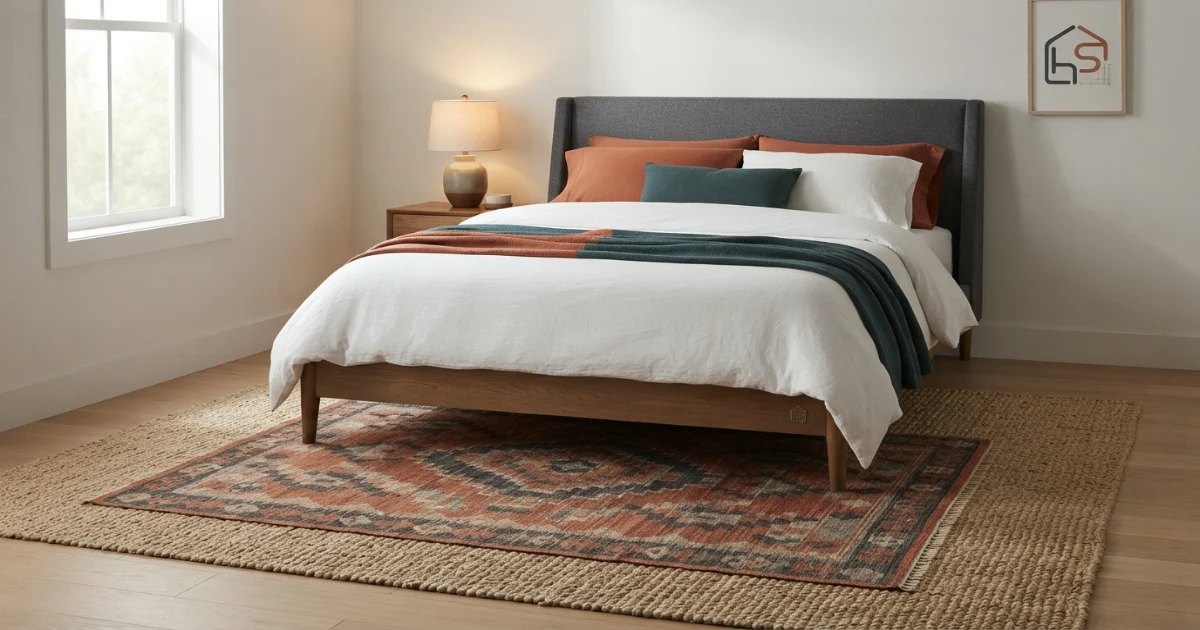
A bedroom base rug should be selected from the bed size and desired landing area. The base may sit beneath the lower two-thirds of the bed or extend under the nightstands in a fuller layout. Use the bedroom rug placement guide to establish the correct first layer.
The top rug can be centered at the foot, placed slightly lower than the base or used as a soft accent where the feet land. For a queen bed, an 8×10 base with a 5×7 top can work when the top rug is shifted toward the foot. For a king bed, a 9×12 base with a 6×9 top provides a broader layered field.
Do not force both layers fully beneath a heavy bed if the top rug’s pattern will disappear. Layering rugs sizes should preserve enough visible top surface to justify the extra rug and cleaning effort.
Can rugs be layered under a dining table?
Dining-room layering is possible but less forgiving. Chairs repeatedly cross the rug edges, so every transition must stay flat. The base and top rugs must both extend far enough for the rear chair legs, or the top rug must remain completely inside a zone that chairs never cross.
A common mistake is placing a smaller top rug directly beneath the table where chair legs move on and off it. That creates a raised boundary in the most active part of the room. For everyday dining, a single rug sized with the 24–30 inch chair-clearance rule is usually simpler.
When layering rugs sizes in a dining room, use a very flat base and top layer, secure both with compatible pads and perform a full chair test before purchase.
Choose the base rug material first
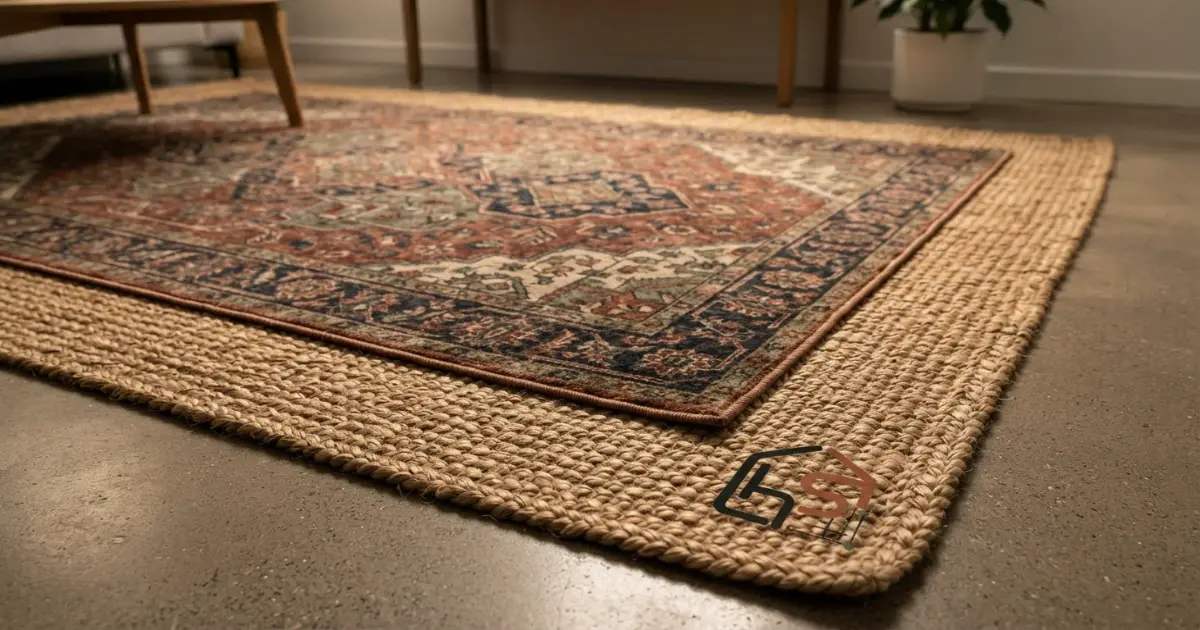
The base rug carries the larger footprint and should be stable, flat and visually quiet enough to support the top layer. Jute, sisal-look, flatwoven wool, low-pile synthetic and tightly woven cotton are common foundations. The base does not need to be plain, but a subtle texture is easier to combine with a detailed top pattern.
The Carpet and Rug Institute’s cleaning guidance is useful when comparing fibers and care requirements. Follow each manufacturer’s cleaning label because the two rugs may need different methods.
For practical layering rugs sizes, the base should also be large enough that its edges are not hidden beneath unstable furniture arrangements. A rug pad should stay slightly inside the base perimeter and must be compatible with the floor finish.
Choose the top rug for texture and pattern
The top layer is where color, age, craftsmanship or softness can become the focus. Vintage rugs, patterned wool, washable printed rugs, hides, sheepskins and round accents can all work. The top rug should look intentionally selected rather than simply placed because it was too small for the room.
A high-pile top over a flat base can create useful contrast, but the combined edge height must remain safe. The U.S. Access Board’s floor-surface guidance reinforces the general importance of firm, stable transitions in accessible spaces.
When layering rugs sizes, avoid stacking two thick, soft rugs in a main walking path. The top layer may shift, curl or make furniture less stable.
Layering rugs sizes in a small room
For layering rugs sizes, a small room needs clearer borders, not more visual clutter. The base rug should still be large enough to connect the main furniture, while the top rug should be meaningfully smaller. A 5×7 base with a 3×5 top can work in a reading nook; a 6×9 base with a 4×6 top can work in an office or small bedroom.
Use fewer competing colors and keep the top rug aligned with the main furniture axis. The small living-room rug guide can help determine whether the room supports a 6×9 or 8×10 base before the second layer is introduced.
If the layered composition leaves very little floor visible, compare the plan with the floor-border calculator. A room can feel crowded even when the ratio between the rugs is technically correct.
Layering rugs sizes in a large room
For layering rugs sizes, large rooms can support wider borders and stronger scale contrast. A 10×14 base with an 8×10 top provides a substantial layered zone without requiring a custom rug. The base defines the seating area, while the top layer brings attention back toward the coffee table or central conversation zone.
In an open plan, do not use the top rug to bridge two functions. Keep the dining and living zones separate unless the furniture composition deliberately overlaps. The base should relate to the living furniture; the top should reinforce a focal point within that area.
For layering rugs sizes in a large room, the top layer can be offset slightly toward a fireplace or major artwork. The offset should correspond with a real focal point, not simply avoid centering.
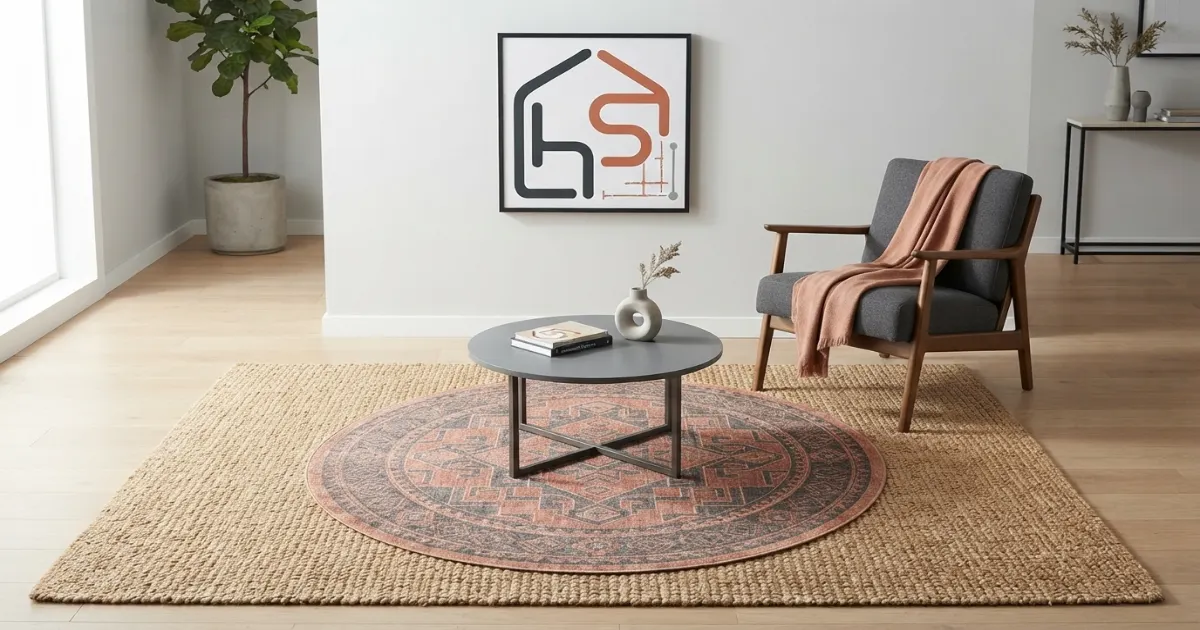
Layering a round rug over a rectangular rug
A round top rug creates useful shape contrast over a rectangular base. It can soften a room with straight furniture, highlight a round coffee table or create a reading zone within a larger rug. The circle should remain clearly inside the base rather than touching one or more edges.
Measure the round rug by diameter and compare that dimension with both base-rug dimensions. A 6-foot round top can work over an 8×10 base, leaving about 12 inches at the narrow sides and 24 inches at the ends when centered.
When layering rugs sizes with different shapes, area ratio becomes less visually predictive. Focus on the visible border around the circle and whether the top rug connects to the furniture it is meant to highlight.
Can a runner be layered over a larger rug?
A runner can add a directional stripe or protect a high-use path, but it should not look like a misplaced hallway rug. Place it along the length of a bench, console, bed or narrow seating arrangement. The runner must stay completely supported by the base and should not extend beyond it.
Use a runner when the long axis adds meaning. For example, a 2.5×8 runner over an 8×10 base can emphasize a long coffee table or bench. Avoid placing a narrow runner across the short axis of a large seating group.
Layering rugs sizes with a runner often produces a low area percentage, so width and alignment matter more than total area share.
How much base rug should remain visible?
A visible border between 6 and 18 inches is a practical starting range for many centered combinations. Smaller rugs may use 6–10 inches; larger pairings often look better with 12–24 inches. The border does not need to be equal when the top rug is intentionally offset.
Do not evaluate only the nearest edge. Check the border on every side that can be seen from the room entry. A top rug that nearly touches one base edge while leaving a broad gap on the opposite side can look like it slipped out of position.
For layering rugs sizes, the border should be wide enough to reveal the base material. A one- or two-inch strip rarely creates meaningful texture contrast.
Orientation and offset placement
For layering rugs sizes, most rectangular rugs should share the same orientation. Their longer sides usually follow the room, sofa or bed. Rotating the top rug 90 degrees can work only when the furniture arrangement supports the cross direction, such as a broad reading zone or a table placed perpendicular to the sofa.
A small diagonal top rug can look energetic, but it is harder to stabilize and may create uneven walking edges. Use diagonal placement for a low-traffic decorative zone rather than beneath moving dining chairs or an office chair.
Before offsetting, start with the top rug centered. Move it gradually toward the focal point and compare the visible base borders. This makes the change intentional and measurable.
Furniture legs and layered rugs
Furniture can sit on the base, the top or both. A common living-room arrangement places the sofa and chairs on the base while only the coffee table sits on the top rug. This keeps the decorative rug visible and avoids unstable furniture legs crossing its edge.
If a chair or sofa leg lands on the top rug, all matching legs should be stable. Avoid placing one leg on a thick top rug and the other on the lower base. That can make the furniture rock and compress the rug unevenly.
Use the rug placement rules guide to solve the furniture first, then apply layering rugs sizes inside that footprint.
Pile height, pads and movement
The base layer should normally have the lower pile. A firm flatweave under a softer wool or washable top rug creates a more stable stack. Two plush rugs can trap furniture legs and create a high edge at the top-rug perimeter.
Use a pad designed for layered rugs or a thin non-slip underlay where the manufacturer allows it. Do not let a separate top-rug pad extend beyond the top layer. Check every corner after furniture is moved.
The EPA’s indoor-air-quality resources provide broader information relevant to ventilation and indoor materials. Air new rugs according to product instructions and keep both layers dry.
| Base layer | Top layer | Pile rule | Main caution |
|---|---|---|---|
| Jute or sisal-look | Patterned wool | Low base, medium top | Check shedding and floor compatibility |
| Flatwoven wool | Vintage low-pile | Low over low | Secure against shifting |
| Low-pile synthetic | Washable printed rug | Keep combined edge modest | Confirm both cleaning methods |
| Tightly woven cotton | Sheepskin accent | Soft top only in low traffic | Avoid main walking route |
Common layering-rug sizing mistakes
- Shrinking the base: the furniture footprint becomes disconnected just to make the top rug appear larger.
- Choosing nearly equal sizes: only a thin accidental-looking border remains visible.
- Ignoring width ratio: the area percentage works, but the top rug is too narrow or too long.
- Stacking thick piles: the top edge becomes unstable and difficult to walk across.
- Placing chair legs on an edge: dining or office chairs repeatedly catch the upper layer.
- Using unrelated orientation: the rugs pull the room in different directions.
- Hiding the top rug: most of the decorative pattern disappears beneath a bed or sofa.
- Skipping actual dimensions: nominal 5×7 and 8×10 labels can differ by several inches.
How to test layering rugs sizes before buying
Mark the base outline first and position the furniture. Confirm that the room still works as a single-rug layout. Then mark the top rug inside the base. Use a different tape color so the borders are easy to compare.
View the outlines from the room entrance, sofa and adjoining space. Walk across the top-rug edges and move any chairs that will cross them. Photograph a centered version and one intentional offset.
Compare the next smaller and next larger top rug. The most balanced option is often easier to see in photos than while standing inside the taped room. Check the standard rug size chart before deciding that a custom size is necessary.
Final decision: choose the base first, then the top
Choose the base rug from room function and furniture coverage. Choose the top rug from the desired contrast, visible border and material relationship. For most layering rugs sizes, begin near a 50–65% top-area share, then adjust for room scale and shape.
Use a 4×6 top over a 6×9 base for a compact layered zone. Use 5×7 over 8×10 for a balanced living-room or bedroom pairing. Use 6×9 over 9×12 when the top pattern should feel substantial. Use 8×10 over 10×14 in a large open room.
The final test is practical: both rugs lie flat, furniture remains stable, walking routes stay clear and the base remains visibly intentional. When those conditions are met, the layered composition will look designed rather than improvised.
Layering rugs sizes by room
The base has a different job in each room, so the top-rug target changes with furniture movement.
| Room | Base-rug priority | Top-rug target | Placement rule |
|---|---|---|---|
| Living room | Connect sofa and chairs | 40–65% of base area | Center on coffee table or conversation zone |
| Bedroom | Create side and foot landing space | 35–60% | Shift top toward the visible foot zone |
| Dining room | Support pulled-back chairs | Use cautiously | Avoid an edge in the chair path |
| Home office | Support desk and rolling-chair movement | Small accent outside chair path | Keep top edge away from casters |
Choose the next guide based on your actual decision
Start with the room, solve the furniture placement, then compare the exact standard rug sizes you are considering.
Size the foundation
Find the base rug that supports the furniture and room function.
Protect the layout
Check leg placement, floor border and small-room scale.
Choose the final pairing
Compare neighboring standard sizes before ordering two rugs.