Valance size guide: how wide and long should a valance be?
Choose the valance type first, then measure the rod, board or opening, add side returns, calculate fullness and select a drop that covers hardware without blocking too much glass.
Written and reviewed by Rehana K · HomeStyle Calculator measurement-first method.
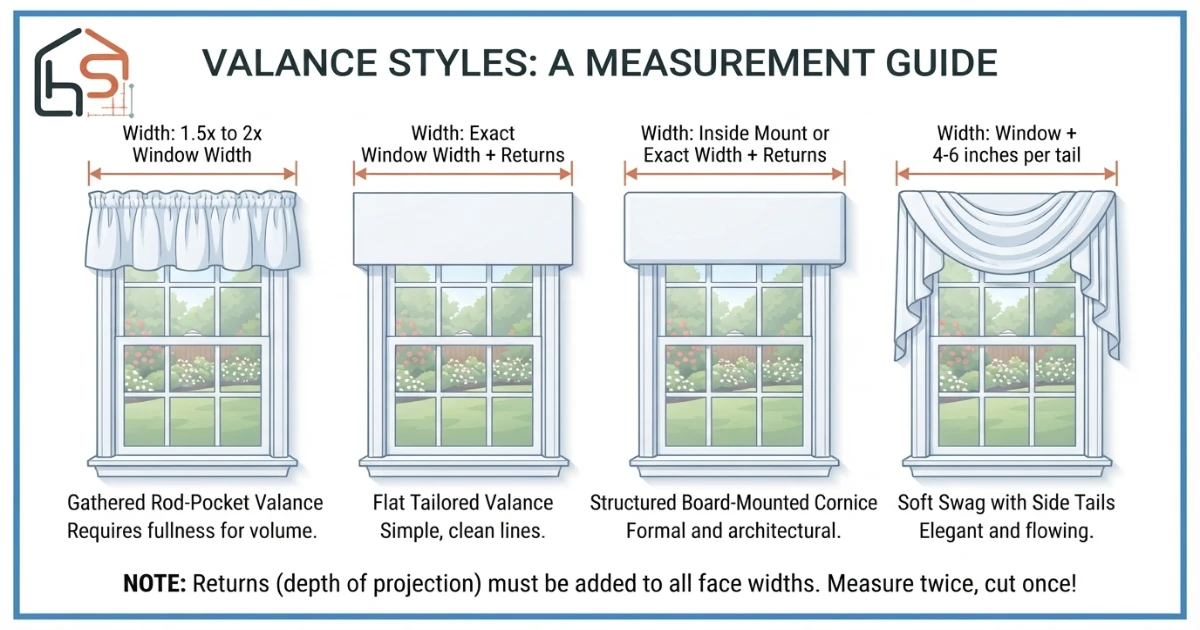
A gathered valance is commonly 1.5 to 3 times the usable rod width, with a finished drop around 12 to 18 inches.
For an outside-mounted valance, begin with the window or rod width plus approximately 2 to 6 inches on each side. Use more extension when the valance needs to cover curtain brackets, side returns or shade hardware.
Tailored, box-pleat and board-mounted valances are sized by exact finished width rather than heavy gathering. Their drop should cover the top trim or hardware while keeping most of the window glass open.
Use the right HomeStyle Calculator guide for every measurement
Valance width depends on rod span, fullness, side returns, panel count and the treatment beneath it. These connected pages complete the order.
Valance sizing from mounting choice to final width and drop
Valance size calculator
Enter the usable rod or board width, side returns, valance style, fullness, panel width and desired drop. The tool estimates required fabric width, panel count and a practical finished drop.
Two 54-inch valance panels provide enough width for a gathered treatment on the entered rod span.
Compare gathered, tailored, board-mounted and swag valances
The style changes how width is calculated. Select a valance type to compare its typical proportion and fullness.
Valance sizes chart
Ready-made valances vary by style and manufacturer. The width printed on the package may describe one panel, one tailored section or the flat fabric before gathering. Use the chart as a practical reference and verify the exact product listing.
| Common listed width | Typical use | Likely style | Width warning | Metric reference |
|---|---|---|---|---|
| 42 in | Small window or narrow tier | Rod pocket or tailored | May need two panels for gathering | 107 cm |
| 50–54 in | Common single valance panel | Rod pocket, scalloped or tailored | Check whether width is flat or finished | 127–137 cm |
| 60–72 in | Medium window or wider tailored valance | Gathered, box-pleat or board mounted | One panel may still look flat | 152–183 cm |
| 84–100 in | Wide window or patio-door header | Extra-wide or custom-style valance | Check center seam and support | 213–254 cm |
| 108 in and wider | Large opening or multiple windows | Wide tailored, swag or cornice | Hardware weight and transport matter | 274 cm and wider |
How to measure valance width
Choose the mounting style first. For a rod-pocket valance, measure the usable rod span between the outer stopping points. For a board-mounted treatment, measure the front board width and both side returns. For an inside mount, measure the actual recess.
An outside valance normally extends beyond the trim. Approximately 2 to 6 inches per side is a practical starting range. Use more extension when the valance must conceal curtain brackets or a blind headrail.
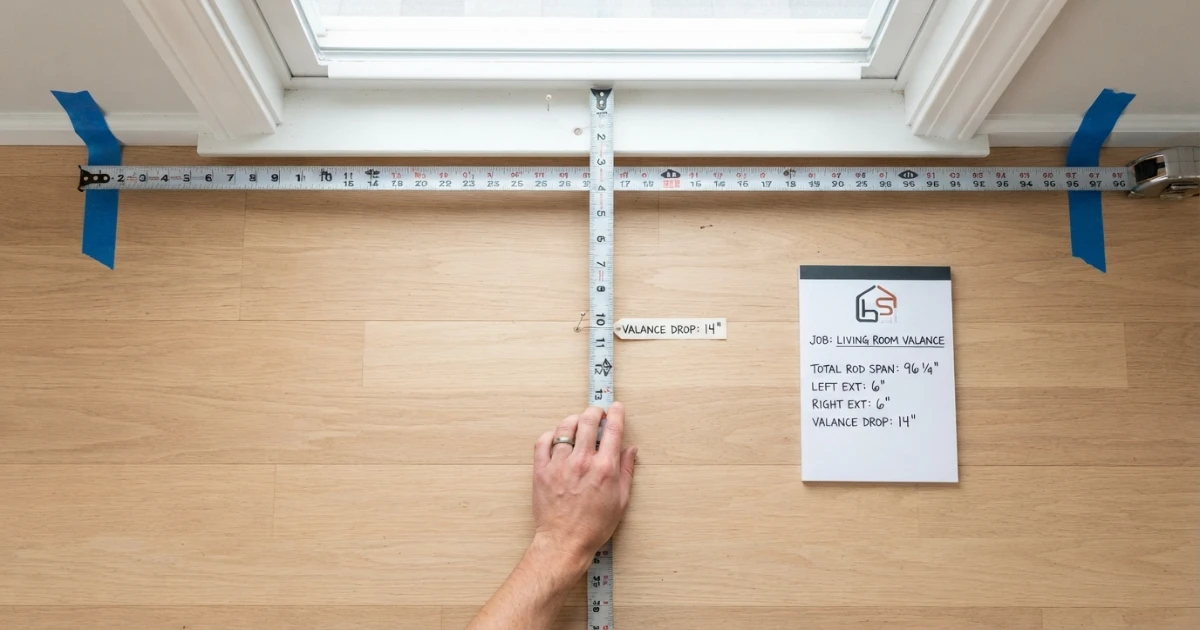
Do not measure only the glass. A valance usually covers the top trim and hardware. Mark the proposed width with painter’s tape and check it from across the room.
How long should a valance be?
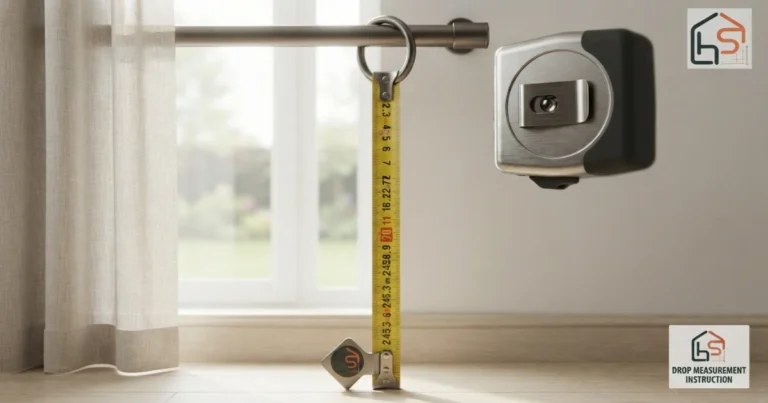
Many ready-made valances have a finished drop around 12 to 18 inches. Small windows may need only 10 to 12 inches, while tall windows or deep hardware may support 18 to 24 inches.
A useful visual starting point is approximately 20% to 30% of the visible window height. A 60-inch window at 25% produces a 15-inch drop. The final value depends on mounting height, valance style and the treatment underneath.
The valance should cover hardware without blocking excessive glass. Raise the mounting position when more drop is needed but daylight should remain open.
| Visible window height | 20% drop | 25% drop | 30% drop | Practical interpretation |
|---|---|---|---|---|
| 36 in | 7.2 in | 9 in | 10.8 in | Small window or shallow valance |
| 48 in | 9.6 in | 12 in | 14.4 in | Common kitchen or bathroom proportion |
| 60 in | 12 in | 15 in | 18 in | Balanced standard-window range |
| 72 in | 14.4 in | 18 in | 21.6 in | Tall window or layered treatment |
| 84 in | 16.8 in | 21 in | 25.2 in | Large architectural window |
How much fullness should a valance have?
Rod-pocket valances commonly use about 2 to 3 times fullness. A light gathered style may use 1.5 times. Heavy gathering can hide patterns and create excessive bulk.
Tailored, box-pleat and board-mounted styles use little or no extra fullness because the folds or shape are built into the finished design. Apply the exact finished-width specification instead.
A 48-inch rod at 2 times fullness needs 96 inches of valance fabric. Two 54-inch panels provide 108 inches and create approximately 2.25 times actual fullness.
Rod-pocket valance sizing
Rod-pocket valances are measured flat and gathered onto the rod. Use the complete usable span, multiply by the chosen fullness and divide by one panel’s width.
Check pocket depth and rod diameter. A thick decorative rod can shorten the apparent drop and make the fabric harder to gather. The header above the pocket also adds height above the rod.
When several panels are used, distribute the seams evenly. Train the gathers so one section does not look denser than another.
Tailored, box-pleat and scalloped valance sizing
Tailored valances use a controlled finished width. A box-pleat design may include exact pleat positions that need to align with the window center or mullions.
Measure the full finished span and verify whether returns are included. A sixty-inch tailored valance intended for a sixty-inch front board may not include the side depth.
Scalloped valances should align symmetrically. Choose a width that places the center scallop or motif correctly over the window.
Board-mounted valances and cornices
A board-mounted valance wraps over a rigid dust board, while a cornice uses a structured upholstered or finished box. Measure the front width, left return, right return and mounting clearance.
The board should be wide and deep enough to cover curtain rods, rings, shades or blinds beneath it. Add clearance for moving parts and curtain stack.
Rigid cornices are heavier than fabric-only valances. Confirm wall fixing, bracket spacing and transport access before building or ordering a wide unit.
Swag and scarf valance sizing
Swag and scarf valances need more fabric than the straight rod width because the material drapes in curves and may form long side tails. Measure the rod span, desired center drop and both tail lengths.
A simple scarf may use one and one-half to three times the rod width plus tails, depending on the number and depth of swags. Mock the shape with inexpensive fabric or string before ordering expensive material.
Heavy fabric forms deeper controlled swags but needs stronger brackets. Lightweight sheers create softer drape and may require more width for visual fullness.
Inside-mount versus outside-mount valances
Inside mounting creates a neat compact look but requires enough recess depth. It works best for tailored or small tension-mounted styles.
Outside mounting covers more trim and makes the window appear wider. Extend beyond the frame and mount high enough to preserve glass.
When mounting over blinds or shades, check the headrail projection. The valance must clear the operating hardware without pressing against it.
Valance sizing over curtains
A valance layered over curtains needs enough width and return depth to cover the main rod, brackets and rings. Measure the curtain hardware at its widest and deepest point.
Do not let the valance interfere with curtain movement. The lower edge should sit above the rings or leave enough clearance for the panels to open.
Coordinate the visual widths. A narrow valance over a wide curtain rod can look disconnected, while an oversized valance can dominate the treatment.
Valance sizing over blinds and shades
A valance can conceal a blind headrail and soften the top of a shade. Measure the headrail width, depth and operating controls.
Inside-mounted blinds may need only a decorative outside valance. Outside-mounted blinds require enough return depth for the full headrail and rolled fabric.
Keep cords, chains and controls accessible and follow current safety guidance for window coverings.
Valance sizing for wide windows and multiple windows
Wide openings may need two or more valance panels, a custom board or a sectional cornice. Join points should align with window mullions or intentional design breaks.
For two adjacent windows, decide whether one continuous valance unifies them or separate valances preserve the architecture. Measure the wall space between frames and the total outside span.
A single long rod or board needs adequate center support. Heavy fabric and rigid cornices create substantial load across a wide span.
Pattern repeat, seams and visual centering
Pattern placement can determine the final width more strongly than the basic formula. A large floral, stripe or geometric motif should center on the window or repeat evenly across multiple valance sections.
When two ready-made panels are joined, check whether the print matches at the seam. Randomly cut fabric may produce a visible jump. Custom work allows the pattern to be centered and matched, but it requires extra fabric.
Scalloped and shaped hems also need symmetry. The center point should align with the window or central mullion unless an asymmetric design is intentional.
How deep should valance returns be?
Return depth is the distance from the front face of the valance back to the wall. Shallow decorative rods may need only a small return, while layered curtain rods or outside-mounted shades may project several inches.
Measure the deepest hardware point and add clearance so fabric does not rub against rings, brackets or blind controls. Board-mounted treatments should also leave room for installation screws and future removal.
Too much return depth can make a small valance look bulky. Use the minimum depth that safely clears the treatment below.
Valance sizes by room
| Room | Common style direction | Typical drop tendency | Main concern | Planning note |
|---|---|---|---|---|
| Kitchen | Rod pocket, tailored or scalloped | 10–16 in | Cabinets, backsplash and heat | Use washable fabric and clear appliances |
| Living room | Tailored, board mounted or layered | 14–22 in | Curtain hardware and room scale | Coordinate with full-length panels |
| Bedroom | Soft gathered, tailored or cornice | 12–20 in | Blackout rod and shade clearance | Cover hardware without blocking light |
| Bathroom | Short washable valance | 10–15 in | Moisture and privacy | Choose moisture-safe materials |
| Dining room | Tailored, box pleat or swag | 14–24 in | Formal proportion and pattern alignment | Use the window center as a design reference |
When a custom valance size is worth it
A custom valance is useful when the window is unusually wide, the rod and blind project far from the wall, or a large pattern must be centered precisely. Ready-made panels can solve many ordinary windows, but several joined sections may create visible seams or uneven gathers across a formal room.
Custom sizing is also practical for bay windows, arched trim, connected window groups and layered treatments with blackout curtains. Provide the workroom with the finished front width, return depth, mounting height, desired drop, hardware projection and pattern direction. Confirm whether the quoted width includes side returns.
Before ordering, mock the outline with painter’s tape or cardboard. View it from the doorway and main seating position. This simple test often reveals that a proposed drop is too deep or that the valance needs additional side extension to balance the window.
Installation and maintenance clearance
Leave enough space to install, remove and clean the treatment. A cornice mounted tightly against the ceiling may hide hardware beautifully but make future curtain removal difficult. Rod-pocket valances should slide off without requiring the main curtain rod to be dismantled whenever possible.
Check air vents, opening sashes, cabinet doors and ceiling fans near the top treatment. In kitchens and bathrooms, choose washable materials and avoid placing fabric where steam, grease or splashing will collect. A properly sized valance should look finished while remaining practical to maintain.
Worked valance size examples
Example one: 48-inch rod-pocket valance. At 2 times fullness, required width is 96 inches. Two 54-inch panels provide 108 inches and create approximately 2.25 times fullness.
Example two: outside mount. A 48-inch window receives 4 inches of extension on each side, producing a 56-inch rod span. At 2 times fullness, target width is 112 inches. Three 42-inch panels provide 126 inches.
Example three: tailored valance. The finished rod span is 60 inches with 4-inch returns on both sides. Total finished width is 68 inches. Do not apply a 2-times fullness factor.
Example four: 60-inch window height. A 25% proportional drop is 15 inches. Choose a 15- or 16-inch finished valance depending on hardware coverage.
Example five: deep curtain rod. The main rod projects 4 inches from the wall. A board-mounted valance needs at least 5 inches of return depth for safe clearance.
Example six: wide window. A 96-inch rod at 2 times fullness needs 192 inches of gathered width. Four 52-inch panels provide 208 inches.
Example seven: swag valance. A 60-inch rod uses two soft swags and 30-inch tails. The fabric requirement exceeds the straight span and should be mocked before cutting.
Example eight: inside mount. A recess measures 35.5 inches at the top and 36 inches at the bottom. Use the narrower top measurement and confirm bracket clearance.
Example nine: double window. Two 36-inch windows separated by a 6-inch mullion create a total outside span of 78 inches before extension. A continuous tailored valance can unify the group, while two separate valances preserve the division.
Example ten: layered blackout treatment. A 72-inch blackout rod projects 4.5 inches. A cornice measuring 80 inches wide with 6-inch returns covers the rod, brackets and side gaps while leaving operating clearance.
Common valance sizing mistakes
- Applying gathered fullness to a tailored finished-width valance.
- Measuring only the glass instead of the rod, board or outside span.
- Forgetting side returns and hardware projection.
- Choosing a drop that blocks too much glass.
- Buying one panel when the gathered width requires two or more.
- Confusing flat panel width with finished pleated width.
- Mounting over curtains without checking ring movement.
- Using a rigid cornice without adequate wall support.
- Ignoring pattern alignment and center motifs.
- Ordering before testing the proportion with painter’s tape.
The most common planning error is choosing a ready-made valance because its width is close to the window width. A gathered rod-pocket panel that merely equals the rod span will look flat. A tailored valance with the same number may be correct. The construction method must be identified before the number has meaning.
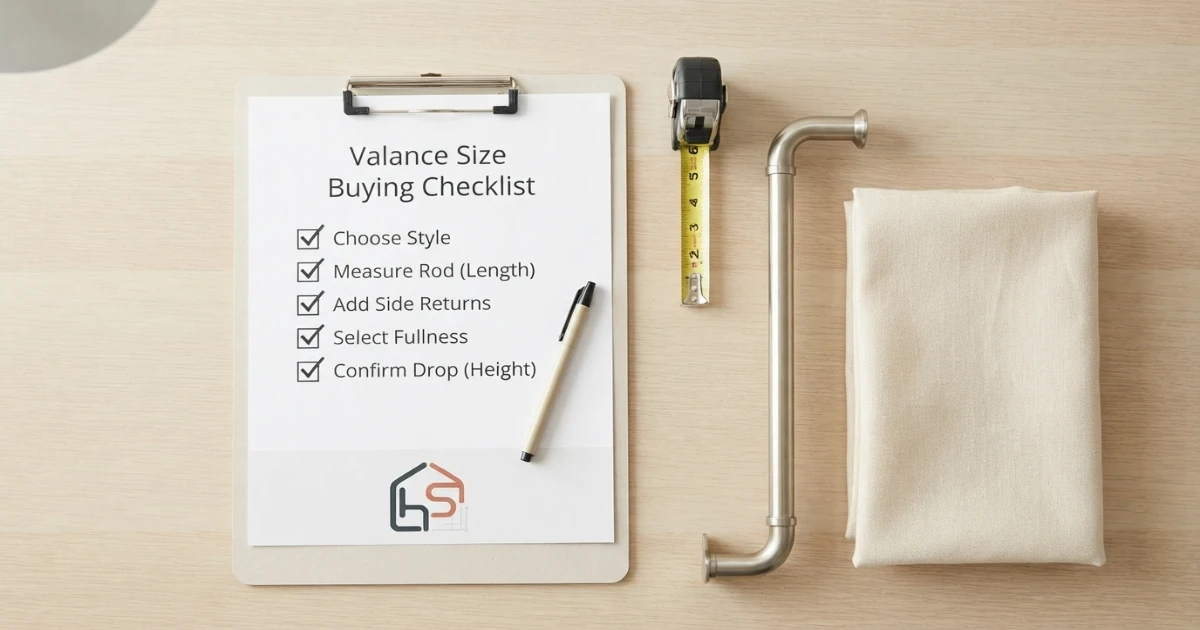
Valance buying checklist
Record the valance style, mounting position, usable rod or board width, side extension, return depth, desired fullness, panel width, panel quantity, visible window height and finished drop.
Check curtain rods, blind headrails, rings, brackets and controls beneath the valance. Confirm that the treatment clears moving parts and leaves enough access for cleaning or removal.
Review fabric composition, pattern repeat, lining, care method, package quantity, alteration limits and return policy. For rigid cornices, confirm wall anchors, bracket locations and delivery access.
Mark the width and drop with painter’s tape, view the proportion from across the room and then use the Curtain Size Calculator to confirm the complete order.
Two practical valance product categories to compare
Search links are used because widths, drops, package quantities and styles change. Confirm the current listing before ordering.
Ready-Made Window Valances
Compare rod-pocket, tailored and scalloped valances after calculating the required width and drop.
- Confirm finished width per panel
- Check flat versus gathered measurement
- Verify one panel or multi-panel package
Valance Rods and Cornice Hardware
Compare shallow rods, return rods and mounting hardware after checking width, return depth and total treatment weight.
- Confirm rod adjustment range
- Check return depth and bracket projection
- Match hardware to fabric or cornice weight
Affiliate disclosure: As an Amazon Associate, HomeStyle Calculator may earn from qualifying purchases. Product specifications, prices and availability can change. Review the current listing before ordering.
Valance sizes FAQs
How wide should a valance be?
A gathered valance is commonly 1.5 to 3 times the usable rod width. Tailored and board-mounted valances use a finished width close to the exact span plus returns.
How long should a window valance be?
Many valances have a finished drop around 12 to 18 inches. The correct length depends on window height, mounting position, style and hardware coverage.
How much wider should a valance be than the window?
For an outside mount, add approximately 2 to 6 inches on each side as a starting point. Use more when covering curtain brackets or a deep blind headrail.
What is a standard valance size?
Common ready-made widths include approximately 42, 50, 52, 54, 60 and 72 inches, with drops often around 12 to 18 inches.
How much fullness should a valance have?
Rod-pocket valances commonly use 2 to 3 times fullness. Tailored, box-pleat and board-mounted styles use little or no added fullness.
Should a valance cover the top of the window?
Yes. It usually covers the top trim, rod or shade hardware while leaving most of the glass open.
Can a valance be used with curtains?
Yes. Measure enough width and return depth to clear the curtain rod, rings, brackets and moving panels beneath it.
How many valance panels do I need?
Divide the required gathered width by one panel’s finished width and round up. Wide windows may need two or more matching sections.
Calculate the exact valance size
Turn rod width, returns, fullness and window height into a complete valance order.