How wide is a 75 inch TV? Best complete size guide
How wide is a 75 inch TV? A standard 16:9 visible screen is approximately 65.4 inches wide and 36.8 inches high, equal to about 166.0 by 93.4 centimeters before adding the bezel or stand.
Written and reviewed by Rehana K · HomeStyle Calculator measurement-first method.
How wide is a 75 inch TV? About 65.4 inches or 166 centimeters.
The visible 16:9 screen measures approximately 65.4 inches wide by 36.8 inches high, or 166.0 by 93.4 centimeters. The diagonal is 75 inches, equal to 190.5 centimeters.
The complete TV body is usually slightly larger because of the bezel. Feet, center stands, depth and total product dimensions vary by model, so always confirm the manufacturer specification sheet.
Use the 75-inch width with distance, stand and mounting guides
Check the visible screen first, then confirm the exact product body, console support, viewing distance and screen-center height.
75-inch TV dimensions from visible screen to installed fit
75-inch TV wall and console fit calculator
Enter the available width and choose a bezel or side-clearance allowance. The calculator estimates complete installed width and remaining space.
Approximate installed width
Approximate 16:9 width.
Visible screen plus selected allowance.
Total space after estimated fit.
Confirm exact model dimensions.
A 75-inch screen fits a 76-inch open wall with the selected allowance, but the exact TV body and mount must still be checked.
How wide is a 75 inch TV in inches and centimeters?
How wide is a 75 inch TV when the screen uses the standard 16:9 aspect ratio? The visible screen is approximately 65.4 inches wide and 36.8 inches high.
In metric measurements, that is approximately 166.0 centimeters wide and 93.4 centimeters high. The advertised 75-inch diagonal equals 190.5 centimeters.
These numbers describe the visible rectangular screen. The complete television may be wider and taller because of the bezel, frame, speakers or housing.
190.5 cm
166.0 cm
93.4 cm
≈15,509 cm²
These numbers describe the visible rectangular screen. The complete television may be wider and taller because of the bezel, frame, speakers or housing.
75-inch 16:9 screen formula
Modern televisions normally use a 16:9 aspect ratio. Width and height come from the diagonal and that fixed ratio.
Width = 75 × 16 ÷ √337 ≈ 65.4 inches
Height = 75 × 9 ÷ √337 ≈ 36.8 inches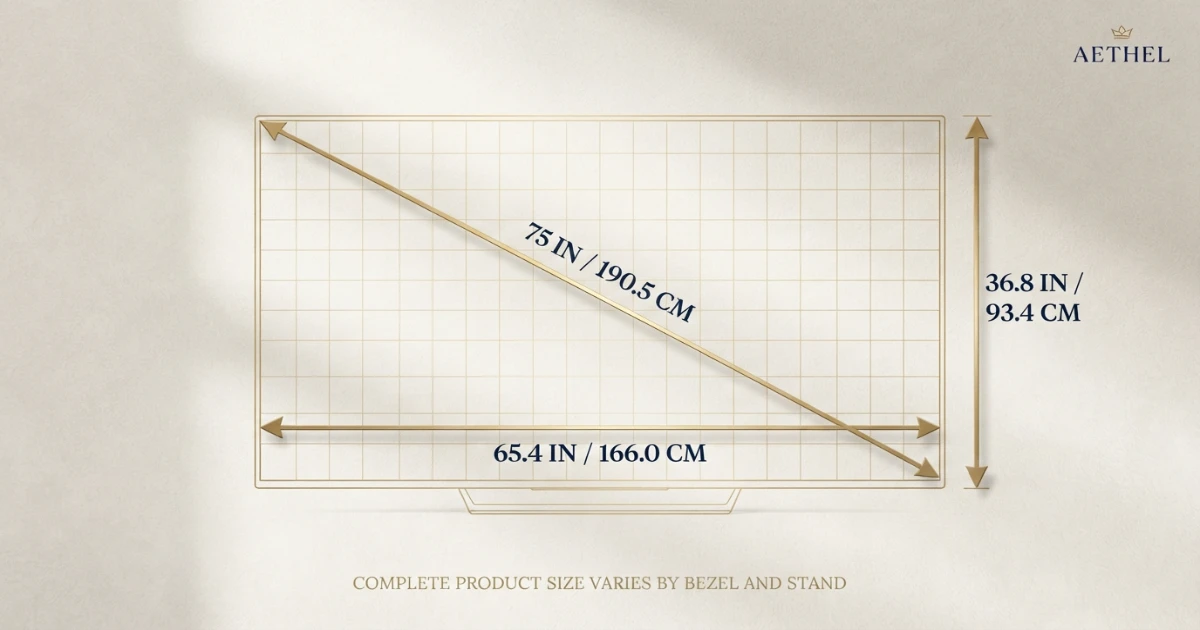
Visible screen width versus complete 75-inch TV width
The 65.4-inch number is not the complete product width. It describes the active 16:9 picture area before bezels.
Modern bezels are often thin, but a complete 75-inch television is slightly wider than the visible screen. Decorative frames, built-in speakers and industrial designs can add more width.
Manufacturer specification sheets normally list body dimensions without the stand and dimensions with the stand. Use the body width for wall or cabinet openings.
For console installation, also check complete height with stand, total depth with stand, outer foot spacing and weight.
Two televisions sold in the 75-inch class can use different bezel designs and support feet, so their complete product measurements are not identical.
How much wall space does a 75-inch TV need?
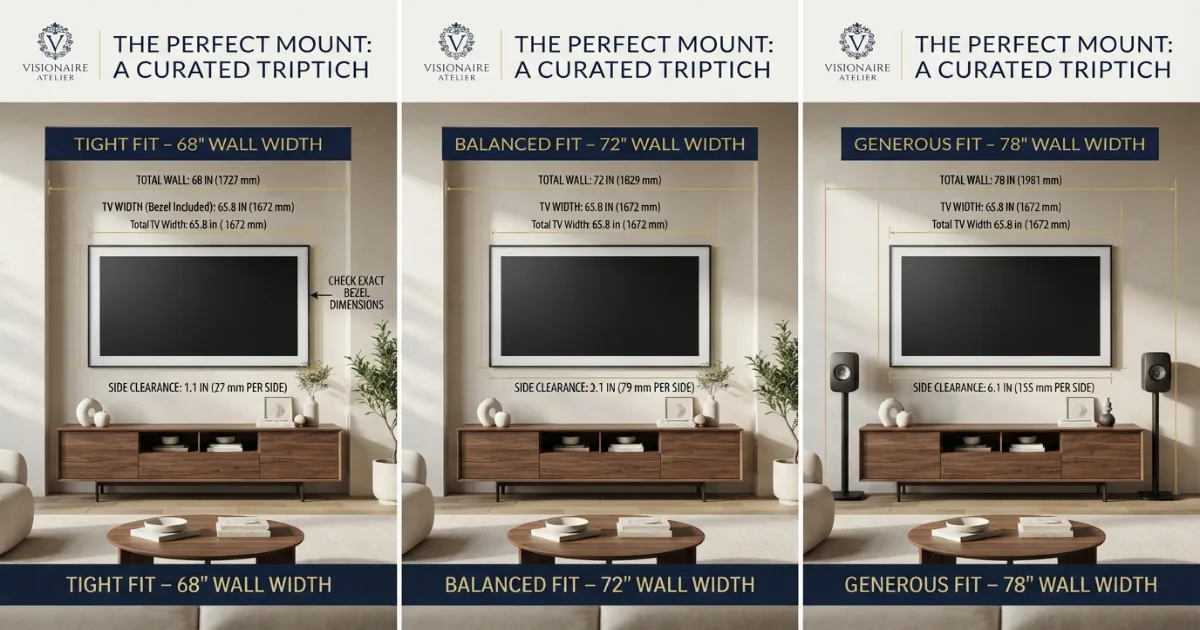
The visible screen needs about 65.4 inches of width. A practical open-wall plan should add the model’s bezel width and any desired space for ventilation, cables, speakers and visual breathing room.
A 68-inch usable wall is tight because it leaves only about 2.6 inches before bezels. A 72-inch zone is balanced for many thin-bezel models. A 78-inch zone provides more comfortable side space.
Measure uninterrupted usable wall space. Windows, door trim, shelves, sconces, speakers and furniture can reduce the actual installation zone.
A screen can technically fit while still looking crowded. Painter’s tape helps reveal how the television will relate to the console, sofa, artwork and architectural details.
When wall mounting, confirm VESA pattern, television weight, mount capacity, wall construction and stud placement.
Tight. The visible screen leaves only about 2.6 inches before bezels.
Balanced for many thin-bezel models after exact width is checked.
Generous side room for breathing space or compact speakers.
Measure uninterrupted usable wall space. Windows, door trim, shelves, sconces, speakers and furniture can reduce the actual installation zone.
A screen can technically fit while still looking crowded. Painter’s tape helps reveal how the television will relate to the console, sofa, artwork and architectural details.
When wall mounting, confirm the mount’s VESA pattern, weight rating, extension, tilt and wall attachment. A mount advertised for 75-inch televisions is not automatically compatible with every 75-inch model.
What size TV stand works for a 75-inch TV?
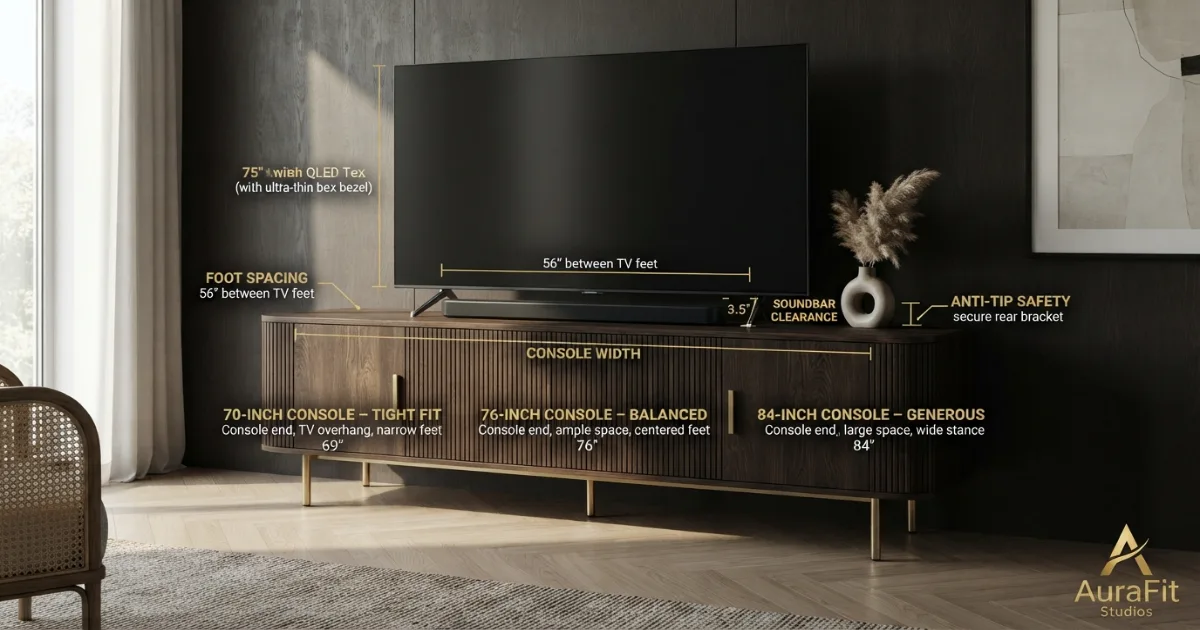
A media console should support the complete television safely, not only match the screen width. Verify the exact product width, outer foot spacing, foot depth and total weight.
A 70-inch stand may support some 75-inch televisions when the feet sit inside the top surface, but the appearance can be tight. A 76-inch console is a useful balanced starting point. An 84-inch console gives more room for speakers, a soundbar and visual breathing space.
The stand must be deep enough for the feet. Angled legs may require more front-to-back depth than expected.
Check the console’s rated weight capacity. Do not assume that wide furniture is automatically strong enough for the TV and audio equipment.
Use the TV Stand Size Guide for complete furniture planning.
Check complete width and outer foot spacing carefully.
Often close to or slightly wider than the complete TV body.
More room for audio equipment and visual balance.
The stand must be deep enough for the feet. Some wide-set legs are shallow, while angled feet may require more front-to-back depth than expected.
Check the console’s rated weight capacity. Do not assume a wide piece of furniture is structurally strong enough for the TV and sound equipment.
Use the TV Stand Size Guide for complete furniture planning.
Will a 75-inch TV fit inside a cabinet or recess?
A cabinet opening is less forgiving than an open wall. The complete 75-inch TV body must clear the opening in width, height and depth.
A 67-inch cabinet opening is normally too narrow because the visible screen alone is about 65.4 inches wide. Bezels and safe side clearance increase the required width.
Measure the opening at the top, center and bottom because cabinetry may not be perfectly square. Use the narrowest measurement.
Allow access for power, HDMI cables, ventilation and future removal. A television that enters only at an angle may be difficult to service.
Manufacturer ventilation instructions should control the final clearance.
How tall is a 75-inch TV for mounting?
The visible screen height is approximately 36.8 inches. The screen therefore extends about 18.4 inches above and below its centerline.
If the desired screen center is 42 inches from the floor, the visible bottom edge would sit near 23.6 inches and the visible top edge near 60.4 inches. Complete body dimensions can shift those edges slightly.
Mounting height should be calculated from seated eye level and screen center rather than from the bottom edge alone.
A soundbar or console may require clearance, but raising the screen too far can create neck strain. Test the complete outline while seated normally.
Use the TV Mounting Height Guide for detailed placement.
How far should you sit from a 75-inch TV?
Physical width answers whether the television fits. Viewing distance answers whether the picture feels relaxed, balanced or immersive.
A 75-inch 4K television commonly suits viewing around 8.5 to 12 feet. The shorter end feels more cinematic, while the longer end feels calmer.
At approximately 10 feet, 75 inches is a strong balanced choice for many family rooms. At 12 feet, it remains usable but an 85-inch screen can improve subtitles and sports detail.
Use the TV Size for 10 Feet and TV Size for 12 Feet guides for distance-specific planning.
The TV Size Calculator combines distance with viewing preference and content quality.
How 75-inch dimensions compare with 65 and 85 inches
| TV size | Visible width | Visible height | Width in cm | Common role |
|---|---|---|---|---|
| 65 in | 56.7 in | 31.9 in | 143.9 cm | Balanced standard family rooms |
| 75 in | 65.4 in | 36.8 in | 166.0 cm | Large and immersive family rooms |
| 85 in | 74.1 in | 41.7 in | 188.2 cm | Extra-large media-focused rooms |
Moving from 65 to 75 inches adds about 8.7 inches of visible width and approximately 33.1% more screen area. Moving from 75 to 85 inches adds another 8.7 inches of visible width and approximately 28.4% more area.
Use the 55 vs 75 Inch TV and 75 vs 75 Inch TV comparisons when two sizes both fit the wall.
What about TV depth and weight?
Depth and weight cannot be calculated from the 75-inch diagonal. They depend on panel technology, backlight design, electronics housing, speakers, materials and stand construction.
An OLED model may be very thin across the upper panel but deeper near the electronics housing. Mini-LED and conventional LED models can have different rear profiles.
For wall mounting, use the weight without the stand. For console placement, use the weight with the stand and any attached sound equipment.
Measure depth when the television sits inside a recess, when a full-motion mount must fold close to the wall or when feet approach the front edge of a shallow console.
Will a 75-inch TV fit through a normal door?
The unpacked television body may fit through many normal doorways, but a 75-inch shipping box is substantially wider and taller than the visible screen.
Measure the boxed dimensions listed by the retailer or manufacturer. Check doors, hallway turns, stairs, elevators and the space needed to rotate the package.
Keep the television upright during transport when required by the manufacturer. Large panels can be damaged by twisting, pressure or incorrect handling.
Plan for at least two capable adults or professional installation support. Retain the packaging until the television is tested.
75-inch TV width in real room examples
Apartment wall: A 70-inch usable zone can hold the approximate screen, but the complete body and side clearance must be checked carefully.
Standard family room: A 72-inch wall zone or console creates a balanced starting point for many thin-bezel models.
Wide living-room wall: A 78-inch or larger zone leaves room for compact speakers and a cleaner visual frame.
Bedroom dresser: Check dresser depth and outer foot spacing. A dresser that is wide enough may still be too shallow.
Fireplace installation: Width may fit, but height, heat, mantel clearance and neck angle become more important. Use the TV Height Above a Fireplace guide.
Built-in cabinet: Use complete product dimensions and ventilation instructions. Do not rely on the 65.4-inch visible width alone.
How to measure your space before buying
- Measure uninterrupted wall or furniture width.
- Mark a 65.4-inch-wide by 36.8-inch-high visible screen outline.
- Add the exact selected model’s bezel width.
- Check complete height with and without the stand.
- Measure outer foot spacing and foot depth.
- Confirm the furniture’s weight capacity.
- Check VESA pattern, mount rating and wall construction.
- Allow room for a soundbar, speakers and cables.
- Measure doors, stairs, halls and elevators.
- Test the screen center from the seated viewing position.
Common mistakes when measuring a 75-inch TV
- Assuming 75 inches is the screen width.
- Using 65.4 inches as the complete TV body width.
- Ignoring bezel thickness and decorative frames.
- Checking console width but not foot spacing.
- Forgetting foot depth and rear housing depth.
- Measuring the whole wall instead of usable uninterrupted space.
- Choosing a mount by diagonal range without checking VESA and weight.
- Mounting from the bottom edge instead of the screen center.
- Ignoring soundbar, speakers and ventilation.
- Measuring the TV but not the shipping box and delivery path.
How wide is a 75 inch TV buying checklist
- Visible screen width: about 65.4 inches.
- Visible screen height: about 36.8 inches.
- Metric size: approximately 166.0 by 93.4 centimeters.
- Complete model width without stand.
- Height and depth with the stand.
- Outer foot spacing and foot depth.
- Total weight with and without stand.
- VESA pattern and mount capacity.
- Wall or console usable width.
- Speaker and soundbar clearance.
- Outlet and cable access.
- Seated eye level and screen-center height.
- Door, stair and elevator clearance.
- Manufacturer ventilation instructions.
Corner placement can work well in multipurpose rooms, yet a flat wall normally provides simpler alignment, cleaner cable management and more predictable speaker placement.
A full-motion mount can angle the screen, but the extended arm increases leverage on the wall and changes cable requirements. Confirm mount capacity and wall construction before using a large extension.
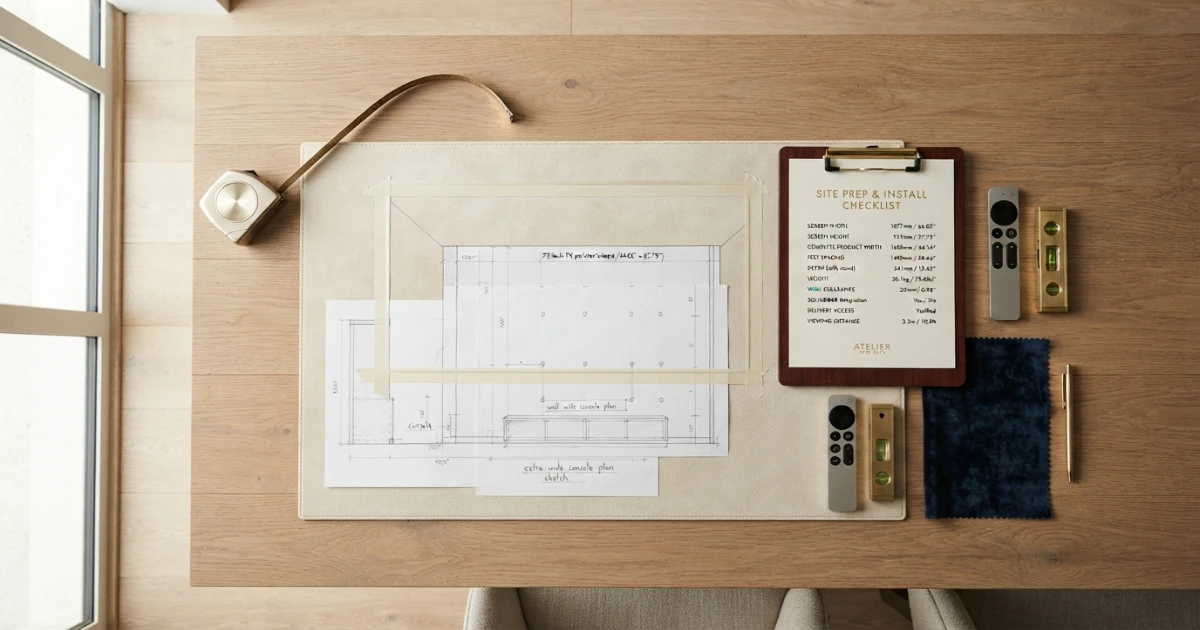
Measure both walls from the corner and create a cardboard or painter’s-tape footprint for the console. Check door swings, walking paths and whether the screen remains centered to the main sofa.
A 75-inch TV placed diagonally across a corner needs more planning than the 65.4-inch screen width suggests. The rear corners of the television, stand depth and viewing angle all affect how far the setup projects into the room.
Does corner placement change the required width?
A 75-inch TV placed diagonally across a corner needs more planning than the 65.4-inch visible width suggests. Rear corners, stand depth and viewing angle affect how far the setup projects into the room.
Measure both walls from the corner and create a painter’s-tape footprint for the console. Check door swings, walking paths and whether the screen remains centered to the main sofa.
A full-motion mount can angle the screen, but the extended arm increases leverage on the wall and changes cable requirements.
Corner placement can work in multipurpose rooms, yet a flat wall usually provides simpler alignment, cable management and speaker placement.
How a 75-inch TV looks against common furniture widths
A 75-inch TV can look different on two consoles even when both support it safely. A narrow console makes the screen appear more dominant, while a wider console creates a calmer horizontal base.
On a 70-inch console, the television may be close to the furniture width. On a 76-inch console, many installations look balanced. An 84-inch console usually gives more generous space for audio equipment.
Wall-mounted televisions still benefit from furniture proportion. The console does not physically support the screen, but its width affects the wall composition.
Minimal interiors may prefer more empty wall around the television, while media-focused rooms can support a stronger screen-dominant layout.
Which model specifications should you record?
Do not assume a two-inch generic allowance will work for every product. Lifestyle-frame televisions, built-in speakers and older designs may have wider borders than conventional thin-bezel models.
A practical planning method is to mark two outlines: the 65.4-inch visible picture and the selected model’s complete body width. This shows how much of the wall is actual image and how much is frame or clearance.
For an open wall, the exact product width plus a small visual margin is usually enough. For a cabinet or recess, follow the manufacturer’s ventilation clearance and leave room to grip, connect and remove the television.
The visible screen is about 65.4 inches wide, but the complete television body is wider. On many modern thin-bezel models, the difference may be modest, yet it still matters when the installation area is close to the minimum.
How much extra width should you allow for 75-inch TV bezels?
The visible screen is about 65.4 inches wide, but the complete television body is wider. On modern thin-bezel models the difference may be modest, yet it matters when the installation area is close to the minimum.
For an open wall, use the exact product width plus the visual margin you want. For a cabinet or recess, follow the manufacturer’s ventilation clearance and leave room to connect and remove the television.
A practical planning method is to mark two outlines: the 65.4-inch visible picture and the selected model’s complete body width.
Do not assume a generic two-inch allowance fits every design. Lifestyle-frame televisions, built-in speakers and older frames can require more.
Final answer: how wide is a 75 inch TV?
How wide is a 75 inch TV? The standard 16:9 visible screen is approximately 65.4 inches or 166.0 centimeters wide.
It is also about 36.8 inches or 93.4 centimeters high, with a 75-inch or 190.5-centimeter diagonal.
Use 65.4 inches to outline the picture area, but use the selected model’s complete manufacturer width, feet spacing, depth and weight for the final wall, cabinet, console or mount decision.
Need to confirm whether 75 inches is the right diagonal?
Use the free TV Size Calculator before finalizing the wall or furniture plan.
Measurement and viewing references
The screen dimensions use standard 16:9 geometry. The official resources below provide additional guidance on diagonal measurement, physical product fit and viewing distance.
Two practical installation categories to compare
Verify the selected TV model’s VESA pattern, weight, feet and complete dimensions before ordering.
75-Inch TV Wall Mounts
Compare mounts only after checking VESA compatibility, TV weight and wall construction.
- Confirm VESA pattern
- Check weight capacity
- Review tilt and extension
TV Stands for 75-Inch TVs
Compare console width, top depth, weight capacity and soundbar space.
- Check outer foot spacing
- Confirm depth and weight
- Allow cable and audio room
Affiliate disclosure: As an Amazon Associate, HomeStyle Calculator may earn from qualifying purchases. Product specifications, prices and availability can change.
How wide is a 75 inch TV FAQs
How wide is a 75 inch TV?
A standard 16:9 75-inch screen is approximately 65.4 inches or 166 centimeters wide before adding the bezel.
How tall is a 75-inch TV?
The visible 16:9 screen is approximately 36.8 inches or 93.4 centimeters high before bezels or a stand.
What are the dimensions of a 75-inch TV in centimeters?
The visible screen is approximately 166.0 centimeters wide by 93.4 centimeters high, with a diagonal of 190.5 centimeters.
Does the 65.4-inch width include the bezel?
No. It is the approximate visible screen width. The complete TV body is usually slightly wider and varies by manufacturer and model.
Will a 75-inch TV fit on a 70-inch stand?
It may fit only if the complete TV width, feet spacing, depth and weight are compatible. A 70-inch console can be visually tight, so check the exact product specifications.
What size TV stand is best for a 75-inch TV?
A stand around 76 to 84 inches wide often creates a balanced appearance, but exact feet spacing, depth and weight capacity determine safe support.
How much wall space is needed for a 75-inch TV?
The visible screen needs about 65.4 inches of width. Allow additional space for bezels, ventilation, cables, speakers and visual breathing room.
How far should I sit from a 75-inch TV?
A 75-inch 4K TV commonly suits viewing around 8.5 to 12 feet, depending on preferred immersion, content quality and eyesight.
Can a 75-inch TV fit in a 67-inch cabinet opening?
Usually not safely. The visible screen alone is about 65.4 inches wide, and the complete product body is wider. Check the exact manufacturer width and required ventilation clearance.
Is every 75-inch TV the same width?
No. Visible 16:9 screen size is similar, but bezel thickness, frame design, speakers, feet and housing can change complete product dimensions.