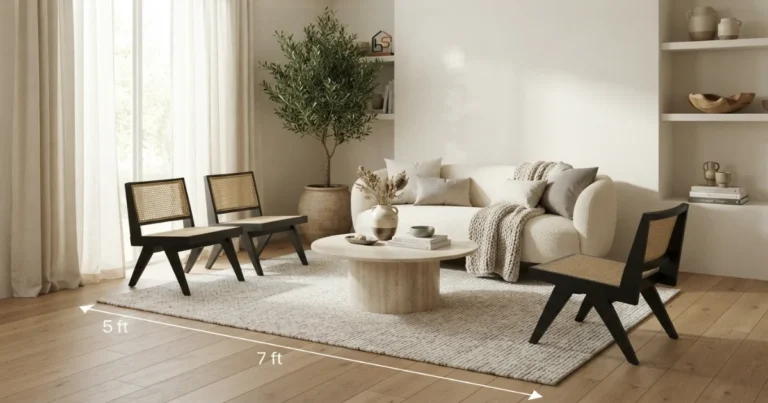
Rug pad size: should it be smaller than the rug?
Yes—the pad normally sits slightly inside the rug edge. Use this rug pad size guide to calculate the finished pad dimensions, choose an appropriate thickness and select a material that matches the floor and the way the rug is used.
Written by Rehana K · Published and updated July 18, 2026.
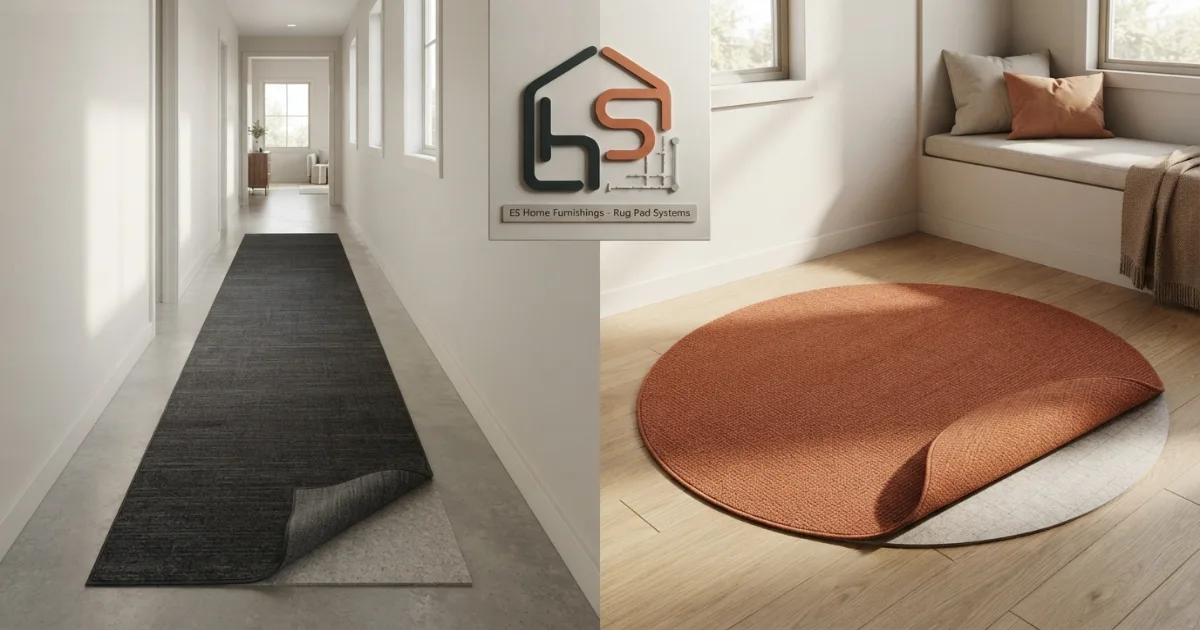
The rug pad should be hidden just inside the rug perimeter.
For most ordinary area rugs, begin with about 1 inch of rug overhang on every edge. That means subtracting approximately 2 inches from the rug’s total width and 2 inches from its total length. Thicker pads, very large rugs and manufacturer-specific products may need a wider inset. The correct rug pad size supports the perimeter without showing or creating a hard ridge.
Rug pad size guide contents
Jump to the exact measurement, floor or buying decision you need.
Calculate the finished rug pad size
Enter the actual rug dimensions and choose how far the pad should sit inside each edge. The result updates automatically.
7 ft 10 in × 9 ft 10 in
Buy an 8×10 pad or a slightly larger trimmable pad, then cut it to the calculated outline.
Choose the rug pad by floor, rug weight and comfort goal
The best rug pad size is only half the decision. Material and thickness determine grip, cushioning, door clearance and whether the product is appropriate for the floor finish.
YOUR-AMAZON-TAG-20 in the HTML with your approved affiliate tracking ID before publishing. We may earn a commission from qualifying purchases at no extra cost to the reader.Natural rubber grip pad
Best for small rugs, runners and rugs that move on hard flooring.
- Low profile
- Strong anti-slip role
- Good near doors
Felt + natural rubber pad
Combines cushioning with grip for living rooms, bedrooms and dining rugs.
- Balanced comfort
- Helps resist shifting
- Multiple thicknesses
100% felt cushioning pad
Useful beneath large furniture-anchored rugs where comfort matters more than grip.
- Dense cushioning
- Noise reduction support
- Best under heavy rugs
Low-profile washable-rug pad
Designed for thin washable covers, tight door clearance and easy handling.
- Minimal height
- Easy trimming
- Better near thresholds
Common rug sizes and finished pad dimensions
These examples use a one-inch inset from each edge. Measure the actual rug because nominal dimensions and handmade rugs can vary.
| Rug size | Finished pad size | Pad to buy | Typical use |
|---|---|---|---|
| 2 × 3 ft | 1 ft 10 in × 2 ft 10 in | 2×3, trim | Door mat or bedside accent |
| 3 × 5 ft | 2 ft 10 in × 4 ft 10 in | 3×5, trim | Entry, kitchen or reading zone |
| 4 × 6 ft | 3 ft 10 in × 5 ft 10 in | 4×6, trim | Small seating or office area |
| 5 × 7 ft | 4 ft 10 in × 6 ft 10 in | 5×7, trim | Compact living room or bedroom |
| 5 × 8 ft | 4 ft 10 in × 7 ft 10 in | 5×8, trim | Apartment seating or office |
| 6 × 9 ft | 5 ft 10 in × 8 ft 10 in | 6×9, trim | Full bed or small living room |
| 8 × 10 ft | 7 ft 10 in × 9 ft 10 in | 8×10, trim | Living room, queen bed or dining |
| 9 × 12 ft | 8 ft 10 in × 11 ft 10 in | 9×12, trim | Large seating or dining group |
| 10 × 14 ft | 9 ft 10 in × 13 ft 10 in | 10×14, trim | Large living room or king bedroom |
Rug pad size guide: the complete measuring and buying method
A correct rug pad size is large enough to support almost the whole rug but small enough to disappear beneath the edge. That difference matters because a pad that shows looks unfinished, while a pad that stops too far inside can create an unsupported border. The rug should transition gradually to the floor instead of dropping from a thick pad to an empty edge.
The safest workflow is to measure the actual rug, choose the edge inset required by the pad maker, calculate the finished pad dimensions and buy a pad that can be trimmed to the result. Do not rely only on a label such as “8×10.” Rugs can be slightly undersized, oversized or irregular, and fringe should normally be excluded from the padded field.
First confirm that the rug itself is correct for the room with the room and furniture rug calculator. A perfectly cut pad cannot fix an area rug that is too small for the sofa, dining chairs or bed.
Reliable buying rule
Buy the same nominal pad size as the rug—or the next available size up when the rug is irregular—then trim the pad to the measured smaller outline. A pre-cut pad that is already far smaller than the rug may leave too much unsupported edge.
Rug pad sizing formula
The calculation is simple: subtract twice the desired edge inset from the rug width, then repeat for the rug length. A one-inch inset removes two inches from the total width and two inches from the total length because the pad moves inward on both sides.
For an actual rug measuring 96 by 120 inches, a one-inch inset on every edge produces a finished rug pad size of 94 by 118 inches. In feet and inches, that is 7 feet 10 inches by 9 feet 10 inches. The calculator above performs the same step for standard and non-standard dimensions.
A practical starting point of about one inch per edge is consistent with manufacturer guidance that the pad should be slightly smaller. Mohawk Home describes a one-inch inset in one buying guide and also notes that pads can be cut down; its FAQ gives a wider minimum in another product context. RugPadUSA custom cuts pads shorter than the submitted rug dimensions and recommends additional allowance for some thick pads and very large rugs. These differences are why the rug pad size should follow the specific product rather than a universal number.
Can a rug pad be too small?
Yes. “Smaller than the rug” does not mean dramatically smaller. A pad that ends several inches inside every edge can leave the rug border unsupported. The outer area may feel thinner, curl, fold or move differently from the center. Under a chair, the wheels or legs can catch the height change between the padded center and the unpadded perimeter.
A very small pad also provides less grip. This is especially important under runners, entry rugs, kitchen rugs and lightweight flatweaves because those rugs depend on the pad rather than heavy furniture. For a small mobile rug, prioritize near-full coverage and a controlled inset instead of using a leftover pad that covers only the middle.
When the existing pad is too small, replace it or add a properly sized product. Do not join random scraps under a rug unless the pad manufacturer explicitly supports modular installation. Seams can shift and create ridges.
Rug pad thickness guide
Thickness changes both comfort and edge geometry. A thick pad creates a greater step down at the rug perimeter, so it may need a little more rug overhang for a smooth taper. A thin pad can often sit closer to the edge without being visible.
| Pad profile | Typical use | Main advantage | Watch for |
|---|---|---|---|
| About 1/8 in | Runners, doors, thin washable rugs | Low edge and easy clearance | Limited cushioning |
| About 1/4 in | General hard-floor use | Balanced grip and comfort | Check door swing |
| About 3/8 in | Living rooms and bedrooms | Noticeable cushioning | Higher perimeter transition |
| About 1/2 in | Large anchored rugs where plushness matters | Maximum cushion in this range | Doors, chairs and thick rug pile |
Thickness ranges are shopping categories rather than guarantees. Compression, density and construction affect how the pad feels. A dense quarter-inch felt-rubber pad may perform better than a soft, loose product that is technically thicker.
Felt vs rubber vs combination pads
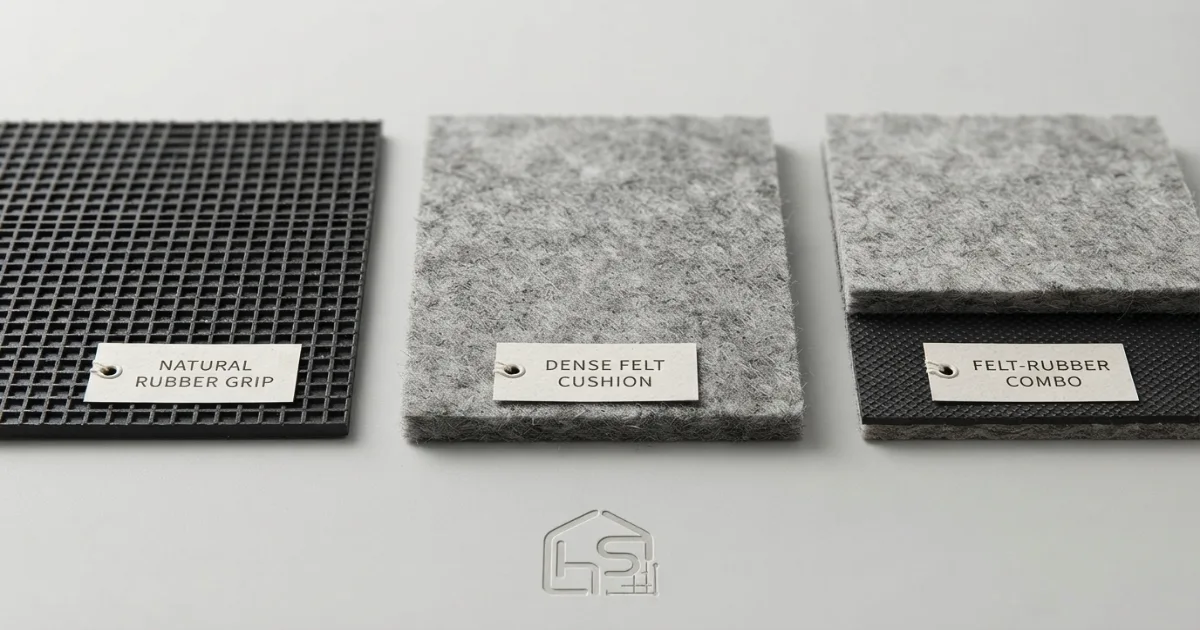
Natural rubber is mainly chosen for grip. It works well beneath small rugs and runners on appropriate hard floors. Felt is mainly chosen for cushioning, sound absorption and support beneath larger furniture-anchored rugs. Felt-rubber combinations provide cushioning on top and grip beneath, making them a versatile commercial option for many living rooms and bedrooms.
Cheap open-grid pads vary widely. Some may degrade, compress or interact poorly with a floor finish. Material compatibility is more important than a low price. Check the flooring warranty and pad label, especially for newly finished hardwood, luxury vinyl, laminate, heated floors and delicate stone.
Rug pad size and material for hardwood floors
On hardwood, the pad must be labeled for the finish and installation. A suitable natural-rubber or felt-rubber pad is often selected for grip, but the floor manufacturer has the final say. Avoid treating every rubber-like backing as interchangeable. Additives, coatings, heat and long contact periods can affect some finishes.
The finished rug pad size should remain hidden so the rug edge contacts the floor and the pad does not collect visible dust. Lift the rug periodically according to the flooring and pad care instructions. Confirm the floor is fully cured before covering a recent finish.
Use the floor-border guide when the rug itself is close to a wall, cabinet or doorway. The room border and the hidden pad border are separate measurements.
Rug pads on vinyl, laminate, tile and stone
Vinyl and laminate require particular care because some backings are not approved for every product. Look for an explicit compatibility statement rather than relying on the word “non-slip.” On tile and stone, grip is often the priority, but grout variation and surface texture can change how a thin pad sits.
For these floors, inspect the underside for trapped grit. A correct rug pad size reduces movement, but dirt between the pad and floor can still scratch a surface. Vacuum the rug and clean beneath the pad at intervals appropriate to the room traffic.
Rug pads beneath rugs on carpet
Rug-on-carpet installations need a pad designed for that direction of use. A hard-floor gripping pad may not stabilize the rug on carpet and may have the wrong surface orientation. The goal is to reduce rippling, walking and bunching without creating an unstable soft stack.
Keep the pad slightly smaller than the rug and check whether heavy furniture causes the rug edge to buckle. In a living room, review the furniture-leg placement rules before buying a very thick pad. The combined rug and pad height can change how chair or sofa legs sit.
Runners, round rugs and irregular shapes
A runner pad should follow the runner closely because long narrow rugs move easily. Subtract the edge inset from both sides and both ends, then round the cut corners when the rug corners are rounded. Under a hallway runner, use a profile that does not interfere with doors or create an abrupt edge.
For a round rug, the pad diameter should be smaller than the rug diameter by twice the desired inset. An 8-foot round rug with a one-inch edge inset needs a pad approximately 94 inches in diameter. Buy an 8-foot round pad or a trimmable square pad that can be marked with a centered circle.
Irregular rugs require a paper template, chalk line or careful tracing. Keep the pad inside concave areas and away from decorative cutouts. Never let the pad project beyond a hide-shaped or scalloped rug edge.
How to trim a rug pad accurately
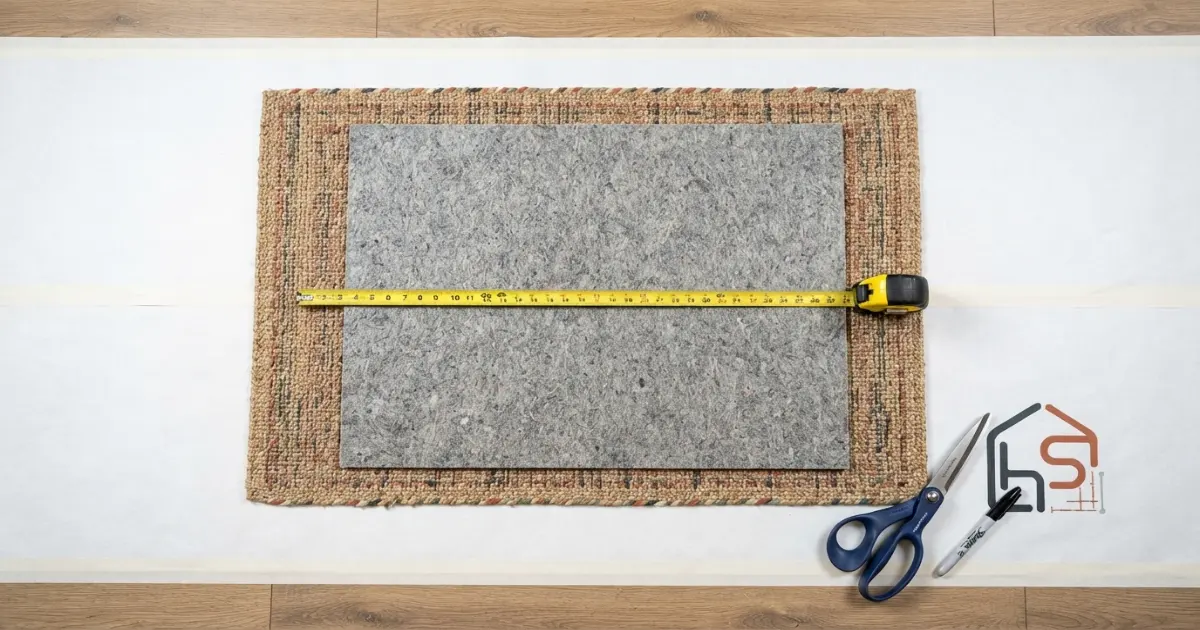
Place the rug face down on a clean protected surface, then center the pad over the back. Measure the intended inset at several points instead of trusting one corner. Mark a straight outline with a suitable marker or chalk. Remove the pad before cutting so the rug fibers and floor are protected.
Use the cutting tool recommended for the material. Many felt or rubber pads can be cut with heavy-duty scissors, while dense products may require a sharp utility knife and a cutting board. Cut slightly outside the final line first. Test the fit, then make a second controlled trim if needed.
- Exclude loose fringe from the padded dimensions.
- Keep the inset consistent unless the rug shape intentionally requires variation.
- Round sharp pad corners beneath rounded rug corners.
- Do not stretch the pad while marking because it can rebound smaller.
- Re-center the rug after furniture is placed.
Door clearance and rug-pad height
Measure the gap beneath the door at the rug location. Add the rug pile and compressed pad thickness, not just the pad specification. A door can clear the bare rug but scrape once a padded edge sits under the swing.
When clearance is tight, choose a low-profile pad, move the rug beyond the door arc or change the rug placement. Do not cut the pad into a deep notch that leaves a weak unsupported rug section unless the layout requires it and the rug remains stable.
Large rugs, heavy furniture and pad sizing
Large rugs are often anchored by sofas, beds or dining tables, but a pad still provides cushioning, floor separation and a more stable field. Because thick pads under very large rugs can create a stronger edge transition, some manufacturers recommend a slightly wider overhang. Measure rather than applying the small-rug rule automatically.
For an 8×10, 9×12 or 10×14 rug, buying the matching nominal pad and trimming it is normally easier than trying to find a pre-cut pad with exact finished dimensions. Compare the actual rug sizes through the 8×10 versus 9×12 guide before investing in a large premium pad.
Washable rugs and brand-specific pad systems
Some washable rugs use a proprietary pad-and-cover system. In that case, the rug pad size, corner attachment and cleaning method are part of the system, and a generic replacement may not perform the same way. Follow the brand instructions before cutting or substituting a pad.
For a normal washable area rug without a proprietary base, choose a low-profile product that is compatible with the floor and the washing routine. Remove the pad before washing unless the manufacturer says otherwise. Confirm that the rug returns to its measured dimensions after cleaning before trimming the pad again.
Rug pad size by room and furniture use
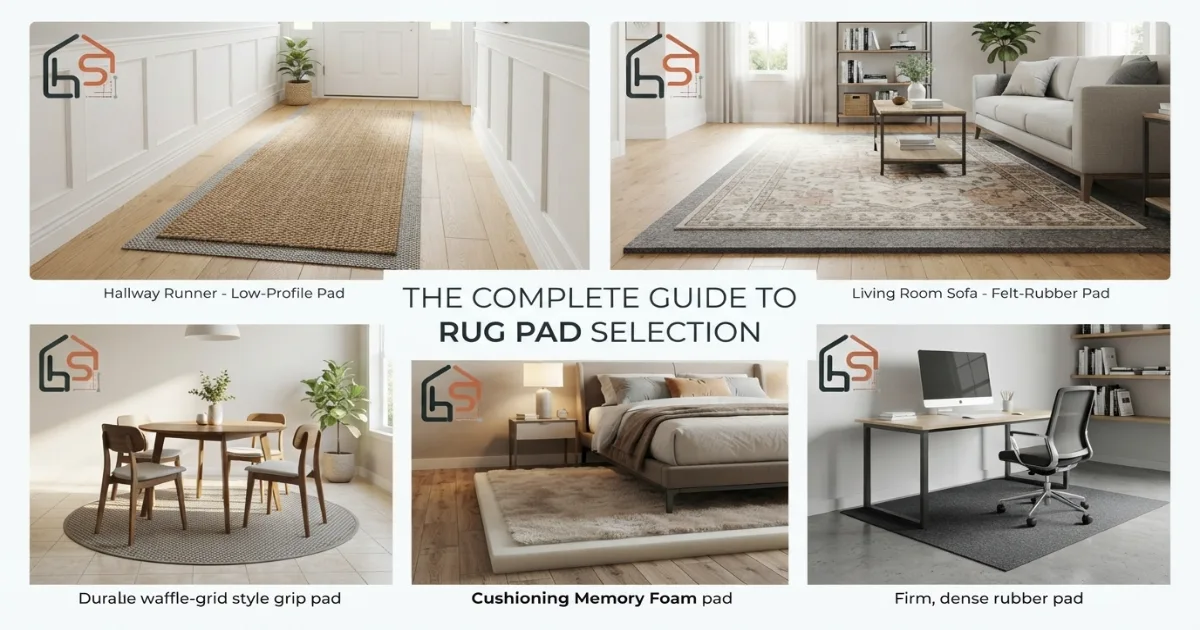
The same rug pad size rule does not behave identically in every room. A runner in a hallway depends on nearly full pad coverage for grip, while a 9×12 living-room rug beneath a sofa may depend more on cushioning and perimeter support. Start with the same hidden inset, then refine the pad material and thickness around the furniture and traffic pattern.
In a living room, the rug pad size should support the area where sofa and chair legs repeatedly load the rug. A pad that ends under a front sofa leg can create a subtle height change. Choose a near-full pad and keep the inset consistent. Use the living-room rug sizing guide to confirm that the rug reaches the intended furniture legs before ordering the pad.
In a dining room, the rug pad size should extend beneath the normal chair path, not only the tabletop. Dining chairs cross the rug perimeter many times, so a pad that is too small can leave the rear chair legs moving between padded and unpadded sections. Pair the pad plan with the dining-room chair-clearance guide.
In a bedroom, the best rug pad size depends on whether the rug sits fully beneath the bed, begins below the nightstands or works as a bedside accent. Large anchored rugs can use cushioning-focused pads, while small bedside rugs need stronger grip. Review the bedroom rug placement guide before choosing a thick felt-only product.
In a home office, the rug pad size should support the rolling-chair path without creating an edge where casters repeatedly climb. A dense low- or medium-profile pad is often easier beneath a desk chair than a soft thick pad. Check the exact desk and chair footprint in the home-office rug size guide.
| Room or rug type | Coverage priority | Useful profile | Buying direction |
|---|---|---|---|
| Hallway runner | Near-full hidden coverage | Low profile | Natural rubber or approved grip pad |
| Living-room area rug | Furniture-leg and perimeter support | Medium | Felt-rubber combination |
| Dining-room rug | Complete chair path | Low to medium, dense | Stable dual-surface pad |
| Bedroom rug | Comfort around bed edges | Medium to cushioned | Dense felt or felt-rubber |
| Home-office rug | Rolling-chair path | Low to medium | Dense, firm pad |
| Small entry rug | Grip and door clearance | Very low | Thin approved non-slip pad |
Rug pad price, value and when to upgrade
A cheap pad is not automatically a good value if it is difficult to trim, lacks a clear floor-compatibility statement or compresses quickly. The commercial decision should compare usable life, grip, density, thickness and whether the rug pad size can be customized without wasting a large portion of the product.
Spend more when the rug is valuable, the floor finish is sensitive, the rug receives heavy traffic or the pad must control a large seating or dining zone. A premium custom-cut pad can reduce installation work, but verify whether the seller automatically subtracts an allowance from the submitted rug dimensions. Entering already-reduced dimensions can produce a pad that is too small.
A budget trimmable pad can be sensible for a small temporary rug, provided the material is appropriate for the floor. For a large wool rug, handmade rug or long-term living-room installation, prioritize a dense pad with documented materials. The correct rug pad size and construction can help the rug lie flatter and feel more intentional, but no pad should be marketed as guaranteed protection for every finish.
Before clicking an affiliate button, measure the rug and save the finished rug pad size from the calculator. Check the listing dimensions, thickness, material, floor-use statement, return policy and cutting instructions. Avoid buying only from the product title because marketplace variations can group different materials and thicknesses on one page.
Rug pad buying mistakes to avoid
| Mistake | Why it fails | Better decision |
|---|---|---|
| Buying a much smaller pad | Leaves unsupported edges and reduced grip | Buy full nominal size and trim |
| Choosing by label only | Actual rug dimensions may differ | Measure the physical rug |
| Ignoring floor compatibility | Backing may not suit the finish | Check flooring and pad guidance |
| Using maximum thickness near doors | Door may scrape or bunch the rug | Measure compressed clearance |
| Letting the pad show | Looks unfinished and catches dust | Trim a consistent hidden inset |
| Using hard-floor pad on carpet | Wrong grip direction and instability | Buy a rug-on-carpet pad |
Care, inspection and replacement
Lift the rug occasionally and inspect the pad for compression, cracking, residue, trapped grit and movement. High-traffic paths and furniture legs can compress the pad unevenly. Rotate the rug and pad only when the room layout and rug construction allow it.
Replace a pad that sheds, hardens, permanently wrinkles or no longer grips. A pad that has bonded to the floor or left residue requires guidance appropriate to the floor finish. Do not scrape or apply solvents without checking the flooring manufacturer.
Sources and editorial methodology
This rug pad size guide separates a practical starting rule from product-specific instructions. Mohawk Home states that pads should be smaller and can be trimmed, while its guidance uses different inset wording in different contexts. RugPadUSA explains custom-cut allowances and notes that thick pads beneath very large rugs may need more overhang. Rugs USA describes pads intentionally cut smaller than the compatible rug. The final recommendation is therefore to measure the actual rug and follow the chosen pad manufacturer.
Reference the Mohawk Home rug-pad buying guidance, the RugPadUSA measurement guide and the Rugs USA custom-pad sizing note. Flooring compatibility should always be verified separately.