55 vs 65 inch TV: Best complete size comparison
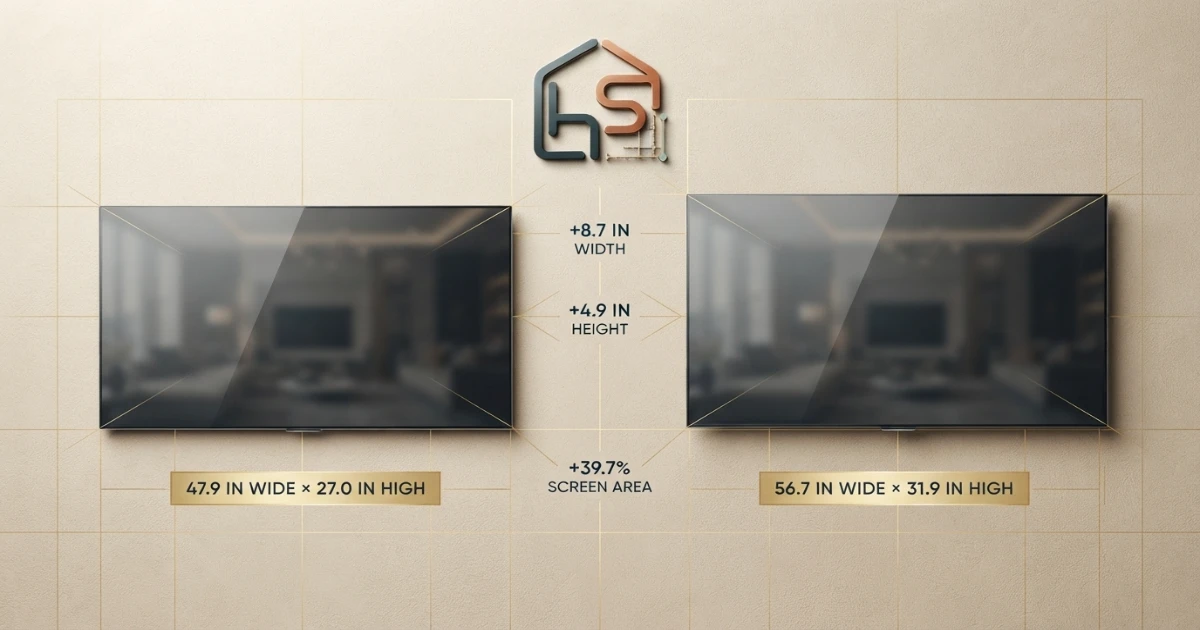
55 vs 65 inch TV is a bigger real-world change than the 10-inch diagonal difference suggests. The 65-inch screen is about 8.7 inches wider, 4.9 inches taller and 39.7% larger by visible screen area.
Written and reviewed by Rehana K · HomeStyle Calculator measurement-first method.
55 vs 65 inch TV: the 65-inch screen gives nearly 40% more picture area.
Choose 55 inches for compact rooms, viewing around 6 to 8 feet, mixed-quality television and a visually calmer setup. Choose 65 inches for stronger movies, sports, subtitles and 4K viewing around 7 to 10 feet.
At the same aspect ratio, every linear dimension grows by about 18.2%, but screen area grows by about 39.7%.
55 vs 65 inch TV: verify every measurement before buying
Use viewing distance first, then confirm actual width, stand fit, mounting height and the next larger comparison.
Real 55-inch versus 65-inch differences from screen area to room fit
55 vs 65 inch TV comparison calculator
Enter viewing distance, content quality, viewing priority and usable wall or stand width.
Recommended option
Based on distance, content and priority.
Screen only; bezels vary.
Useful for mounting planning.
Complete model dimensions still required.
A 65-inch TV is the balanced choice at 8 feet with mainly 4K content. Confirm complete model width and foot spacing.
55 vs 65 inch TV real size and dimensions chart
55 vs 65 inch TV labels describe diagonal screen measurements, not physical width. Because both use the same 16:9 aspect ratio, the 65-inch screen is larger in width, height and total picture area.
| Measurement | 55-inch TV | 65-inch TV | Real difference |
|---|---|---|---|
| Diagonal | 55 in | 65 in | +10 in / +18.2% |
| Approx. screen width | 47.9 in | 56.7 in | +8.7 in |
| Approx. screen height | 27.0 in | 31.9 in | +4.9 in |
| Approx. screen area | 1293 sq in | 1805 sq in | +39.7% |
| Common character | Compact and relaxed | Balanced and immersive | Stronger visual presence |
Product width, height, depth, feet and weight differ by model. The chart measures the visible 16:9 screen only and should be followed by the manufacturer’s complete dimensions.
Why the 65-inch screen looks much more than 10 inches bigger
Diagonal size grows along one line, but the picture expands in two directions. Moving from 55 to 65 inches increases both width and height by approximately 18.2%. Multiplying those two changes produces about 39.7% more visible screen area.
This is why the upgrade looks substantial in a room. The 65-inch screen adds approximately 8.7 inches of picture width and 4.9 inches of height. It is not simply a narrow border added around the 55-inch screen.
Screen area matters for subtitles, score graphics, faces, fine sports detail and split-screen content. It also increases visual dominance when the TV is off, so the larger option must fit the room’s design.
Real-area formula
Screen area scales with the square of the diagonal. The ratio 65² ÷ 55² equals about 1.397, which means approximately 39.7% more picture area.
55 vs 65 inch TV by viewing distance
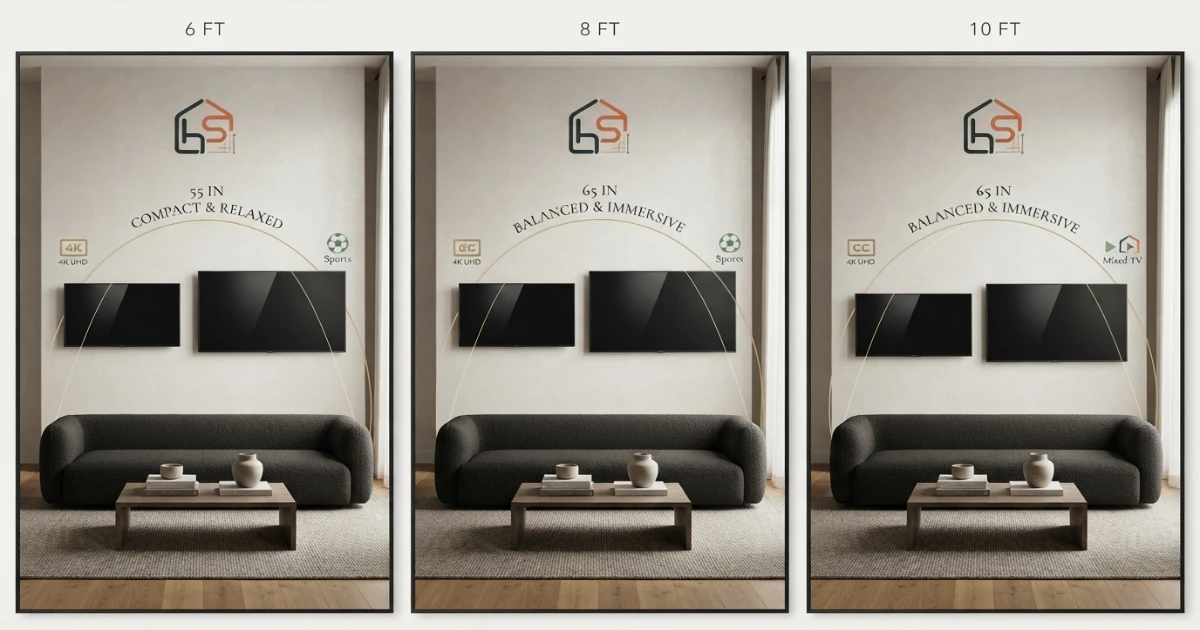
Viewing distance changes the value of the larger screen. At a short distance, both sizes appear substantial. At a longer distance, the extra width and height of the 65-inch screen improve readability and immersion.
| Viewing distance | 55-inch TV | 65-inch TV | Better starting choice |
|---|---|---|---|
| 5–6 ft | Immersive and clear | Very immersive | 55 for mixed use; 65 for cinema/gaming |
| 7–8 ft | Comfortable and relaxed | Balanced and stronger | 65 for most 4K living rooms |
| 9–10 ft | Can feel small | Relaxed to balanced | 65; also compare 75 inches |
| Over 10 ft | Usually undersized | May still feel modest | Compare 75 or 85 inches |
Use the TV Size for 8 Feet, TV Size for 10 Feet and TV Size for 12 Feet guides for distance-specific decisions.
When the 55-inch TV is the better choice
A 55-inch TV is the better option when the seating distance is short, the wall is compact or the room should remain visually quiet. It provides a large image without dominating apartments, bedrooms and small family rooms.
Mixed television quality can also favor 55 inches. Old broadcasts, compressed cable channels and low-bitrate streaming may look cleaner because artifacts are less enlarged.
A 55-inch set is generally easier to place on existing furniture. Its approximate screen width is 47.9 inches, although the complete product, feet and bezel must still be checked.
Delivery, lifting and wall mounting are usually simpler. This matters in apartments, narrow stairs and rooms where one person may need to reposition the television later.
Choose 55 inches when the main viewing distance is near 6 feet, casual television is more important than cinematic impact, or the stand cannot safely support a wider model.
When the 65-inch TV is the better choice
A 65-inch TV is the stronger choice when movies, sports, subtitles, streaming and console gaming are important. The 39.7% increase in screen area is noticeable without entering the installation demands of 75- or 85-inch categories.
At approximately 7 to 9 feet, 65 inches creates a balanced modern viewing experience for many living rooms. It gives faces, score graphics and interface text more scale.
The larger screen is easier to justify when most content is 4K. Fine details remain visible, and the wider picture provides more value than it does with low-resolution broadcasts.
A 65-inch TV is about 56.7 inches wide by 31.9 inches high before bezels. Confirm the complete model width and weight, especially when reusing a 55-inch stand or mount.
Choose 65 inches when there is adequate wall width, the viewing distance is around 8 feet, and the screen is intended to be a clear focal point.
55 vs 65 inch TV wall, stand and furniture fit
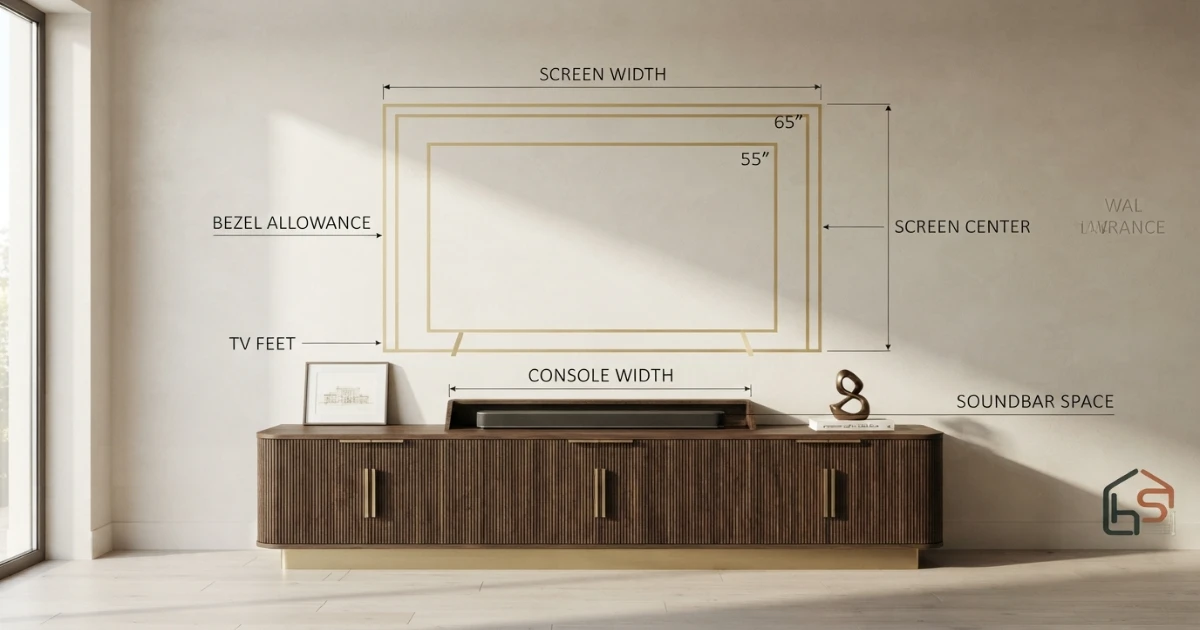
The 65-inch screen adds approximately 8.7 inches of visible width. Complete product width can be slightly larger, and wide-set feet may create an even larger support requirement.
Measure the uninterrupted wall area rather than the full wall. Exclude door swings, windows, shelves, sconces, speakers and built-ins. Leave room for ventilation, cable access and visual breathing space.
If the TV sits on furniture, measure the stand’s top width and depth. Every foot must sit fully on the surface. Check the model’s foot spacing because two TVs with the same diagonal can use very different leg positions.
Weight matters too. Confirm the stand rating, wall-mount capacity and VESA pattern. A mount used for a lighter 55-inch television is not automatically suitable for a heavier 65-inch model.
Use the TV Stand Size Guide and TV Dimensions Chart before ordering.
55 vs 65 inch TV for movies, sports, subtitles and gaming
Movies and streaming
The 65-inch TV creates a more cinematic field of view and gives letterboxed films a larger active picture. The 55-inch option remains suitable in compact rooms and at shorter distances.
Sports
The larger screen makes players, ball movement and score graphics easier to follow. At 7 to 9 feet, 65 inches is normally the stronger sports choice.
Subtitles and eyesight
The additional height and width improve subtitle readability. Viewers who lean forward to read a 55-inch screen often benefit from 65 inches, provided the seating distance and resolution are suitable.
Gaming
Console gaming gains immersion on 65 inches, especially for racing, adventure and sports titles. Competitive players sitting close may prefer 55 inches because interface elements remain within a tighter field of view.
News and casual television
For background viewing, news and mixed channels, 55 inches can be sufficient and less visually dominant. It may also hide compression flaws better.
Use the 4K Viewing Distance Guide and TV Size for Gaming guide for specialized use.
Does mounting height change between 55 and 65 inches?
Yes. A 65-inch screen is approximately 4.9 inches taller than a 55-inch screen. If both TVs use the same bottom-edge height, the center of the 65-inch screen sits roughly 2.5 inches higher.
Mounting from the bottom edge alone can create an unnecessarily high screen after an upgrade. Mark the screen center and place it near seated eye level, adjusting for recline and viewing distance.
Check space for a soundbar and console without pushing the TV upward. A larger television may require a lower bottom edge to keep the center comfortable.
Use the TV Mounting Height Guide for the full placement method.
Picture quality versus picture size
A larger screen does not automatically provide better picture quality. Panel technology, brightness, black levels, processing, motion handling and source quality may matter more than ten inches of diagonal.
When the budget is fixed, compare a higher-quality 55-inch model with a basic 65-inch model. The better choice depends on viewing conditions. A bright room may benefit from stronger reflection handling, while a dark movie room may prioritize contrast.
Do not sacrifice essential features solely for size. Confirm input count, gaming features, operating system, audio support and warranty. Then decide whether the remaining budget supports the larger diagonal.
55 vs 65 inch TV: six real-room examples
Example one: 6-foot apartment setup. A 55-inch TV already feels immersive and leaves more wall space. Choose 65 inches only when movies and gaming are the clear priority.
Example two: 8-foot family room. The 65-inch TV is the balanced recommendation for mainly 4K streaming, sports and subtitles. A 55-inch set works when the room should remain visually calm.
Example three: 10-foot living room. Choose 65 inches over 55. Also outline a 75-inch screen because both smaller options may feel relaxed at that distance.
Example four: 52-inch-wide console. A 55-inch screen may fit depending on complete dimensions and foot spacing. Many 65-inch models require wall mounting or a wider console.
Example five: mixed cable and old content. A quality 55-inch TV may look cleaner than a larger basic model because compression artifacts are less enlarged.
Example six: subtitle-heavy movie viewing. The 65-inch screen gives text and faces more scale, making the upgrade worthwhile when the wall and budget allow.
Is upgrading from 55 to 65 inches worth it?
The upgrade is worth it when viewing distance, content and room fit can use the extra 39.7% of picture area. The change is particularly visible in movies, sports, subtitles and games.
It is less valuable when seating is very close, most content is low resolution or the larger TV forces poor mounting height and crowded furniture.
Include the complete cost: television, mount or console, delivery, installation, cable management and possible soundbar repositioning. A size upgrade that creates an unsafe or awkward installation is not a true improvement.
Common 55 vs 65 inch TV comparison mistakes
- Judging only the 10-inch diagonal difference.
- Ignoring the 39.7% screen-area increase.
- Confusing screen width with complete product width.
- Measuring from the sofa edge instead of the viewer’s eyes.
- Assuming an existing stand supports the 65-inch model.
- Ignoring foot spacing, depth and weight.
- Mounting the larger TV from the old bottom-edge position.
- Choosing size without considering 4K versus compressed content.
- Ignoring glare, side viewing and soundbar space.
- Skipping painter’s-tape outlines of both sizes.
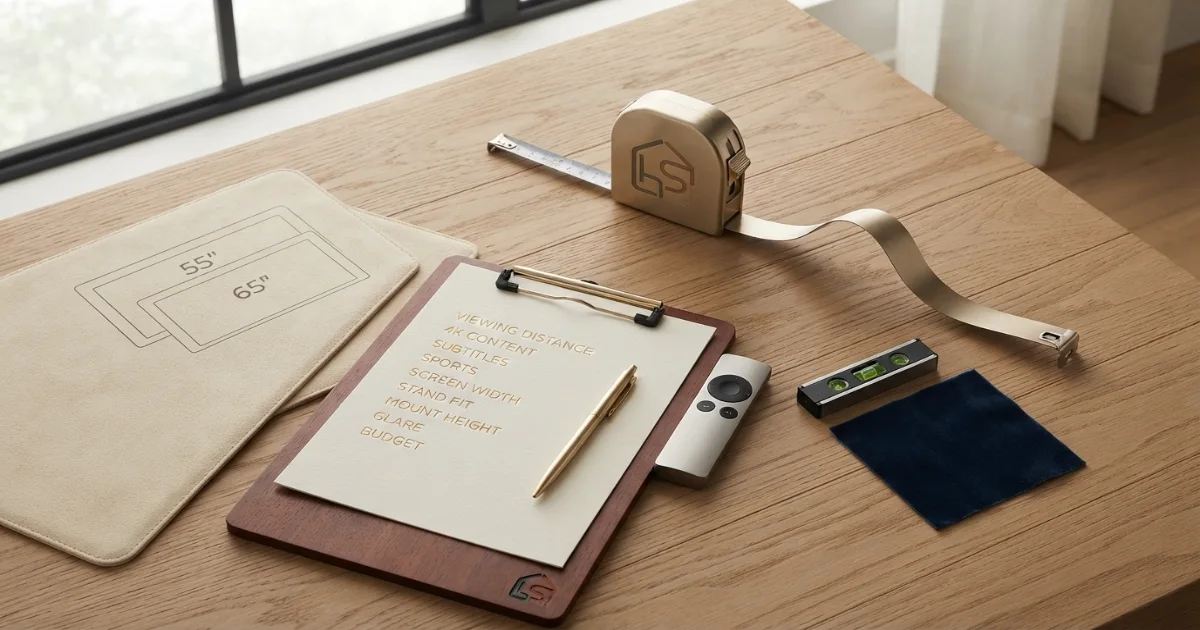
55 vs 65 inch TV buying checklist
- Measure eye-to-screen viewing distance.
- Outline 47.9 × 27.0 inches for the 55-inch screen.
- Outline 56.7 × 31.9 inches for the 65-inch screen.
- Check complete model dimensions and bezel width.
- Measure stand width, depth and foot spacing.
- Confirm TV and mount weight ratings.
- Compare 4K, mixed HD and lower-resolution content.
- Test subtitles and sports graphics from the main seat.
- Mark screen center near seated eye level.
- Check window and lamp reflections.
- Allow soundbar, speaker and cable space.
- Compare total installed cost, not television price alone.
Outline both sizes while the television is off. Judge the wall as part of the room, not only the screen while playing dramatic demo footage. The best option should work during everyday viewing and blend with the space when unused.
A 65-inch TV creates a stronger focal point and often looks better above a broad media console. On a narrow wall, however, it can crowd speakers, trim and decorative lighting.
A 55-inch TV leaves more negative space for artwork, shelving and architectural panels. It suits rooms where television is useful but should not become the dominant visual feature.
How each size changes the room’s design balance
When budget forces a tradeoff between size and picture quality, compare the actual models in the room’s lighting conditions. A premium 55-inch display may outperform a basic 65-inch display in brightness, reflections, motion and black levels.
The larger screen can still provide better long-term value when the viewing distance supports it. Buyers often keep televisions for several years, so stronger subtitle readability and movie immersion may justify the initial difference.
Compare the complete installed cost rather than the television price alone. Moving to 65 inches may require a wider console, stronger mount, professional installation and different soundbar placement.
Price difference and long-term value
A full-motion mount can improve alignment for occasional side viewing, but it requires wall clearance and secure installation. It should not project into a walkway or interfere with doors and furniture.
Test both painter’s-tape outlines from every regularly used seat. A 65-inch screen may feel better from the far side of the room, while a 55-inch screen can feel more comfortable from a chair placed close to the wall.
The larger 65-inch image can help side viewers read subtitles and score graphics, but screen size does not correct poor off-axis picture quality. Panel technology, reflections and seating angle still control how the image looks from the ends of a sectional.
Side seats and viewing-angle planning
A 55-inch model is usually easier to move, unpack and reposition. This practical advantage matters for renters, upstairs rooms and households that expect to relocate the television.
Large televisions should remain upright and protected during transport. Follow the manufacturer’s handling instructions and use enough people for lifting. Do not hold the screen surface or carry the television by one corner.
A 65-inch TV is not only wider on the wall; the shipping carton is also larger and harder to turn through stairs, narrow corridors and apartment doorways. Measure the delivery route before ordering, including elevator openings, stair landings and the space needed to rotate the box.
Delivery, doorway and lifting differences
Final answer: should you buy a 55 or 65-inch TV?
In the 55 vs 65 inch TV decision, choose 55 inches for compact rooms, shorter viewing distances, mixed-quality television and a calmer visual presence. Choose 65 inches for stronger 4K movies, sports, subtitles and gaming at moderate living-room distances.
The 65-inch screen is approximately 8.7 inches wider, 4.9 inches taller and 39.7% larger in visible area. For many living rooms around 7 to 9 feet, 65 inches is the safer balanced recommendation when the wall, stand and budget allow it.
Confirm the complete model width, foot spacing, weight, mounting height and content quality before ordering.
Calculate your room before buying
Use the free TV Size Calculator, then compare the wall outlines from every regular seat.
Measurement references
The screen dimensions on this page use the standard 16:9 geometry formula. Viewing recommendations are presented as practical ranges because personal preference, source quality and room layout vary.
Two installation categories to compare after choosing the size
Check the selected TV’s VESA pattern, complete dimensions, weight and foot spacing before ordering.
55–65 Inch TV Wall Mounts
Compare mounts only after checking VESA compatibility, weight rating and wall construction.
- Confirm both size and weight limits
- Check tilt and extension
- Verify stud requirements
TV Stands for 55–65 Inch TVs
Compare stand width, top depth, weight capacity and soundbar space against the exact model.
- Check foot spacing
- Confirm depth and capacity
- Allow cable and soundbar room
Affiliate disclosure: As an Amazon Associate, HomeStyle Calculator may earn from qualifying purchases. Product specifications, prices and availability can change.
55 vs 65 inch TV FAQs
What is the real size difference between a 55 and 65-inch TV?
A 65-inch 16:9 screen is about 56.7 inches wide and 31.9 inches high, while a 55-inch screen is about 47.9 inches wide and 27.0 inches high. The 65-inch screen adds about 8.7 inches of width, 4.9 inches of height and 39.7% more screen area.
Is a 65-inch TV much bigger than a 55-inch TV?
Yes. The diagonal increases by 18.2%, but visible screen area increases by about 39.7%. The difference is easy to notice in movies, sports, subtitles and split-screen gaming.
How wide is a 55-inch TV?
A 55-inch 16:9 screen is approximately 47.9 inches wide before bezels. Complete product width varies by model.
How wide is a 65-inch TV?
A 65-inch 16:9 screen is approximately 56.7 inches wide before bezels. Complete product width varies by model.
Which is better for an 8-foot viewing distance, 55 or 65 inches?
At about 8 feet, 65 inches is the stronger balanced choice for 4K movies, sports and subtitles. Choose 55 inches when the room is visually quiet, content quality is mixed or the wall and stand are limited.
Which is better for a 10-foot viewing distance, 55 or 65 inches?
At about 10 feet, 65 inches is usually the better option because the 55-inch screen can feel small for movies, sports and subtitles. Larger sizes may also be worth comparing.
Is 55 inches enough for a living room?
A 55-inch TV can be enough for compact living rooms and viewing distances around 6 to 8 feet, especially for casual mixed television. The final answer depends on viewing style and content quality.
Does 4K make a 65-inch TV better than a 55-inch TV?
4K content makes the larger 65-inch screen easier to justify at moderate distances because fine detail remains clearer. Lower-resolution and heavily compressed content may look rougher on the larger display.
Will a 65-inch TV fit on the same stand as a 55-inch TV?
Not always. A 65-inch TV is wider and may have wider-set feet, greater depth and more weight. Check complete product width, foot spacing, foot depth and the stand weight rating.
Should I upgrade from 55 to 65 inches?
The upgrade is worthwhile when you want stronger immersion, better subtitle readability or a larger sports image and have enough wall, stand and budget. Keep 55 inches when compact fit and a calmer room matter more.