How high to mount TV on the wall: Best complete guide
How high to mount TV starts with the main viewer’s seated eye level. Position the screen center close to that height, then adjust only as needed for viewing distance, furniture, soundbar clearance and a comfortable vertical angle.
Written and reviewed by Rehana K · HomeStyle Calculator measurement-first method.
How high to mount TV: place the screen center near seated eye level.
Measure from the floor to the main viewer’s eyes while seated normally. Use that measurement as the starting screen-center height. In many living rooms this falls around 40 to 44 inches, with 42 inches as a practical fallback—not a universal rule.
When furniture forces the screen higher, calculate the vertical viewing angle from the actual sofa distance and keep the rise modest. Larger TVs should not automatically be mounted higher; they extend farther above and below the same centerline.
Combine mounting height with screen size, distance and furniture fit
Choose the diagonal first, confirm its physical height, then calculate a centerline that works with the normal seating posture.
TV mounting height from eye-level measurement to final installation
TV mounting height calculator
Enter seated eye level, viewing distance, screen size and desired upward angle. The tool calculates screen-center, bottom and top heights.
Floor-to-screen measurements
Floor to visible screen center.
Floor to visible screen bottom.
Floor to visible screen top.
Approximate 16:9 picture height.
For a 65-inch TV with a 42-inch seated eye level and a 0° rise, place the visible screen center about 42 inches from the floor.
How high to mount TV: the complete formula
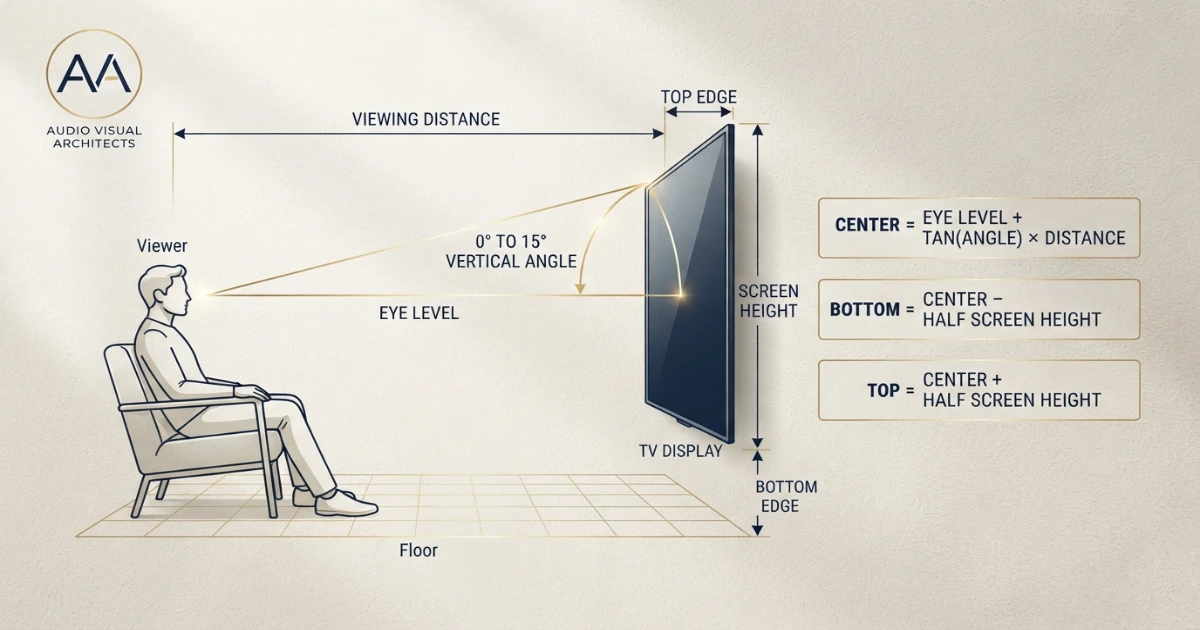
The most reliable TV mounting-height formula starts with the viewer rather than the television. Measure seated eye height, then calculate any deliberate rise from the viewing distance and vertical angle.
Add the vertical rise to seated eye level.
Center = eye height + tan(angle) × distanceSubtract half the visible screen height.
Bottom = center − screen height ÷ 2Add half the visible screen height.
Top = center + screen height ÷ 2Convert viewing distance to inches before using the tangent formula. A 10-foot distance equals 120 inches. At zero degrees, the screen center equals eye height. At five degrees and 10 feet, the center rises about 10.5 inches above eye level.
The formula calculates geometric placement. Final comfort still depends on reclining posture, seat depth, multiple viewers, screen reflections and room constraints.
How to measure seated eye level correctly
Sit in the main viewing position using the posture you normally maintain while watching television. Do not sit unusually upright just for the measurement.
Ask another person to measure vertically from the finished floor to the center of your eyes. Measure more than one regular viewer when the room is shared.
If eye heights differ, use a comfortable middle value or prioritize the seat used most often. A difference of two or three inches rarely requires moving the television after the outline is tested.
Deep sofas lower the eyes, while upright chairs and bar-height seating raise them. Recliners change both eye position and head angle, so measure in the supported viewing posture.
Do not measure from the seat cushion without adding torso height. Direct eye-level measurement is faster and more accurate.
When the 42-inch center rule works—and when it does not
A 42-inch floor-to-center height is a useful fallback because it approximates seated eye level for many adults on standard sofas. Samsung provides it as a general living-room starting point when direct measurement is unavailable.
It is not a universal mounting standard. A low sectional may place eye level near 38 or 40 inches. An upright chair may raise it to 44 or 46 inches.
The 42-inch rule also becomes less useful in bedrooms, home bars, kitchens, gyms and rooms with elevated seating. Measure the actual posture whenever possible.
Use 42 inches as the centerline, not the bottom edge. Confusing those two measurements can raise a large television by more than a foot.
TV mounting height by screen size at a 42-inch center
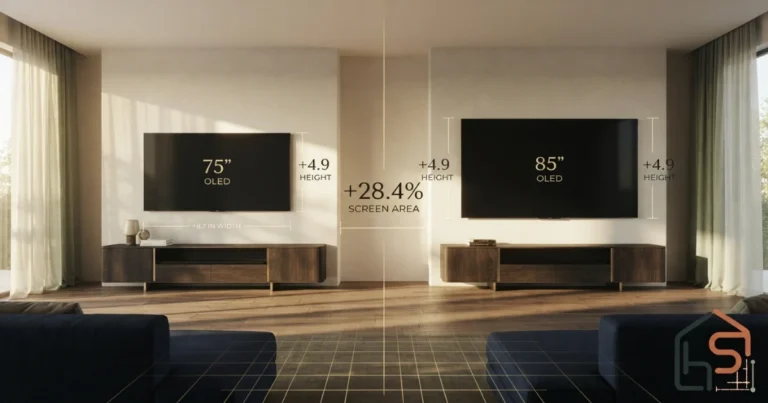
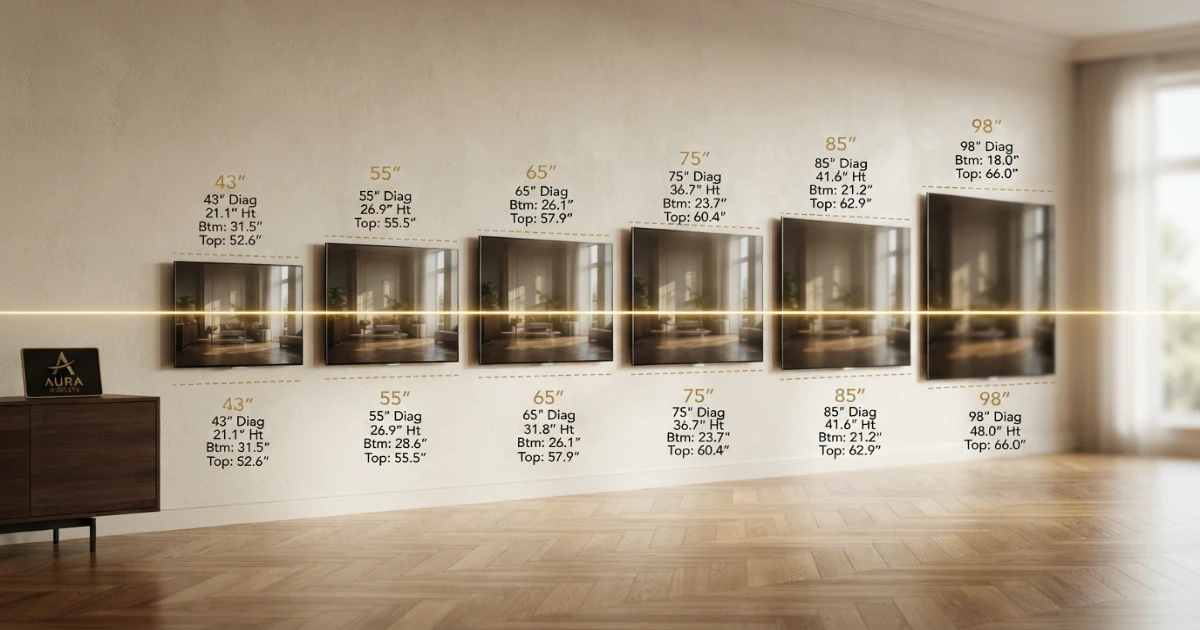
The table below keeps the visible screen center fixed at 42 inches. Larger screens extend farther above and below that center; they do not need a higher center merely because the diagonal is larger.
| TV size | Visible screen height | Bottom edge | Top edge |
|---|---|---|---|
| 43 in | 21.1 in | 31.5 in | 52.5 in |
| 50 in | 24.5 in | 29.7 in | 54.3 in |
| 55 in | 27.0 in | 28.5 in | 55.5 in |
| 65 in | 31.9 in | 26.1 in | 57.9 in |
| 75 in | 36.8 in | 23.6 in | 60.4 in |
| 85 in | 41.7 in | 21.2 in | 62.8 in |
| 98 in | 48.0 in | 18.0 in | 66.0 in |
Product bezels slightly change the complete top and bottom edges. Use the selected model’s body height when aligning with cabinets, soundbars or architectural features.
How viewing distance changes the vertical angle
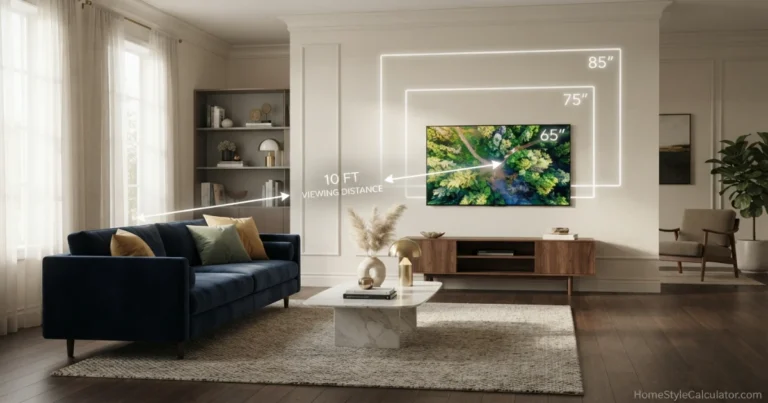
A television mounted above eye level creates an upward viewing angle. The same vertical rise feels more extreme from a close sofa and more modest from a distant sofa.
Vertical-angle guide
THX recommends keeping the line of sight close to the screen center and suggests approximately 15 degrees or less above or below center.
At a 10-foot distance, a five-degree angle raises the center about 10.5 inches above eye level. At six feet, the same angle raises it only about 6.3 inches because the horizontal distance is shorter.
Do not target a higher angle simply because the mount can tilt. Tilt can aim the screen toward the viewer, but it does not remove the neck angle created by looking upward.
Test the complete outline while watching for several minutes. Comfort during a brief installation check may differ from comfort during a two-hour movie.
How high to mount TV above a console or soundbar
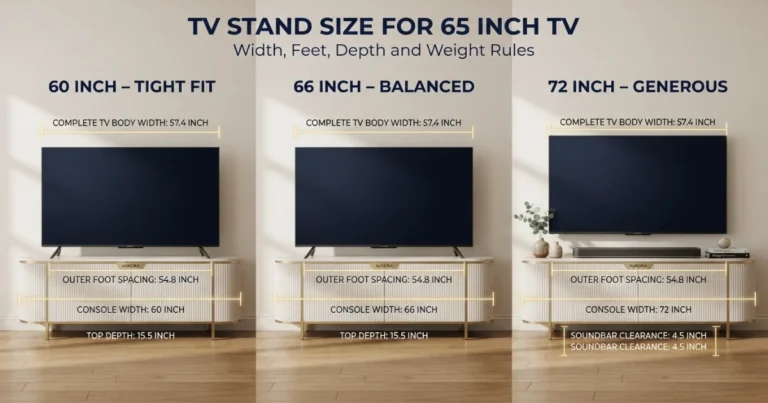
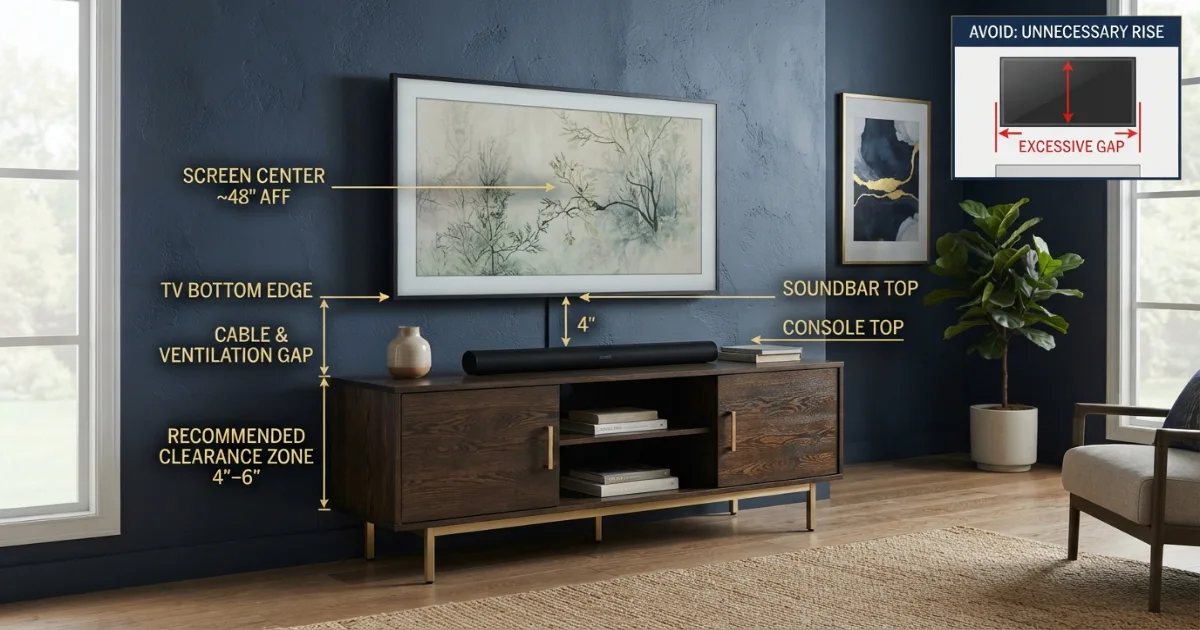
Furniture and audio equipment often create the practical lower limit for the television. Measure the console height, soundbar height and the gap needed for ventilation, cables and visual separation.
Start with the desired centerline. Calculate the bottom edge from the screen height. If the screen overlaps the soundbar zone, consider lowering the furniture, using a slimmer soundbar, mounting the soundbar or accepting a modest center rise.
A common mistake is to begin with an arbitrary gap above the console and let the screen center rise wherever it lands. This can make a large television unnecessarily high.
Usually allows eye-level placement with comfortable soundbar clearance.
May force the screen center upward; calculate the angle before drilling.
Can preserve a clean gap, but align it with the screen and listening seats.
How high to mount a bedroom TV
Bedroom viewing differs because the viewer is commonly reclined rather than seated upright. Measure eye position while supported by the pillows or adjustable bed position normally used.
A bedroom television may be mounted higher than a living-room screen because the natural line of sight angles upward. The correct height depends on bed height, pillow support, viewing distance and whether the viewer lies flat or sits partially upright.
Use the same calculator with the measured eye height and selected angle. Do not copy a living-room 42-inch center without checking the bed posture.
Keep the screen clear of dresser objects, but avoid raising it solely to create decorative space. Test the outline from both sides of a shared bed.
Use the What Size TV for a Bedroom? guide to confirm the diagonal before mounting.
How to plan height for several seats
A sectional or wide family room may include viewers at different heights and distances. Measure the primary seats rather than only the center cushion.
When eye heights vary, choose a centerline near the group average. When distances vary, check the vertical angle from the closest seat because it experiences the strongest upward angle.
Side seats also introduce horizontal viewing-angle concerns. A full-motion mount can improve orientation, but large extensions increase wall leverage and cable movement.
Outline the screen and sit in every regular seat. The best shared mounting height is usually a compromise that avoids an extreme angle for any frequent viewer.
How high to mount TV above a fireplace
A fireplace frequently forces the television above ideal eye level. The mounting decision must consider heat, mantel clearance, flue or chimney construction, wall materials and local requirements.
Measure the proposed screen center and calculate the vertical angle from the main sofa. If the angle is uncomfortable, alternatives include another wall, a lower mantel, a pull-down mount or a different room arrangement.
Do not assume a tilting mount solves excessive height. Tilt directs the panel toward the viewer, but the viewer still looks upward.
Verify the television and mount manufacturer instructions, fireplace documentation and local building or safety requirements before installation.
Use the TV Height Above a Fireplace guide for the dedicated process.
Mounting height, windows and glare
Before drilling, inspect the planned screen outline during daytime and evening lighting conditions. A higher screen can catch ceiling lights or upper window reflections that were not visible at eye level.
Moving the screen vertically may reduce one reflection while creating another. Window treatments, lamp relocation or a modest mount angle can be better solutions than raising the television.
Glossy screens show reflections more strongly, while matte treatments can diffuse them. Panel technology and anti-reflection coatings vary by model.
Use painter’s tape and a dark temporary surface to approximate the screen position while checking reflections from every regular seat.
Step-by-step TV mounting-height process
Use the actual normal viewing posture.
Measure from eyes to the planned screen surface.
Use the dimensions chart or exact product specifications.
Start at zero degrees and increase only when furniture requires it.
Use the calculator and record each floor measurement.
Use painter’s tape and test from all regular seats.
Confirm the screen bottom does not conflict with equipment.
Confirm VESA pattern, weight capacity and wall construction.
Keep connections accessible and follow electrical requirements.
Confirm actual center height before final tightening.
Mount type and height adjustment
A fixed mount creates the lowest-profile installation but offers little adjustment after drilling. A tilting mount helps aim an elevated screen downward and improves cable access.
A full-motion mount can angle the television toward different seating zones. It also increases extension, leverage, movement and installation complexity.
Some mounts provide vertical post-installation adjustment. This can correct a small measuring difference, but it should not replace accurate planning.
Verify the VESA hole pattern, total television weight, mount capacity, wall construction, hardware and stud spacing. Diagonal-size compatibility alone is insufficient.
Common mistakes when deciding how high to mount TV
- Using 42 inches as a universal rule without measuring eye level.
- Measuring 42 inches to the bottom edge instead of the center.
- Mounting a larger TV higher because the diagonal is larger.
- Ignoring viewing distance when the screen is above eye level.
- Using mount tilt as a substitute for comfortable height.
- Starting from console clearance rather than the desired centerline.
- Forgetting the soundbar, cables and ventilation gap.
- Measuring screen height but ignoring the complete product body.
- Testing only one seat in a shared room.
- Ignoring windows, lights and glare.
- Choosing a mount without checking VESA, weight and wall structure.
- Installing above a fireplace without heat and clearance checks.
How high to mount TV final checklist
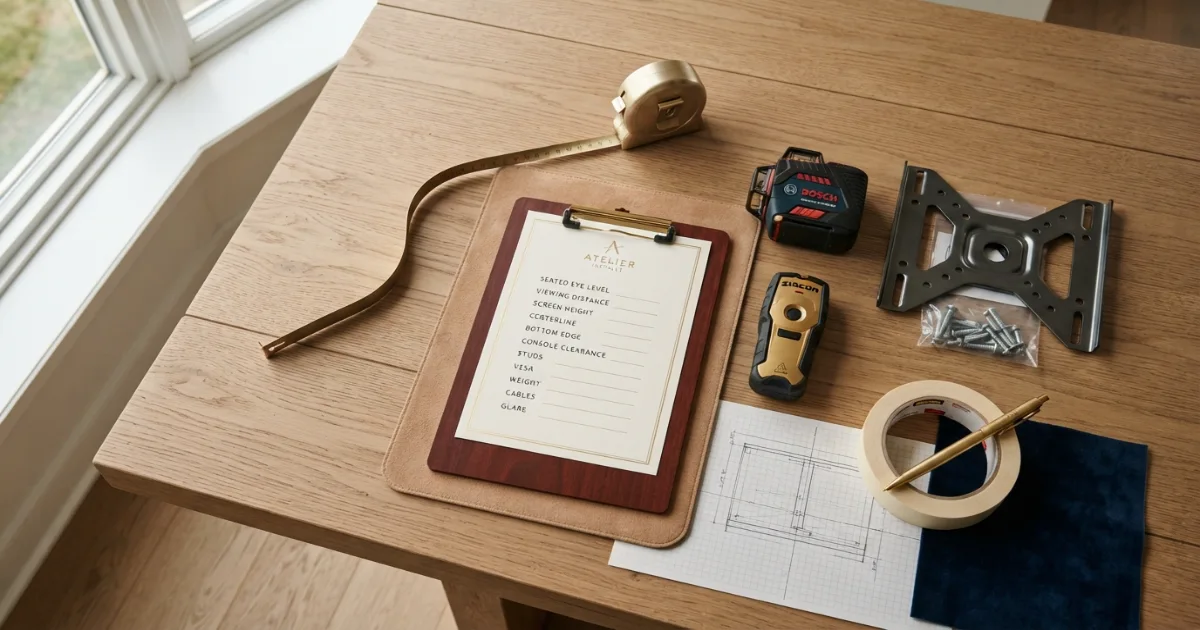
- Main seated eye height.
- Closest regular viewing distance.
- TV diagonal and visible screen height.
- Exact complete product height.
- Chosen vertical center angle.
- Calculated floor-to-center height.
- Calculated floor-to-bottom height.
- Calculated floor-to-top height.
- Console and soundbar clearance.
- Window and lamp reflections.
- VESA pattern and television weight.
- Mount capacity and adjustment range.
- Studs, wall construction and approved hardware.
- Power, HDMI and cable-routing access.
- Fireplace heat and clearance when applicable.
- Outline tested from every regular seat.
Recheck soundbar alignment, remote-sensor visibility and cable movement. Full-motion mounts need enough cable slack for their complete range without pulling connectors.
Review reflections during daytime and evening. Adjusting a tilting mount by a few degrees can reduce glare, but do not use tilt to compensate for a severely elevated center.
Verify that the screen is level, the mount is fully secured and the center matches the planned measurement. Post-installation adjustment slots may allow a small correction.
After the television is mounted, sit in every regular position and watch normal content for at least several minutes. Check whether the chin lifts, the eyes feel drawn upward or the screen edges require noticeable head movement.
Post-installation height and angle calibration
A modest full-motion mount can help orient the screen toward different zones, but the chosen center height should still remain comfortable for the closest main seating.
Check whether pendant lights, kitchen cabinets or circulation paths block the screen from secondary areas. Horizontal placement may solve a sightline problem without increasing height.
Raising the screen for distant standing viewers can make it uncomfortable for the sofa used during movies. Prioritize the regular seated position unless the television mainly serves casual viewing from several zones.
An open-plan room may have a sofa, dining table and kitchen sightline at different eye heights. Decide which zone is the primary viewing area before calculating the center.
Mounting height in open-plan and multi-zone rooms
Use approved hardware, verify studs or suitable anchors, and follow the mount and television instructions. Professional installation is appropriate when wall construction or load capacity is uncertain.
Do not place the television unusually high solely to keep it out of reach. Excessive height can reduce viewing comfort while failing to address accessible cables, furniture climbing or loose equipment.
Keep cables managed so children cannot pull them. Avoid unstable furniture below the screen and secure tall consoles or cabinets according to their manufacturer instructions.
Wall mounting can reduce tip-over risk when the television and mount are installed correctly, but the installation must be appropriate for the wall type and television weight.
Child safety and secure wall mounting
When comfort needs differ significantly, an adjustable mount or revised seating layout may provide a better result than one fixed height chosen from an average.
Subtitles and interface text should remain easy to read without lifting the chin. Screen size, contrast and distance matter alongside mounting height.
Wheelchair users, children and adults on low seating can have substantially different eye heights. Measure the people who use the room regularly and identify the closest seat because it experiences the largest vertical angle.
Viewers with limited neck mobility may need the screen center closer to their natural eye line than a general room rule suggests. Small changes in center height can make a meaningful difference during long viewing sessions.
Accessibility and comfort considerations
When several viewers use different recliner settings, choose a moderate shared center rather than optimizing for the most extreme posture.
Check both the relaxed movie position and the more upright position used for news, gaming or conversation. A centerline that works only when fully reclined may feel too high during everyday viewing.
Measure the eyes while the recliner is in the position used most often. Do not estimate from the chair’s seat height because the backrest angle and head support affect the line of sight.
Recliners and deep sofas change both eye height and head angle. A viewer who leans back naturally looks slightly upward, so a screen center above upright seated eye level may still feel comfortable.
How recliners and deep sofas change mounting height
Final answer: how high to mount TV on the wall
How high to mount TV begins with the main viewer’s seated eye level. Use that measurement as the starting floor-to-screen-center height.
Calculate the bottom and top edges by subtracting and adding half of the visible screen height. When furniture forces the center higher, calculate the upward viewing angle from the actual seating distance and keep it modest.
For many living rooms, the screen center falls around 40 to 44 inches, with 42 inches as a useful fallback. The correct installation is the one verified against the actual viewer, screen size, furniture, soundbar, glare and wall construction.
Need to confirm the correct TV size first?
Use the free TV Size Calculator, then return with the selected screen height.
Official placement and mounting references
The calculation method combines basic geometry with current manufacturer and viewing guidance.
Two installation-tool categories to compare
Use tools suitable for the wall type and follow the mount and television manufacturer instructions.
TV Wall Mounts
Compare VESA compatibility, weight rating, tilt, extension and post-installation adjustment.
- Confirm VESA pattern
- Check weight capacity
- Match the wall structure
Stud Finders and Laser Levels
Useful for locating framing, marking a level centerline and checking final placement.
- Choose for your wall type
- Verify detected framing
- Use a physical level check
Affiliate disclosure: As an Amazon Associate, HomeStyle Calculator may earn from qualifying purchases. Product specifications, prices and availability can change.
How high to mount TV FAQs
How high should a TV be mounted on a wall?
Start with the center of the screen close to the main viewer’s seated eye level. For many living rooms this is around 40 to 44 inches from the floor, but the correct height depends on the actual seating and screen size.
Is 42 inches to the center of the TV always correct?
No. Forty-two inches is a useful fallback for some standard sofas, but measuring the regular viewer’s seated eye height is more accurate.
How do I calculate the bottom edge of a mounted TV?
Subtract half of the visible screen height from the selected screen-center height. For example, a 65-inch screen is about 31.9 inches high, so half is approximately 16 inches.
How high should a 65-inch TV be mounted?
If the screen center is 42 inches from the floor, the visible bottom edge of a 65-inch screen is about 26 inches and the visible top edge is about 58 inches.
How high should a 75-inch TV be mounted?
With a 42-inch screen center, the visible bottom edge of a 75-inch screen is approximately 23.6 inches and the top edge is about 60.4 inches.
How much space should be between a TV and console?
Leave enough space for the soundbar, ventilation, cables and visual separation. The exact gap depends on furniture height, screen-center target and equipment dimensions.
Can the TV be mounted above seated eye level?
Yes, when room constraints require it, but keep the upward viewing angle modest. THX guidance recommends keeping the line of sight within about 15 degrees of screen center.
Does viewing distance affect TV mounting height?
Yes. The same vertical rise creates a smaller viewing angle from farther away and a larger angle from a close sofa. Distance should be included when the screen center is above eye level.
Should a bedroom TV be mounted higher?
Often yes because viewers watch while reclining. Measure eye position in the normal supported posture rather than using a living-room eye-height rule.
Should a TV above a fireplace use the same height formula?
Use the same eye-level and angle principles, but fireplace heat, mantel clearance and building requirements can force a compromise. Verify manufacturer and local safety requirements.