Outdoor rug size for patio, deck, and dining layouts.
Choose an outdoor rug size that anchors the furniture, keeps dining chairs supported, clears doors and drains, and remains practical to clean.
Written by Rehana K · Published and updated July 19, 2026.
Start with the furniture footprint, then protect doors, drains, and circulation.
A practical outdoor rug size is large enough to support the furniture placement but small enough to leave access around the patio. Use 5×7 or 6×9 for bistro and balcony zones, 8×10 for a medium conversation group, and 9×12 or 10×14 for larger dining tables or sectionals.
Fit the outdoor rug to the furniture, not just the patio outline
Measure working furniture
Include pulled-back dining chairs, sectional chaises, ottomans, and reclined lounge chairs.
Preserve clear routes
Keep doors, steps, drains, grills, planters, and main walking paths usable.
Tape before buying
Mark the exact rug outline and inspect it from the doorway and seating position.
Estimate a patio or deck rug size
Enter the usable outdoor area and furniture footprint. The checker suggests a standard size while preserving a practical border.
Outdoor rug result
What outdoor rug size works for a patio or deck?
The correct outdoor rug size depends on the usable floor area and the furniture footprint, not the total deck dimensions. A 5×7 or 6×9 rug suits a bistro or compact balcony. An 8×10 often works beneath a four-seat conversation group or small dining set.
A 9×12 or 10×14 is more appropriate for a large sectional, six-seat dining table, or an open patio where the rug should establish a complete outdoor room.
How to measure an outdoor area before buying
Measure the clear, usable rectangle after subtracting grill zones, door swings, steps, posts, planters, drains, and narrow circulation paths. Then measure the furniture in its real working position. Dining chairs must be measured while pulled back; lounge chairs need their reclined or moved position; sectional chaises must be included.
The outdoor rug size should fit both the furniture and the weather-exposed floor without creating a trip edge.
Outdoor rug size chart for patios and decks
Use the chart as a starting point, then confirm the exact product dimensions because outdoor rugs may be sold in nominal sizes.
| Outdoor setup | Starting rug size | Placement goal | Watch for |
|---|---|---|---|
| Two-seat bistro | 5×7, 6×9, or 7–8 ft round | Table and chairs fully supported | Door swing and railing path |
| Loveseat + 2 chairs | 6×9 or 8×10 | Front legs on | Coffee-table island effect |
| Compact sectional | 8×10 or 9×12 | Front legs and table connected | Chaise overhang |
| 6-seat dining | 9×12 | Pulled-back chairs stay on | Grill and door clearance |
| Large sectional zone | 9×12 or 10×14 | Complete outdoor room | Drainage and cleaning access |
Outdoor rug size for conversation seating
For a loveseat and two chairs, the rug should normally reach at least the front legs of every seat. A 6×9 may work in a narrow patio, while an 8×10 creates a more complete zone. A compact sectional commonly needs 8×10 or 9×12.
The correct outdoor rug size prevents the coffee table from looking isolated while keeping furniture stable when people sit down or stand up.
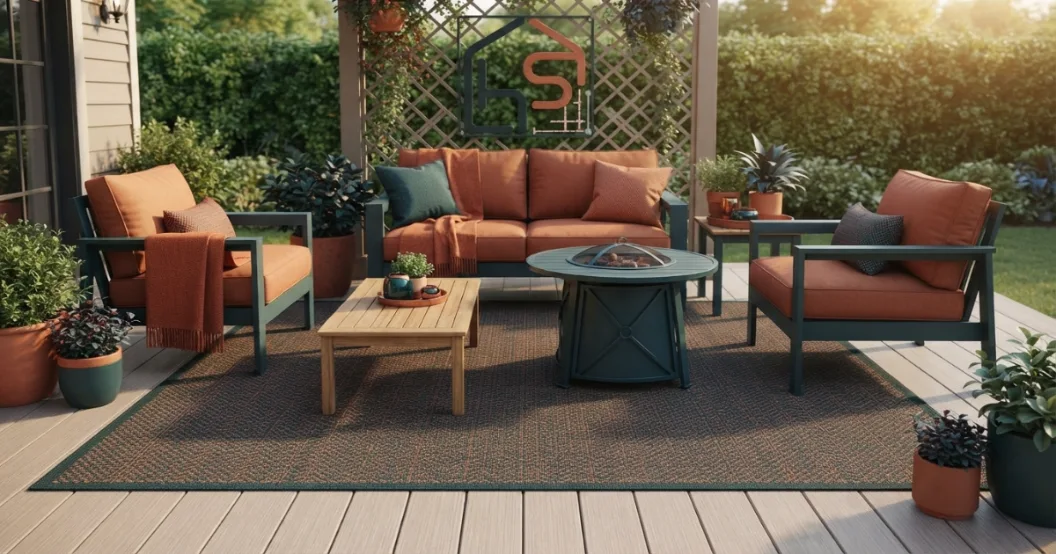
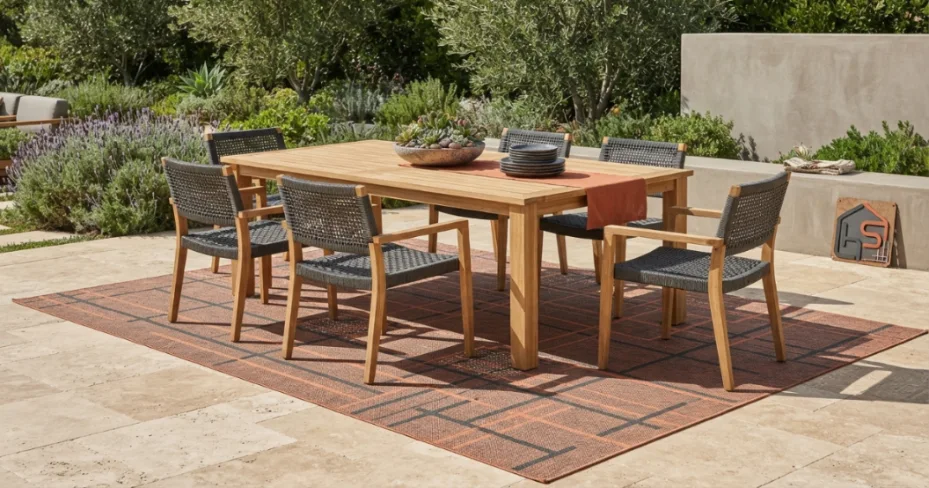
Outdoor rug size under a patio dining table
Add 48 to 60 inches to both tabletop dimensions so chairs remain on the rug when pulled back. A 36×36-inch bistro table can often use 6×9 or a 7–8 foot round rug. A four-seat rectangular table often needs 8×10.
Six-seat tables commonly need 9×12, while eight-seat outdoor tables may require 10×14 or a custom size.
Outdoor rug size for a sectional sofa
Measure the full width of the sectional, including the chaise and any side tables that should connect visually. Front-legs-on placement is often the best compromise for an outdoor sectional because it preserves drainage and exposed flooring.
A 9×12 is a common starting point for medium sectionals, but a compact L-shaped sofa can work on 8×10 when the chaise does not extend beyond the rug.
Balcony and narrow deck rug sizes
Small balconies need clear door movement and a safe path to railings or storage. A 3×5, 4×6, or runner may be more useful than forcing a standard room-size rug.
On a long deck, a 2.5×8 or 3×10 runner can define a walkway, while a 5×7 or 6×9 creates a small seating zone at one end.
How much deck or patio floor should remain visible?
A border of roughly 12 to 24 inches often looks balanced on a medium patio, while 6 to 12 inches can work in a compact balcony. Large open decks may leave 18 to 36 inches or more. The shortest border matters most.
Keep the rug away from drains, fire features, grill heat, door thresholds, and areas where water regularly pools.
Material, drainage, and weather exposure
Polypropylene and other solution-dyed synthetic fibers are common outdoors because they resist moisture and are easier to clean than many indoor fibers. Even a weather-resistant rug should dry between storms.
Place it on a surface that drains, lift it periodically, clean debris beneath it, and follow the manufacturer’s instructions for the rug and the deck material. For broader care practices, review the Carpet and Rug Institute cleaning and maintenance guidance.
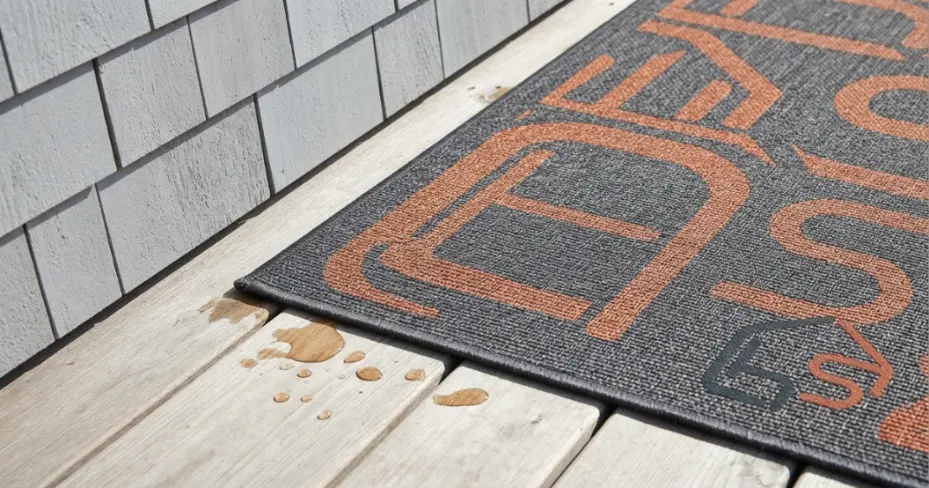
Using an outdoor rug on a wood or composite deck
Do not leave trapped organic debris or standing moisture beneath the rug. A breathable construction and regular lifting help the surface dry. Check the deck manufacturer’s guidance before using rubber-backed products, adhesives, or pads because some materials can mark finishes or slow evaporation.
Composite-deck owners can also consult Trex deck care and cleaning guidance before leaving mats or backing materials in place.
Outdoor rug size on concrete, tile, and stone
Concrete and stone can support larger rugs, but drainage and edge stability still matter. Avoid placing the edge across uneven joints or where water flows toward a drain. On smooth tile, use a floor-compatible outdoor pad only when the manufacturer permits it. The pad should stay hidden beneath the rug and should not obstruct drainage.
Furniture placement: all legs, front legs, or legs off
Use all-legs-on placement for dining sets and compact furniture groups when the patio is large enough. Front-legs-on placement works well for sofas, sectionals, and lounge chairs. Legs-off placement is best reserved for a small accent rug beneath a coffee table or a clearly separate decorative zone. Consistency across the furniture group matters more than forcing one universal rule.
| Placement | Best use | Minimum coverage | Main advantage |
|---|---|---|---|
| All legs on | Dining sets and compact groups | Full furniture footprint | Most stable and complete |
| Front legs on | Sofas, sectionals, lounge chairs | Front 6–12 inches of seating | Efficient on medium patios |
| Legs off | Small accent beneath table | Coffee-table zone only | Preserves exposed deck |
Rectangular, round, square, and runner outdoor rugs
Match the rug shape to the furniture footprint rather than the patio outline alone. Rectangular rugs suit sofas and long dining tables. Round rugs work beneath round bistro tables or circular chair groups. Square rugs can support square tables and symmetrical conversation areas. Runners are useful on narrow balconies, beside outdoor kitchens, and along deck walkways.
| Rug shape | Best furniture match | Common sizes | Planning note |
|---|---|---|---|
| Rectangle | Sofas and long tables | 5×7 to 10×14 | Align long side with furniture |
| Round | Bistro tables and circular groups | 6, 7, 8, 9 ft | Keep chairs within diameter |
| Square | Square tables and symmetrical groups | 6×6 to 10×10 | Useful on square patios |
| Runner | Balconies and deck paths | 2.5×8 to 3×12 | Preserve edge clearance |
Doors, grills, fire pits, and safety clearance
Test every door at its full swing and include the combined thickness of the rug and any pad. Keep rugs away from grill grease zones, direct flames, fire-pit sparks, and hot appliance surfaces. Follow product clearances for grills, heaters, fire tables, and cooking equipment.
A rug that fits visually but conflicts with heat or egress is the wrong outdoor rug size. For setups near fire features, review the U.S. Consumer Product Safety Commission fire-safety resources.
Common outdoor rug sizing mistakes
The most common error is selecting a rug from the patio dimensions without measuring the furniture. Other mistakes include placing dining chair rear legs off the rug, covering drains, ignoring door clearance, choosing a tiny coffee-table island, and buying a rug so large that it traps debris across the entire deck. Tape the outline before ordering.
Cleaning, storage, and seasonal planning
Sweep or vacuum regularly, rinse only when the label allows, and dry both sides before storage. In climates with snow, prolonged freeze-thaw cycles, or a long wet season, rolling and storing the rug can extend its usable life. Clean the floor below it before reinstalling so grit does not abrade the deck finish.
Buying checklist
Confirm the actual dimensions, pile height, backing, UV and moisture claims, cleaning method, return policy, and whether a pad is recommended. Photograph the taped outline from the main doorway and seating position. The best outdoor rug size should support the furniture, preserve circulation, clear doors and drains, and remain practical to clean.
| Check | Pass condition | Why it matters |
|---|---|---|
| Furniture fit | Chosen placement is consistent | Prevents disconnected furniture |
| Chair movement | Rear legs remain supported | Improves dining safety |
| Door and route | No contact or narrowed path | Protects circulation |
| Drainage | Water can escape and rug can dry | Reduces trapped moisture |
| Cleaning access | Rug can be lifted and moved | Supports deck maintenance |
Outdoor rug size for a small patio
On a small patio, the rug should define one clear activity rather than cover every visible surface. Begin with the furniture that must feel connected: a loveseat, two compact chairs, a coffee table, or a bistro set.
Leave enough exposed flooring for the door to open, for people to step around chair backs, and for water to move toward the drain. A 5×7 can work when the furniture sits mostly off the rug and the rug acts as an accent.
A 6×9 is more useful when front legs should rest on the surface. In a tight rectangle, rotating the rug can create a better walkway, but the long edge should still follow the main furniture group.
Compare the taped outline with the compact living-room rug layout guide, because the same visual principles apply even though outdoor circulation and drainage need extra attention.
Outdoor rug size for a large patio
A large patio can make a standard rug appear smaller than expected. Do not automatically center one rug in the entire outdoor area. Decide whether the patio contains one room or several zones, such as dining, lounging, grilling, and circulation.
A 9×12 rug can anchor a sectional and coffee table, while a separate 8×10 may support a dining set elsewhere. This is often more functional than one oversized rug that crosses traffic lanes or reaches a cooking zone.
When a single seating group is the main feature, select an outdoor rug size that carries the front legs of every seat and leaves an intentional border around the group. Use the floor-border planning method to compare the shortest exposed edge rather than averaging all four sides.
Large patios also need regular access for sweeping, washing, and inspecting the surface below the rug.
Covered patio versus fully exposed deck
A covered patio may protect the rug from direct rain and intense sun, but wind-driven moisture, dust, and humidity can still reach the surface. A fully exposed deck needs faster drying, easier handling, and more frequent inspection beneath the rug.
The size decision changes because a very large rug is harder to lift and may stay wet longer after storms. In a covered conversation area, an 8×10 or 9×12 can behave much like an indoor room anchor.
On an uncovered deck, two smaller zones may be easier to maintain than one very large rug. Keep the rug away from low points where water collects. Confirm that furniture feet do not trap wet fabric against the deck.
When the rug needs added grip, read the rug pad size and compatibility guide before adding any pad, because outdoor surfaces and backing materials require specific manufacturer approval.
Four-seat, six-seat, and eight-seat patio tables
For a four-seat table, an 8×10 rug is a common starting point when the table is rectangular and the patio has room for pulled-back chairs. A compact round four-seat table may fit a 7- or 8-foot round rug.
Six-seat tables frequently need 9×12 because the long dimension must support chairs at both ends. Eight-seat tables often require 10×14, especially when armchairs occupy the table ends. Measure the table in its largest regular configuration, including extension leaves. Then add 24 to 30 inches on every side.
A rug that only matches the tabletop can create an unstable edge directly beneath the rear chair legs. Use the six-chair rug calculation or the eight-chair table guide for exact furniture footprints before selecting the final outdoor rug size.
L-shaped, U-shaped, and modular outdoor sectionals
L-shaped outdoor sectionals usually look balanced when the rug extends beneath the front legs of both arms and supports the coffee table. U-shaped arrangements need greater width because the rug must visually connect seating on three sides.
Modular furniture should be measured in the arrangement used most often, not in its smallest stored configuration. An 8×10 may support a compact L shape, while 9×12 is a stronger starting point for a medium sectional. Large U-shaped seating can require 10×14 or multiple coordinated rugs.
Keep the chaise from projecting far beyond the rug edge, because the layout can appear unbalanced and furniture feet may sit at different heights. The sectional rug-size guide explains front-legs-on and all-legs-on options in more detail. Outdoors, also verify that the selected placement does not block deck-access panels or drainage routes.
Poolside and covered porch rug planning
Poolside rugs need slip awareness, fast drainage, and a location outside the immediate splash and equipment zone. Do not place a loose edge where wet feet regularly change direction. Keep clear access to pool gates, ladders, drains, and safety equipment.
On a covered porch, the rug can define a bench, swing, or conversation group, but door clearance and narrow circulation often limit the width. A 4×6 or 5×7 may be sufficient for a porch bench and side table, while a wider seating arrangement can use 6×9 or 8×10.
Select a low-profile construction when a door passes over the rug. The outdoor rug size should make the furniture feel intentional without turning the route into an obstacle. Tape the corners, walk the route in both directions, and test the space while chairs and tables are in their real positions.
Which direction should an outdoor rug face?
Orient the long side of the rug with the dominant furniture group or the main visual axis. Beneath a rectangular dining table, the long rug dimension normally follows the tabletop length. With a sofa, the long edge usually runs parallel to the sofa front.
On a narrow deck, however, rotating a rug can preserve a better route between the house and the yard. Compare both directions before buying. The best orientation is the one that supports the furniture footprint while leaving usable borders near doors, steps, and railings.
Do not rely only on the overall patio shape; a square patio can still contain a long rectangular furniture group. Use the rug placement rules guide to decide whether all legs, front legs, or no furniture legs should sit on the rug, then choose the orientation that applies that rule consistently.
Can outdoor rugs be layered?
Outdoor rugs can be layered when both products are suitable for the location and the combined edges remain stable. A large flatwoven base can define the patio while a smaller patterned top rug highlights the coffee table or central seating zone.
The top rug should be clearly smaller so the base remains visible on every side. Avoid layering near doors, stairs, grill areas, or heavily wet routes, because the extra thickness can slow drying and create an uneven edge. Check whether the manufacturers allow the products to be used together.
Lift both rugs regularly and clean the floor underneath. The layering rugs size-ratio guide provides practical base-to-top proportions. For an outdoor setup, prioritize drying, secure edges, and manageable weight over decorative complexity.
Pattern scale and color on an outdoor rug
Pattern can change how the rug size appears. A broad border may make the usable center look smaller, while a large all-over pattern can make an 8×10 feel more expansive. Small repeating motifs are forgiving beneath dining chairs because the pattern remains visible even when furniture covers the center.
Strong stripes can emphasize the long direction and visually lengthen a narrow deck. Dark colors may show dust, pollen, or faded traffic paths differently from light colors. These visual effects should not replace measurement, but they can help refine a choice between two sizes.
When comparing 5×8 and 6×9 or 8×10 and 9×12, review the complete flat product image rather than judging from a close-up swatch. Visit the standard rug sizes chart to compare the real floor-area difference before ordering.
A complete outdoor tape test
Mark all four rug corners and connect the outline with painter’s tape or removable chalk approved for the surface. Place the furniture exactly where it will sit. Pull dining chairs back to the position used when someone stands. Recline lounge chairs, extend ottomans, and open every nearby door.
Walk from the house to the yard, grill, stairs, and storage. Check whether any rug edge falls directly in a turning path. Mark drains, low spots, and fire-equipment clearances. View the outline during daylight and after outdoor lighting is switched on. Photograph the layout from the main doorway and from each seat.
This test often reveals that the larger outdoor rug size creates a stronger room, or that a smaller size preserves a safer route. Enter the final measurements in the rug size calculator before buying.
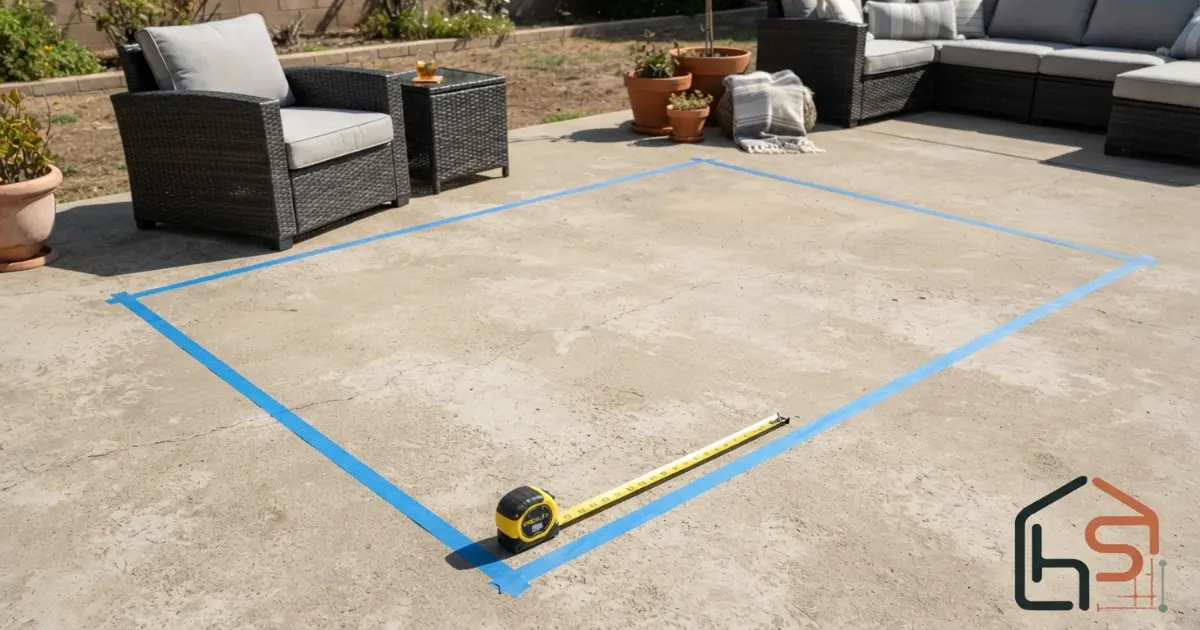
Final outdoor rug size check before checkout
Before placing the order, compare the selected dimensions with the exact product listing rather than the nominal label alone. Confirm whether fringe is included, whether the corners are square or rounded, and whether the rug can be rotated without exposing furniture legs.
Review the real footprint of an 8×10 rug, the real footprint of a 9×12 rug, or the 5×7 versus 8×10 comparison when the decision is close. Recheck the shortest floor border, not only the longest side.
Confirm that the rug can be lifted for cleaning and stored if seasonal weather requires it. A good outdoor rug size should still work when chairs move, guests walk through the zone, and the surface needs to dry after rain.
Save the taped measurements and product dimensions so a replacement or second coordinated rug can be selected accurately later.
Outdoor rug size FAQs
What is the most common outdoor rug size for a patio?
An 8×10 rug is a common starting point for a medium patio conversation group or small dining set, but the furniture footprint and clear patio dimensions should decide the final size.
Should all patio furniture legs be on the outdoor rug?
Not always. Dining chairs should normally remain fully on the rug when pulled back. Sofas and lounge chairs can use consistent front-legs-on placement when the patio is smaller.
How large should an outdoor rug be under a dining table?
Add about 24 to 30 inches beyond every table edge so the chair rear legs stay on the rug when diners pull back.
Can an outdoor rug cover most of a deck?
It can, but leave access to drains, doors, edges, and inspection areas. Regularly lift and clean beneath the rug so moisture and debris do not remain trapped.
What outdoor rug size works for a small balcony?
A 3×5, 4×6, 5×7, or narrow runner usually works better than a large room-size rug. Preserve door movement and a clear walking route.
Is 9×12 too large for a patio?
A 9×12 rug works well for a medium sectional or six-seat dining set when the clear patio is large enough to leave practical borders and circulation.
Do outdoor rugs need pads?
Some setups benefit from an outdoor-rated, floor-compatible pad for grip, but not every surface or rug permits one. Follow both the rug and deck or flooring manufacturer’s guidance.
How do I test outdoor rug size before buying?
Mark the exact rug outline with painter’s tape, arrange the furniture, pull dining chairs back, open doors, and confirm grill, drain, stair, and walkway clearance.