96 vs 108 inch curtains: which length should you choose?
Use this 96 vs 108 inch curtain comparison to choose the correct ready-made panel from your actual attachment-point height, floor clearance, hanging hardware and room layout.
Written and reviewed by Rehana K · HomeStyle Calculator measurement-first method.
Choose 108 inches for a near-ceiling installation; choose 96 inches when the measured drop fits a standard high rod.
108-inch curtains are usually the stronger decorative choice for nine-foot ceilings, near-ceiling rods and a tall uninterrupted floor-length line. Choose 96-inch curtains when the attachment-point-to-floor measurement is close to 96 inches, the rod sits at a standard high position, or the room cannot support a near-ceiling installation.
When the required finished drop falls between 96 and 108 inches, 108-inch panels are usually the safer purchase because excess fabric can be hemmed while a short panel cannot be extended cleanly.
Use the right HomeStyle Calculator page for each measurement
Choose the panel length only after connecting mounting height, floor finish, rod span, fullness and package quantity.
96 vs 108 inches from first measurement to final installation
96 or 108 inch curtain length calculator
Enter the attachment-point height, floor clearance, hardware adjustment and floor finish. The calculator compares both standard lengths and shows the likely alteration.
Your curtain-length result
See how the two panel lengths change rod position and floor finish
Select 96 or 108 inches. The window stays the same while the rod height and finished drop change.
Measure from the actual fabric attachment point because hardware changes the drop.
96 vs 108 inch curtains comparison chart
The twelve-inch difference changes the possible rod position, floor clearance and alteration flexibility. Use the chart as a buying screen, then confirm the finished drop with the calculator.
| Decision factor | 96-inch curtains | 108-inch curtains | Best buying note |
|---|---|---|---|
| Typical measured drop | About 82–96 in | About 94–108 in | Measure from the attachment point |
| Rod position | Closer to the frame | Higher above the frame | Mark the rod before ordering |
| Visual effect | Compact and practical | Taller and more custom-looking | Floor-length usually looks more intentional |
| Alteration flexibility | Limited | Can be hemmed shorter | Longer is safer between sizes |
| Main risk | Visible gap above floor | Excess fabric if rod is low | Choose the floor finish first |
Measure from the actual curtain attachment point
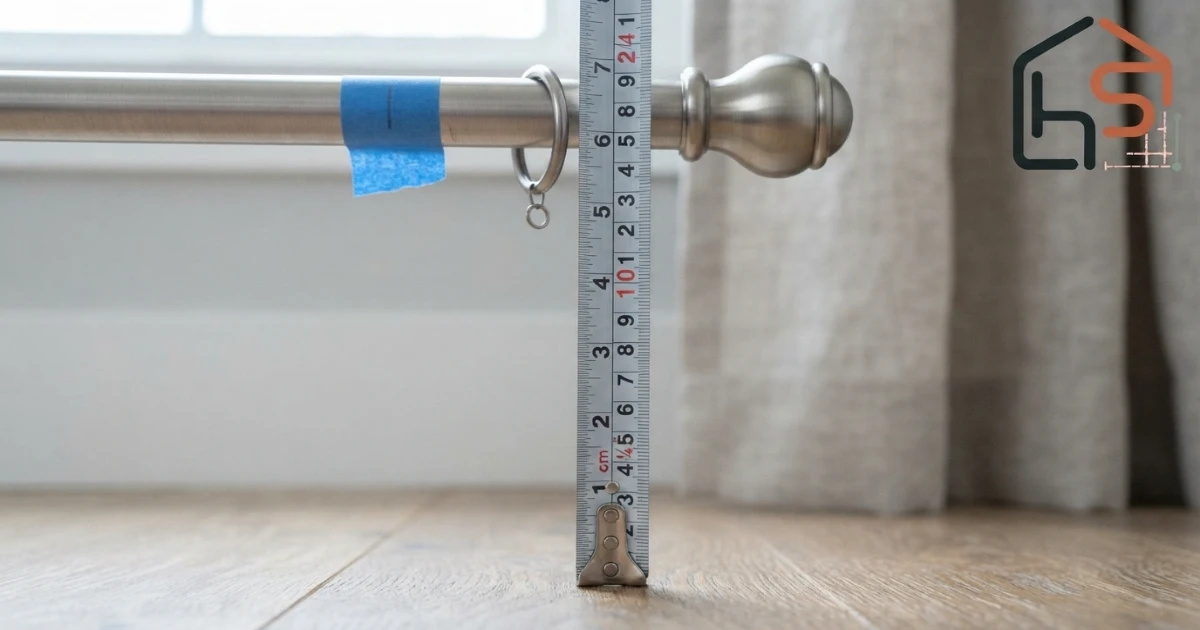
Measure from the point where the curtain fabric begins to the finished floor. Do not automatically measure from the top of the rod. Rings, clips, hooks, grommets and rod pockets can all change the real drop.
Take the measurement at the left, center and right because floors and ceilings are not always level. For a tailored float, use the shortest practical measurement so the hem does not drag on one side.
Record the full opening in Measure Window for Curtains and choose the mounting line in How High to Hang Curtains.
Why 108-inch curtains create a taller, more custom look
A 108-inch panel gives the rod more vertical freedom. It can be mounted higher above the frame while the hem still reaches the floor, creating a longer vertical line and a more finished window wall.
The extra fabric also gives more alteration flexibility. If the measured drop is 90, 92 or 94 inches, a 108-inch panel can be hemmed. An 96-inch panel would remain visibly short unless the rod is lowered.
Safer between sizes
Choose the longer ready-made panel and hem it. A curtain that is too long can usually be corrected; a curtain that is too short cannot.
When 96-inch curtains are the better practical choice
An 96-inch curtain is correct when the measured finished drop is genuinely close to 96 inches. It can suit an existing rod mounted near the frame, a rental where bracket holes cannot be moved, or a room where a radiator, desk, bench or cabinet limits the drop.
The shorter result should look deliberate. A clean hem line can work; a random floor gap usually looks like a measuring mistake.
- The attachment-point-to-floor measurement is about 82 to 96 inches.
- The existing rod cannot be raised.
- Furniture or heating equipment blocks a longer panel.
- The design intentionally uses a shorter stopping point.
96 vs 108 inch curtains for 8-foot and 9-foot ceilings
For an eight-foot ceiling, 96-inch curtains can work only when the attachment point and floor finish have been measured carefully. Because the ceiling itself is 96 inches high, a true 96-inch panel cannot hang from the ceiling and still clear the floor once the track, rings or grommet position is considered. In many eight-foot rooms, the rod sits several inches below the ceiling and the actual fabric drop falls somewhere below 96 inches. That makes a 96-inch panel a practical starting point that can be hemmed for a tailored float.
For a nine-foot ceiling, 108-inch curtains offer the same basic relationship: the panel length matches the nominal ceiling height, but the usable drop depends on hardware. A near-ceiling rod may still require a small hem because the fabric begins below the rod. When a ceiling track is installed almost flush with the ceiling, the required panel may be very close to 108 inches or may exceed it slightly.
Ceiling height therefore identifies the likely size range, not the final answer. Measure from the actual attachment point to the finished floor. Then subtract the planned floor clearance, or add the allowance required for a touch, break or puddle finish.
Ceiling height is only a starting clue
An eight-foot ceiling does not automatically mean 96-inch curtains. The rod position controls the usable drop. A rod close to the frame may suit 96 inches, while a higher rod may require 108 inches.
Nine-foot rooms may use 108 inches with a moderate mount, but a near-ceiling installation can require 120 inches. The panel should follow the measured attachment point rather than a generic ceiling chart.
Floor finish changes the required panel length
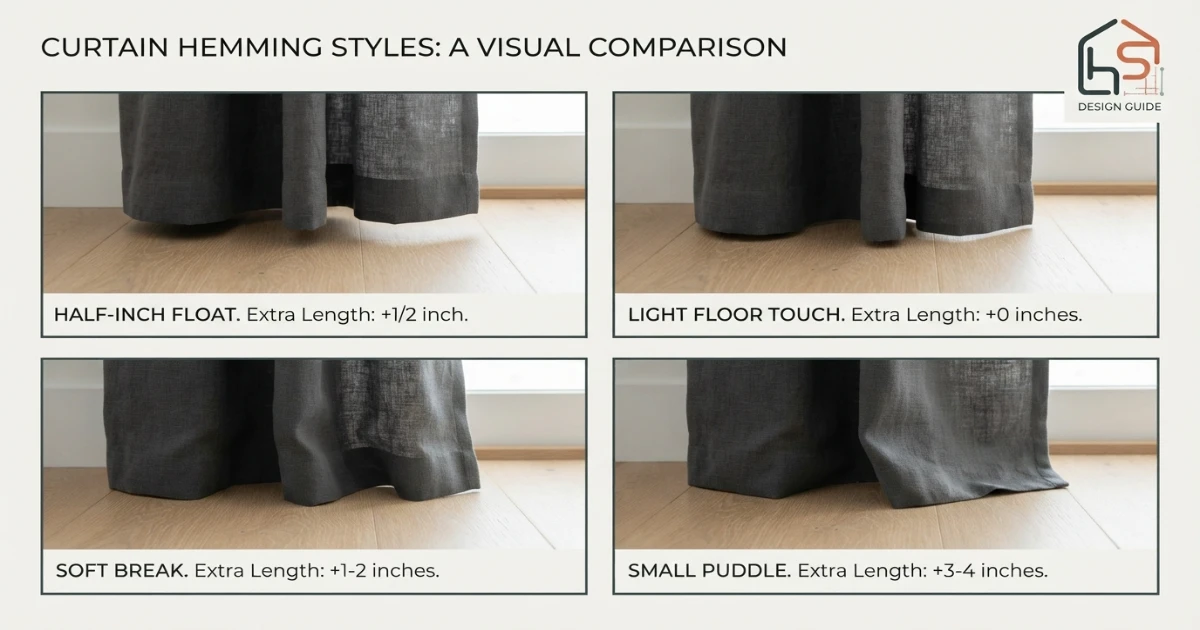
A float normally finishes about one-half inch above the floor. A light touch meets the floor without extra fabric. A small break adds one to two inches, while a decorative puddle needs substantially more.
For busy living rooms, bedrooms and dining rooms, a float or light touch is usually easier to maintain. Puddled fabric gathers dust and can catch under furniture or feet.
Rings, clips and grommets change the drop
Rings and clips lower the point where the fabric begins. Grommet curtains include fabric above the rod opening, while rod pockets can place the top edge differently depending on the header construction.
Measure from the actual fabric attachment point. When possible, hang one panel temporarily before finalizing the bracket line.
What to do when the measurement falls between 96 and 108 inches
Choose 108 inches and hem to the exact length. Pin a temporary hem, allow the fabric to hang, steam it according to the care label and remeasure before cutting.
Lined curtains may need the face fabric and lining adjusted separately. Decorative borders and bottom weights can affect how much fabric can be removed.
96 vs 108 inch curtains by room and ceiling height
Living room: 108 inches is usually the stronger starting point because a high floor-length line makes the main window wall feel more complete.
Bedroom: choose the length that creates full floor coverage without dragging. Blackout bedrooms often benefit from a higher and longer treatment.
Dining room: check chair movement, sideboards and heating vents. A 108-inch panel can look more formal, but clearance still controls the hem.
Home office: 96 inches may be practical where a desk sits below the window. If the wall is clear, 108 inches creates a cleaner backdrop.
Which length is better for blackout curtains?
The better blackout length is the one that covers the opening from the planned high rod position to the floor without leaving a lower gap. In many bedrooms, 108 inches is safer because it supports a higher mount and fuller vertical coverage.
Length alone does not create blackout performance. Side returns, overlap, rod extension, lining and top coverage also matter.
Choosing 96 or 108 inches in a rental
Measure the existing rod before buying. If it cannot be moved, the installed attachment point controls the curtain length. An 96-inch panel may fit a lower rod, while a 108-inch panel can be temporarily hemmed.
A removable hem is often safer than buying a short curtain that cannot be reused in a future room.
Worked 96 vs 108 inch curtain examples
Example one: A measured drop of 83.5 inches with a half-inch float suits an 96-inch panel with little or no alteration.
Example two: A measured drop of 94.5 inches suits a 108-inch panel with an approximate 1.5-inch hem.
Example three: A measured drop of 88 inches falls between the standard sizes. Choose 108 inches and shorten it rather than lowering the rod to force an 96-inch panel.
| Measured finished drop | 96-inch result | 108-inch result | Recommended action |
|---|---|---|---|
| 82 in | 2 in long | 14 in long | Choose 96 and hem |
| 96 in | Exact | 12 in long | Choose 96 |
| 90 in | 6 in short | 6 in long | Choose 108 and hem |
| 94.5 in | 10.5 in short | 1.5 in long | Choose 108 and hem |
| 108 in | 12 in short | Exact | Choose 108 |
Why ready-made curtain lengths use 96 and 108 inches
Ready-made curtain panels are sold in standard increments because manufacturers need a manageable range that works across common rooms. Eighty-four inches and ninety-six inches are two of the most familiar lengths, but they are not interchangeable. The twelve-inch difference changes where the rod can be mounted, how close the hem sits to the floor, whether the treatment looks intentionally full length, and how much alteration may be required.
An 96-inch curtain is often associated with a rod placed only a few inches above a standard window frame. A 108-inch curtain gives more freedom to move the rod higher, which can make the window wall appear taller and more balanced. Neither length should be selected from the product label alone. The correct decision begins with the actual distance from the curtain attachment point to the finished floor.
Standard sizing also means the listed length may not be perfectly exact. Manufacturing tolerances, laundering, steaming, fabric relaxation and header construction can create small differences. Measure the panels after they arrive and before making permanent alterations. For pairs, compare both panels because one may hang slightly differently from the other.
How curtain length changes visual proportion
Curtain length influences how the eye reads the height of a room. A higher rod with a longer panel draws the eye upward and creates one continuous vertical line. This is why 108-inch curtains often look more custom than 96-inch panels even when both technically cover the glass.
Shorter curtains can make the window feel visually separated from the floor. That may be acceptable when furniture sits below the window, when a radiator requires clearance, or when the treatment is intentionally casual. In a main living room or bedroom with a clear wall, however, a near-floor finish generally creates a calmer and more complete composition.
Proportion matters horizontally as well. A longer curtain combined with a rod that extends beyond the window can frame the opening rather than covering it. Pair this page with the Curtain Rod Length Guide and How Wide Should Curtains Be so the vertical and horizontal decisions support each other.
Mounting height differences between 96 and 108 inches
The most important practical difference is the rod position each length allows. Suppose the attachment point must finish 94.5 inches above the floor. A 108-inch curtain can be hemmed by approximately 1.5 inches. An 96-inch curtain would be more than ten inches short, so the rod would need to be lowered dramatically.
Lowering the rod may place it too close to the trim, reduce the sense of height, and cause the panel header to crowd the top of the frame. Raising the rod too high without enough panel length creates the opposite problem: the hem floats well above the floor and looks accidental.
Mark the proposed rod line with painter’s tape before buying. Then measure from the exact hook, ring, clip, grommet or pocket position. This simple mock-up makes the difference between a standard-length guess and a reliable installation plan.
Curtain length does not replace width and fullness planning
A correct 108-inch length can still look underfinished when the panels are too narrow. Likewise, a perfect 96-inch drop may fail to close across the rod. Curtain length and curtain width solve different problems. Length controls the vertical finish; width controls coverage, fullness and stack-back.
For most decorative floor-length curtains, combined panel width is commonly greater than the usable rod span. The exact ratio depends on fabric, header and desired fullness. Use the usable pole width rather than the decorative finial tips when calculating coverage.
Check how many panels are included in each package. Some listings show a styled pair in the photograph but sell only one panel. Confirm finished width per panel, panel count, header type and listed length before ordering.
How fabric weight and construction affect the choice
Lightweight cotton, linen-look fabric and sheers tend to hang with less bulk, but they may relax after steaming. Heavy blackout fabric, velvet and interlined curtains can settle under their own weight and may require stronger hardware. The heavier the panel, the more important it is to allow the fabric to hang before final hemming.
Natural fibers can shrink after washing. Polyester generally changes less, though heat can still affect it. Read the care instructions before choosing a permanent hem. When shrinkage is possible, pre-treat the fabric according to the label or use a removable alteration until the first cleaning cycle is complete.
Pattern placement also matters. A large border, embroidered band or printed motif near the bottom can limit how much length can be removed without disturbing the design. In that situation, raising or lowering the rod slightly may be better than cutting through the decorative detail.
96 vs 108 inches by curtain header type
Grommet curtains: the listed length usually includes fabric above the grommet opening. Because the rod passes through the grommets, the actual hanging drop begins below the top edge. Measure from the top inside edge of the grommet or test one panel on the rod.
Rod-pocket curtains: the pocket position determines where the fabric begins. A decorative header above the pocket can add visible height without increasing the true drop below the rod.
Clip-ring curtains: clips lower the fabric below the rod. Depending on ring diameter and clip length, this can add one or more inches to the total installed distance.
Pinch-pleat or hook curtains: hook placement can often be adjusted slightly, giving useful fine control. However, hook adjustment should refine a nearly correct length, not compensate for a twelve-inch sizing mistake.
What to do with uneven floors and ceilings
Older homes frequently have floors that vary from left to right. Measure the curtain drop at the left, center and right side of the window. If the difference is small, use the shortest measurement for a clean float so the hem clears the floor everywhere.
For a touch or break finish, a custom hem may need to follow the floor line. Ready-made panels can be pinned individually to create an even visual result. Do not assume both panels require the exact same fold when the floor slopes.
A level rod is usually more important than following an uneven ceiling line. Use a level or laser level for the brackets, then adjust the hem to the floor rather than tilting the rod.
Radiators, desks and furniture below the window
Furniture and heating equipment can make a shorter curtain more practical. A radiator, baseboard heater, window seat, desk or dresser may block a full floor-length panel. In that case, 96 inches may still be too long, and a sill- or apron-length treatment may be safer.
Do not allow fabric to rest against a heat source. Follow the appliance manufacturer’s clearance requirements. Where floor-length curtains are desired, rearrange the furniture or use side panels that remain outside the heat zone.
In bedrooms, check nightstands and headboards. In dining rooms, check sideboards and chair movement. In home offices, check desk depth and cable access. The best curtain length must work with the actual room, not only the isolated window.
Washing, steaming and shrinkage allowance
Before permanent hemming, review whether the curtain is machine washable, hand washable or dry-clean only. Washable cotton or linen blends may shrink. If the care label allows, clean the panels before final alteration so the finished length reflects their stable size.
Steam or press carefully because wrinkles can make a panel appear shorter than it really is. After steaming, hang the curtains for at least a day so the fibers and seams relax. Heavy curtains may need longer.
When using fusible hem tape, confirm the fabric can tolerate the required heat. Test a hidden area first. Sewing is generally more durable and easier to reverse cleanly, but removable hem tape can be useful in rentals or for temporary sizing.
How to hem 108-inch curtains for a precise floor finish
Hang the curtains on the final hardware and mark the desired hem while they are installed. Use pins or fabric clips at several points across the width. Remove the panel, measure the fold, and confirm the line is square unless the floor requires a custom adjustment.
Keep enough fabric for the chosen hem depth. A deeper hem can help lightweight panels hang more smoothly, while blackout curtains may contain lining or weights that need separate handling. Do not cut immediately. Fold and test the new length first.
For a pair, label the left and right panels before removing them. This preserves any custom adjustment made for an uneven floor. After sewing or applying hem tape, reinstall the curtains and check the final clearance in daylight.
Cost and value comparison
At first glance, 96-inch panels may cost slightly less, but the lower price does not make them better value when they are too short. Replacing an incorrect set costs more than buying the correct length once.
A 108-inch panel offers more reuse potential because it can be hemmed for a shorter room and later released or altered again, depending on the method used. This is useful for renters and anyone expecting to move.
Compare total treatment cost rather than panel price alone. Include the number of panels, rod, brackets, rings, hemming supplies and possible professional alteration. A longer panel with a simple hem may still be the most economical complete solution.
Style combinations that work with each length
Eighty-four-inch curtains can work well in compact bedrooms, casual offices and rooms where the rod position is fixed. Choose a clean, simple header and a deliberate float rather than allowing the hem to stop several inches above the floor.
Ninety-six-inch curtains suit living rooms, primary bedrooms and dining rooms where a more elevated appearance is desired. They pair especially well with rods mounted several inches above the frame and extended beyond the window sides.
For layered treatments, the main decorative panel and the sheer layer should coordinate at the floor. A visible difference in length can look accidental unless it is part of a clearly planned design.
Bay windows and sliding doors
Bay windows often use separate panel drops because the floor or sill conditions vary across each segment. Measure every hanging position individually. The standard 96-versus-108 comparison still applies, but one number may not fit every section.
Sliding doors usually need longer and wider panels. A 108-inch length is common for a higher track or rod, but the exact door height and mounting point control the decision. Check handle clearance, active-panel movement and the open stack zone.
For very wide openings, ceiling tracks may position the fabric higher than a decorative rod. That can push the required length beyond 108 inches, so verify the track-to-floor drop before buying.
Seasonal and layered curtain use
Seasonal curtains should use the same finished drop if they share the same rod. A lightweight summer panel and a heavy winter blackout panel may behave differently, but their visible hem line should remain coordinated.
When layering sheers behind blackout curtains, measure both systems separately. A double rod may place the rear layer at a different attachment height. Choose lengths that finish together or intentionally offset the sheer by a small, controlled amount.
Heavy winter curtains may require more floor clearance in frequently used rooms because they are moved more often and can drag. A tailored float is usually easier to operate than a puddle.
Detailed decision matrix
| Situation | 96-inch option | 108-inch option | Recommended direction |
|---|---|---|---|
| Existing low rod in rental | Often fits with minimal work | Requires temporary hem | Measure existing attachment point |
| High rod in living room | Usually too short | Often the better match | Choose 108 and tailor hem |
| Measurement around 89–92 in | Clearly short | Can be shortened | Choose 108 |
| Desk or radiator below window | May still be too long | Usually unsuitable | Consider sill or apron length |
| Blackout bedroom | Can leave lower gap with high rod | Better vertical coverage | Usually 108, measured precisely |
| Uneven floor | Limited adjustment room | More custom-hemming flexibility | Choose longer and tailor each panel |
More real-world measurement examples
Example four: The rod attachment point is 92 inches above the floor and the desired float is 0.5 inch. The finished drop is 91.5 inches. An 96-inch curtain is 7.5 inches short, while a 108-inch curtain needs a 4.5-inch hem. Choose 108 inches.
Example five: The attachment point is 96.25 inches and the desired floor clearance is 0.5 inch. The finished drop is 83.75 inches. An 96-inch panel is the correct starting size and may require only a small adjustment.
Example six: Clip rings lower the fabric by 1.5 inches from a rod positioned 108 inches above the floor. With a 0.5-inch float, the required fabric drop is approximately 94 inches. Choose 108 inches and hem about 2 inches.
Example seven: A near-ceiling track sits 101 inches above the floor. Neither 96 nor 108 inches is long enough for a floor finish. Move to a 120-inch panel or a custom length.
Example eight: A rental rod sits at 86 inches and cannot be moved. The user wants a 1-inch floor clearance. The finished drop is 85 inches. An 96-inch panel is one inch short; a 108-inch panel needs an eleven-inch hem. The final choice depends on whether alteration or a small floor gap is more acceptable, but the 108-inch panel provides the cleaner tailored result.
What to verify on the product listing
Confirm whether the listed length is measured from the absolute top edge, the top of the grommet, the rod pocket, or the hook position. Product diagrams are more reliable than lifestyle photos.
Check whether the package contains one panel or two, the finished width of each panel, the fabric composition, lining, care method, header dimensions and return policy. Color can look different across screens, so review customer photos when available.
For blackout products, look for construction details rather than relying only on the word “blackout.” Dense fabric, coated backing and full coverage matter more than marketing labels.
Recommended installation sequence
First, measure the window and surrounding wall. Second, choose the intended rod height and extension. Third, calculate the finished drop and compare it with 96, 108 and the next available length. Fourth, buy the hardware and curtains only after confirming both vertical and horizontal measurements.
Install the brackets level, hang the curtains, steam them, and allow the fabric to settle. Mark the final hem while the panels are on the actual rod. Complete permanent alterations only after checking both sides and the center.
This sequence prevents the common mistake of hemming curtains before the final hardware position is known.
Common 96 vs 108 inch curtain mistakes
The first mistake is choosing from ceiling height alone. The second is measuring from the rod top instead of the fabric attachment point. The third is selecting 96 inches because it seems easier, then discovering a visible floor gap after mounting the rod high.
- Do not measure from the ceiling unless the curtain hangs there.
- Do not ignore rings, clips or grommet fabric above the rod.
- Do not assume every panel is exactly the listed length.
- Do not cut before the fabric has settled.
- Do not choose length without checking width and fullness.
Final 96 vs 108 inch curtain buying checklist
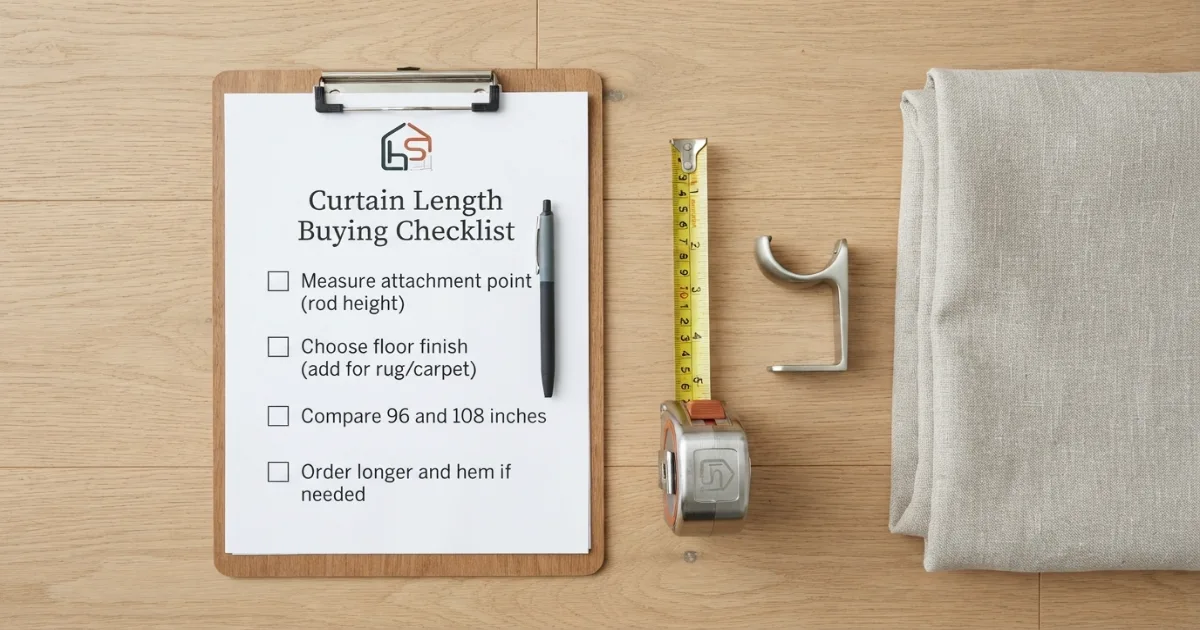
Record the attachment-point height, floor clearance, hanging hardware, desired floor finish, finished drop, panel width, fullness, rod span and package quantity.
Mark the rod and hem lines with painter’s tape and view them from the doorway and main seating position. Then place the complete measurements into the Curtain Size Calculator.
Two practical products to compare after choosing 96 or 108 inches
Search links are used because fabric, color, header, width and package count vary. Confirm the current listing before ordering.
108-Inch Extra-Long Curtain Panels
Compare ready-made 108-inch panels when the goal is a higher rod position and a tailored floor-length finish.
- Confirm finished panel width
- Check whether panels are sold singly or as a pair
- Review fabric shrinkage and care instructions
Curtain Hem Tape or Sewing Supplies
Compare hemming options when a 108-inch panel needs to be shortened to the exact finished drop.
- Match the method to fabric weight
- Test on a hidden area first
- Follow heat and care instructions
Affiliate disclosure: As an Amazon Associate, HomeStyle Calculator may earn from qualifying purchases. Product specifications, prices and availability can change. Review the current listing before ordering.
96 vs 108 inch curtain comparison FAQs
Are 96-inch or 108-inch curtains better?
For most floor-length installations, 108-inch curtains are the more flexible choice because they allow a higher rod position and can be hemmed. Choose 96-inch curtains when the actual attachment-point-to-floor measurement is close to 96 inches or the existing rod must remain low.
Can I use 96-inch curtains with an 8-foot ceiling?
Yes, but ceiling height alone does not choose the panel. Measure from the actual curtain attachment point to the finished floor. If that drop is close to 96 inches, the shorter panel can work.
Do 108-inch curtains make a room look taller?
They often do because the extra length allows the rod to be mounted higher while the hem still reaches the floor, creating a longer vertical line.
Should 108-inch curtains touch the floor?
A tailored finish usually floats about one-half inch above the floor or lightly touches it. A small break adds one to two inches, while a puddle requires more fabric and maintenance.
What if my measurement is between 96 and 108 inches?
Choose the 108-inch panel and hem it to the exact finished drop. A longer panel can usually be shortened cleanly, while a short panel cannot be extended easily.
Do rings and clips change curtain length?
Yes. Rings, clips, hooks, grommets and rod pockets change where the fabric begins. Measure from the actual fabric attachment point rather than automatically measuring from the top of the rod.
Can 108-inch curtains be hemmed to 96 inches?
Yes. Check the lining, bottom weights, decorative borders and care label first. Pin a temporary hem and allow the curtain to settle before making the final alteration.
Which length is better for blackout curtains?
The correct blackout length is the one that covers from the planned high mounting point to the floor without a lower gap. In many bedrooms, 108 inches is safer, but side returns, overlap and top coverage also affect light control.
Turn your 96-or-108-inch choice into a complete curtain order
Calculate rod width, panel length, fullness and quantity before buying curtains or hardware.