Blackout curtain size guide: overlap rules that reduce light gaps
Choose blackout curtains by coverage—not by window width alone. Add rod extension, side returns, top coverage, floor or below-sill length, center overlap and enough fullness for the panels to remain gathered when closed.
Written and reviewed by Rehana K · HomeStyle Calculator measurement-first method.
Blackout curtains should extend beyond the glass on every side and remain gathered when closed.
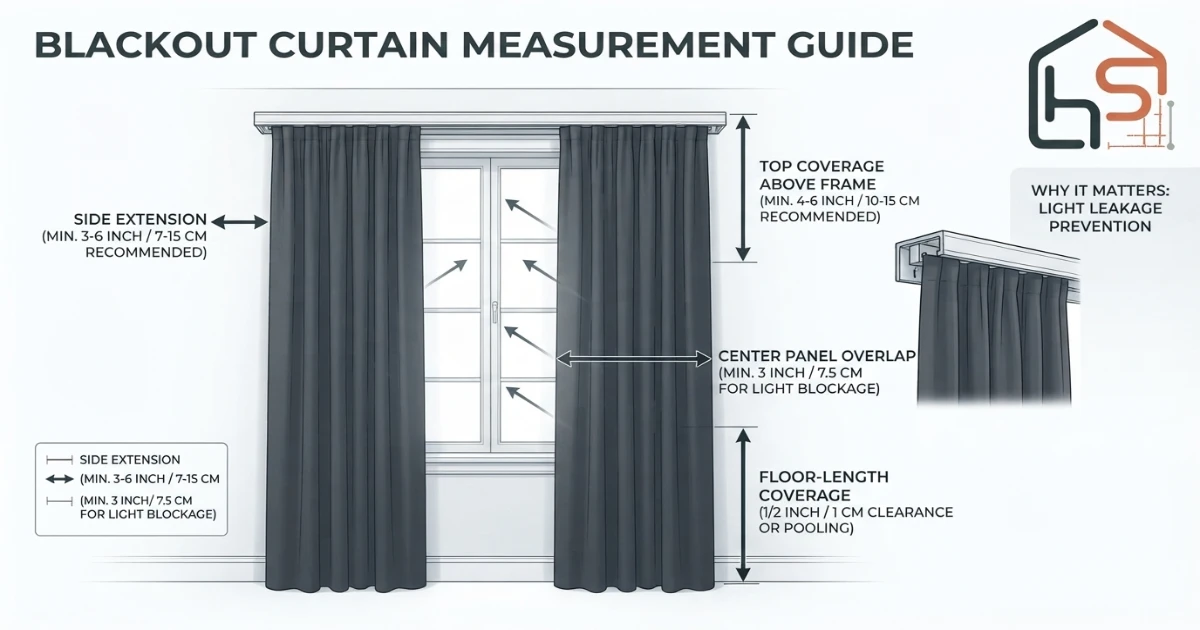
Start with approximately 6 to 12 inches of rod extension on each side, 4 to 8 inches above the frame, floor-length or at least 4 to 6 inches below the sill, and 2 to 4 inches of center overlap. Increase these allowances when the room needs stronger darkness.
For width, multiply the usable rod span by about 1.8 to 2.5 times fullness, then add center overlap or return allowance. A wraparound rod or track is more effective than a straight rod when side light gaps are the main problem.
Use the right HomeStyle Calculator page for every sizing decision
Blackout performance depends on length, width, panel count, rod placement and side return. These connected pages complete the order.
Blackout curtain sizing from overlap rules to final purchase
Blackout curtain size and overlap calculator
Enter the frame dimensions, side extension, fullness, panel width, top coverage, finished drop and center overlap. The tool estimates rod span, combined curtain width, panel count and likely standard length.
Four 52-inch panels provide enough width for a balanced center closing and leave room for center overlap and side returns.
See where blackout curtain light gaps appear
Select a coverage level. Strong darkness comes from controlling the full perimeter, not only choosing opaque fabric.
Blackout curtain overlap rules chart
The correct allowances depend on how dark the room needs to become, the wall space available and the hardware system. The ranges below are practical planning values rather than universal guarantees.
| Coverage area | Everyday darkening | Strong blackout | Maximum practical control | Main purpose |
|---|---|---|---|---|
| Side extension per side | 4–6 in | 6–12 in | 12+ in or full return | Reduce side light and preserve stack-back |
| Top coverage above frame | 3–4 in | 4–8 in | Near ceiling or sealed pelmet | Reduce top halo and rising light |
| Bottom coverage | 2–4 in below sill | 4–6 in below sill or floor length | Floor length with controlled float | Reduce lower light leakage |
| Center overlap total | 1–2 in | 2–4 in | 4–8 in with overlap system | Close the meeting line |
| Fullness | 1.5–1.8× | 1.8–2.2× | 2.2–2.5× where stack allows | Prevent panels from stretching flat |
| Side return depth | Optional | 2–4 in | Return to wall or track recess | Block the line of sight around the edge |
More overlap is not always better. Excess fabric can create a bulky stack, block furniture and place too much weight on the rod. The strongest result comes from combining sensible overlap with suitable hardware rather than adding width without a plan.
How to measure blackout curtains correctly
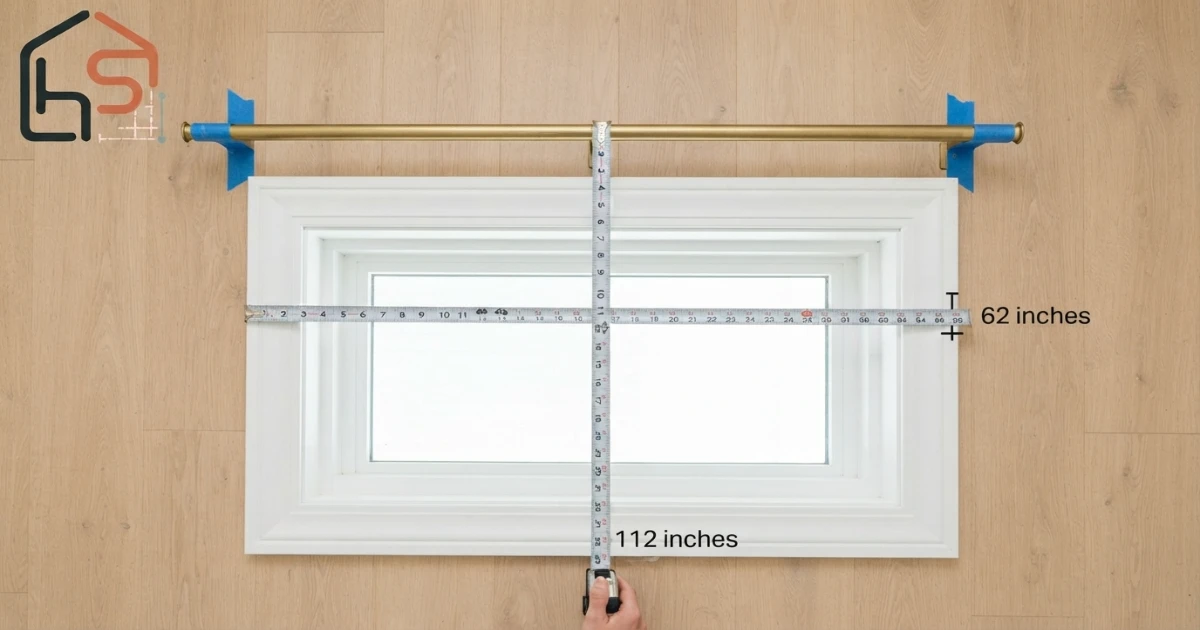
Measure the outside width and height of the frame or trim. Then inspect the surrounding wall. Record the available space above, below and beside the window, along with nearby corners, cabinets, switches, vents and furniture.
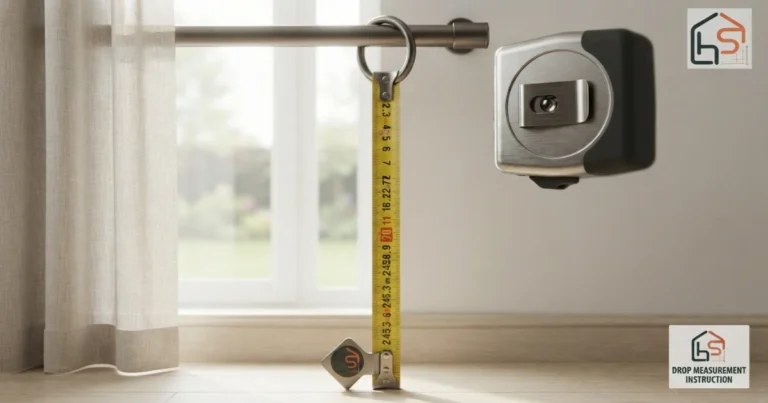
Choose the hardware line before selecting curtain length. Mark the proposed rod or track with painter’s tape. Measure from the point where the fabric begins—not automatically from the top of the rod—to the desired hem position.
For width, decide how far the rod extends past the frame. Add center overlap and return allowance after calculating the rod-span fullness. Measure all dimensions twice and confirm that the selected panel width is the finished width of one panel.
How much side overlap do blackout curtains need?
Side light is often the brightest remaining gap because the curtain hangs several inches in front of the wall. From an angle, light can pass between the fabric edge and window trim even when the curtain extends beyond the glass.
A straight rod can begin with approximately 6 to 12 inches of extension on each side. Wider extension improves coverage and gives the folded curtain somewhere to stack, but it does not close the gap between the rod and wall.
A wraparound rod curves toward the wall at both ends. A return track uses short side sections that bring the fabric closer to the wall. These systems reduce the viewing angle around the curtain edge and usually outperform a straight rod with the same front width.
Where wall space is limited, use the available extension and add fitted side channels, shades or a layered treatment. Do not force a long rod into a corner where the finial or curtain stack cannot fit.
How far above the window should blackout curtains hang?
Mounting 4 to 8 inches above the frame is a common strong-coverage starting range. A near-ceiling rod can reduce the visible gap above the trim and create a taller appearance, provided the curtain length reaches the floor.
Light rises through the space behind the curtain and can form a bright halo at the top. A ceiling track, cornice, pelmet or sealed top treatment can reduce this effect more than height alone.
Check whether the wall above the frame contains suitable fixing points. Heavy lined curtains require strong brackets and anchors. Do not mount into weak trim simply to gain a few inches of overlap.
When the curtain is mounted high, choose the length from the exact attachment point. An 84-inch panel may be too short after the rod is raised, even if it previously reached the floor from a lower position.
How far below the window should blackout curtains extend?
Floor-length blackout curtains provide strong lower coverage and create a continuous vertical line. A half-inch float above the floor is practical because it avoids dragging while keeping the lower gap small.
When floor length is impossible, extend at least several inches below the sill or apron. A short panel that stops at the sill can leave a visible light band, especially when the window is high on the wall.
Keep fabric clear of radiators, baseboard heaters and floor vents. Follow all appliance clearance instructions. Where a heater sits below the window, use a fitted shade inside the frame and decorative curtains outside the heat zone.
Measure the left, center and right drop because floors and sills can slope. Use the shortest practical dimension for a clean float across the full treatment.
How much should blackout curtains overlap in the center?
Two panels can separate at the center because of uneven fullness, air movement, a bowed rod or fabric memory. A deliberate overlap reduces the bright vertical line.
For ordinary darkening, 1 to 2 inches may be enough. Strong blackout often benefits from 2 to 4 inches. Maximum practical control may use 4 to 8 inches with a baton, overlapping track, magnetic edge or layered center design.
Center overlap must be included in the total width. If the rod-span fullness calculation requires 160 inches and the treatment needs 4 inches of center overlap, target at least 164 inches before rounding to whole panels.
Train the panels so the leading edges meet consistently. Steam according to the care label and use suitable weights or magnets only when compatible with the fabric and hardware.
How wide should blackout curtains be?
Calculate width from the usable rod span after side extension. Multiply by approximately 1.8 to 2.5 times fullness, depending on the desired darkness and fabric. Add center overlap and any extra return allowance.
Suppose the frame is 60 inches wide and the rod extends 8 inches on each side. The rod span is 76 inches. At 2 times fullness, the base width is 152 inches. Add 4 inches of center overlap and 4 inches of return allowance for a target of 160 inches.
Two 52-inch panels provide only 104 inches and are far too narrow. Four provide 208 inches, which exceeds the target and creates about 2.74 times fullness. Two 84-inch panels provide 168 inches and may be the cleaner option.
Compare actual achieved fullness after rounding. More panels can improve coverage, but very high fullness increases stack-back and weight.
How many blackout curtain panels do you need?
Use the same panel formula as other curtains, but include center and return allowances. Divide the target combined width by the finished width of one panel and round up. Use an even number for a balanced center opening.
A 90-inch rod at 2 times fullness plus 4 inches of center overlap requires 184 inches. Four 52-inch panels provide 208 inches. Two 100-inch panels provide 200 inches. Both work, but their stack size and seam count differ.
Check whether the package includes one panel or a pair. Four recommended panels may mean four single-panel packages or two pair packages. Use the dedicated How Many Curtain Panels Do I Need guide for package calculations.
Best rods and tracks for blackout sizing
A straight decorative rod is simple but leaves side gaps. A wraparound rod brings the curtain closer to the wall at both ends. A return track creates a similar effect and may operate more smoothly with heavy lined panels.
Ceiling tracks reduce the top gap and can support a near-floor treatment. Recessed tracks, pelmets and cornices provide stronger perimeter control but require more planning.
Check the combined curtain weight, bracket spacing and wall anchors. Blackout and thermal panels can be substantially heavier than unlined curtains. A rod that is wide enough may still be structurally unsuitable.
For one-way draw, confirm that rings or carriers pass support points. For center opening, a fixed center bracket is usually acceptable because each panel stops at the middle.
Blackout curtain size for bedrooms
Bedrooms usually benefit from floor-length panels, strong side coverage and a controlled center overlap. Mount the rod high enough to reduce the top halo while keeping the treatment practical to open every day.
Check nightstands, headboards and radiators. The curtain should not bunch behind furniture or brush lamps and cords. A wider rod can move the curtain stack away from the glass, but side wall space may be limited by bedroom furniture.
For shift workers or light-sensitive sleepers, combine blackout curtains with an inside-mounted blackout shade. The shade controls the glass opening while the curtains cover the perimeter gaps.
Blackout curtain sizing for a nursery
Use secure hardware, cordless operation where possible and a hem that does not create a climbing or tripping hazard. Keep cords, chains, tiebacks and loose accessories out of reach.
Strong darkness can support daytime naps, but ventilation and safe room temperature remain important. Do not block heaters or air vents. Follow current local safety guidance for window coverings.
A floor float is practical when the curtain is safely secured and clear of the crib. Do not place a crib where a child can reach the curtain or hardware.
Blackout sizing for media rooms
Media rooms need control of direct glare and reflected light. Use generous side extension, a high mount, floor length and planned center overlap. Darker fabric and a dense lining can reduce reflected brightness, but perimeter coverage remains essential.
For very strong control, use a track with returns, a pelmet or side channels. Layering an inside shade with curtains provides better performance than relying on one surface.
Motorized tracks may be useful for wide or hard-to-reach windows. Confirm exact dimensions, power access and load capacity before ordering custom curtains.
Blackout curtains for sliding glass doors
Sliding doors need wide rods, enough stack-back and a floor hem that clears the threshold. Extend the rod beyond the complete door assembly, not only the active panel.
Use two extra-wide panels or several standard panels based on the total width calculation. Match the draw direction to the active passage so the folded blackout stack does not block access.
A wraparound or return track improves side coverage, but the handle and lock must remain accessible. Use the Curtains for Sliding Glass Doors guide for the complete door layout.
Why blackout curtains still leak light
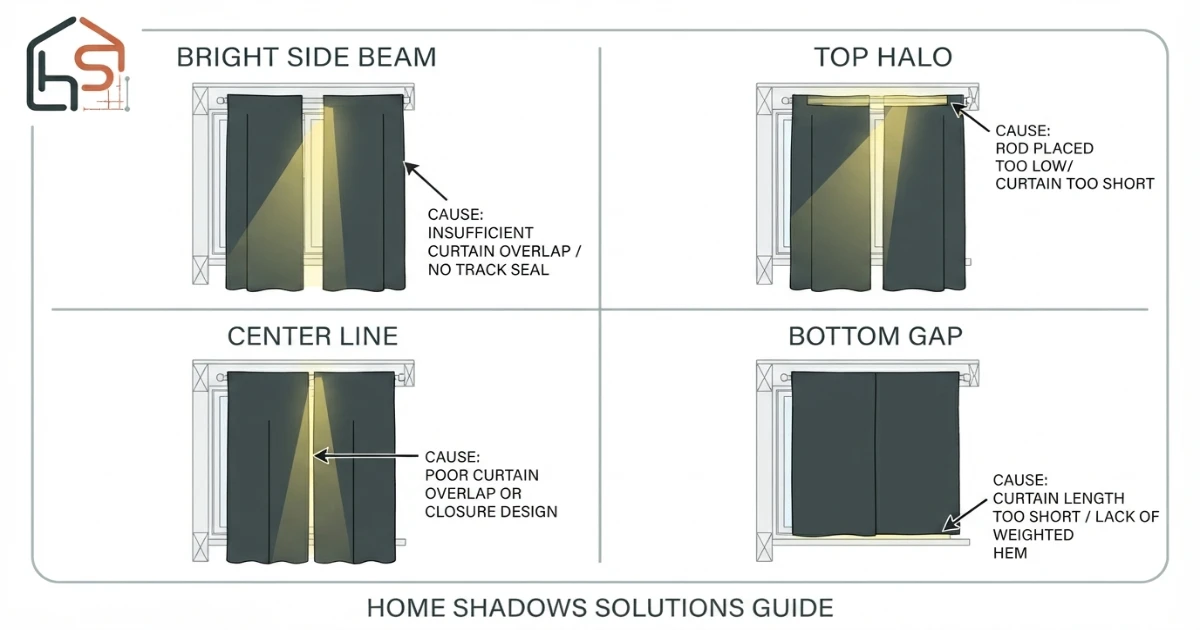
When the fabric itself is opaque but the room remains bright, inspect the perimeter. Top halos come from low rods and open space behind the header. Side beams come from straight rods without returns. Center lines come from insufficient overlap or panels stretching flat. Lower gaps come from short curtains.
| Light problem | Likely cause | Size or hardware fix | Do not assume |
|---|---|---|---|
| Bright side beam | Curtain edge sits far from wall | Add side extension and wraparound returns | More fullness alone will close the side gap |
| Top halo | Rod is low or open above fabric | Raise rod, use ceiling track or pelmet | Darker fabric fixes the top gap |
| Center light line | Panels meet without overlap | Add width, magnets or overlap track | Two panels automatically seal at center |
| Lower light band | Curtains stop near sill | Use below-sill or floor length | Window-height panels are enough |
| Panels pull apart | Too little width or uneven hanging | Increase combined width and train leading edges | The fabric label guarantees closure |
Worked blackout curtain size examples
Example one: 48-inch bedroom window. Add 8 inches on each side for a 64-inch rod. At 2 times fullness, base width is 128 inches. Add 4 inches of center overlap for 132 inches. Two 72-inch panels provide 144 inches and work well.
Example two: 60-inch window. Add 10 inches per side for an 80-inch rod. At 2 times fullness plus 4 inches center overlap, target width is 164 inches. Two 84-inch panels provide 168 inches.
Example three: four standard panels. A 76-inch rod needs 160 inches after overlap allowances. Four 52-inch panels provide 208 inches, producing about 2.74 times fullness. This works but creates a larger stack than two 84-inch panels.
Example four: high mount. The attachment point is 95 inches above the floor and the desired float is half an inch. Finished drop is 94.5 inches. Choose 95- or 96-inch panels and hem if required.
Example five: nine-foot room. The track carrier sits 106 inches above the floor. A half-inch float needs 105.5 inches. Choose 108-inch curtains and hem approximately 2.5 inches.
Example six: media room. A 96-inch rod uses 2.2 times fullness and 6 inches of center overlap. Target width is about 217 inches. Four 54-inch panels provide 216 inches and are slightly short; four 56-inch panels or wider panels are safer.
Example seven: sliding door. A 108-inch rod at 1.8 times fullness plus 6 inches overlap requires about 200 inches. Two 100-inch panels provide exactly 200 inches; four 52-inch panels provide 208 inches.
Example eight: radiator below window. Floor-length blackout curtains are unsafe because they cover the heater. Use an inside blackout shade with short decorative panels that remain outside the heat zone.
Common blackout curtain sizing mistakes
- Buying panels equal to the window width instead of the extended rod width.
- Using opaque fabric without planning side returns.
- Mounting the rod high but keeping a short curtain length.
- Forgetting center overlap in the combined width calculation.
- Stretching two panels flat across a wide rod.
- Assuming every “blackout” product has the same construction.
- Blocking radiators, vents, handles or door tracks.
- Choosing heavy panels without checking rod capacity.
- Ignoring package quantity and finished width per panel.
- Expecting curtains alone to create laboratory-level darkness.
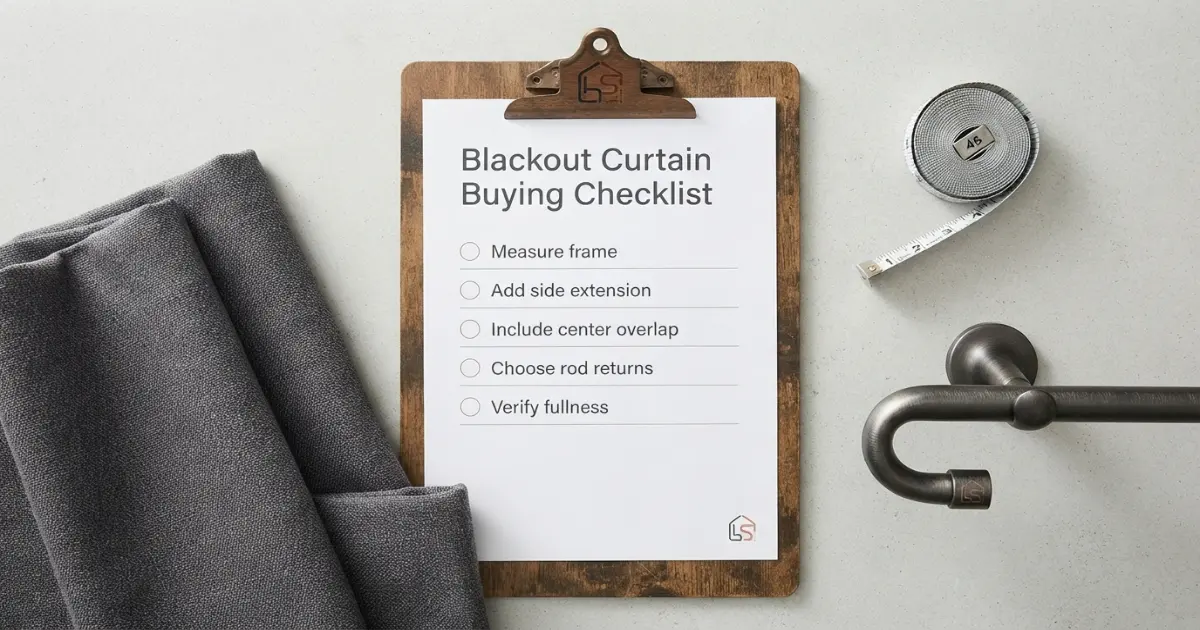
Blackout curtain buying checklist
Record outside frame width, side extension, rod span, attachment-point height, floor or sill finish, center overlap, return allowance, fullness, finished panel width and package quantity.
Choose straight, wraparound or track hardware. Confirm total supported weight, bracket spacing, center support, ring movement and wall anchors. Check whether the fabric is true blackout, room-darkening, coated, lined or thermal.
Review care instructions, shrinkage risk, lining construction, bottom weights, alteration limits and return policy. Order all matching panels together to reduce dye-lot variation.
Mark the proposed rod, side returns and hem with painter’s tape. View the setup in daylight from different angles. Then use the Curtain Size Calculator to confirm the full order.
Blackout curtain products worth comparing after measuring
Search links are used because colors, widths, lengths, package quantities and hardware ratings change. Confirm the exact current listing before ordering.
Blackout Curtain Panels in Wide Sizes
Compare wide and extra-wide panels when two standard panels cannot provide the calculated fullness and center overlap.
- Confirm finished width per panel
- Verify true blackout versus room-darkening construction
- Check one-panel or pair package quantity
Wraparound Blackout Curtain Rods
Compare rods that return toward the wall when side light leakage is the main problem.
- Check usable front span and return depth
- Verify total weight capacity and bracket spacing
- Confirm clearance from trim and handles
Affiliate disclosure: As an Amazon Associate, HomeStyle Calculator may earn from qualifying purchases. Product specifications, prices and availability can change. Review the current listing before ordering.
Blackout curtain size FAQs
How much wider should blackout curtains be than the window?
A practical starting point is to extend the rod about 6 to 12 inches beyond each side and use approximately 1.8 to 2.5 times fullness. Stronger darkness may need wraparound returns.
How far above the window should blackout curtains start?
About 4 to 8 inches above the frame is a common strong-coverage range. Near-ceiling mounting can improve top coverage when the curtain length supports it.
Should blackout curtains touch the floor?
Floor length reduces the lower gap. A tailored float about half an inch above the floor is practical because it avoids dragging while maintaining coverage.
How much center overlap do blackout curtains need?
Allow around 2 to 4 inches for strong everyday blackout. Use more with overlapping tracks, magnets or batons when maximum practical darkness is required.
Are blackout curtains sized like regular curtains?
The basic width formula is similar, but blackout treatments need more attention to side returns, top coverage, lower coverage and center overlap.
How many blackout curtain panels do I need?
Multiply rod span by fullness, add overlap allowances, divide by one panel’s finished width and round up. Use an even number for a balanced center opening.
Why do blackout curtains still leak light?
Light usually enters around the sides, top, center or bottom rather than through the fabric. Improve hardware position, returns, overlap and total width.
What rod is best for blackout curtains?
A wraparound rod or return track usually controls side light better than a straight rod. Confirm that the hardware supports the full weight of the curtains.
Calculate the exact blackout curtain size
Turn frame width, rod extension, overlap, fullness and finished drop into a complete curtain order.