
Curtains Too Short? 9 Fixes and Correct Sizing
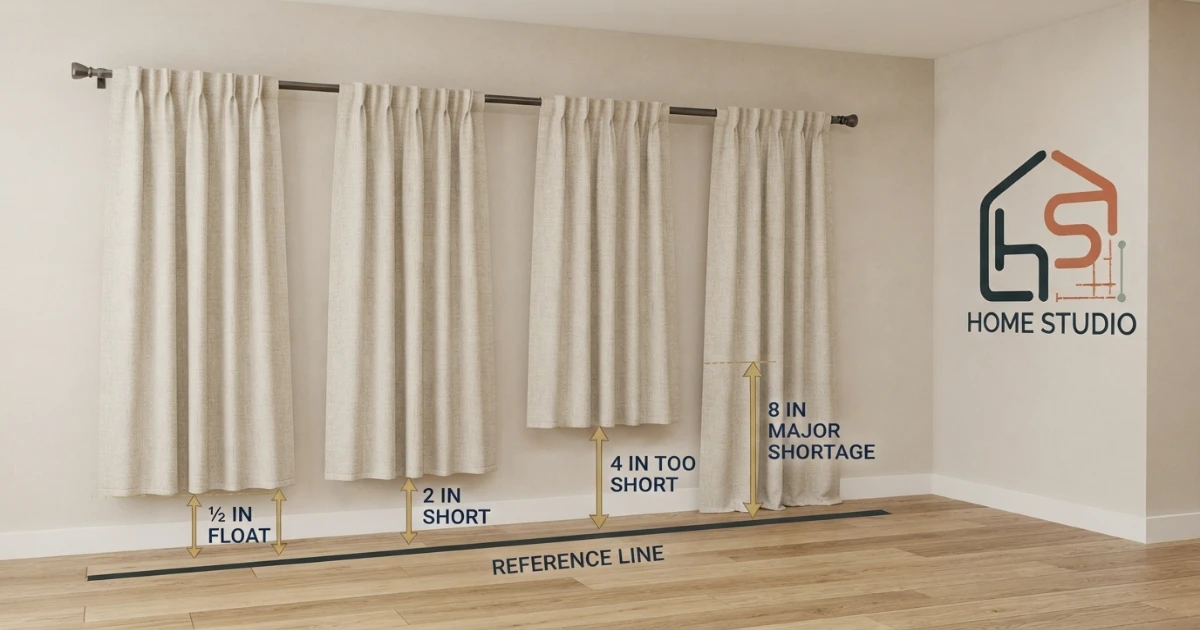
Measure the exact floor gap before changing the rod or fabric. Small shortages may be solved with hardware or hem adjustments; large shortages usually need a designed border or correctly sized replacement panels.
Written and reviewed by Rehana K · HomeStyle Calculator measurement-first method.
A deliberate half-inch float can look finished; a random multi-inch gap usually looks too short.
If curtains are too short, first measure the vertical distance from the current hem to the intended finish. Then compare that shortage with the usable adjustment from the rod, rings, hooks and existing hem.
A shortage under about 2 inches may be fixable with hardware or hem release. A 2- to 5-inch shortage often needs a fabric border or lower rod. A larger shortage usually looks cleaner with longer replacement panels.
Use the right HomeStyle Calculator guide for every correction
Short curtains are a length problem, but the permanent solution also depends on rod height, window measurement, available standard lengths, width and panel quantity.
Measure before choosing a fix
The visible gap may come from the wrong panel length, a high rod, short rings, an unexpected header allowance, shrinkage or an uneven floor.
Measure the actual gap
Record the distance between the current hem and the target finish at the left, center and right.
Inspect the top connection
Check rod height, ring drop, hook adjustment and the way the header sits on the hardware.
Inspect the lower hem
Look for usable fabric, lining, weights, old stitch marks and color fading before releasing it.
Curtains too short fix calculator
Enter the current panel length and measured floor gap. The tool calculates the missing drop, nearest standard replacement and whether your available rod, ring or hem adjustments can close the shortage.
Required extra length
Extra vertical length needed for the selected finish.
Current panel plus the missing drop.
May require a small hem adjustment.
Rod lowering, hardware drop and usable hem.
Calculator estimates are planning aids. Verify bracket safety, product construction and actual fabric allowance before altering curtains.
How to lengthen curtains that are too short
Start with reversible options. Move to sewing or replacement only when the measured shortage cannot be solved cleanly with hardware.
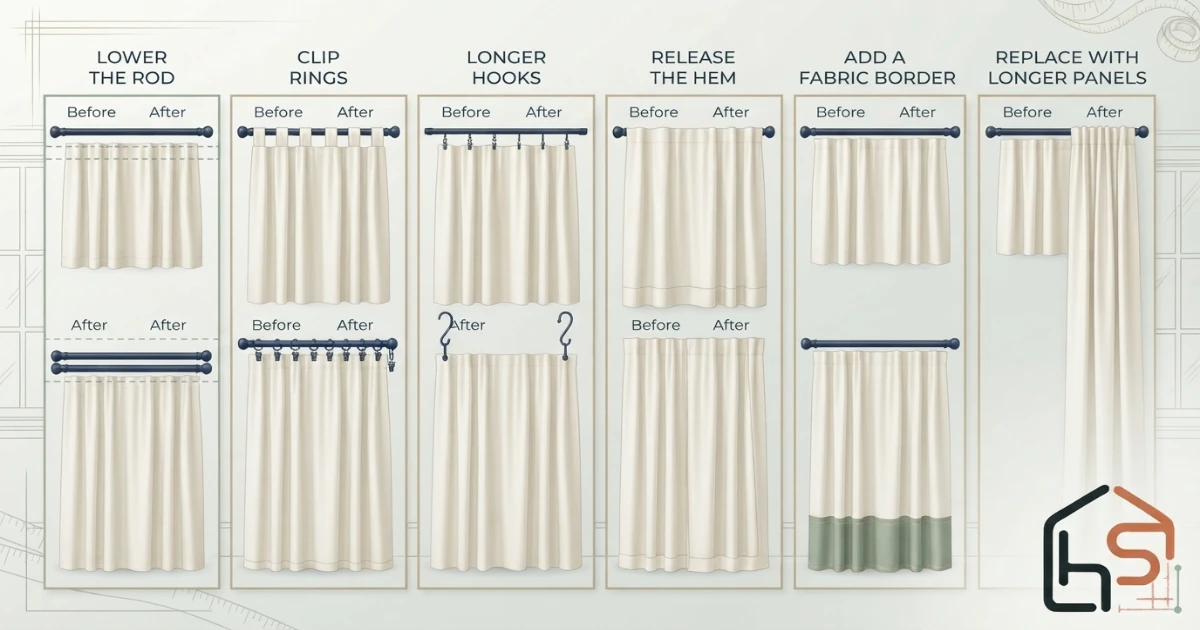
Lower the rod
Move brackets down only when the new position still clears trim, preserves proportions and uses secure wall support.
Add clip rings
Clip rings can lower a flat panel, but measure the ring and clip geometry because the added drop is not universal.
Use longer hooks
Adjustable drapery pins or longer hooks can shift pleated curtains lower without changing the panel itself.
Release the hem
A deep hem may hide usable fabric. Inspect lining, weights, stitch holes and fading before opening it fully.
Add a fabric border
A coordinated bottom band can add several inches and look intentional when repeated consistently across all panels.
Add decorative trim
Wide tape, fringe or a contrasting band can disguise a small shortage while strengthening the design.
Change to an intentional short style
In suitable rooms, convert the treatment to sill, apron or cafe length rather than pretending it is floor length.
Layer with longer panels
A longer sheer or blackout layer can visually complete the window while the shorter panel becomes decorative.
Replace with the correct length
Replacement is the cleanest option when the shortage is large or the fabric and construction do not support alteration.
Curtains too short: complete diagnosis and correction guide
Short curtains are easy to notice because the eye expects a deliberate relationship between the hem and the floor. A small, consistent float can look crisp. A random gap of several inches often looks like a measurement error, especially when the rod is mounted high and the panels were intended to be floor length.
The correct fix depends on the measured shortage. Hardware may solve one inch. A deep hem may solve two or three inches. A designed fabric band may solve four or five inches. When the gap is larger or the construction is complicated, new panels usually cost less time and produce a more reliable result.
Before altering anything, use the Curtain Length Guide to choose the final floor relationship and the Window Measurement Guide for Curtains to confirm the full drop.
The most important rule
Measure the current shortage at three points and mock up the proposed correction before drilling new holes, cutting fabric or opening the full hem.
Why curtains end up too short
The most common cause is buying a standard panel before the rod position is final. An 84-inch panel may look appropriate in a product listing, but a near-ceiling rod can require 96 inches or more. Header style and rings also change where the panel begins relative to the rod.
Other causes include shrinkage after washing, an unexpectedly deep floor transition, uneven floors, incorrect hook placement, a high bracket location and product dimensions that differ from the nominal label. A panel sold as 84 inches may be slightly shorter, and natural fibers can change after cleaning.
When replacing one header with another, read the Grommet vs Rod Pocket Length Difference guide. Equal labeled lengths can create different installed drops.
How to measure the exact missing length
Hang every panel on the final rod and hardware. Let the fabric relax, then measure from the current hem to the intended stopping point at the left edge, center and right edge. Use the largest shortage if the floor is uneven and the panels must remain aligned.
For a float, target approximately one-half inch above the floor. For a kiss, target the floor line. For a soft break, add roughly one inch beyond the floor line. A puddle needs more fabric and should be reserved for low-traffic rooms where cleaning and moisture are controlled.
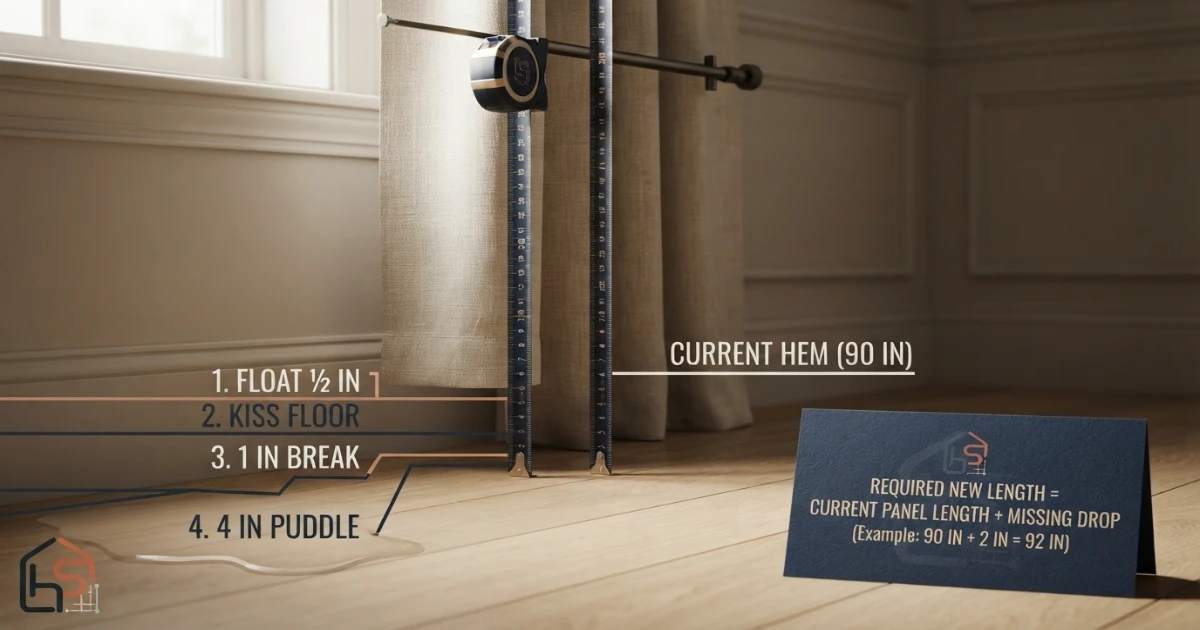
Use the same reference point on every panel. For rings, measure from the point where the fabric hangs. For grommets, account for the top edge above the rod. For rod pockets, account for the pocket and any header ruffle.
Fix 1: lower the curtain rod
Lowering the rod increases the visible panel drop without altering the fabric. It is useful when the rod was mounted too high and there is enough wall area above the window to move it down while preserving a balanced position.
Do not lower the rod if it blocks the window, exposes the top of the frame, weakens bracket anchoring or creates excessive light leakage. Fill old holes properly and use a level. Review How High to Hang Curtains before changing the brackets.
Moving a rod down by one inch does not guarantee a full one-inch visual correction if the header shifts or the fabric settles differently. Test the proposed position with painter’s tape first.
Fix 2 and 3: use clip rings or longer hooks
Clip rings can turn flat panels into a lower-hanging treatment. The clip sits below the ring, adding measurable drop. This option is reversible and useful for a small shortage, but the clips remain visible and may not suit every room.
Pleated curtains can use adjustable hooks or drapery pins. Moving the hook higher on the back of the panel lowers the curtain. Do not pierce too close to the top edge, and confirm that the header can support the weight.
Measure the actual ring, clip and hook arrangement on the rod. Hardware descriptions are not a reliable substitute for the installed drop.
Fix 4: release the existing hem
Many ready-made curtains use a double-fold hem. Opening the fold can expose additional fabric, but the full folded amount is not always usable because a new hem still needs a clean finished edge.
Open a small section with a seam ripper. Inspect the fabric for needle marks, fading, adhesive, weights and lining. Steam the test section according to the care label. If the old fold line remains visible, a bottom border may hide it better than a simple hem release.
Lined blackout curtains can be difficult to lengthen because both face fabric and lining need finished edges. The Blackout Curtain Sizing Guide helps prevent replacement panels from being short again.
Fix 5 and 6: add a fabric border or decorative trim
A lower border is one of the best solutions for a three- to six-inch shortage. Choose a solid, stripe or texture that relates to the room. Repeat the same border height across every panel and align pattern repeats carefully.
The border should look designed rather than improvised. A narrow strip that nearly matches the original fabric can reveal the alteration. A clearly contrasting band often looks more intentional. Prewash compatible fabrics before sewing when shrinkage is possible.
No-sew bonding tape can work for lightweight decorative panels, but heat and adhesive may damage some fabrics. Test a hidden sample and follow both product and curtain care instructions.
Fix 7: convert the treatment to an intentional shorter style
Not every curtain needs to reach the floor. Cafe curtains, sill-length panels and apron-length curtains can be appropriate in kitchens, bathrooms and casual spaces. The key is choosing a recognized stopping point rather than leaving an accidental gap.
If the panels stop near the sill or apron, adjust them consistently and use the Cafe Curtain Measurements Guide for proportions. This approach is rarely the best solution for formal living-room panels that were clearly designed as floor-length drapes.
Fix 8 and 9: layer or replace
Layering can turn short decorative curtains into an intentional top layer. Place correctly sized sheers or blackout panels behind them. Keep the shorter panels symmetrical and ensure the longer layer controls privacy and light.
Replacement is usually best when the shortage exceeds the available rod, hardware and hem adjustments. Compare 84 vs 96 Inch Curtains and 96 vs 108 Inch Curtains using the installed measurement rather than ceiling height alone.
Check the exact finished product length, header style, return policy and expected shrinkage. The Standard Curtain Sizes Chart shows the common ready-made categories.
Do not fix length and ignore width
New longer panels can still look wrong when they are too narrow. Measure the usable rod span and choose adequate fullness. The combined flat width is generally greater than the rod span so the curtains retain folds when closed.
Use How Wide Should Curtains Be? and How Many Curtain Panels Do I Need? before replacing the set. Length, width and quantity should be solved together.
Room-specific decisions
Living rooms
A floor kiss or slight float usually looks tailored. Clip rings can suit relaxed interiors, while formal lined drapes often benefit from professional hemming or replacement.
Bedrooms
Length affects blackout performance because a large lower gap can admit light. Pair the correct hem with side overlap and a suitable top return.
Sliding doors
Panels must clear traffic and move easily. Use the Curtains for Sliding Glass Doors guide before adding puddling or bulky bottom borders.
Bay windows
Multiple rods and angled tracks can produce different drops. Measure every section using the Bay Window Curtain Size Guide.
Shrinkage and fabric settling
If curtains became short after washing, check the care label and fiber content. Cotton, linen and blends may shrink, while heavy fabric can also relax after hanging. Avoid aggressive stretching that distorts the weave.
Steam according to the care instructions and hang the panels for a day before measuring again. If the shrinkage is uneven, a uniform border can restore alignment more reliably than releasing different amounts from each hem.
Uneven floors and crooked rods
A panel may appear short on one side because the floor rises or the rod is not level. Measure the rod with a level and check the floor gap across the full width. Do not cut every panel to match a single high point until you understand the room.
For a slight floor variation, a small float can hide the difference. For a large variation, custom hemming by panel position may be necessary. Label each panel so it returns to the correct location after cleaning.
What a successful correction should look like
The corrected hem should appear deliberate from the doorway, align across all panels and move without catching on the floor. The rod should remain secure and visually connected to the window. Added fabric or trim should repeat consistently.
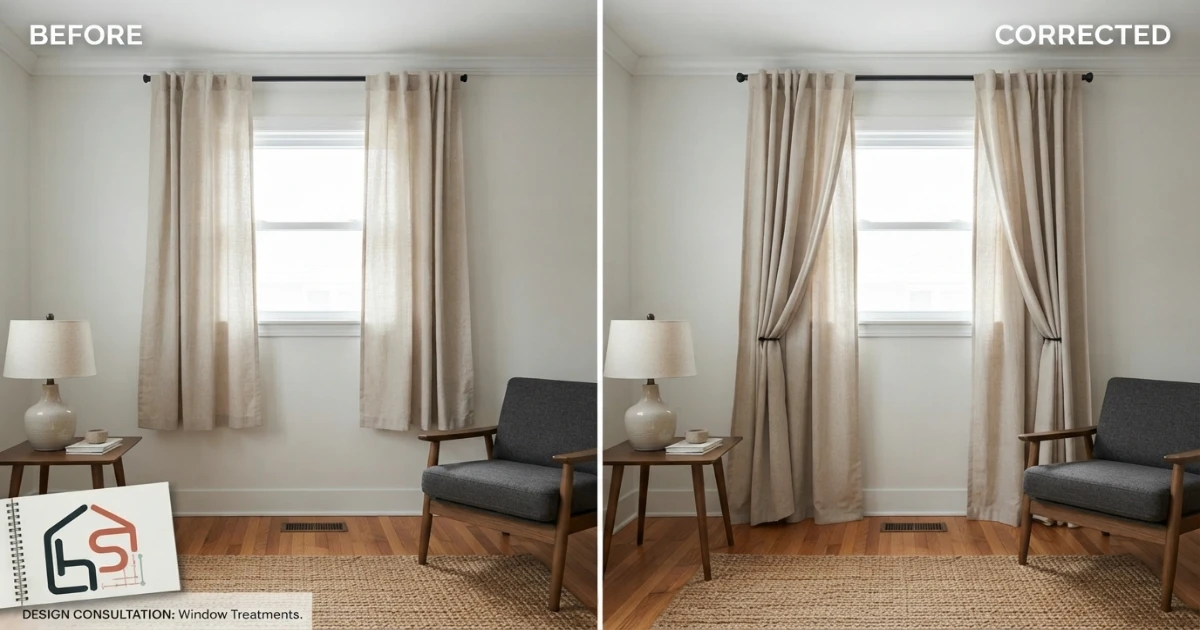
Let altered panels hang before completing any final trimming. Fabric weight can change the drop slightly, and steamed fold lines may relax. Measure again at the left, center and right, then make only the small finishing adjustment that remains.
After fixing curtains too short, close the complete set and check the hem from across the room. Open and close the panels several times. Confirm that rings and hooks do not tilt, the border does not twist and the curtain does not catch on furniture, vents or floor mats.
Final installation check after correcting curtains too short
Repair makes more sense when the fabric is high quality, the width is correct and the measured shortage has a clean solution. A simple hem release or one coordinated bottom band can preserve custom or sentimental curtains. Replacement makes more sense when several panels need complex work or the new standard length is readily available.
Before investing in an alteration, rate the panels in four areas: fabric condition, correct width, useful lining and compatible header. When curtains too short are also faded, narrow or difficult to operate, replacement is usually a better use of the budget.
Repair or replace: a practical decision test
A removable fabric border can be prepared separately and attached with hand stitching or a suitable temporary method, but adhesives should be tested because heat, residue and color change can damage curtain fabric. Tension rods are not a universal solution for floor-length curtains; the wall span, panel weight and manufacturer limits must support the load.
Renters often need a correction that avoids new holes. If curtains too short hang from an existing rod, clip rings are the first option to test. Some adjustable hooks can also increase drop without changing brackets. Keep the original hardware so the installation can be restored before moving out.
Rental-friendly fixes for curtains too short
Compare the alteration cost with correctly sized panels. New curtains also allow you to correct width, fullness, lining and header style at the same time. If the current set is narrow as well as short, spending money on length alone will not solve the complete window-treatment problem.
For curtains too short by six inches or more, replacement usually produces the cleanest floor-length result. A large border can work in a bold two-tone design, but it changes the original curtain substantially and requires careful sewing, lining and pattern alignment.
When curtains are 6 inches or more too short
Lowering the rod by several inches may make the window look compressed, especially if the brackets move close to the upper trim. Test the proposed position with painter’s tape and view it from the doorway before drilling. If the room needs a high rod for visual height or blackout coverage, keep the rod and lengthen the fabric instead.
When curtains too short leave a four- or five-inch gap, small hardware tricks can start to look forced. A coordinated bottom border is often the best alteration because it adds enough length while creating an intentional design feature. Use a border height that is consistent across the full set and wide enough to look purposeful.
When curtains are 4 to 5 inches too short
A combination of a modest ring adjustment and partial hem release may work, but every panel must receive the same treatment. If the floor or rod is uneven, measure and label each panel before sewing. When the original stitch line remains visible, add a deliberate decorative band rather than leaving a faded fold line exposed.
For curtains too short by two or three inches, inspect the lower hem carefully. A deep double fold may provide enough fabric for a new narrow hem. The exact usable amount is smaller than the visible folded depth because the fabric still needs a finished edge.
When curtains are 2 to 3 inches too short
Do not release a large hem merely to gain one inch until you test the easier options. A reversible correction gives you room to restore the original installation if the new header position creates light leakage or uneven folds.
If curtains too short by about one inch are otherwise well made, begin with the rod, rings and hooks. Measure whether a clip ring or adjustable drapery hook can add the missing drop without making the header look awkward. A slight rod adjustment may also work, provided the new bracket location is secure and remains visually balanced above the window.
When curtains are 1 inch too short
When curtains too short is the main problem, the measured gap should control the repair. A one-inch shortage and an eight-inch shortage are not the same project. The smaller problem may be solved with reversible hardware; the larger problem usually requires fabric work or replacement.
How to choose a fix by the size of the curtain shortage
Common mistakes when fixing short curtains
- Moving the rod before measuring the actual shortage.
- Assuming clip rings always add the same amount.
- Opening the full hem before checking fading and lining.
- Adding a narrow matching strip that looks accidental.
- Ignoring uneven floors or an unlevel rod.
- Choosing longer replacement panels without checking width.
- Using adhesive without testing the fabric.
- Creating puddles in high-traffic or pet-friendly rooms.
- Hemming immediately before the fabric settles.
Curtains too short correction checklist
- Hang the complete curtain set on final hardware.
- Choose float, kiss, break or puddle.
- Measure the gap at left, center and right.
- Check whether the rod can move safely.
- Measure the real added drop from rings or hooks.
- Inspect the hem, lining, weights and stitch marks.
- Mock up a border with painter’s tape or fabric samples.
- Compare replacement standard lengths.
- Recalculate total panel width and quantity.
- Let altered or new panels settle before final hemming.
Further measuring references
For additional general measuring and hanging guidance, see IKEA’s curtain-length planning guide and West Elm’s curtain-hanging guide. Product-specific dimensions and installation instructions still control the final result.
Final answer: what should you do when curtains are too short?
Measure the missing drop, confirm the desired floor finish and compare the shortage with safe rod movement, actual hardware drop and usable hem fabric. Use the smallest correction that produces an even, deliberate hem.
For a small shortage, hardware or hem adjustment may be enough. For several inches, a designed bottom border can look intentional. For a large shortage, replacement panels in the correct standard or custom length normally give the cleanest finish.
Enter the real measurements in the calculator above, then verify the complete order with the Curtain Size Calculator.
Correct the full curtain order
Calculate rod position, finished length, width and panel quantity before buying or altering another set.
Two practical products to compare before altering or replacing
Confirm the exact hardware dimensions, panel construction and product return terms before ordering.
Curtain Clip Rings
Compare clip rings when a small reversible hardware adjustment may close the floor gap.
- Measure total ring-and-clip drop
- Confirm rod diameter compatibility
- Check clip strength for panel weight
- Review finish and package quantity
Extra-Long Curtain Panels
Compare longer ready-made panels when alteration cannot solve the shortage cleanly.
- Confirm exact finished length
- Check header style and rod fit
- Compare lining, width and panel count
- Review shrinkage and return policy
Affiliate disclosure: As an Amazon Associate, HomeStyle Calculator may earn from qualifying purchases. Product dimensions, prices and availability can change. Confirm the current listing before ordering.